
Post-traumatic stress or psychiatric injuries

Photo by Thư Anh on Unsplash

Author’s note: Ms Weddle appealed to the Sheriff Civil Appeal Court where the original decision of the Sheriff (who ruled against her claim) was upheld. The decision was issued on 7 June 2021 and does not contain any surprises.

A link to the Appeal Court’s decision, Danielle Weddle v Glasgow City Council [2021] SAC (Civ) 17 PIC-PN2982-17, can be found below:

https://www.scotcourts.gov.uk/docs/default-source/cos-general-docs/pdf-docs-for-opinions/2021-sac-(civ)-017.pdf?sfvrsn=0

It’s hard to believe that, this month, it will be 5 years since the event infamously dubbed the Glasgow Bin Lorry Crash occurred.

To those readers unfamiliar with the events that happened on 22 December 2014, Harry Clarke, an employee of Glasgow City Council, was responsible for causing the deaths of 6 people and injuring 15 others. Mr Clarke was employed by the City Council as the driver of a bin lorry (garbage truck for our North American readers). He lost control of the vehicle while driving it in Glasgow City Centre. It later emerged that Mr Clarke had a history of illness which caused him to suffer from blackouts. He had not revealed this fact to his employer. Mr Clarke suffered one of those episodes on the day of the accident.

A link to an article which appeared in The Guardian the day after the accident can be found below:

https://www.theguardian.com/uk-news/2014/dec/23/glasgow-bin-lorry-crash-three-victims-family-named

Clearly, the Council was potentially (vicariously) liable for the actions of its employee to the primary victims in delict (tort), but what about bystanders who witnessed the tragic turn of events and who had no personal or family links with the primary victims (the dead and the injured)?

I’ll discuss this incident later in the Blog in relation to a recent decision of the All Scotland Personal Injury Sheriff Court.

The law of delict and PTSD

Scots law (and indeed the English law) recognises two kinds of victim who can develop psychiatric injuries as a result of the defender’s negligence in these types of situation:

  • Primary victims
  • Secondary victims

Primary victims are those individuals who have been directly involved in an accident caused by the defender’s negligence. They may have suffered both physical and psychiatric injuries or their injuries may be limited purely to psychiatric damage.

Secondary victims, on the other hand, are not directly involved in the initial accident that occurred as a result of the defender’s negligence. In fact, they may not have witnessed the occurrence of the accident at all.

This category of victim often appears on the scene during the aftermath of the accident as in Bourhill v Young [1943] AC 92 when the important events had already taken place. Alternatively, secondary victims might be related or connected to the primary victims and as such it would be reasonably foreseeable that they would suffer some sort of distress. Whether or not secondary victims can claim compensation for their psychiatric injuries is, however, not always a straightforward matter.

Primary victims have traditionally had a more straightforward task when it comes to convincing the courts that they should be awarded damages for the psychiatric injuries that they have suffered.

As we shall see, strict rules are now in place that will determine whether a secondary victim should succeed in her claim for damages against the defender.

The obstacles facing secondary victims

The ability of secondary victims to bring successful claims for psychiatric injury has been at the heart of some high profile judicial decisions over the last four decades.

In McLoughlin v O’Brian [1983] 1 AC 410, the pursuer’s husband and three children were all victims of a serious car accident which had been caused as a result of the defender’s negligence. One of the pursuer’s daughters was killed in the accident and the surviving family members were all seriously injured. It is important to realise that the pursuer was not physically present at the scene of the accident and she was not informed about the accident until several hours after it had occurred.

When the pursuer reached the hospital she saw for herself the graphic and serious nature of the injuries that her family had suffered. This all proved too much for the pursuer to deal with and she developed a long-running and serious psychiatric condition which she claimed had been caused by the defender’s negligence.

The difficulty for the pursuer was that she was clearly a secondary victim and the law relating to psychiatric injuries was quite clear – only primary victims could be granted compensation for the psychiatric injuries that they had suffered as a result of the defender’s negligence. The House of Lords, therefore, had to consider the issue of whether the pursuer was someone that the defender could reasonably foresee would suffer harm as a result of his negligence. Furthermore, some of the Law Lords felt reasonable foreseeability of harm was not enough and the strength of the pursuer’s relationship with the primary victims had to be examined.

Held: by the House of Lords that the psychiatric injuries suffered by the pursuer were reasonably foreseeable. The ties of love and affection were clearly a crucial feature of her relationship with the primary victims. She was, therefore, entitled to compensation from the defender.

McLoughlin v O’Brian was not without its critics and it did not entirely settle the question of whether secondary victims were entitled to sue for psychiatric injury. Lord Bridge suggested that reasonable foreseeability of the pursuer suffering harm should be enough to establish liability. Lords Wilberforce and Edmund-Davies felt that reasonable foreseeability was only one part of the story. The strength of the pursuer’s relationship with the primary victims was a very important factor in determining whether any claim for psychiatric injury should be allowed.

The decision of Alcock and Others v Chief Constable of the Yorkshire Police [1992] 1 AC 310 that the approach that Lords Wilberforce and Edmund-Davies had taken in McLoughlin was confirmed as correct. 

Alcock was regarded as a special case because the pursuers represented a group of individuals who had a broad range of relationships with the primary victims. The pursuers included parents, children, siblings, grandparents, in-laws, fiancés and friends. All these individuals were claiming that they had suffered psychiatric shock as a result of the harm that had been suffered by the primary victims to whom they were connected. The House of Lords was left with the task of deciding which of these secondary victims was entitled to claim compensation for psychiatric injuries.

The facts of Alcock and Others v Chief Constable of the Yorkshire Police [1992] are detailed below:

The events surrounding this case relate to the English FA Cup semi-final which was being contested by Liverpool and Nottingham Forest. The match was being played at the neutral venue of Hillsborough (the Sheffield Wednesday ground) and it was a sellout. The game was also being televised live on the BBC – although individuals who were caught up in the crush could not be identified from the live television pictures. The South Yorkshire Police force which was responsible for policing the match was accused of negligence for the way in which it operated its crowd control procedures. The game had to be stopped after six minutes of play because too many fans had been allowed into a section of the terraces and many of these individuals were crushed against the fencing which prevented access to the pitch.

Ninety-five people died as a result of the incident and at least another 400 had to be treated in hospital for the injuries that they received. The police paid compensation to the primary victims of the incident i.e. those had suffered physical and psychiatric injuries as a result of being directly involved in the accident. This compensation payment, however, did not settle the claims of a group of secondary victims, consisting mainly of relatives of the primary victims. These secondary victims, of course, had not been directly caught up in the incident. Many had, admittedly, been present at Hillsborough and had witnessed the terrible scenes from a distance. Others in the group of secondary victims had witnessed the incident on live television, had been told about the incident by third parties or had gone directly to the ground after hearing the information in order to search for family and friends who were missing presumed injured or dead.

The pursuers attempted to rely upon Lord Bridge’s test in McLoughlin v O’Brian that their psychiatric injuries were reasonably foreseeable and, therefore, they could claim compensation. The House of Lords felt that although the secondary victims had suffered as a result of the incident at Hillsborough, stricter rules had to apply to their claims than was the case with the primary victims. The starting point of any secondary victim’s claim for damages the psychiatric injuries must be reasonably foreseeable. This is only the first hurdle placed in the pursuer’s way. There are a further three tests that pursuers must satisfy:

  • Do they belong to a group of individuals that the courts should recognise are capable of suffering psychiatric injury as a result of the defender’s negligence?
  • How close to the accident was the pursuer in terms of time and space?
  • How was the psychiatric injury caused?

In practice, many pursuers (who are classified as secondary victims) will find the above tests very difficult to satisfy in order to succeed in their claims.

Held: by the House of Lords that all the pursuers failed to meet one of the three tests listed above and, therefore, the claims must fail.

Primary or secondary victim?

What happens, however, when the status of the victim is disputed: in other words, do they fall into the category of a primary or secondary victim?

This was precisely the issue with which the All Scotland Personal Injury Sheriff Court in Edinburgh had to grapple.

The case in question is that of Danielle Weddle v Glasgow City Council [2019] SC EDIN 42. Miss Weddle, a student, witnessed the events of the Bin Lorry Accident. She was present in the City’s George Square as Harry Clarke’s vehicle (the bin lorry) lost control colliding into pedestrians and damaging street furniture. Prior to the incident, Weddle had been standing on the pavement looking at her mobile phone. She looked up when she heard the noise of the collision and saw the damage caused.

When she left George Square shortly afterwards, Weddle came across a dead body (an earlier victim of Harry Clarke’s negligence). She thought that the victim’s intestines were hanging out of the abdomen. Needless to say, she was traumatised by this scene.

She tried to telephone her mother, but was unsuccessful at first. She managed to contact her father and told him she had seen a horrible accident.  Mr Weddle then contacted his wife and got her to phone their daughter; which she duly did. Mrs Weddle wanted her daughter to go to hospital. Weddle instead decided to go home by bus. When she got off the bus, she went into a pharmacy in the Cardonald area of Glasgow to seek some help. Mrs Wade, the pharmacist who attended to her, recognised that she was in deep shock. The pharmacist immediately arranged for a GP to come and see Weddle. She was ‘distraught’; given diazepam; and was eventually allowed to go home.

Weddle claimed that as a result of what she had witnessed, she was not able to return to university after the Christmas holidays; she suffered ‘nightmares’ and ‘psychological symptoms such as intrusive thoughts, flashbacks, anxiety and depression’. Her GP subsequently referred her to counselling and she had to take anti-depressants.

To this day, there is no doubt that Weddle has been affected by the events that she witnessed in Glasgow City Centre. She is a victim of post-traumatic stress as a result of what she experienced in Glasgow City Centre on 22 December 2019.

The key question before the All Scotland Personal Injury Sheriff Court was whether Weddle fell into the category of a primary or a secondary victim?

Held: by Sheriff Kenneth J McGowan ‘… that the defender’s employee (Harry Clarke) would not have reasonably foreseen that his driving at the relevant time would have given rise to the risk of physical injury to the pursuer (Weddle); and in any event, that the pursuer did not in fact suffer fear of physical injury to herself at the relevant time; that accordingly, the pursuer does not qualify as a primary victim and she cannot therefore obtain damages for any psychiatric injury suffered by her.

A link to Sheriff McGowan’s decision can be found below:

https://www.scotcourts.gov.uk/docs/default-source/cos-general-docs/pdf-docs-for-opinions/2019scedin42.pdf?sfvrsn=0

A link to a report on the BBC website about the outcome of the Weddle case can be found below:

Student refused damages over Glasgow bin lorry crash

The woman suffers from PTSD after witnessing part of the crash which resulted in the death of six people in December 2014.

Copyright Seán J Crossan, 10 December 2019

Howzat! (or Volenti again?)

alessandro-bogliari-oDs_AxeR5g4-unsplash (1)

Photo by Alessandro Bogliari on Unsplash

Volenti non fit injuria (or to one who is willing a wrongful act cannot be done) is one of the most common defences used to defeat a claim for negligence. I very often refer to this defence as hell mend you! You have knowingly and willingly placed yourself in harm’s way and you have no one to blame but yourself for anything bad that happens to you.

I always remember telling my students the cautionary tale of the unfortunate man who was visiting Mexico City Zoo. He accidentally dropped his mobile phone into the Lions’ Den. The beasts appeared to be sleeping, so our foolhardy friend jumped into the Den in an attempt to retrieve said phone. At that point, he received a call on his phone; one of the lions woke up; saw an intruder in its territory …

… I think you can guess the end of the story. Our hapless friend was taken out of the Den barely alive. Volenti non fit injuria anyone?

Recently, a number of stories have appeared in the media which made me think about this defence.

Both stories involve the sport of cricket. In the first incident, a player (Steve Smith) was injured during The Ashes Tournament and, in the second incident, an umpire (referee) died as the result of injuries sustained during a cricket match.

Links to these stories can be found below:

 http://news.sky.com/story/the-ashes-steve-smith-forced-off-field-after-being-struck-by-92mph-delivery-11787547

htthttp://news.sky.com/story/cricket-umpire-hit-by-ball-during-match-dies-in-hospital-11786256

A range of sports (cricket included) involve a certain amount of risk to the participants, referees and, on occasion, the spectators. It has not been unknown for players and referees to be injured because the sport is of the contact variety. Spectators of golf, football and tennis are also not immune from the occasional injury – especially if they are close to the action.

This is where the defence of volenti non fit injuria may be applicable to such situations. The essence of this defence is that the pursuer (or injured party) has, with full knowledge of the facts, voluntarily assumed and accepted the risk of injury and, in this way, has absolved the defender of the consequences of the defender’s breach of duty.

The defender still owes a duty of care but the chain of causation has been broken by the pursuer voluntarily undertaking the risk.

In sporting situations, of course, the participants must stay within the normal, ordinary rules of the game to benefit from this defence. Deliberate acts of aggression or violence or bad temper by a player which cause injury (up to and including death) would almost certainly not be covered by the defence.

In 1995, the British tennis player, Tim Henman (and his doubles partner) were disqualified from Wimbledon after Henman had hit a ball girl (they are still referred to using this description – apparently) with a tennis ball. This occurred in a moment of frustration when Henman hit the ball with his racket. The young woman received a blow to her ear when the ball made contact. In some respects, Henman was lucky to escape with disqualification alone:

The rules precisely state that a player must be in control of his actions on court, and in such cases there is no choice but to default automatically on the basis of unsportsmanlike conduct. The ball-girl, Caroline Hall, has been taken home and will undergo a thorough medical examination. Tim Henman is extremely upset about this freak accident, and although rare, the rules clearly state that default is the only course of action in cases of this nature.

Yes, the injured party may have accepted the risks associated with this type of employment at Wimbledon, but surely not totally reckless actions from a player who should have known and behaved in a better fashion.

A link to this story as reported by The Independent can be found below:

https://www.independent.co.uk/sport/henman-and-bates-are-disqualified-in-doubles-1588962.html

There are several well known cases dealing with the defence of volenti non fit injuria:

ICI v Shatwell [1965] AC 656 the pursuer and his brother were explosives experts who, contrary to instructions issued by their employer, agreed to test their detonators before returning to a safety shelter. There was an explosion and pursuer was injured while his brother was killed.

Held: by the House of Lords that the employer could successfully plead volenti as the pursuer and his brother had agreed to run the risk of injury by not returning to the safety shelter.

Morris v Murray [1991] 2 QB 6 the pursuer and defender had been consuming a large amount of alcohol throughout the course of the day. The defender, a qualified pilot, then made a suggestion to go for a ride in his light aircraft and the pursuer readily assented to this (in fact, he drove them both to the airfield). Both parties got into the plane and the pilot flew it away from the airfield. The plane later crashed, killing the pilot in the process and severely injuring the pursuer. A post mortem later established that the defender had drunk in the region of 17 whiskies. The pursuer raised an action in damages against the defender’s estate.

Held: by the English Court of Appeal that the pursuer’s action should fail because the legal representatives of the defender’s estate successfully pleaded the defence of volenti non fit injuria. Although the pursuer had been drunk, he was not insensible and he knew exactly what he was doing – he had voluntarily accepted the risks of getting into a plane with a drunk pilot. In fact, the pursuer had assisted the pilot to get the plane ready for take-off!

Related Blog article:

Volenti non fit injuria? (or hell mend you!)

https://seancrossansscotslaw.com/2019/01/26/volenti-non-fit-injuria-or-hell-mend-you/

Copyright Seán J Crossan, 9 December 2019

Different standards?

Photo by Elyssa Fahndrich on Unsplash

An interesting case which caught my attention recently seemed to raise many issues which I have been emphasising to my students who are preparing for their upcoming Discrimination Law exam this month.

The case (The Governing Body of Tywyn Primary School v Aplin Case No 1600635/2016 [2019]) seemed to cover (almost) the whole syllabus of the Discrimination Law unit:

  • A discrimination dismissal of a high flying professional employee (a head teacher)
  • A large sum of compensation awarded to the employee for the dismissal (nearly £700,000)
  • Direct discrimination on the basis of a protected characteristic (the employee’s sexual orientation) in terms Sections 4, 12 and 13 of the Equality Act 2010
  • The real problems faced by the employee in attempting to mitigate his losses (which the amount of the compensation award reflects)
  • Breach of disciplinary procedures by the employer
  • Breach of human rights i.e. Article 8 of the European Convention on Human Rights (right to privacy and family life)
  • Alleged reputational damage caused to the employer as a result of the employee’s conduct
  • The reversal of the burden of proof
  • The use of hypothetical comparators

The facts

Matthew Aplin is an openly gay man who was the head teacher of Tywyn primary school in Wales. He has been a teacher for 19 years and has an excellent professional reputation. In 2015, allegations about Aplin’s private life came to the attention of his employer (the School’s Board of Governors). It was alleged that Aplin had engaged in consensual sexual relationships with two 17 year old males that he had met through Grindr, the well known dating app. Users of Grindr must be aged 18 or over and, significantly, Aplin did not suspect the true age of the two males.

Aplin believed that the two young men were over 18 and, in any case, users of Grindr have to be aged 18 or over.

Following these allegations of alleged misconduct, Aplin was suspended and the Board of Governors commenced a disciplinary investigation.

At the request of the Governors, an investigating officer (Mr Gordon) was appointed by the local council. Mr Gordon’s terms of reference in respect of Aplin’s behaviour were as follows:

  • (a) had this brought the reputation of the School into disrepute?
  • (b) had it impacted on his ability to undertake the role of Head Teacher?; and/or
  • (c) had it demonstrated so gross an error of judgment as to undermine the School’s confidence in him and, therefore, to call into question his continuation in the role?

Mr Gordon quickly concluded that Aplin should be dismissed from his post despite the fact that this employee did not represent a possible threat to children. Local Police officers were briefly involved in their own investigation, but significantly they later concluded that no crime had been committed by Aplin.

Despite this, Aplin was dismissed for gross misconduct by the School Governors.

He promptly appealed against his dismissal, but the Governors did not deal with this matter efficiently or properly. Angered at the perceived lack of fair treatment of his appeal, Aplin decided to resign from his employment and claim unfair (constructive) dismissal; discrimination by reason of his sexual orientation; and interference with his right to respect for private and family life.

The Employment Appeal Tribunal (which became involved to deal with technical aspects of the case) later noted:

There were numerous procedural errors which amounted to a breach of the implied term of trust and confidence in the investigation and the disciplinary hearing.”

Ordinarily, the burden of proof lies upon the claimant (Aplin) to show that discrimination has taken place. In this case, there were enough factors present which meant that the burden of proof should shift to the respondent (the School Governors) who would now have to show that they had not discriminated against Aplin.

On the question of whether the burden of proof should be reversed, Judge Shanks in the Employment Appeal Tribunal had this to say:

“… in my view the thrust of it [the Tribunal’s reasoning] is clear and it provides a sufficient basis for the ET’s decision that the burden of proof had shifted on the question of whether Mr Aplin was treated unfavourably because of his sexual orientation.”

In arriving at this position, Judge Shanks was firmly of the view that:

.. the Tribunal had rightly recognised that the background to the whole case was intimately connected with Mr Aplin’s sexuality; they then judge that the procedural failures by the School were so egregious that the inference could be drawn that there was more to it than simply the fact that he had had lawful sex with two 17 year olds; and they therefore considered that it would be possible, in the absence of any other explanation, properly to infer that he had been discriminated against because of his sexual orientation. That seems to me a perfectly acceptable line of reasoning.

The decision of the Employment Tribunal

Aplin had been unfairly dismissed; and subjected to direct discrimination by reason of his sexual orientation.

As a point of interest, the case involved the use of hypothetical comparators to arrive at its decision, namely, would a heterosexual teacher (either male or female) who had sexual relations with two 17 year olds have been treated in the same way as Aplin? The Employment Tribunal concluded that such individuals would not have been treated any differently.

Interestingly, in its final judgement, the Tribunal found that, although a person’s sexual relationships are undoubtedly covered by Article 8 of the European Convention on Human Rights, it is not an absolute right. Such a right may be restricted or interfered with “where it is necessary for the protection of morals” in “a democratic society”:

Thererefore, we consider that it is possible to conclude that in the circumstances of this case the claimant could have been disciplined
for his admitted conduct within the qualification in Article 8(2). …

… However, a fair process would require the respondent to consider whether the claimant was aware that the individuals were 17 years of age. Further it would have to consider what the real risk of the issues becoming public were and therefore what the real potential for
reputational damage was.

The two 17 year olds were children in the eyes of the law and Aplin, as a Head Teacher, could be viewed as someone who was in a position of power and that position which could be abused by him.

As Aplin had admitted to his conduct (the relationships with the two males), the Employment Tribunal concluded that there was at least. 20% chance of him being dismissed successfully – had the proper disciplinary procedures been carried by the employer (which of course they were not). In this respect, Aplin suffered a 20% deduction in the overall compensation awarded to him as per the guidelines originally laid down in Polkey v AE Dayton Services Ltd [1987] UKHL 8.

Links to the decisions of the Employment Tribunal and the Employment Appeal Tribunal can be found below:

https://assets.publishing.service.gov.uk/media/5dcd4bf140f0b608cb5cb738/Mr_Aplin_v_The_Governing_Body_of_Tywyn_Primary_School_-_1600635.2016_-_Judgment.pdf

https://www.bailii.org/cgi-bin/format.cgi?doc=/uk/cases/UKEAT/2019/0298_17_2203.html&query=(Tywyn)

A link to the story on The Independent’s website can be found below:

https://edition.independent.co.uk/editions/uk.co.independent.issue.171119/data/9205646/index.html

Copyright Seán J Crossan, 8 December 2019

Not British enough?

Photo by Guillaume de Germain on Unsplash

It never feels to amaze me that by casually flicking through the weekend newspapers and news outlets you can discover stories about discrimination without really making much of an effort. I often say this to my students when I ask them to highlight a media story about an aspect of discrimination law at the beginning of each class. There’s really no excuse for saying that they couldn’t find anything to talk about.

And so it proved today – although I must give credit to my students who had alerted me to this story some weeks ago during one of their regular presentations.

The story concerns Mr and Mrs Mander who have just won their claim for unlawful direct discrimination on the grounds of their race. Race (including national origin and a person’s colour), of course, is one of the protected characteristics which is set out in terms of Sections 4 and 9 of the Equality Act 2010.

Section 13 of the Act contains the definition of direct discrimination.

The Manders are of Sikh and Indian heritage who were both born in the UK and are British citizens. Their parents all came to the UK when they were small children. The couple participate in ceremonies and events throughout the Sikh Holy Year, but otherwise they are not particularly religious.

In this respect, they are very similar to people from a White British or Irish background who attend Church, for example, at Christmas and Easter. The couple are both university educated professionals with senior positions in the IT industry and they are comfortably well off. Culturally, the Manders see themselves as British, but obviously they are rightly aware and proud of their heritage.

After numerous attempts to start a family, the Manders decided to investigate the possibility of adopting a child. For this purpose, the couple dealt with the Royal Borough of Windsor and Maidenhead and Adopt Berkshire. The experience would end in disappointment for the couple.

The Manders took a claim to Oxford County Court alleging direct race discrimination (and alternatively indirect discrimination in terms of Section 19 of the Act of 2010) against the Royal Borough of Windsor and Maidenhead and Adopt Berkshire (the defendants).

It should also be appreciated that Section 29 of the Equality Act makes it clear that individuals can experience unlawful discrimination in respect of the provision of a service – in this case that of adoption services.

The couple also alleged that they had suffered discrimination in respect of the European Convention on Human Rights in respect of the following:

  • Article 8 (the right to family and private life)
  • Article 12 (the right to marry and found a family)
  • Article 14 (the prohibition on discrimination)

In the event, at the trial, the Manders decided not to pursue claims in terms of Article 8 and Section 19.

Her Honour Judge Clarke summarised the essence of the Manders’ claim:

It is important to understand that Mr and Mrs Mander’s claim is not that they applied to be approved as adopters but were wrongly or unfairly rejected or discriminated against either during the process of consideration of their application for adoption, or when considering whether to match them to a child. Mr and Mrs Mander’s case is that the Defendants discriminated against them on the basis of their race before they made formal application to adopt, inter alia by refusing to progress them to the ROI/application stage.’

The Council and Adopt Berkshire did not at any time advance the argument that the Manders were in any way unsuitable as prospective, adoptive parents.

The justification given for the refusal to permit the Manders to proceed to the Registration of Interest/application stage was that it was unlikely that children from the same cultural background as the couple would become available for adoption in the short or longer term.

The couple were informed by letter from the Service Manager of Adopt Berkshire that:

In the last 17 months since Adopt Berkshire we have not had a single child of Indian or Pakistani heritage referred to us for placement …

The letter went on to state:

‘… it is hard at the current time to advise you how best to proceed regarding adopting within the U.K.; however another option that you may wish to explore is the option of adopting from India – while this is likely to be a lengthy process and may be financially stretching, it may ultimately be more likely to enable you to achieve the placement of a young child whose cultural heritage is similar to your own.

Eventually, the couple adopted a child from the United States of America, but at a considerable financial cost.

In evidence, the Manders were in no doubt that they had been treated differently by Adopt Berkshire:

There was no doubt in my mind that she [Mrs Popat, an employee of Adopt Berkshire] in fact made a judgment based on the colour of our skin. I was never treated like this before. I grew up in this country. My grandfather fought in the British Army – I was hurt and disappointed.’ (Mrs Manders)

Adopt Berkshire made me feel that the country where I grew up still saw me as different. It did not matter that I grew up here, as long as I was not white, I could not be British. I found this thought very disturbing – I had trouble sleeping at night because of how angry and helpless I felt.’ (Mr Manders)

Held: by the County Court that the Manders had suffered direct discrimination on the grounds of their race when their application was not progressed to the ROI/application stage of the adoption process.

Her Honour Judge Clarke did not, however, uphold the couple’s claim that their rights under Article 12 of the European Convention had been breached. As her Honour pointed out the right to adopt a child is not covered by the Convention, but rather is left to national law.

Judge Clarke also acknowledged that the discrimination suffered by the Manders was of a very serious nature:

I consider this to be a very serious case, which sits at the top of the middle, or bottom of the upper, range of the Vento bands …’

In this respect, the Manders were awarded both ordinary (£29,000) and special damages (£60,000).

The application of the Vento Bands was discussed in a previous Blog, Hurt feelings:

https://seancrossansscotslaw.com/2019/02/14/hurt-feelings/

A link to the decision of the County Court in Reena and Sandeep Mander v (1) Royal Borough of Windsor and Berkshire and (2) Adopt Berkshire [2019] Case No: C01RG184 can be found below:

https://www.judiciary.uk/wp-content/uploads/2019/12/Mander-Mander-v-RBWM-Adopt-Berkshire-FINAL-Judgment-C01RG184.pdf

A link to the story in The Guardian can be found below:

https://www.theguardian.com/society/2019/dec/06/sandeep-reena-mander-win-race-discrimination-case-adoption-berkshire

Copyright Seán J Crossan, 7 December 2019

Biased blood?

Photo by LuAnn Hunt on Unsplash

Yesterday, I tuned into Jeremy Vine’s daily show on BBC Radio 2 while out in the car and happened to catch an interesting discussion about potential discrimination and blood donation.

Ethan Spibey was a guest on the show and he was discussing his campaign to make it easier for gay and bisexual men to make regular blood donations. Mr Spibey is involved in a campaigning organisation called Freedom to Donate.

Readers of this Blog will be aware that I often discuss examples of actual or potential discrimination in terms of the Equality Act 2010.

Mr Spibey’s contribution to the Jeremy Vine show got me thinking about an issue – to which I readily confess hadn’t featured much on my radar previously: was the requirement or condition imposed by the NHS in this country making gay or bisexual men abstain from sex for 3 months before they are permitted to give blood an example of discriminatory treatment?

A link to Freedom to Donate’s Twitter account can be found below:

https://twitter.com/FreedomToDonate

The discussion about restrictions on who can give blood got me thinking: would this be an example of direct and/or indirect discrimination in terms of Sections 13 and 19 respectively of the Equality Act 2010?

Direct discrimination occurs when someone experiences unlawful, less favourable treatment because they possess a protected characteristic (in this situation: sexual orientation).

As we shall see, gay and bisexual men are certainly placed at a distinct disadvantage in regarding the current restrictions on blood donation when comparing their situation to that of heterosexuals.

The National Health Service (NHS) is also applying a practice criterion or policy (PCP) which has a disproportionately adverse effect on men who are gay or bisexual.

Section 19 of the Equality Act defines indirect discrimination in the following terms:

A person (A) discriminates against another (B) if A applies to B a provision, criterion or practice which is discriminatory in relation to a relevant protected characteristic of B’s.’

Section 19(2) makes it very clear what it is meant by a discriminatory provision, criterion or practice in relation to a relevant protected characteristic:

(a) A applies, or would apply, it to persons with whom B does not share the characteristic,

(b) it puts, or would put, persons with whom B shares the characteristic at a particular disadvantage when compared with persons with whom B does not share it,

(c) it puts, or would put, B at that disadvantage, and

(d) A cannot show it to be a proportionate means of achieving a legitimate aim.

In 2017, to much fanfare, NHS England announced that the previous 12 month abstention period for gay and bisexual men had been reduced to the current period of 3 months.

A link to a press release from NHS England can be found below:

https://www.blood.co.uk/news-and-campaigns/news-and-statements/blood-donation-rules-have-changed/

NHS Scotland also operates a similar approach as can be seen from the link below (click on the section entitled Sexual relations):

https://www.scotblood.co.uk/giving-blood/can-i-give-blood/

Apparently, all blood donors are asked about their sexual orientation as part of the screening process. However … if you are a gay or bisexual man, then you are asked further questions about your sex life.

Needless to say this requirement does not apply to individuals whose stated sexual orientation is heterosexual.

Now, Ethan Spibey conceded that the paramount duty of the NHS was to ensure the safety of blood donations, but he was firmly of the view that heterosexuals could pose just as much of a threat to the health and safety of the beneficiary.

Are gay and bisexual men suffering as a result of a hangover from the 1980s when the fear of AIDS and HIV was omnipresent as the rather grim public information film from the time demonstrates?:

The current approach to blood donations, as campaigners like Mr Spibey would argue, results in a blanket policy which has a disproportionately adverse effect on gay and bisexual men. A person’s sexual orientation is, of course, a protected characteristic in terms of Sections 4 and 12 of the Equality Act 2010.

Health and safety can be used as an objective justification to defeat claims of discrimination, but it must be a credible defence. Do gay and bisexual men represent a greater threat to the safety and security of the nation’s blood supply? Clearly, the scientific evidence would have to be objective and credible to sustain this argument.

After listening to Mr Spibey, I was left with the impression that the scientific evidence for treating this group of people differently might not be so clear cut.

A link to a discussion on the BBC website about the issue can be found below:

https://www.bbc.co.uk/news/health-48598461

Copyright Seán J Crossan, 6 December 2019

Tis the season of special offers?

Photograph by Seán J Crossan

Don’t believe the hype …

If you were fooled by all the hype surrounding the retail extravaganza that has become Black Friday (and now extending to Cyber Monday), you might think that retailers (both on the High Street and on-line) have gone offer crazy …

… and that is where you would be wrong (very wrong).

Let’s begin by examining the photograph of the McDonald’s flyer at the top of this Blog. The word ‘offer’ helpfully appears in the flyer, but is this what it seems to be? I’ll return to this issue at the end of this Blog.

During the last fortnight, I’ve just started teaching a group of students about the basics of contract law.

I often begin these sessions by asking them to consider whether advertising material (or advertorial content these days – I must have missed this development) whether it is of the on-line variety; goods in shop windows or goods on the shelves or plain old fashioned advertisements constitutes an offer capable of acceptance by the customer?

My students seem quite surprised when I say to them that the vast majority of these so called offers are nothing more than an invitation to treat. Merely because the retailer calls a marketing device an offer doesn’t make it so.

I must admit that the first time that I heard the phrase ‘invitation to treat’ during one of my first contract law classes as an 18 year old university student I was pretty baffled.

What was this mysterious thing? It turned out to be quite simply a device used by a retailer or a trader to get potential customers interested in the goods and services that they could supply. A stimulus in other words. In fact, it was up to the customer to make the offer to purchase the goods and/or services and, most of the time, the retailer or the trader would accept this offer.

Obviously, a retailer might refuse to accept an offer if, for example, it someone under the age of 18 attempting to purchase alcohol or cigarettes.

In situations, where the customer wished to haggle over the price, the retailer might reject any offer which was lower than that wished they hoped to achieve. After all, price tickets are merely an indication of what the trader or retailer would like to achieve (although beware of a possible breach of a possible breach of the criminal law in terms of the Consumer Protection from Unfair Trading Regulations 2008).

Previously decided case law (or judicial precedent) in the United Kingdom is very clear about the differences between offers and invitations to treat, as we can see below:

  • Harvey v Facey [1893] AC 552
  • Jaeger Brothers Ltd v J & A McMorland (1902) 10 SLT 63
  • Fenwick v MacDonald Fraser & Co Ltd (1904) 6 F 850
  • Pharmaceutical Society of Great Britain v Boots Cash Chemists [1953] 1 QB 401
  • Fisher v Bell [1961] 3 ALL ER 731

As Lord Parker CJ remarked in Fisher v Bell (1961):

It is clear that, according to the ordinary law of contract, the display of an article with a price on it in a shop window is merely an invitation to treat. It is in no sense an offer for sale, the acceptance of which constitutes a contract.

Invitations to treat are, therefore, a form of marketing:

  • Advertisements
  • Goods on shelves
  • Goods in shop windows
  • Goods placed for sale at auction
  • Internet sites e.g. Amazon
  • Price indications/tickets
  • Quotes

You’ve got to admit the following statement blasted out across the public address system of a retail outlet or on a website doesn’t quite have the desired impact:

Hello shoppers! We have a great range of invitations to treat in store and on-line. Grab one while you can because they won’t last! When they’re gone, they definitely gone!

I suspect that most shoppers would find the above announcement most unhelpful.

That is not to say, however, that businesses themselves always get their marketing approach spot on. Two cautionary cases are worth mentioning:

  • the better known English decision, Carlill v Carbolic Smokeball Co Ltd [1893] 1 QB 256; and
  • the less celebrated Scottish decision, Hunter v General Accident Fire and Life Assurance Corporation Ltd (1909) SC (HL) 30; 1909 SC 344.

Both cases involved advertisements aimed at the general public. Individual members of the public (Mrs Carlill and Mr Hunter respectively) responded to the advertisements by purchasing the item or service (in Mrs Carlill’s case, a carbolic smokeball; and in Mr Hunter’s case, life insurance cover).

The legal status of both advertisements came under scrutiny when both customers tried to hold the traders to statements which appeared therein. The businesses fell back on the traditional argument that the advertisements were nothing more than invitations to treat. Unfortunately, this is not how the English and Scottish courts viewed matters. The advertisements contained a level of very specific detail which gave them status of offers which both Mrs Carlill and Mr Hunter had accepted. Both customers had, therefore, concluded a binding contract with the traders.

The lesson learned? Since these two cases, advertisers have gone to great lengths to avoid being caught out. The lack of concrete detail in advertisements is often astonishing when you examine them; or statements about goods and services are usually qualified by all sorts of exceptions.

I often say to my students to look out for the stock phrases in advertisements or other marketing material, such as:

  • Terms and conditions apply
  • While stocks last
  • For a limited period only
  • On selected products only
  • ‘Offer’ ends on or ‘offer’ valid until …
  • Subject to status
  • Subject to availability

If any of these appear in an advertisement, in all likelihood you’re looking at an invitation to treat – most definitely not an offer.

This, of course, takes me neatly back to our flyer from McDonalds: offer or invitation to treat?

Well, two smoking guns from me are the phrases: ‘Offer valid until 15 December 2019’ and ‘Not valid at restaurants with a drive thru’. Definitely, an invitation to treat. In any case, I live in area where all the McDonald’s outlets have a drive thru, so no use to me.

Related Blog Articles:

Special offers!

https://seancrossansscotslaw.com/2019/03/27/special-offers/

Too good to be true

https://seancrossansscotslaw.com/2019/03/14/too-good-to-be-true/

Copyright Seán J Crossan, 6 December 2019

For your eyes only?

Photo by camilo jimenez on Unsplash

Two days running and we seem to be on a bit of a theme in this Blog about a person’s right to privacy and the limits of such a right.

If you picked up on yesterday’s Blog article (The limits of privacy), you’ll be aware that generally speaking the common law of Scotland (and indeed that of England) does recognise a person’s right to a private life. This right is also protected in terms of Article 8 of the European Convention on Human Rights (as implemented by the Scotland and Human Rights Acts 1998).

That said, privacy is not an absolute right and there may be all sorts of situations where the State (or your employer for that matter) might legitimately take in interest in your activities (whether these happen on the job or are of an extra-curricular nature).

If you’re William Beggs today, you might be feeling rather upset about this. William Beggs, for those of you who don’t know, is currently serving a life sentence for murder in a Scottish Prison. He earned the rather grim moniker, ‘The Limbs in the Loch’ killer because of he dismembered his victim (Barry Wallace).

Well, Mr Beggs – somewhat ironically many would no doubt be quick to pass comment – wished to pursue a legal action in which he alleged that his human rights had been breached by the prison authorities. Specifically, Beggs objected to the practice of the authorities in opening and reading his private correspondence from his doctors and lawyers. In his opinion, the authorities (the Scottish Prison Service and the were in breach of his right to privacy as guaranteed by Article 8 of the European Convention on Human Rights.

There were three incidents between October and November 2018 where Beggs objected to the Scottish Prison Service monitoring his correspondence: two letters with the details of hospital appointments and one letter from his lawyer had been opened. The prison official who opened the letter from Beggs’ lawyer had done so mistakenly and the authorities apologised fully for this action.

Beggs submitted a petition for judicial review of the actions of the Scottish Prison Service (and also that of the Scottish Government as the supervising state authority) to the Court of Session in Edinburgh.

Beggs also brought a claim for damages of £5,000 that he was a victim in terms of Section 6 of the Human Rights Act 1998 and the Section 100(3) of the Scotland Act 1998.

The outcome of Beggs’ petition

Unfortunately, for Beggs the Court of Session (where his application for judicial review was being heard) did not agree.

Yes, there is a general duty in terms of Article 8 for public authorities (the Scottish Prison Service and the Scottish Government to which it is answerable) to guarantee the right to privacy for serving prisoners, but it is not an absolute right.

As Article 8 makes abundantly clear:

There shall be no interference by a public authority with the exercise of this right except such as in accordance with the law and is necessary in a democratic society in the interests of national security, public safety or the economic well-being of the country, for the prevention of disorder or crime, for the protection of health or morals, or for the protection of the rights and freedoms of others.

Lord Armstrong (in the Outer House of the Court of Session) was very clear, when arriving at his decision to reject Beggs’ petition, that the Scottish Prison Service had very good reasons for monitoring his confidential correspondence. According to rules 55 and 56 of the Prison and Young Offenders Institutions (Scotland) Rules 2011, such actions could be justified in situations where there was:

“reasonable cause to believe that the contents of the correspondence might endanger the security of the prison, endanger the safety of any person, or relate to criminal activity”.

Although the Prison authorities had erred when they opened Beggs’ legal correspondence, they had recognised this situation and promptly apologised to him.

Consequently, Beggs’ claim for damages was also rejected.

A link to Lord Armstrong’s Opinion can be found below:

William Frederick Ian Beggs v The Scottish Ministers [2019] CSOH 95

https://www.scotcourts.gov.uk/docs/default-source/cos-general-docs/pdf-docs-for-opinions/2019csoh95.pdf?sfvrsn=0

Copyright Seán J Crossan, 4 December 2019

The limits of privacy

Photo by Tony Liao on Unsplash

Several of my previous blogs (It happened outside work … (or it’s my private life!) published on 7 February 2019; Social Media Misuse published on 11 April 2019; and Social media and dismissal published on 20 May 2019) have addressed the issue of whether employees have a right to privacy in the work-place.

The short answer is yes and no: privacy is not an absolute right.

Privacy in the work-place is becoming more of an issue thanks to the widespread use of social media by employees outwith working hours (and, of course, during the working day).

If you’re working in the public sector (and this, potentially, covers a large number of employees), Article 8 of the European Convention on Human Rights i.e. the right to family and private life could be particularly relevant to your situation.

Even if you’re employed by a private sector organisation, Article 8 rights are still relevant because they are ultimately guaranteed by the State (the United Kingdom) as a signatory to the European Convention. Furthermore, there are all sorts of situations where private sector organisations may be regarded as ’emanations/entities of the State’ because they carry out some type of work or provide a service which is beneficial to the wider public (think utilities companies or those organisations which benefit from outsourced contracts from local and central government).

Regular readers of this blog will know, of course, that provisions of the European Convention have been incorporated into Scots Law via the Scotland Act 1998 and the Human Rights Act 1998.

Employers, quite rightly, may have legitimate concerns about the type of content or statements that their employees post on social media platforms – especially if such material could cause the organisation to suffer some sort of reputational damage.

In such circumstances, it’s simply not a competent defence for employees to argue that disciplinary action (up to and including dismissal) which might be taken by their employers represents unwarranted interference in their private lives.

That said, it is very important for employers to set out clear guidelines and policies covering social media (mis)use by employees during and outwith working hours. There is a balancing exercise to be had here between the legitimate interests of the employer and the employee.

So, it was with some interest that I read about a case before the Outer House of the Court of Session during the summer which dealt with the boundaries of employee privacy (see Petition of B, C and Others v Chief Constable Police Service of Scotland and Others [2019] CSOH 48).

Lord Bannatyne rejected the Petition for judicial review lodged by a number of serving Police Scotland officers who were accused of (non-criminal) misconduct by their employer. These officers had allegedly used the WhatsApp social media platform to exchange a number of messages between them which were deemed to be offensive in nature and not in keeping with their role as serving members of Police Scotland.

Police Scotland wished to access the content of these messages in order to progress the misconduct hearings, but the officers involved in the disciplinary investigation argued that this constituted a breach of their human rights – specifically their rights to privacy Article 8 of the European Convention on Human Rights. More generally, the officers were also arguing that they had the right to privacy at common law.

His Lordship highlighted the significance of the important decision of the European Court of Human Rights: Von Hannover v Germany [2005] 40 EHRR 1 to the case before him.

Von Hannover raises three important considerations:

“… the width of the concept of private life; the purpose of Article 8, i.e. what it seeks to protect; and the need to examine the particular circumstances of the case in order to decide whether, consonant with that purpose, the applicant had a legitimate expectation of protection in relation to the subject matter of his complaint.”

The key issue which Lord Bannatyne identifies from Von Hannover, is whether the Scottish police officers “had a legitimate expectation of protection” in terms of Article 8; or to draw upon a phrase later formulated by UK Supreme Court Justice, Lord Toulson: “a legitimate expectation of privacy” (see In re JR38 2016 AC 1131).

In rejecting the officers’ petition, Lord Bannatyne focused on the existence of the Standards of Professional Behaviour contained in Schedule 1 to the 2014 Regulations to which all serving Police officers must adhere (in particular the officers had sworn an oath to uphold these Standards both while on and off duty).

His Lordship stated:

There is a restriction on police officers’ private life and therefore their expectation of privacy. … It is only in relation to these matters that there is a limitation on the officer’s privacy it is not a whole scale intrusion into his private life. Accordingly to achieve the underlying purpose of the Standards, namely: the maintenance of public confidence in the police, police officers have a limitation on their expectation of privacy as above described.

A link to Lord Banntyne’s judgement can be found below:

https://www.scotcourts.gov.uk/docs/default-source/cos-general-docs/pdf-docs-for-opinions/2019csoh48.pdf?sfvrsn=0

A link to how the story was reported by BBC Scotland can be found below:

https://www.bbc.co.uk/news/uk-scotland-tayside-central-48799289

As a point of interest, several days after Lord Bannatyne’s judgement was reported, the BBC carried a story about United States Border Patrol officers who were suspended from employment for posting offensive remarks about migrants (and other individuals) on Facebook.

A link to this story can be found below:

https://www.bbc.co.uk/news/world-us-canada-48834824

Reclaiming motion to the Inner House

Clearly dissatisfied with the judgement of Lord Bannatyne in the Outer House, the Petitioners appealed to the Inner House of the Court of Session by way of a reclaiming motion.

On 16 September 2020, the Inner House issued its judgement in this regard (see Petition of B, C and Others v Chief Constable Police Service of Scotland and Others [2020] CSIH 61). The Petitioners’ arguments (the reclaiming motion) were comprehensively and unanimously rejected by Lady Dorrian, the Lord Justice Clerk, Lords Menzies and Malcolm.

Some of Lord Malcolm’s remarks were especially striking and illuminating:

Essentially, the touchstone of private life is whether in respect of the disclosed facts the person in question had a reasonable expectation of privacy.” (Lord Nicholls in Campbell v MGN Ltd [2004] 2 AC 457 at paragraph 21)

… All of those involved were police officers. Each had solemnly sworn to uphold certain professional responsibilities and standards in both their public and private lives, and had promised, in effect, to take action if informed of the misconduct of others. This was known to each participating officer. To take perhaps an extreme example, if a constable (or indeed any public official) writes to a colleague stating that he accepts bribes, he might hope that it will be treated in confidence; he might even have such an expectation, but if so, it is neither reasonable nor legitimate.

Lord Malcolm also pithily disposed of an argument put forward by Counsel for the Petitioners:

“Mr Sandison submitted that police officers should enjoy the opportunity to have “off the record” communications between each other in whatever terms they consider to be appropriate. As he put it, the petitioners should be “free to be persons”, presumably as opposed to being members of the police force. The difficulty is that they are both.”

A link to the judgement of the Inner House can be found below:

https://www.scotcourts.gov.uk/docs/default-source/cos-general-docs/pdf-docs-for-opinions/2020csih61.pdf?sfvrsn=0

Copyright Seán J Crossan, 3 December 2019 & 16 September 2020

Dieselgate (or truth through engineering or vorsprung durch teknik …)

Photo by Cesar Salazar on Unsplash

Readers may recall a previous blog – “If only everything in life was as reliable as a VW …” in which I discussed the legal problems the Audi/VW motor corporation was facing as a result of the emissions scandal which affected the corporation’s diesel vehicles:

https://seancrossansscotslaw.com/2019/03/16/if-only-everything-in-life-was-as-reliable-as-a-vw/

A link from the The Guardian’s website can be found below which discusses the background to the emissions scandal:

https://www.theguardian.com/business/ng-interactive/2015/sep/23/volkswagen-emissions-scandal-explained-diesel-cars

Misrepresentation?

Essentially, it is alleged that Audi/VW Group deliberately misrepresented data about the environmental impact of its vehicles (principally in relation to its diesel models) in a cynical attempt to increase sales. Environmentally minded consumers may well have been heavily influenced by the favourable presentation of emissions data when considering whether to purchase a new diesel vehicle.

The issue of misrepresentation is a factor which can invalidate a contractual agreement. The Audi/VW scandal is an excellent discussion point for this area of contract law as I often remark to my students.

If one party (e.g. a seller of goods) makes exaggerated or false claims (the misrepresentation) about a product in order to encourage or induce a buyer to enter the contract, the buyer may be decide to treat the agreement as voidable. This will mean that the buyer may have the right to the following remedies:

  • Rescission (or cancellation) of the contract; and/or
  • An award of damages

Critically, the innocent parties must be able to demonstrate to the courts that the misrepresentation actively encouraged them to enter contracts. It is not enough to say that a false statement has been made therefore the contract should be cancelled or there is an automatic entitlement to damages. The false statement must have influenced the decision of the innocent parties to enter into a legally enforceable agreement.

In Scotland, three types of misrepresentation have been recognised by the courts since the decision of the House of Lords in Hedley Byrne & Co Ltd Heller and Partners Ltd [1964] AC 365:

  • Innocent (no intention to deceive/an honest mistake)
  • Negligent (a statement carelessly made)
  • Fraudulent (a deliberate intention to deceive)

In the United States of America, the Group has had to pay out a huge amount of money in the form of fines to the regulatory authorities and compensation to consumers who bought the offending motor vehicles.

Well, Dieselgate (which is the moniker which seems to have stuck to this particular scandal) has at last come to the United Kingdom.

Class action

Today, in the English High Court in London, lawyers representing approximating 90,000 customers of Audi/VW have initiated the UK largest class action for damages against the Group.

Audi/VW are countering this action by stating that the claims are essentially misconceived because none of the litigants has suffered a loss.

Interestingly, the English High Court action presents me with the opportunity to highlight a key difference between Scotland and England in relation to misrepresentation. South of the border, the Misrepresentation Act 1967 applies and victims of a false statement (even one innocently made) are entitled to claim damages.

This is a case which is set to keep on running for the foreseeable future …

… we await developments with interest.

Links to the story from the BBC’s and The Guardian’s websites can be found below:

Volkswagen: UK drivers fight for ‘dieselgate’ compensation

Tens of thousands of UK car buyers start a compensation claim over the Volkswagen emissions scandal.

https://www.theguardian.com/business/2019/dec/02/vw-accused-of-using-innovative-defences-in-high-court-battle

Copyright Seán J Crossan, 2 December 2019

From 8 to 12

Photo by Michael Skok on Unsplash

Blink and you might have missed it.

Missed what?

From today (29 November 2019), the age of criminal responsibility in Scotland rises from 8 to 12. This Act of the Scottish Parliament was only passed in May.

Before introducing the original Bill, the Scottish Government had previously carried out a public consultation about raising the age of criminal responsibility. This exercise opened on 18 March 2016 and closed on 17 June 2016.

The Scottish Government heralded the results of the consultation exercise as demonstrating overwhelming support for its proposal (95% of respondents agreed), but only 74 responses were received in total.

True, important organisations which are involved in the criminal justice system (such as Police Scotland, the Faculty of Advocates and the Law Society of Scotland) did respond, but many local authorities did not.

Links to a press release from the Scottish Government about the consultation and the report which resulted from it can be found below:

https://consult.gov.scot/youth-justice/minimum-age-of-criminal-responsibility/

https://www2.gov.scot/Resource/0051/00510795.pdf

Historically, Scotland had one of the lowest ages of criminal responsibility in the Western World. The Act now means that Scotland falls more into line with other countries.

Not everyone thinks the Act goes far enough: Bruce Adamson, the Scottish Children’s Commissioner had argued that the reform should go further and that the age of responsibility for criminal behaviour should be raised to 14. Mr Adamson argued that this would bring Scotland into line with the international standard.

https://www.scottishlegal.com/article/children-s-commissioner-argues-12-is-not-an-acceptable-age-of-criminal-responsibility

Interestingly, this reform means that England and Wales and Northern Ireland now have a lower criminal age of responsibility (10) than Scotland.

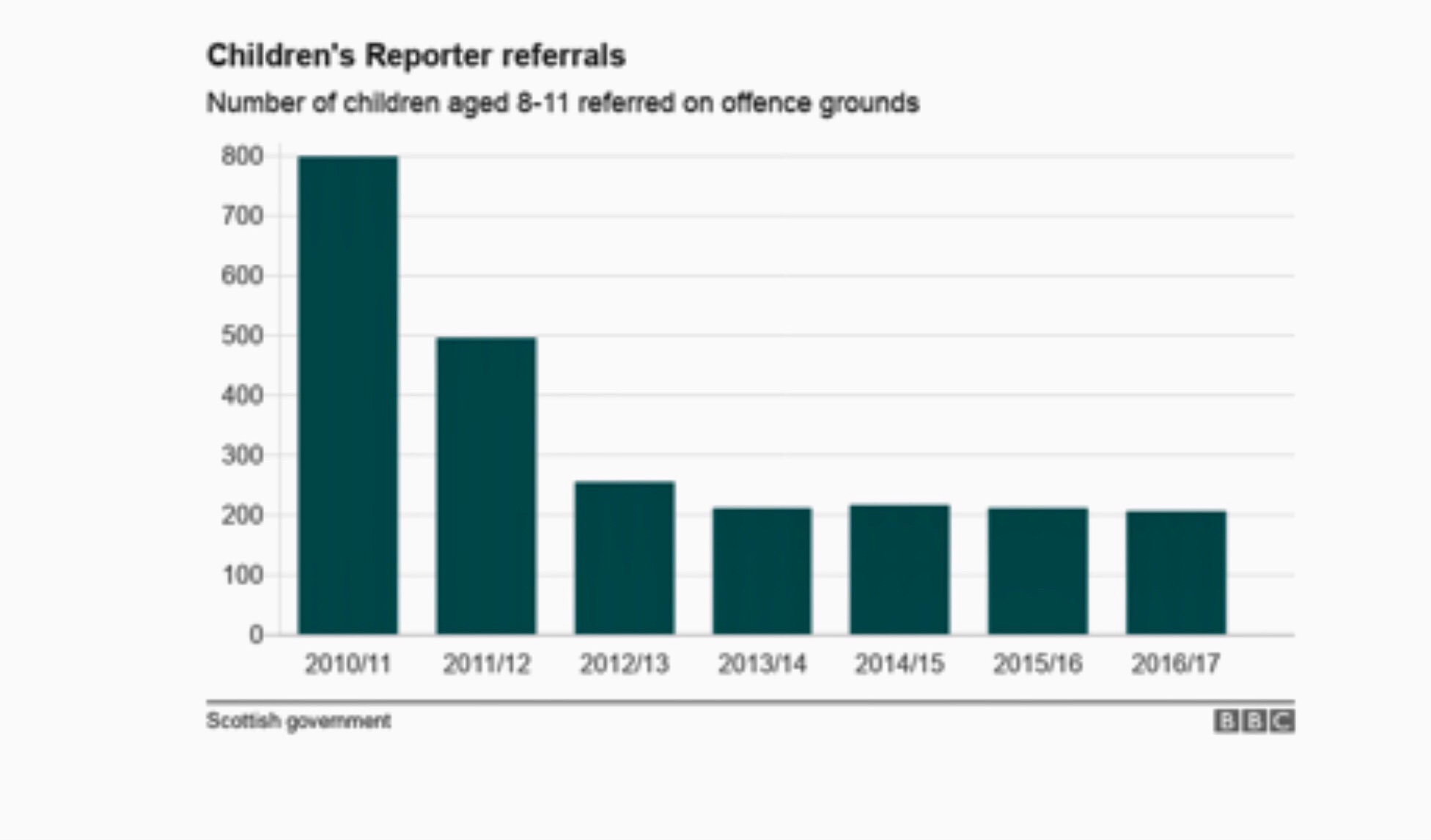
Examining the bigger picture, the number of children aged 8-11 who have been referred to the Children’s Reporter for committing an offence in Scotland has fallen dramatically from a high of about 800 (2010/11) to about 200 (2016/2017) as the Scottish Government’s own figures demonstrate (see below).

A link to the new Act of Parliament can be found below:

https://www.legislation.gov.uk/asp/2019/7/contents

It is also worth emphasising that the scope of the new Act goes further than merely raising the age of criminal responsibility – as the preamble to the original Bill makes clear:

[A] Bill for an Act of the Scottish Parliament to raise the age of criminal responsibility to 12 years and to make consequential changes to the law on the disclosure of criminal records and on disclosure of information about individuals working or seeking to work with children or certain adults; on the provision of information by the Principal Reporter to persons adversely affected by the behaviour of children; on the taking of certain children to a place of safety by the police; on the search of certain children by the police; on police interviews with certain children; and on the taking of forensic samples from certain children by the police; and for connected purposes.”

Copyright Seán J Crossan, 29 November 2019