Grindhouse Day (or Man with an International Travel Ban)

Photo by Nathan Wright on Unsplash 

An interesting story appeared in the Scottish and national UK media on Wednesday 26 February 2025 about a case at Wick Sheriff Court which has made legal history.

Chief Constable of Police Scotland v Kevin Booth [2025] SC WCK 8

A link to the judgement (issued by Sheriff Neil Wilson) on the British and Irish Legal Information Institute (BAILII) can be found below:

https://www.bailii.org/cgi-bin/format.cgi?doc=/scot/cases/ScotSC/2025/2025scwck008.html&query=(Chief)+AND+(Constable)+AND+(of)+AND+(Police)+AND+(Scotland)+AND+(v)+AND+(Kevin)+AND+(Booth)+AND+(.2025.)+AND+(SC)+AND+(WCK)+AND+(8)

When I heard the first account of this story on BBC’s Six ‘o’ Clock News and, immediately afterwards on BBC Reporting Scotland, I assumed that the Sheriff Court had issued its Order under its criminal jurisdiction. I was wrong, but more about that later.  

A word of warning to anyone contemplating reading Sheriff Wilson’s judgement, it contains graphic accounts of violence carried out by Booth against his victims. The judgement is not for the faint hearted.

Totally by coincidence, this story was reported around the time that a major Hollywood film, Heretic (starring Hugh Grant) had just been released; the plot of which featured a misogynist running a torture dungeon under his suburban home. Although the real life setting of Booth’s remote, baronial mansion in the Scottish Highlands definitely won out over Hollywood for its sheer spookiness factor.

A link to the BBC Scotland report can be found below:

https://www.bbc.co.uk/news/articles/cy9dld3jgx8o

The Man with an International Travel Ban

The case centred around Kevin Booth who had been accused of physically abusing women in a private dungeon located in the cellars of his Highland home. Adding to the Grindhouse Movie atmosphere of this story, Booth was in the habit of filming these encounters. It later transpired that many of Booth’s victims were employed by him as domestic servants at his Highland home. Many of these women were foreign nationals who had been lured to the UK by promises of well paid employment with Booth. They were highly vulnerable to abuse and exploitation. These women were to be bitterly disappointed: the golden future that Booth had painted was a deception and, little did they know it, but they were about to enter a nightmare.

At first, I thought, nothing unusual about this story as violence against and the abuse of women and girls is still shockingly and depressingly common in Scotland (and the rest of the UK). Just that week, The Metro had run a front page story detailing the fact that the incidence of the crime of upskirting on trains had rocketed across the UK (see the link below). 

Back to Mr Booth: he is a millionaire (apparently) who owns a remote Scottish Baronial mansion located at the end of a 10 mile private road in the Highlands. The Police, acting on complaints received from several women who had worked for Booth, gathered evidence against him of potential, criminal wrongdoing e.g. torture (referred to as punishment beatings) and human trafficking, but the Crown Office and Procurator Fiscal Service (COPFS) later abandoned criminal proceedings against Mr Booth. 

When the average person hears phrases like human trafficking and punishment beatings, you can’t blame them for arriving at the completely justifiable conclusion that this will involve breaches of the criminal law.  

From knowledgeable sources of mine, it has been speculated that the Crown abandoned proceedings against Booth because it was not in the public interest (yes amazingly); there may have been some level of ‘consent’ given by Booth’s victims; and there was not a sufficiently high chance of securing a conviction against him.

That said, there are limits placed upon physical abuse that an adult may agree to undergo as the House of Lords made very clear in its decision of R v Brown [1993] UKHL 19 [1994] 1 AC 212. This case made headlines at the time because of the types of physical abuse which went way beyond the types of sado-masochostic sexual practices that would be deemed legally permissible.  

At this point, it is worth restating that we have a system of public prosecution in Scotland (private prosecutions are extremely rare). It is the Crown Office and Procurator Fiscal Service (COPFS) which make decisions about whether an accused person will face trial in a criminal court.  Police Scotland can charge a person with a crime (in this case Mr Booth), but it will be up to COPFS to green light a prosecution.

As we have seen, a criminal prosecution against Booth was attempted, but was later abandoned. This development, however, did not deter Police Scotland from taking further civil action against Booth at Wick Sheriff Court by applying for a Trafficking and Exploitation Prevention Risk Order (TERO).

Mr Booth is now the subject of an international travel ban to last for a duration of 5 years. This Order is the first of its kind in Scottish legal history.  The ban or was made in terms of section 26 of the Human Trafficking and Exploitation (Scotland) Act 2015. The official name for this type of ban is a Trafficking and Exploitation Prevention Risk Order or TERO for short.

In relation to his activities, Booth, however, has not been convicted of any criminal acts and the travel ban was imposed by a civil court. The Police actively sought this civil order. There are other restrictions imposed on Booth by the Sheriff Court. He will, for instance, have to notify Police Scotland in advance if he proposes to employ women at his home. This Order is more about controlling Booth in the future as opposed to punishing him (in the criminal sense) for his past treatment of the victims in the story. 

It has to be said that Mr Booth has a rap sheet that would turn most people’s hair white: physical abuse of pupils at a school in Africa where he worked as a teacher; further physical abuse of young children of school age in the North East of England; and, more worryingly, allegations of rape of a woman in the Republic of Ireland. Clearly, Booth is not a nice person – to put it mildly.  

The Police have had significant involvement with Booth and have investigated him after a number of complaints were received from women who stated that they had been physically abused by him.

On BBC Scotland, the reporter likened the abuse to “punishment beatings”. Booth is still a free man for now – although the Police will continue to monitor his activities.  At the time of writing, Booth was the subject of a criminal trial at Wick Sheriff Court for allegedly making indecent communication s to a woman (please see link to article on the BBC website below).

https://www.bbc.co.uk/news/articles/cd7v27nnv9go

The question being asked is “Why is this man not in jail?”  

This is clearly a question for COPFS to answer because it is the relevant legal authority for determining whether a public prosecution of an accused should proceed.  

The decision not to proceed against Booth is going to be particularly controversial given high profile campaigns about violence against women and attempts by the authorities to reduce these types of incidents.  

What about the victims pursuing private prosecutions against Booth?  

Well, this Blog has previously discussed the problems associated with these types of legal action in Scotland. It is theoretically possible, but highly unlikely in practice as the victims would have to make an application to the High Court of Justiciary for a Bill for Criminal Letters which would permit them to initiate a private prosecution against Booth. It’s worth remembering that the last successful private prosecution in Scotland was over 40 years ago (X v Sweeney [1982] JC 70

A civil action, for the time being, might be the only effective remedy for the victims. 

That said, the Police and COPFS are monitoring the situation and, if significant new, evidence comes to light, Booth may well have to face his day in a criminal court. 

In conclusion, Sheriff Neil Wilson had this to say about Booth’s conduct (at paragraph 102 of his judgement):

… the evidence of Mr Booth’s egregious conduct, as presented in court, was, at times, utterly harrowing. The graphic video footage, combined with the context and background provided by supporting documentary evidence in various forms, was redolent of a level of cruelty and depravity which, whilst extreme, one can only hope is rare. It might be thought that the use of such value-laden language in a legal judgment is inappropriate. I would beg to differ, and make no apologies for including it. This judgment may be primarily concerned with the legal issues before the court, but it is important not to lose sight of the human suffering giving rise to this case.” 

Recent Update About Mr Booth

On 28 October 2025, at Wick Sheriff Court, Mr Booth was found guilty of making an indecent communication to a woman who had been employed by him. Booth will return to Court at a later date to be sentenced by the Sheriff.

A link to the story on the BBC website can be found below:

https://www.bbc.co.uk/news/articles/cwyp392jx2do

Explanatory Note About Grindhouse Movies

According to Wikipedia: A grindhouse or action house[1] is an American term for a theatre that mainly shows low-budget horror, splatter, and exploitation films for adults.

According to historian David Church, this theater type was named after the “grind policy”, a film-programming strategy dating back to the early 1920s that continuously showed films at cut-rate ticket prices that typically rose over the course of each day. This exhibition practice was markedly different from the era’s more common practice of fewer shows per day and graduated pricing for different seating sections in large urban theatres, which were typically studio-owned.

Copyright Seán J Crossan, 26 February 2025 and 28 October 2025

Assault!

red white and black textile
Photo by Martin Sanchez on Unsplash

The situation caused by the COVID-19 continues to generate all sorts of legal consequences. One of the latest angles to be given wide publicity is the rising number of incidents involving assaults carried out by individuals who claim to be infected with the virus.

Several innocent members of the public – whether they be private individuals, shop workers, Police officers or National Health Service staff – have experienced confrontations with extremely anti-social individuals who have threatened to cough over them or spit on them.

One such incident occurred at the weekend, which was reported by BBC Scotland (see below):

Assault in Scotland is generally treated as a common law offence. It would involve a physical attack (or an attempted attack) on another person. Threats issued by a person to a victim would also constitute an assault if these put the victim into a state of fear and alarm.

In relation to the above incident, the clear intention of the teenager (even if he was completely healthy) was to put the healthcare worker into a state of fear and alarm. Hopefully, the victim will remain completely healthy and free of viral symptoms.

This is not, however, the point: her attacker clearly had the mens rea (the guilty mind) and he followed this through with the actus reus (the wrongful act). If there are witnesses and other evidence which can corroborate the incident, then the Police may have grounds to charge her attacker with assault.

If the criminal investigation proceeds to this stage, it will then be for the Procurator Fiscal (the local prosecutor) to determine whether there is enough evidence to initiate criminal proceedings against the accused.

The Lord Advocate, James Wolfe QC has issued a statement in relation to assaults on key workers:

The Crown has a range of responses available to tackle unacceptable criminal conduct that may arise during the coronavirus pandemic. Any person who deliberately endangers life, or spreads fear and alarm by pretending to do so, will be dealt with robustly. It is difficult to imagine a more compelling case for prosecution in the public interest.

Although assault is generally considered to be a common law offence, we should be mindful of the provisions of Section 90 of the Police and Fire Reform (Scotland) Act 2012 which creates the statutory offence of assaulting or impeding the Police in the discharge of their duties. If an accused is successfully convicted of an offence in terms of Section 90, they may face a maximum prison sentence of 12 months and/or the imposition of a fine.

In England and Wales, a different approach is taken to assault: it is regarded as a statutory offence in terms of the Offences Against the Person Act 1861.

The Crown Prosecution Service for England and Wales has stated that attacks on emergency workers may result in a prison sentence of two years being imposed should the accused (the defendant) be found guilty of such an assault (as per Section 38 of the Offences Against the Person Act 1861).

Links to stories on the Sky News website about the rise of this type of criminal offence can be found below:

http://news.sky.com/story/coronavirus-nhs-staff-police-and-public-being-coughed-on-by-people-claiming-to-have-covid-19-11965058

http://news.sky.com/story/coronavirus-man-who-spat-on-police-while-claiming-he-had-coronovairus-is-jailed-11967349

http://news.sky.com/story/coronavirus-police-want-spit-guards-to-protect-officers-from-vile-behaviour-11969529

http://news.sky.com/story/coronavirus-policewoman-bitten-on-the-arm-while-explaining-covid-19-lockdown-rules-11971769

In the United States of America, incidents such as the above have more serious consequences: COVID-19 is classified as a ‘biological agent’. Attempts to spread or threats to spread the virus are treated as a terrorist offence (see below):

http://news.sky.com/story/coronavirus-two-charged-with-terror-offences-over-threats-to-spread-covid-19-11970802

Copyright Seán J Crossan, 31 March; 6 & 11 April 2020

Homicide?

Photo by Valentin Salja on Unsplash

For my latest Blog, I’m sticking with Scotland’s public prosecution system.

The Lord Advocate, James Wolffe QC, has just won an interesting ruling before the Appeal Judges of the High Court of Justiciary.

The case in question is Crown Appeal under Section 74 by Her Majesty’s Advocate v Jason Gilmour [2019] HCJAC 74 HCA/2018/000542/XC.

The reason for the Crown’s appeal was that Mr Gilmour’s victim had subsequently died.

The simple question was this: could the Crown, having accepted Mr Gilmour’s guilty plea to the charge of aggravated assault, then pursue a subsequent prosecution against him for murder?

As Lady Dorrian, the Lord Justice Clerk (Scotland’s second most senior judge) noted:

The charge of murder alleges that on 11 June 2012 the respondent [Gilmour] assaulted the deceased by repeatedly punching him on the head causing him to fall to the ground, and then kicking, stamping and jumping on his head, whereby he was so severely injured that he died almost five years later on 17 April 2017.”

Before the introduction of the Double Jeopardy (Scotland) Act 2011, it was a clearly established principle of Scottish criminal law that an accused who had assaulted a victim could be charged subsequently with either culpable homicide or homicide if the victim later died due to the injuries sustained by reason of the assault.

The introduction of the Act meant that some clarification of the law was required.

As Lady Dorrian, the Lord Justice Clerk stated in response to the Lord Advocate’s appeal:

The rationale for this was that the crime of murder was a separate crime and “it cannot be said that one is tried for the same crime when he is tried for assault during the life, and tried for murder after the death, of the injured party”- HM Advocate v Stewart (1866) 5 Irv. 301. In Tees v HMA 1994 JC 12 the accused had pled guilty to a charge of assault under deletion of attempted murder, and was re-indicted for culpable homicide when the victim died.

In delivering the Opinion of the Court, Lady Dorrian succinctly concluded that:

“Whatever may have been the position prior to the introduction of the 2011 Act … that Act makes it abundantly clear that it should now be possible to prosecute for murder even where there has been a prior prosecution for attempted murder. It is against that background that the Lord Advocate’s acceptance of the plea must be analysed. For this reason also we consider that the acceptance of the plea cannot be construed as the renunciation of a right to prosecute should the victim die.

Section 11 was the key part of the 2011 Act and the intention of the legislation was clearly to permit the possibility of a subsequent prosecution of the accused for murder – even in situations where s/he had previously faced a charge of attempted murder and had been acquitted.

In early 2019, Mr Gilmour’s had been prosecuted for his victim’s murder. He was convicted of culpable homicide and sentenced to a prison sentence of four and a half years. This has now been upheld by the Appeal Court.

A link to the judgement can be found below:

https://www.scotcourts.gov.uk/docs/default-source/cos-general-docs/pdf-docs-for-opinions/2019hcjac74.pdf?sfvrsn=0

Copyright Seán J Crossan, 14 November 2019

Smacking: banned!

Photo by Anna Kolosyuk on Unsplash

John Finnie, a Green Party member of the Scottish Parliament introduced a Bill (Children (Equal Protection from Assault) (Scotland) Bill) on 6 September 2018.

This Bill seeks to remove the common law defence of reasonable chastisement in Scotland which permits parents and guardians (primarily) to use smacking as a punishment in relation to children in their care.

The main objective of the Bill was expressed in its accompanying Explanatory Notes:

A person charged with assault of a child will no longer be entitled to claim that a use of physical force was justifiable on the basis that it was physical punishment administered in exercise of a parental right (or a right derived from having care or charge of a child). This will give children the same protection from assault as adults.

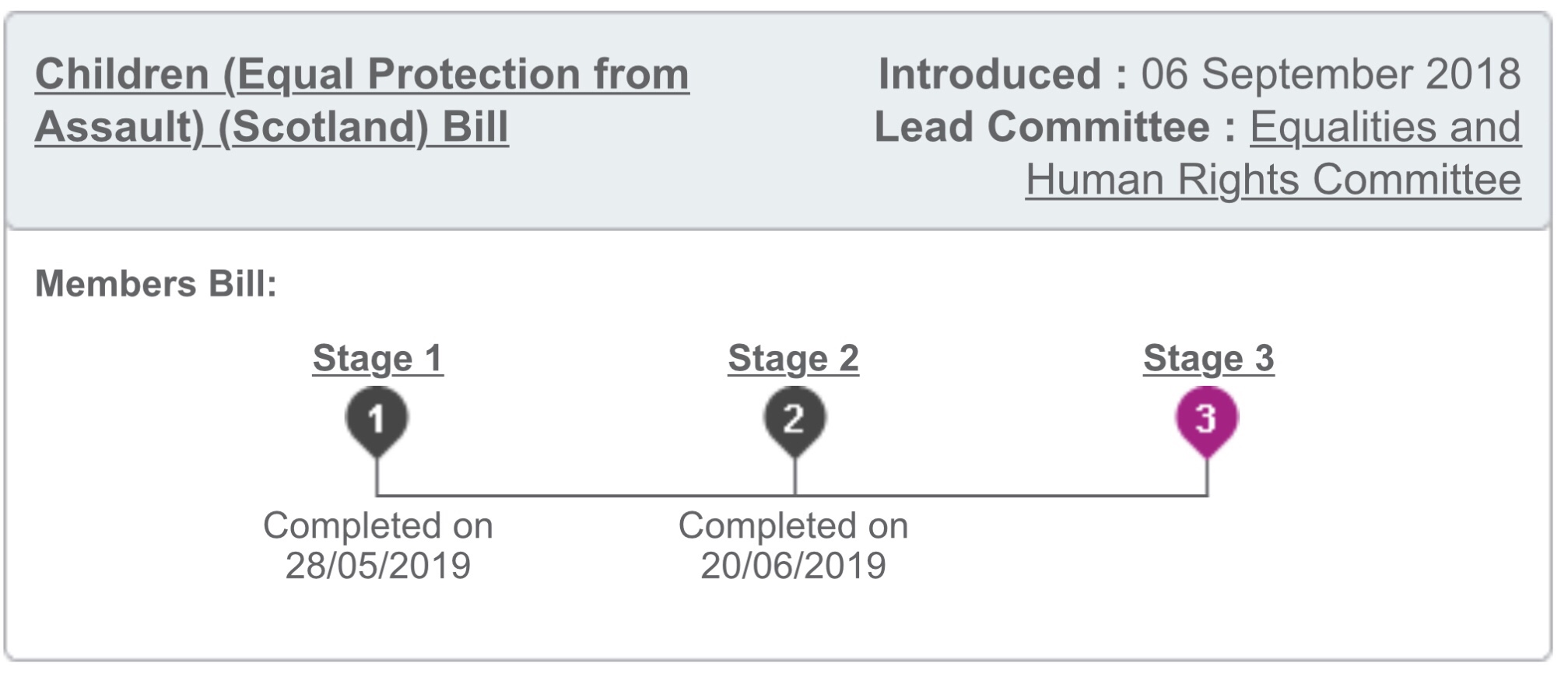
This week (beginning 30 September 2019), Mr Fannie’s Bill passed Stage 3 of the legislative process in the Scottish Parliament. The Bill will shortly receive the Royal Assent (a mere formality) thus becoming the Children (Equal Protection from Assault) (Scotland) Act 2019.

An info graphic showing that the Bill has now passed Stage 3 of the legislative process in the Scottish Parliament can be found below:

As a result of the passing of this Bill into law, Scotland will follow 54 other countries from around the world where the physical chastisement of children is now the criminal offence of assault.

A link to how the passing of the Bill was reported by The Guardian can be found below:

https://www.theguardian.com/uk-news/2019/oct/03/scotland-becomes-first-country-in-uk-to-ban-smacking-of-children

Copyright Seán J Crossan, 4 October 2019

Ban smacking!

Photo by Kat J on Unsplash

John Finnie, a Green Party member of the Scottish Parliament introduced a Bill (Children (Equal Protection from Assault) (Scotland) Bill) on 6 September 2018.

This Bill would remove the common law defence of reasonable chastisement in Scotland which permits parents and guardians (primarily) to use smacking as a punishment in relation to children in their care.

The main objective of the Bill is expressed in its accompanying Explanatory Notes:

A person charged with assault of a child will no longer be entitled to claim that a use of physical force was justifiable on the basis that it was physical punishment administered in exercise of a parental right (or a right derived from having care or charge of a child). This will give children the same protection from assault as adults.

The Bill is quite a short one – a mere 5 sections – but if passed into law it is sure to have a very significant effect.

Section 1 contains the actual provision which would abolish the defence of reasonable chastisement

Section 2 places a duty on the Scottish Ministers to raise awareness and understanding of the proposed legislation

Section 3 contains the transitional and saving provision which is essentially interim arrangements for repealing the previous legislation  and gives the Scottish Ministers the power to do anything which would bring the provisions of the new law into force

Section 4 deals with the commencement of the proposed law i.e. the day after it receives Royal Assent

Section 5 contains the short title of the Bill.

The Bill will be debated and scrutinised by other MSPs in the Chamber and in Committee and it is quite possible that amendments or changes will follow. With every Bill, there is also the possibility that it might fall at a particular stage of parliamentary proceedings or, even if passed, could be subject to legal challenge e.g. the Scottish Government’s Children and Young Person’s (Scotland) Act 2014 which the UK Supreme Court found fault with on human rights grounds in 2016 (see The Christian Institute and Others v The Lord Advocate [2016] UKSC 51).

A link to the Scottish Parliament’s website where the Bill (as introduced) and its accompanying or supporting documents (which must be submitted) can be found below:

https://www.parliament.scot/parliamentarybusiness/Bills/109156.aspx

The Bill must, of course, comply with Scotland’s international human rights obligations as contained in the Scotland and Human Rights Acts (of 1998); and it must be within the “legislative competence” of the Scottish Parliament as per the Scotland Acts of 1998 (which the Presiding Officer, Ken McIntosh MSP has indeed confirmed).

The Bill is also subject to a Financial Memorandum. This can be summed up as a cost analysis to the Scottish Administration:

The Bill does not create a new offence; rather, it removes the defence of reasonable chastisement for the assault of a child. Thus, once the Bill is in force, some prosecutions may proceed as a result of the Bill which may not have proceeded when the defence was available. The Bill may also lead to additional cases of lower level physical punishment being reported, and prosecuted, which are currently not reported due to the defence being available.

Accordingly, the Bill can be expected to have some impact and costs on the criminal justice system.” [author’s emphasis]

Progress so far

The Equalities and Human Rights Committee of the Scottish Parliament gave its unanimous backing to the Bill (as as has the Scottish Government).

In support of his Bill, Mr Finnie has emphasised that 54 countries around the world have removed the right from parents and guardians to use physical chastisement as a method of disciplining children. His contention is that, if the Bill is adopted, it would bring Scotland into line with other developed countries.

In order to become a new Scottish law, the Bill, of course, must pass through all (3) legislative stages of Scottish parliamentary procedure.

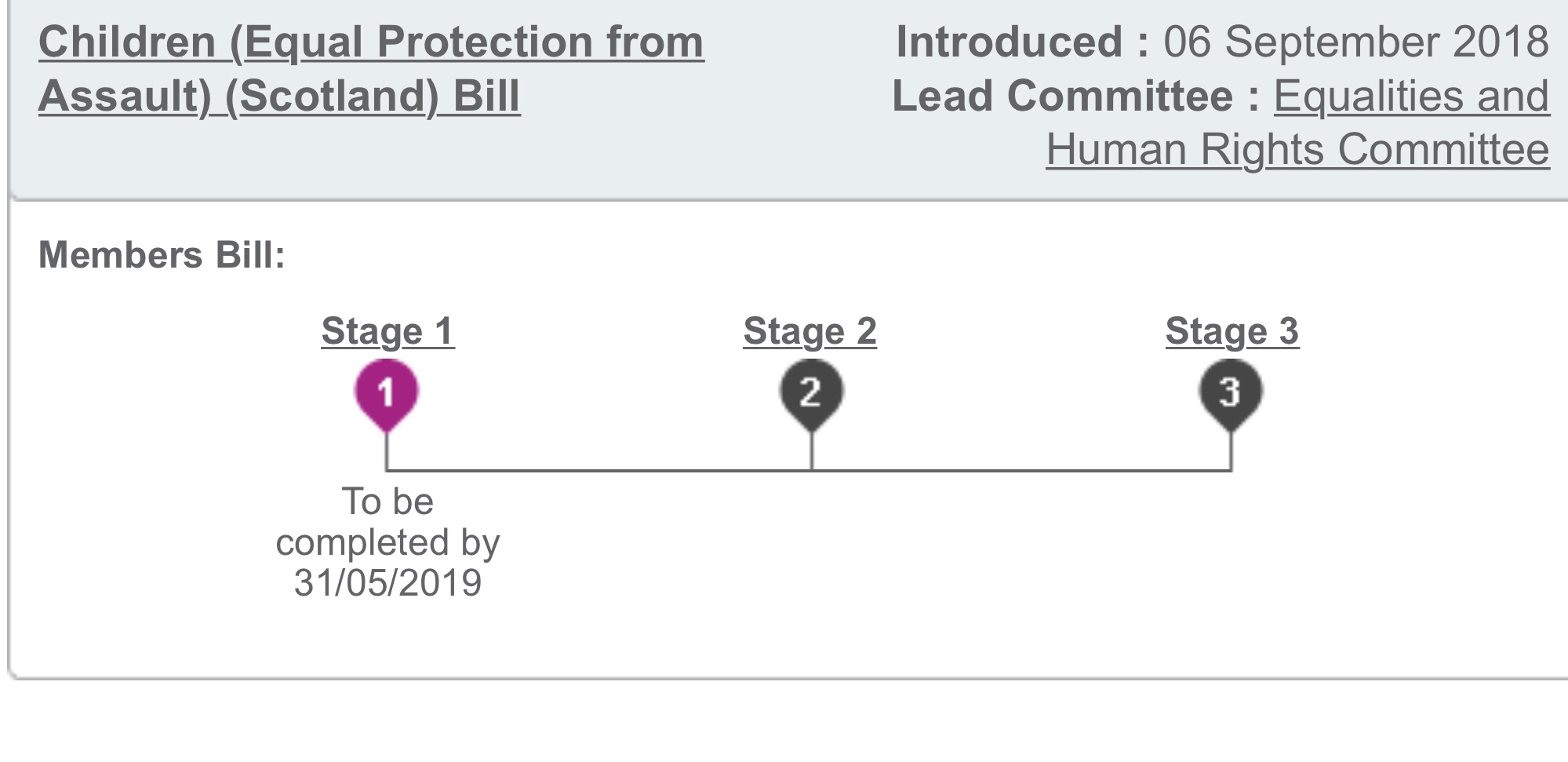
The Bill is currently at Stage 1 of proceedings. Please see the diagram below taken from the Scottish Parliament’s website which tracks the current progress of the Bill (as of today – Tuesday 28 May 2019):

In a previous Blog (Private Members’ Bills published on 29 April 2019), I drew attention to the fact that backbench members of the Scottish Parliament have a much greater ability to introduce Bills (and ultimately get them onto the Statute Book) when compared to their counterparts sitting in the House of Commons at Westminster. The term backbench or private member is a description which covers any MP or MSP who is piloting a Bill through Parliament which is not a Government Bill.

A link to an article on Mr Finnie’s Bill can be found below:

MSPs to discuss smacking ban bill in parliament debate

Postscript

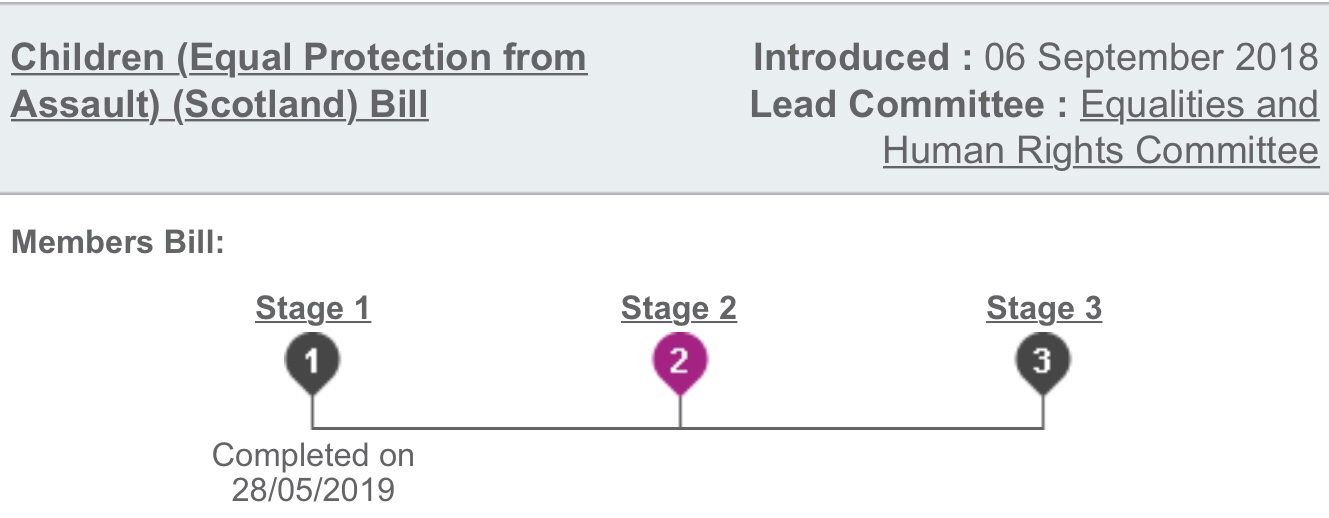
The Bill has now proceeded to Stage 2 of the legislative process in the Scottish Parliament as the infographic displayed below demonstrates:

Copyright Seán J Crossan, 28 May and 13 June 2019