More hell on the high street (or redundancy again)

Photo by Becca McHaffie on Unsplash

The difficult trading conditions on the UK high street don’t seem to be easing with news that Debenhams, one of the country’s biggest retailers, will close 50 of its stores. This will affect about 1,200 employees of Debenhams, many of whom will be facing up to the threat of redundancy.

Debenhams have just announced the names of the first 22 stores which will close in 2020.

Debenhams names 22 stores to close

The struggling department store chain plans to close the shops next year, affecting 1,200 staff.

Redundancy

Redundancy can be potentially fair reason for dismissal… if handled correctly by employers.

Only employees can be made redundant. 

Remember: Section 230 of the Employment Rights 1996 defines who is an “employee”.

The definition of redundancy can be found in Section 139(1) of the Employment Rights Act 1996:

(1) For the purposes of this Act an employee who is dismissed shall be taken to be dismissed by reason of redundancy if the dismissal is wholly or mainly attributable to-

(a) the fact that his employer has ceased or intends to cease-

(i) to carry on the business for the purposes of which the employee was employed by him, or

(ii) to carry on that business in the place where the employee was so employed, or

(b) the fact that the requirements of that business-

(i) for employees to carry out work of a particular kind, or

(ii) for employees to carry out work of a particular kind in the place where the employee was employed by the employer,

The relevant legal provisions governing redundancy are quite extensive and can be found in:

● Trade Union and Labour Relations (Consolidation) Act 1992 

● Employment Rights Act 1996

● Information and Consultation of Employees Regulations 2004 

● Transfer of Undertakings (Protection of Employment) Regulations 2006

● Collective Redundancies and Transfer of  Undertakings (Protection of Employment) (Amendment) Regulations 2014.

The really critical provisions of UK employment law which govern redundancy handling are to be found in the following:

● Sections 188-198 of the Trade Union and Labour Relations (Consolidation) Act 1992 

(Section 188 is further supplemented by the Collective Redundancies and Transfer of Undertakings (Protection of Employment) (Amendment) Regulations 1999).

Handling redundancies

Employees should be selected for redundancy in a fair way.

The employees who are at risk for potential redundancy will be part of a group of individuals known as the redundancy pool.

Employers can manage situation in a number of ways. 

How?

● LIFO

● Volunteers 

● Disciplinary records

● Staff appraisal – skills, experience etc (redundancy matrices or re-applying for your job).

What is LIFO? 

Last in, first out – was the most commonly used method, but it could fall foul be regarded as indirect discrimination e.g. too many young people are made redundant. So there are limitations to this approach.

Redundancy selection criteria must be objective. 

Many employers will have contractual redundancy policies. Must stick with this: see John Anderson v Pringle of Scotland [1998] IRLR 64.

Appeals should be permitted.

Individuals will still be an employee until effective date of redundancy.

Avoiding redundancies

Redundancy could be avoided by:

● Short-time working

● Lay-offs

The employer needs to consult with employees or their representatives.

Both sides may not reach agreement, but consultation has occurred. 

 It has to be a meaningful exercise – not a paper one.  

Additional rights

Employees have additional rights in redundancy situations:

● Consultation with employer

● Notice period

● Suitable, alternative employment 

● Time off to find new employment

Selection for redundancy

Selection for redundancy is automatically unfair in relation to:

● Protected characteristics e.g. age, disability, gender, maternity and pregnancy etc

● Trade Union participation or acting as employee representatives

● Jury service

● Whistle-blowing & health and safety cases

● Asserting statutory rights

● Occupational pension trustees

Statutory redundancy pay

Statutory redundancy pay is most common payment. Only those employees who have 2 years or more continuous service are entitled to claim statutory redundancy pay.

It is worked out according to the following formula:

● half a week’s pay for each full year employees were under 22

● 1 week’s pay for each full year employees were 22 or older, but under 41

● 1 and half week’s pay for each full year employees were 41 or older

Length of service which can be used to calculate the amount of redundancy pay is capped at 20 years and the amount of weekly pay is capped at £525 (the maximum statutory amount claimable is £15,750) from 6 April 2019.

Employers can be more generous with redundancy pay or they can include employees with less than 2 years’ continuous service.

No tax is payable on redundancy pay less than £30,000.

Employees can calculate their entitlement to statutory redundancy pay by clicking on the link below:

https://www.gov.uk/calculate-employee-redundancy-pay

Notice of redundancy

Proper notice of redundancy must be given. Section 86 of the Employment Rights Act 1996 contains the relevant notice periods for termination of the employment contract.

The maximum period of notice for those employees with 12 years or more continuous service is 12 weeks.

Sometimes contractual periods of notice can be longer, but not shorter than the those laid down by the Employment Rights Act 1996.

That said, notice can be shorter if the employment contract permits employer to make a payment in lieu of notice. 

Employees will receive full entitlement to redundancy pay, notice pay, holiday pay & other entitlements.

Collective redundancies?

This situation arise where more than 20 employees are going to be  made redundant in a 90 day period. Fixed term contract employees do not need to be included in collective consultation, except if contract ending early because of redundancy.

The Debenhams’ situation is likely to be classified as a case of collective redundancy.

There must be consultation with with Trade Union or employee representatives.

Consultations must cover:

● ways to avoid redundancies

● the reasons for redundancies

● how to keep the number of dismissals to a minimum

● how to limit the effects for employees involved, e.g. by offering retraining

Length of consultation period?

No time limit for how long this period should be, but the minimum is:

● 20 to 99 redundancies – the consultation must start at least 30 days before any dismissals take effect

● 100 + redundancies – the consultation must start at least 45 days before any dismissals take effect

These minimum periods apply if employers are contemplating making collective redundancies within a 90 day period. 

The UK Coalition Government (2010-15) substantially reduced redundancy consultation periods.

Failure to consult employees?

Dismissals will almost certainly be unfair. 

In a collective redundancy situation, employers should notify the Redundancy Payments Service (RPS) by filling out form HR1. It is a (strict liability) criminal offence not to complete the HR1.

A link to a template HR1 form can be found below:

https://assets.publishing.service.gov.uk/government/uploads/system/uploads/attachment_data/file/782487/NEW_HR1.pdf

Failure to pay redundancy payments or payment of the wrong amount?

Affected employees have 6 months (minus 1 day) to lodge an Employment Tribunal claim.

Insolvent employers?

The State will ultimately pay out from the National Insurance Fund (employee’s should complete and submit an RP1 Form).

Employees can find out if their employer is insolvent by going to the following link:

https://www.gov.uk/get-information-about-a-company

A short film from ACAS about the core employments rights in relation to redundancy can be found below:

Copyright Seán J Crossan, 28 April 2019

Social Media Misuse

Photo by Sara Kurfeß on Unsplash

In a previous Blog (It happened outside work (or it’s my private life!) published on 7 February 2019), I discussed the importance of employers drawing up a clearly defined social media policy to which employees must adhere. It’s of critical importance that employers make employees aware of the existence of such policies and the potential consequences of breach. Generally speaking, employers will be rightly concerned that the misuse of social media platforms by employees may lead to reputational damage.

An interesting example of the type of reputational damage which can be caused to an employer’s brand by malicious or careless or thoughtless social media use was reported by The Independent in November 2018. A company in the Irish Republic was forced to take down a video on its Facebook site where an employee had used racially offensive images to promote Black Friday:

https://edition.independent.co.uk/editions/uk.co.independent.issue.251118/data/8650006/index.html

Misuse of social media can potentially be regarded by employers as misconduct. In really serious cases, the situation might be regarded as gross misconduct – a potentially fair reason for dismissal of the employee in terms of Section 98(4) of the Employment Rights Act 1996.

Right on cue, two stories have appeared about social media misuse on the BBC website this afternoon.

In the first story, Rugby Australia has announced that it intends to dismiss, Israel Folau for making homophobic comments on Twitter. Folau had been warned last year about previous offensive tweets that he had made. Clearly, he hasn’t learned his lesson and Rugby Australia is legitimately concerned about the reputational damage that such remarks may do to its image as an inclusive sports organisation.

A link to the story on the BBC News website can be found below:

Israel Folau: Rugby Australia ‘intends’ to sack full-back after social media post

Rugby Australia says it intends to terminate Israel Folau’s contract following a social media post by the full-back in which he said “hell awaits” gay people.
In the second story, Shila Iqbal, an actress who appears in the long running ITV soap opera, Emmerdale has been dismissed due to offensive tweets that she made some 6 years ago.
A link to the story can be found below:

Shila Iqbal: Emmerdale actress fired over old tweets

Shila Iqbal says she’s “terribly sorry” for using offensive language online six years ago.

Trawling through the case law archives

Since the previous Blog was published, I have been browsing through the archives and discovered a number of Employment Tribunal cases which involved alleged social media misuse.

Weeks v Everything Everywhere Ltd ET/250301/2012

In this case, the dismissed employee posted comments on Facebook which likened his work place to Hell (or Dante’s Inferno for the more cultured readership). The employer had given the employee a warning about this kind of behaviour, but he continued to post these types of comments on Facebook. The employer regarded this type of behaviour as causing it to suffer reputational damage.

Held: by the Employment Tribunal that the employer was entitled to dismiss the employee in terms of Section 98 of the Employment Rights Act 1998.

A link to the full ET judgement in the Weeks’ case can be found below:

https://uk.practicallaw.thomsonreuters.com/Link/Document/Blob/I42aaca4f0c5511e498db8b09b4f043e0.pdf?targetType=PLC-multimedia&originationContext=document&transitionType=DocumentImage&uniqueId=e621efe4-fda9-4b65-9f21-67c5e720fbf0&contextData=%28sc.Default%29&comp=pluk

Game Retail Ltd v Laws Appeal No. UKEAT/0188/14DA

The employee, who worked for Game, had set up a personal Twitter account. This account was followed by colleagues at approximately 65 other Game stores. The settings on the Twitter account were public, meaning that any person could read them. The employee’s tweets typically consisted of a wide range of disparaging and derogatory remarks. The employer dismissed the employee on grounds of gross misconduct.

Held: by the Employment Appeal Tribunal that the dismissal was fair in terms of Section 98 of the Employment Rights Act 1996. These remarks were being publicly broadcasted via Twitter (despite the employee’s assertion that they were private remarks) and these could cause the employer to suffer damage in terms of its reputation.

A link to the full ET judgement in the Game Retail case can be found below:

https://assets.publishing.service.gov.uk/media/592d608ee5274a5e510000fa/Game_Retail_Ltd_v_Mr_C_Laws_UKEAT_0188_14_DA.pdf

Creighton v Together Housing Association Ltd ET/2400978/2016

The employee was a manager of 30 years’ service with the Association, but found himself dismissed for tweeting disparaging remarks about colleagues. These tweets were 2 or 3 years old, but they came to light when another colleague took a grievance against him.

Held: by the Employment Tribunal that the dismissal (on grounds of the employee’s conduct) was fair in terms of Section 98 of the Employment Rights Act 1996. This may seem a harsh decision given that the employee had 30 years of service with his employer, but the Tribunal was clearly of the view that the employer had acted fairly and dismissal was in the reasonable band of responses for such behaviour. In some respects, this case has similarities to another Tribunal decision, Plant v API Microelectronics Ltd (ET Case No. 3401454/2016) 30th March 2016 which was discussed in the blog entitled It happened outside work (or it’s my private life!, which was published on 7 February 2019

Conclusion

The above 3 cases, once again, demonstrate the dangers of social media misuse – whether in the work place or outside. Employers are very foolish if they fail to put a clear social media policy in place. From the employees’ perspective, it is of critical importance that they are (a) aware of the existence of such a policy; and (b) they have read and understood its contents.

It will also be highly advisable for employers to update social media policies on a regular basis (especially as new platforms and technologies will continue to be developed) and to ensure that social media awareness is part and parcel of induction and training regimes.

Admittedly, there are pitfalls for employers: unauthorised or unjustified surveillance of employees could be viewed as a breach of privacy.

Expect this area of employment relations, to continue to generate some interesting case law in the weeks, months and years to come.

Postscript

Following on from the tweets posted by the rugby player, Israel Folau, a second rugby star is embroiled in a further homophobic social media row:

Israel Folau: RFU to meet England’s Billy Vunipola after he defended Australian’s comments

The Rugby Football Union says it does not support Billy Vunipola’s views after the England forward defended Israel Folau’s social media post claiming “hell awaits” gay people.

Copyright Seán J Crossan, 11 April 2019

Drunk and disorderly?

Photo by Bobby Rodriguezz on Unsplash

Misconduct

Several of my previous blogs have focussed on misconduct inside and outside the work place. In the most serious cases of (gross) misconduct, an employer could fairly dismiss an employee (Section 98(2)(b): Employment Rights Act 1996.

That said, employers are well advised to follow proper pre-dismissal procedures – usually in line with the latest ACAS Code of Practice on Discipline and Grievance at Work.

Summary (i.e. on the spot) dismissal can be an appropriate response to a breach of discipline by an employee, but I tend to caution employers against this. The eminent English judge, Sir Roger Megarry VC was quite correct to warn employers about the dangers of what they might perceive to be an open and shut case (see John v Rees & others [1969] 2AER 274, CD). It’s always better to be safe rather than sorry and by carrying out a procedure, the employer is minimising its exposure to risk i.e. the possibility of a successful unfair dismissal claim brought by the employee.

A typical disciplinary process usually consists of the following stages:

  • Stage 1: The investigation of the allegations
  • Stage 2: The disciplinary meeting
  • Stage 3: The appeal hearing

If the investigation uncovers clear evidence that the employee should be exonerated of all allegations of misconduct, the employer is legally bound to put a stop to the disciplinary process (see A v B [2003] IRLR 405; Salford Royal NHS Foundation Trust v Roldan [2010] EWCA Civ 522; Miller v William Hill Organisation Ltd UKEAT/0336/12/SM [2013])

It is also important to note that the employer must set out the disciplinary charges as clearly as possible so that the employee can prepare her case. The employer cannot, under any circumstances, play fast and loose with the disciplinary charges as this may undermine the integrity of the entire disciplinary procedure (see Strouthos v London Underground [2004] IRLR 636 CA and Celebi v Scolarest Compass Group UK & Ireland Ltd UKEAT/0032/10/LA [2010]).

If, however, matters proceed to a formal, disciplinary meeting, the allegations must be put to the employee and the evidence which supports them. The employee in turn has the right to present her case to the disciplinary panel or manager taking the proceedings. In terms of the Employment Relations Act 1999, the employee has a right to be accompanied by a colleague or a recognised trade union representative.

Should the disciplinary meeting arrive at a decision to dismiss the employee for misconduct, it is extremely important to allow an appeal (see West Midlands Co-operative Society v Tipton [1986] 1 ALL ER 513). An appeal can lead to the dismissal being upheld or overturned; and it can be used to cure any defects in the previous stages of the disciplinary proceedings.

Discipline at work

It’s very common (indeed essential) for employers to have detailed codes of practice or discipline which regulate the behaviour of employees inside and outside the work place. The content of disciplinary codes should be clearly communicated to employees. For new employees, this could be carried out as part of their induction process. For existing employees, a regular series of training seminars or development events could accommodate this aim. The urban myth that what happened outside the work place is no business of the employer is that exactly that: a dangerous myth. If staff misbehaviour outside working hours causes serious reputational damage to the business or the organisation, the employer is entitled to treat this as gross misconduct and to use the ultimate disciplinary sanction of dismissal.

Examples of gross misconduct might include any of the following:

  • Alcohol and drug abuse
  • Acts of bullying & harassment
  • Fraud
  • Negligent performance of duties
  • Theft
  • Persistent late-coming

The above list is by no means an exhaustive one, but it covers some of the most common examples of gross misconduct.

As I have discussed in a previous blog, It happened outside work (or it’s my private life!) (published on 7 February 2019), employers do not have an automatic right to meddle in employees’ private lives. The right to a private life is protected in terms of Article 8 of the European Convention on Human Rights (as implemented by the both the Scotland Act 1998 and the Human Rights Act 1998). Employers will have to walk a very fine line between what is a legitimate act to protect their business interests and what would otherwise be unwarranted interference in the private lives of employees.

Lloyd’s of London

So, bearing all of the above in mind, it was with some interest that I read today that Lloyd’s of London, the financial giant, was introducing a new code of conduct for employees. This is in the wake of some unpleasant allegations being disclosed about the business – sexual harassment claims and drunkenness and drug taking.

Traditionally, the serving of alcohol at business meetings in the City of London or long, boozy lunches were as much a fixture of the Square Mile as was St Paul’s Cathedral. Alcohol oiled the wheels of commerce it was thought, but it also encouraged people to behave recklessly within a work environment.

It would seem that, in other work places, employees seem to know that they can’t turn up for work under the influence of drugs or alcohol, but Lloyd’s obviously feels that it still has a problem with these issues and they need to be addressed. Admittedly, two years ago, the organisation did ban employees from drinking alcohol between 0900 and 1700 hours.

The new code of conduct at Lloyd’s will apply not only to its 800 employees, but also to any person who holds a pass to its London HQ (potentially such 40,000 individuals). Anyone attempting to enter Lloyd’s HQ who appears to be under the influence of drugs or alcohol (or both) will be denied admission to the premises.

A link to the BBC News article about the new code of conduct at Lloyd’s can be found below:

Lloyd’s of London insurance has a new code of conduct, but not everyone welcomes it.

Lloyd’s of London calls time on drink and drugs

Photo by Boris Stefanik on Unsplash

Conclusion

Misconduct by employees – both in and outwith the work place – can be used by employers as a potentially fair reason for dismissal in terms of Section 98 of the Employment Rights Act 1996. Employers must ensure that employees clearly understand what is expected of them in terms of their conduct. It is very important, however, that employers carry out proper procedures when contemplating dismissal as the ultimate sanction for breaches of the disciplinary code. By implementing a new code of conduct, Lloyd’s of London is carrying out a risk management exercise i.e. spelling out what is and isn’t acceptable behaviour in and outside the work place. This is very wise given the bad publicity which Lloyd’s has experienced in the past regarding allegations of employee misconduct.

Copyright Seán J Crossan, 9 April 2019

Hell on the High Street

Photo by kevin laminto on Unsplash

It’s been a tough time for many retailers on the UK high street over the last few years.

This has led to a succession of well known businesses going into liquidation (e.g. Maplins and Toys ‘R’ Us UK ) or being taken over by other companies (e.g. Evans Cycles and House of Fraser).

In February 2019, it was announced that the music chain HMV was being taken over by Sunrise Records, a Canadian company. Sunrise was willing to take over 100 former HMV and Fopp Records stores from the company administrators. As a result of this acquisition, nearly 1500 jobs were saved. Unfortunately, 27 stores had to close with the loss of 445 jobs. Many music and film fans will lament the loss of Fopp’s Byres Road store in Glasgow which was one of the outlets that ceased trading.

The lucky HMV and Fopp employees will have their employment transferred to Sunrise Records in terms of the Transfer of Undertakings (Protection of Employment) Regulations 2006. This protects them from dismissal and guarantees continuation of their core terms and conditions of employment.

As for the unlucky employees, they are being made redundant in terms of Section 139 of the Employment Rights Act 1996. Redundancy is a potentially fair reason for dismissal – so long as the procedure is carried out fairly and objectively.

A link to a BBC article about the takeover of HMV and Fopp by Sunrise Records can be found below:

HMV chain saved but some stores will close

The firm is to buy 100 stores out of administration, but 27 outlets will close, including the Oxford Street store

Copyright Seán J Crossan, 3 April 2019

TUPE for lawyers

Photo by Melinda Gimpel on Unsplash

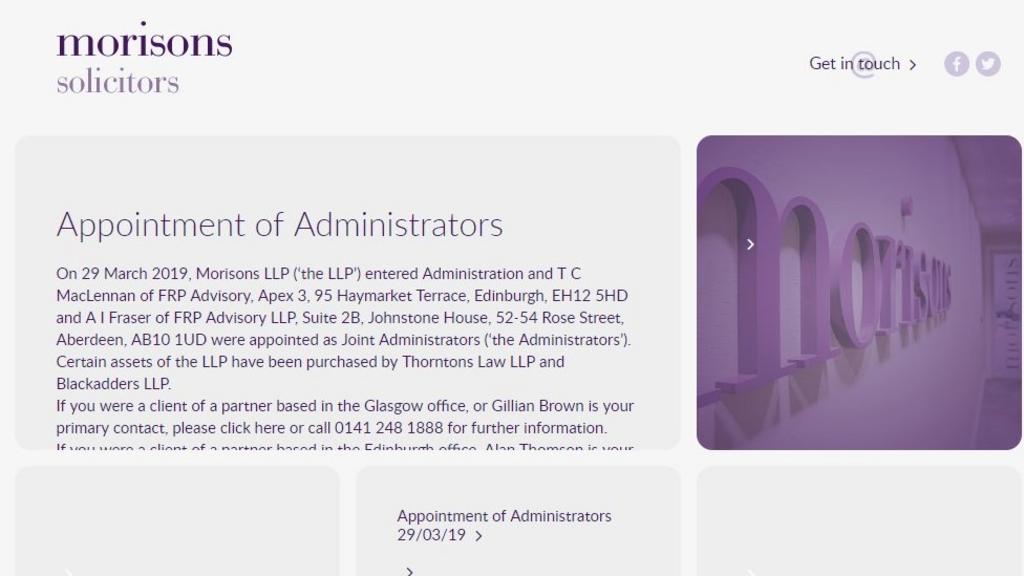
An interesting story by BBC Scotland about the demise of the well known Glasgow/Edinburgh law firm, Morisons Solicitors LLP. The story primarily concerns aspects of the transfer of an undertaking.

The majority of staff at Morisons are having their employment transferred: Blackadders Solicitors have agreed to take over the Glasgow operations and Thorntons will take over the Edinburgh side of the business.

The movement of former Morisons’ staff to their new employers will, of course, be governed by the Transfer of Undertakings (Protection of Employment) Regulations 2006. This means that the employees in question will have their employment and their core terms and conditions of employment protected by their new employers.

The prospect of staff being made for redundant, as a result of the collapse of Morisons, is not imminent for the time being.

A link to the story can be found below:

Some jobs saved after administrators appointed at law firm

The business of Morisons LLP, which has offices in Glasgow and Edinburgh, will be taken over by two firms.

A link to a video on the ACAS website dealing with TUPE can be found below:

Copyright Seán J Crossan, 31 March 2019

I wish I hadn’t done that …

photo-1521996319423-90475f382dff.jpg

Photo by Gem & Lauris RK on Unsplash

The employee’s duty of care

There is an implied duty that the employee will take reasonable care in the discharge of her duties. In other words, employees are expected to discharge their duties with skill and care. After all, this is one of the reasons that the employer has selected them.

Breach of the employee’s duty of care may be particularly relevant in situations where the employer is held liable to an innocent third party or another member of the workforce for the negligent actions of his employee. Theoretically, the employer (or more likely his insurance company) could always exercise the right to sue the employee for breach of her duty of care.

Since Morris v Ford Motor Company Ltd [1973] 2 Lloyd’s Rep. 27, the English Court of Appeal appeared to put the brakes on this practice (known as subrogation in insurance circles). The Court was of the view that it would be unfair to pursue an employee for loss or injury caused by negligent acts or omissions where there the employer had a policy of insurance in place to cover such eventualities. The UK Parliament, of course, introduced the Employers’ Liability (Compulsory Insurance) Act 1969 to address such situations.

Insurance companies appear to have put this practice into operation in that they will not pursue the employee for breach of duty should they have to pay out to the employer under an employee liability insurance policy. There are often very practical (not to say commercially sensible) reasons for this policy approach by insurance companies:

  • Pursuing a claim against an employee who has breached a duty of care to the employer may not make much economic sense i.e. you might obtain a successful decree for damages against an individual, but the practicalities of obtaining this sum from a low paid employee are almost nil; and
  • Employers may not wish to publicise certain situations because they fear the damage done to their reputation by effectively putting the wrongful acts of their employees in the spotlight of legal action.

This has meant in practice, that these types of cases tend to be few and far between, but not unheard of. Two older decisions are of interest:

Lister v Romford Ice and Cold Storage [1957] 1 All ER 125, [1957] AC 555, [1956] UKHL 6  at the insistence of the insurers, the employer sued his employee, a lorry driver, for failing to drive safely (an implied term of his employment contract) and causing a fellow employee to suffer a personal injury as a result of the negligent driving. The House of Lords permitted the insurers to bring a successful claim against the negligent employee.

Admittedly, Lister is an older decision and insurance companies have, since the Morris case, tended not to adopt this approach.

However, in Janata Bank v Ahmed [1981] IRLR 457 Ahmed was employed as bank manager. His employer sued him for damages for overdrafts that he had negligently authorised in respect of certain customers. Unfortunately, Ahmed had failed to investigate whether these customers were in a financial position to pay back the overdrafts. They were not and the debts owed to the bank amounted to a considerable sum.

Held: by the English Court of Appeal that Ahmed was liable in damages (£34,640) to his employers for the losses caused by his negligence. It should be appreciated that the damages awarded in this case reflect 1970s/1980s values.

Recent developments

In a more recent decision of the English High Court: Pemberton Greenish LLP v Jane Margaret Henry [2017] EWHC 246 (QB), an insurance company failed to bring a successful claim against a consultant solicitor who had forged a client’s signature on a letter of authority in respect of a transaction for heritable property. It appeared that the solicitor had forgotten to obtain the client’s signature and panicked. The solicitor, however, was not aware that the transaction involved a fraudulent mortgage application and breach of the Money Laundering Regulations. The client was, in fact, using a fraudulent identity to obtain mortgage funding.

When the fraud was eventually uncovered, the client’s lender sued the law firm for damages. The solicitor had, of course, a duty to act of care to her employer to act with skill and care – something which now appeared she had failed to do.

The firm’s professional indemnity insurance covered this situation and the matter was concluded by payment of damages to the lender. The insurance company then attempted to bring a claim against the solicitor. However … the professional indemnity insurance policy had a clause which only permitted the insurers to pursue an employee where the claim had arisen as a result of “a dishonest, fraudulent, intentional, criminal or malicious act or omission of the employee”.

The solicitor was eventually struck off from practising by the Solicitors’ Disciplinary Tribunal (in England) for dishonestly signing the letter of authority, but crucially this act had taken place after the main fraud – the fraudulent mortgage application – was well under way. It might be said that the solicitor’s action was merely incidental to the main act i.e. the fraudulent mortgage transaction.

Admittedly, the solicitor had a duty of care to ensure that the mortgage application was above aboard, but in this sense she had acted in a negligent manner and could not be said to have committed a crime. It must also be appreciated that the solicitor did not forge the client’s signature for her own personal gain – she did so to cover up her own error. In this way, she unknowingly enabled the fraudulent transaction to proceed. Her actions were, therefore, negligent rather than criminal in nature and the law firm’s insurers failed to recover compensation from her.

In many respects, the decision of the English High Court in Pemberton Greenish LLP, just confirms what we already knew: it is very rare in practice for insurance companies to pursue employees for wrongful acts, let alone secure a favourable outcome.

That said, however, the wording of insurance policies may permit insurers to pursue claims where it can be proved that the employee acts or omissions are “dishonest, fraudulent, intentional, criminal or malicious.”

I couldn’t help thinking about cases such as Lister, Janata and Pemberton Greenish LLP when reading a recent story on the BBC website.

Peebles Media Group Ltd Patricia Reilly (A226/17) February 2019

The case involves a situation where the employer is claiming that a (now) former  employee was negligent when she transferred nearly £200,000 to an online fraudster. The employee is claiming that she believed that the order to transfer the cash had been legitimately issued by her boss. The employer, on the other hand, is alleging that the ex-employee ignored warnings from the company’s bankers that fraudsters were attempting to obtain funds from unsuspecting victims by sending what appeared to be legitimate orders from bosses. By not heeding these warnings, the employer clearly believes that its former employee was negligent in the discharge of her duties. It is also alleged that the ex-employee had no authority to make payments on behalf of the company.

According to the BBC, the employer’s bank has refunded approximately £85,000, but there is still the issue of an outstanding sum of nearly £107,000 – hence the dispute.

The case is currently being heard at the Court of Session in Edinburgh and it will be interesting to hear the eventual outcome of the case.

A link to the story on the BBC website can be found below:


Company sues worker who fell for email scam

Patricia Reilly transferred almost £200,000 after receiving emails from someone she thought was her boss.
Conclusion
Employees owe a common law duty of care to exercise skill and care in the discharge of their duties on their employers’ behalf.
Theoretically, employers have the legal right to sue their employees for losses caused by wrongful acts or omissions. It might be thought that insurance companies would be actively pressing employers to raise legal actions for damages against incompetent employees. This tends to happen less in practice than might otherwise be expected.
As we have seen, the Morris decision of the English Court of Appeal in the 1970s, discouraged insurers from pursuing claims against employees. There were also practical reasons why an employer might be reluctant to pursue matters: you might obtain an award of damages, but enforcing it against the errant employee wasn’t worth the bother; and public court proceedings might actually cause reputational damage.
In many situations, an employer might simply choose to sack an employee who had breached the duty of care on grounds of capability or conduct (as per Section 98 of the Employment Rights Act 1996). That, of course, is another matter for discussion entirely …

Copyright Seán J Crossan, 15 February 2019

Employment contracts: read them or weep!

cytonn-photography-604680-unsplash.jpg

Photo by Cytonn Photography on Unsplash

In Chapter 6 of Introductory Scots Law, I examine the various sources of the employment contract which include, amongst other things:

  • The written statement of the main terms and conditions of the contract (as per Section 1 of the Employment Rights Act 1996)
  • Employee handbooks (e.g. available on employer’s intranet)
  • Employer’s policies and codes of conduct (e.g. disciplinary codes)
  • EU Laws, Acts of Parliament and statutory instruments (e.g. ERA 1996, Equality Act 2010, TUPE Regulations 2006 , Equal Treatment Directives)
  • Judicial precedent and the common law (e.g. Walker Northumberland County Council 1 AER 737)

So, it was of interest when I saw an article in The Independent this weekend (Saturday 9 February 2019) discussing the importance of examining what employees should be looking for before they agree a new contract. According to the article, no less than 27% of lawyers fail to read their contracts properly before signing a contractual document or agreeing to new terms!

Just remember, of course, that the definition of an employment contract (i.e. a contract of service) can be found in Section 230 of the Employment Rights Act 1996.

A link to the article in The Independent can be found below:

“What to check for in your contract before taking a job”

The UK Government’s Department for Business, Innovation & Skills also has a useful link to a blank template (absolutely free of charge) which provides employers with access to the written statement of the main terms and particulars of employment (so no excuses small businesses!):

Copyright Seán J Crossan, February 2019

Employment Status

I thought that I would begin by drawing readers to an employment law story. Those of you who are familiar with Introductory Scots Law will already know that Chapter 6 covers Employment Law. In this chapter, the topic of a person’s employment status is discussed. It’s often a difficult area for both lawyers and lay people to get their heads around. The key question can often be reduced to this: does the individual have a contract of service or a contract for services?

If you have a contract of service (or employment), you are often in much a stronger position legally speaking because you either have employment rights or the potential to access employment rights as you build up your continuity of service. Significantly, employees have the right (potentially) to claim unfair dismissal; claim a redundancy payment; be consulted about changes which their employer is going to make; access maternity and paternity rights. People working under more casual arrangements, for example, zero hours contracts or the genuinely self-employed will not be entitled to such employment rights.

The story which I wish to focus on concerns Jess Varnish, the ex-Team GB cyclist. Ms Varnish wished to pursue an Employment Tribunal claim for wrongful dismissal and sex discrimination against British Cycling and UK Sport. The legal action by Varnish has been dismissed by the Employment Tribunal on the basis that she was not an employee or even a worker of British Cycling or UK Sport. This decision, in common with many other cases over the years, demonstrates the ability of a person to claim certain legal rights depends very much on her employment status. Quite simply, Jess Varnish was never an employee and that is why her claim failed.

Please see below the link to the story on the BBC website:

Jess Varnish: Cyclist loses employment case at tribunal

Ex-GB cyclist Jess Varnish fails in her attempt to prove she was an employee of British Cycling and UK Sport at an employment tribunal.

Copyright Seán J Crossan, January 2019