As of today (31 December 2019), heterosexual couples in England and Wales will be able to enter civil partnerships as an alternative to marriage.
This change does not yet extend to Scotland: the Scottish Government has introduced its own Bill to introduce civil partnerships for heterosexual couples.
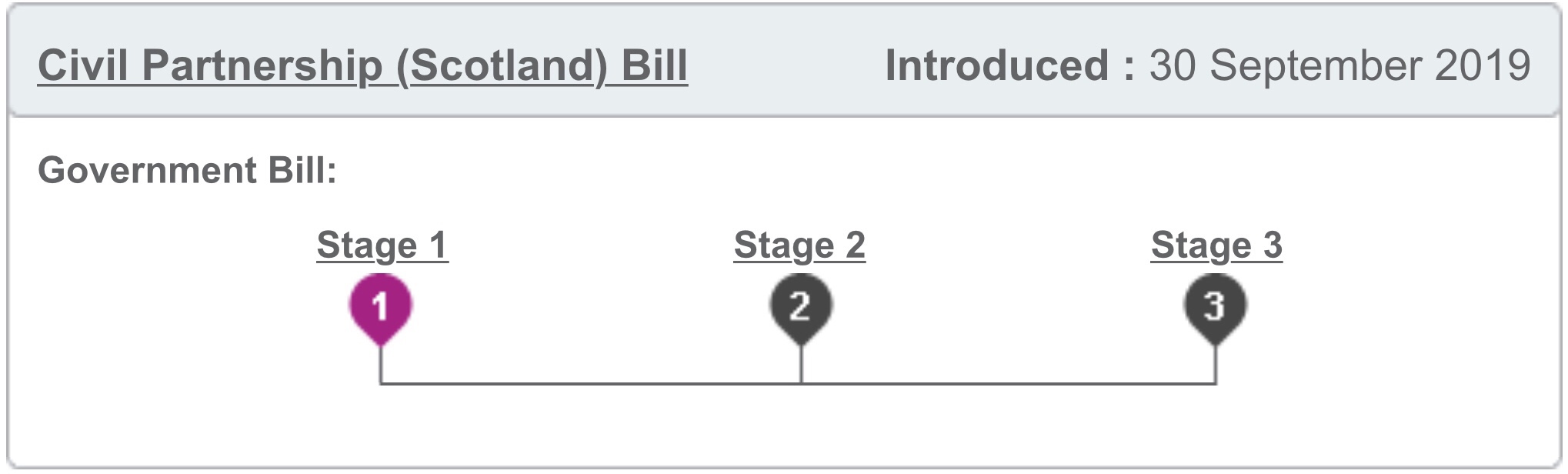
An info graphic showing the current progress of this Bill in the Scottish Parliament (Stage 1) can be seen below:
When the Labour Government of Prime Minister Tony Blair originally introduced civil partnerships across the UK (as a result of the Civil Partnerships Act 2004) such legal unions were open to gay and lesbian couples only.
It was the first time in the history of Scots and English family law that gay and lesbian couples were entitled to enter a legally recognised relationship.
Fast forward a decade or so and we now have same sex marriage in Scotland, England and Wales – but not yet Northern Ireland (although the clock may be ticking here on this issue). Admittedly, same sex couples can enter civil partnerships in Northern Ireland, but since the Republic of Ireland made same sex marriage legal in 2015, pressure has been mounting for change in the North.
The case which started the ball rolling was Steinfeld and Keidan v Secretary of State for Education[2016] EWHC 128 (Admin).
In Steinfeld and Keidan, an unmarried, heterosexual couple brought a claim for unlawful less favourable treatment against the UK Government on the basis that the law (contained in the Civil Partnership Act 2004) discriminated against them by forcing them to enter marriage as opposed to their preferred option of a civil partnership arrangement. The couple had strong “ideological objections” to marriage (irrespective of whether it took a religious or civil form) and argued, amongst other things, that the failure by the United Kingdom to give them the option of entering a civil partnership was a potential breach of their Article 8 rights (the right to privacy and family life) in terms of the European Convention on Human Rights. The ban on civil partnerships for heterosexual couples was also a potential breach of the Equality Act 2010 in the sense that it represented direct discrimination on grounds of a person’s sexual orientation.
Initially, the English High Court rejected the challenge brought by Steinfeld and Keidan, whereupon the case was allowed to proceed to the English Court of Appeal. Although expressing sympathy for Steinfeld and Keidan’s predicament, the Lord Justices of Appeal refused to overturn the ban (see Steinfeld and Keidan v Secretary of State for Education [2017] EWCA Civ 81).
The couple were then given leave to appeal to the UK Supreme Court.
On 27 June 2018, the Supreme Court issued its decision: R (on the application of Steinfeld and Keidan) (Appellants) v Secretary of State for International Development (in substitution for the Home Secretary and the Education Secretary) [2018] UKSC 32.
Lord Kerr gave the leading judgement (with which his fellow Justices concurred) and allowed Steinfeld and Keidan’s appeal:
“I would allow the appeal and make a declaration that sections 1 and 3 of CPA [Civil Partnership Act 2004] (to the extent that they preclude a different sex couple from entering into a civil partnership) are incompatible with article 14 of ECHR taken in conjunction with article 8 of the Convention.”
Following the Supreme Court’s decision, the UK Government of former Prime Minister Theresa May initiated steps to amend the Civil Partnership Act 2004 in respect of the law for England and Wales.
A link to an article about the change to the law in England and Wales on the Sky News website can be found below:
Michael Howard, former UK Conservative Party Leader from 2003 until 2005 (and now, somewhat ironically, an unelected member of the House of Lords) certainly thinks so – and he hasn’t been afraid to make his views known on the subject during the last few days.
A link to an article in The Independent discussing Mr Howard’s remarks can be found below:
In an interview on the BBC’s Today programme, Mr Howard posited the question as to whether the law should be made by “elected, accountable politicians, answerable to their constituents and vulnerable to summary dismissal at election, or by unaccountable, unelected judges who can’t be removed”.
Sour grapes?
To some extent, we could accuse Mr Howard of sour grapes or dissatisfaction with a number of recent legal judgements which have gone against the express wishes of the previous UK Conservative Government (2017-19) which wished to prioritise the exit of the UK from the European Union (Brexit).
It is also worth remembering that Mr Howard’s tenure as British Home Secretary (the Minister of the Interior) from 1993 until 1997 was characterised by conflicts with judges who often ruled against Government policy when making decisions about applications for judicial review.
Brexit
As a long established Eurosceptic (and as one of the prime suspects for membership of the group of “3 b*stards” in former Prime Minister John Major’s cabinet (1992-97), you would not really have expected Mr Howard to be terribly happy about the lack of progress on Brexit (some three and a half years on from the Referendum of 23 June 2016).
In R (on the application of Miller and another) v Secretary of State for Exiting the European Union [2017] UKSC 5, the former Prime Minister, Theresa May was forced to concede that she personally could not trigger Article 50 of the Treaty on European Union in order to begin the process of the UK’s withdrawal from the European Union. Brexit wasn’t going to ‘get done’ without first having undergone a series of confirmatory votes in both Houses of the Westminster Parliament. The use of the Royal prerogative (the ancient powers of the Monarch) by the then Prime Minister to ignore Parliament was not an appropriate legal action in a modern democracy.
In Wightman and Others (Notification by a Member State of its intention to withdraw from the European Union – Judgment) [2018] EUECJ C-621/18 (10 December 2018), the Court of Justice of the European Union, in a preliminary ruling, stated that a member state which had initiated Article 50 proceedings to leave the EU could reverse its decision unilaterally without first seeking the consent of all the other member states.
The request for the preliminary ruling (in terms of terms of Article 267: Treaty on the Functioning of the European Union) had been submitted by the Inner House of the Court of Session; but critically the action had been initiated by a group of democratically elected politicians (in the main).
In R (on the application of Miller) (Appellant) v The Prime Minister (Respondent) Cherry and others (Respondents) v Advocate General for Scotland (Appellant) (Scotland) [2019] UKSC 41 (On appeals from: [2019] EWHC 2381 (QB) and [2019] CSIH 49), the proverbial really hit the fan when the UK Supreme Court ruled (unanimously) that the decision by current UK Prime Minister, Boris Johnson to suspend or prorogue the Westminster Parliament for 5 weeks was nothing less than unlawful.
As Baroness Hale, President of the Supreme Court, stated:
“It is impossible for us to conclude, on the evidence which has been put before us, that there was any reason – let alone a good reason – to advise Her Majesty to prorogue Parliament for five weeks, from 9th or 12th September until 14th October. We cannot speculate, in the absence of further evidence, upon what such reasons might have been. It follows that the decision was unlawful.”
The Human Rights Act 1998
The mask really slips from Mr Howard’s face (possibly revealing something of the night about him?) when he turns his ire upon the effect of the Human Rights Act 1998. He begins by acknowledging that the UK Parliament conferred powers on senior judges to determine whether UK legislation was human rights compliant and then blames the judges for this situation! As a former barrister, Mr Howard really should know better.
Opponents of human rights legislation have always beaten the drum that the discretion given to (unelected) judges to attack or strike down laws which are deemed not to comply with those parts of the European Convention are a threat to British democracy. In the febrile atmosphere of Brexit, judges are now acutely aware that they can and will be accused of meddling in politics.
As I have previously remarked, statements such as Mr Howard’s recent remarks are factually incorrect when viewed through the prism of Westminster legislation. It soon becomes apparent that his arguments are highly misleading because all that superior court judges can do is to issue a declaration of incompatibility if a particular law or legal provision is found not to comply with the Human Rights Act 1998.
The declaration of incompatibility is like a football referee issuing a yellow card: foul play is being acknowledged, but the player remains on the field … for now. It will then be over to the Westminster Parliament (as the highest legal authority in the land) to bring in corrective measures to ensure that the law is changed, but this is Parliament’s decision alone
The consequences of declaring UK parliamentary legislation incompatible with the European Convention on Human Rights can be fully appreciated if we refer to the Supreme Court’s decision in R (Nicklinson) v Ministry of Justice (CNK Alliance Ltd intervening)[2014] UKSC 38:
“An essential element of the structure of the Human Rights Act 1998 is the call which Parliament has made on the courts to review the legislation which it passes in order to tell it whether the provisions contained in that legislation comply with the Convention. By responding to that call and sending the message to Parliament that a particular provision is incompatible with the Convention, the courts do not usurp the role of Parliament, much less offend the separation of powers. A declaration of incompatibility is merely an expression of the court’s conclusion as to whether, as enacted, a particular item of legislation cannot be considered compatible with a Convention right. In other words, the courts say to Parliament, ‘This particular piece of legislation is incompatible, now it is for you to decide what to do about it.’ And under the scheme of the Human Rights Act 1998 it is open to Parliament to decide to do nothing.”
Judicial Review
It is also apparent that Mr Howard is not a big fan of judicial review: he obviously thinks that this area of the law has expanded. True, it has but this is because the role of Government across the UK has dramatically expanded since the Second World War. This is due to a large part with the expansion of the Welfare State. Government policies which affect education, employment, health, immigration, taxation etc can be challenged by members of the public via an application for judicial review before either the Court of Session (Scotland); the High Court (England and Wales); and the High Court (Northern Ireland).
Conclusion
The UK has an unwritten Constitution – unlike other countries which have written constitutions (France, Germany, Italy and the USA). In political systems with a written constitution, there are often very clear rules governing the conduct of elected politicians.
This does not mean that, in political systems with written constitutions, the courts have no role to play. Of course they do.
It is an accepted part of the political culture of these countries that a Supreme Court or a Constitutional Court will be the final arbiter of very thorny legal and political issues e.g. the role of the US Supreme Court in legalising abortion (Roe v Wade 410 U.S. 113 (1973)) or same sex marriage (Obergefell v Hodges 576 U.S. ___ (2015)). They may be controversial in nature and generate heated debate for decades to come, but very few US citizens would contest the right of the Supreme Court to make such judgements.
As a point of contrast, note the hysteria which was generated when judges of the English High Court permitted Gina Miller’s action to succeed in blocking former Prime Minister Theresa May’s attempt to trigger Article 50 of the Treaty on European Union without, first, securing UK parliamentary approval (see R (Miller) v Secretary of State for Exiting the European Union[2017] UKSC 5).
The UK tabloid newspaper, The Daily Mail ran an astonishing front page on 4 November 2016 branding the judges “enemies of the people”. More prosaically, the High Court’s judgement (later approved by the UK Supreme Court in early 2017) was merely clarifying the law surrounding the Prime Minister’s use of the Royal prerogative in foreign affairs. You would not have thought this from the media and political reaction in certain quarters.
Governments, just as much as individuals, should not think themselves to be above the law. The rule of law in a democratic society is a principle worth hanging on to.
Petitions for judicial review in respect of alleged breaches of Article 8 of the European Convention (right to respect for private and family life) submitted by serving prisoners seem to be very much in vogue.
At the beginning of December, we had the Court of Session dismissing a petition for judicial review submitted by William Beggs (the notorious ‘Limbs in the Loch’ killer (see William Frederick Ian Beggsv The Scottish Ministers [2019] CSOH 95).
Some weeks later, another petition has been disposed of by the Court of Session which raised many of the same legal principles. David Gilday, another inmate of Her Majesty’s penal establishments, has proved to be no luckier than Beggs.
Gilday was complaining about a breach of his Article 8 rights when correspondence (a greetings card) addressed to him was seized by the prison authorities on suspicion that it was impregnated with unlawful (psychoactive) drugs. Suspicions had been raised when a sniffer dog gave the package more than usual attention.
Article 8 of the European Convention is not an absolute right and it may be limited by State authorities (in this case the Scottish Prison Service) for:
“… the prevention of disorder or crime and for the protection of health or morals.”
Lord Pentland in the Outer House of the Court of Session noted:
“… that prison officers sometimes come into inadvertent contact with psychoactive substances in prison and the view had been taken that the SPS has a duty not knowingly to expose its officers to the risk of being exposed to such substances. That stance seems to me to be responsible and proportionate. In my opinion, a wide margin of discretion should be extended to the SPS to identify what constitutes a risk in a prison setting and to determine how best to address that risk … As I have already explained, the petitioner will become entitled to receive the card in the sealed bag at the stage when he eventually comes to be liberated from custody. I am satisfied that retention of the card until then serves the legitimate aim of controlling the use and distribution of drugs in prison.”
Consequently, the petition submitted by Gilday should be dismissed as the prison authorities had acted quite legitimately in interfering with the prisoner’s rights under Article 8 of the European Convention.
A link to Lord Pentland’s Opinion (Petition of David Gilday for Judicial Review of the actions of the Scottish Ministers [2019] CSOH 103) can be found below:
An interesting case which caught my attention recently seemed to raise many issues which I have been emphasising to my students who are preparing for their upcoming Discrimination Law exam this month.
The case (The Governing Body of Tywyn Primary Schoolv Aplin Case No 1600635/2016 [2019]) seemed to cover (almost) the whole syllabus of the Discrimination Law unit:
A discrimination dismissal of a high flying professional employee (a head teacher)
A large sum of compensation awarded to the employee for the dismissal (nearly £700,000)
Direct discrimination on the basis of a protected characteristic (the employee’s sexual orientation) in terms Sections 4, 12 and 13 of the Equality Act 2010
The real problems faced by the employee in attempting to mitigate his losses (which the amount of the compensation award reflects)
Breach of disciplinary procedures by the employer
Breach of human rights i.e. Article 8 of the European Convention on Human Rights (right to privacy and family life)
Alleged reputational damage caused to the employer as a result of the employee’s conduct
The reversal of the burden of proof
The use of hypothetical comparators
The facts
Matthew Aplin is an openly gay man who was the head teacher of Tywyn primary school in Wales. He has been a teacher for 19 years and has an excellent professional reputation. In 2015, allegations about Aplin’s private life came to the attention of his employer (the School’s Board of Governors). It was alleged that Aplin had engaged in consensual sexual relationships with two 17 year old males that he had met through Grindr, the well known dating app. Users of Grindr must be aged 18 or over and, significantly, Aplin did not suspect the true age of the two males.
Aplin believed that the two young men were over 18 and, in any case, users of Grindr have to be aged 18 or over.
Following these allegations of alleged misconduct, Aplin was suspended and the Board of Governors commenced a disciplinary investigation.
At the request of the Governors, an investigating officer (Mr Gordon) was appointed by the local council. Mr Gordon’s terms of reference in respect of Aplin’s behaviour were as follows:
(a) had this brought the reputation of the School into disrepute?
(b) had it impacted on his ability to undertake the role of Head Teacher?; and/or
(c) had it demonstrated so gross an error of judgment as to undermine the School’s confidence in him and, therefore, to call into question his continuation in the role?
Mr Gordon quickly concluded that Aplin should be dismissed from his post despite the fact that this employee did not represent a possible threat to children. Local Police officers were briefly involved in their own investigation, but significantly they later concluded that no crime had been committed by Aplin.
Despite this, Aplin was dismissed for gross misconduct by the School Governors.
He promptly appealed against his dismissal, but the Governors did not deal with this matter efficiently or properly. Angered at the perceived lack of fair treatment of his appeal, Aplin decided to resign from his employment and claim unfair (constructive) dismissal; discrimination by reason of his sexual orientation; and interference with his right to respect for private and family life.
The Employment Appeal Tribunal (which became involved to deal with technical aspects of the case) later noted:
“There were numerous procedural errors which amounted to a breach of the implied term of trust and confidence in the investigation and the disciplinary hearing.”
Ordinarily, the burden of proof lies upon the claimant (Aplin) to show that discrimination has taken place. In this case, there were enough factors present which meant that the burden of proof should shift to the respondent (the School Governors) who would now have to show that they had not discriminated against Aplin.
On the question of whether the burden of proof should be reversed, Judge Shanks in the Employment Appeal Tribunal had this to say:
“… in my view the thrust of it [the Tribunal’s reasoning] is clear and it provides a sufficient basis for the ET’s decision that the burden of proof had shifted on the question of whether Mr Aplin was treated unfavourably because of his sexual orientation.”
In arriving at this position, Judge Shanks was firmly of the view that:
“.. the Tribunal had rightly recognised that the background to the whole case was intimately connected with Mr Aplin’s sexuality; they then judge that the procedural failures by the School were so egregious that the inference could be drawn that there was more to it than simply the fact that he had had lawful sex with two 17 year olds; and they therefore considered that it would be possible, in the absence of any other explanation, properly to infer that he had been discriminated against because of his sexual orientation. That seems to me a perfectly acceptable line of reasoning.”
The decision of the Employment Tribunal
Aplin had been unfairly dismissed; and subjected to direct discrimination by reason of his sexual orientation.
As a point of interest, the case involved the use of hypothetical comparators to arrive at its decision, namely, would a heterosexual teacher (either male or female) who had sexual relations with two 17 year olds have been treated in the same way as Aplin? The Employment Tribunal concluded that such individuals would not have been treated any differently.
Interestingly, in its final judgement, the Tribunal found that, although a person’s sexual relationships are undoubtedly covered by Article 8 of the European Convention on Human Rights, it is not an absolute right. Such a right may be restricted or interfered with “where it is necessary for the protection of morals” in “a democratic society”:
“Thererefore, we consider that it is possible to conclude that in the circumstances of this case the claimant could have been disciplined for his admitted conduct within the qualification in Article 8(2). …
… However, a fair process would require the respondent to consider whether the claimant was aware that the individuals were 17 years of age. Further it would have to consider what the real risk of the issues becoming public were and therefore what the real potential for reputational damage was.”
The two 17 year olds were children in the eyes of the law and Aplin, as a Head Teacher, could be viewed as someone who was in a position of power and that position which could be abused by him.
As Aplin had admitted to his conduct (the relationships with the two males), the Employment Tribunal concluded that there was at least. 20% chance of him being dismissed successfully – had the proper disciplinary procedures been carried by the employer (which of course they were not). In this respect, Aplin suffered a 20% deduction in the overall compensation awarded to him as per the guidelines originally laid down in Polkey v AEDayton Services Ltd [1987] UKHL 8.
Links to the decisions of the Employment Tribunal and the Employment Appeal Tribunal can be found below:
It never feels to amaze me that by casually flicking through the weekend newspapers and news outlets you can discover stories about discrimination without really making much of an effort. I often say this to my students when I ask them to highlight a media story about an aspect of discrimination law at the beginning of each class. There’s really no excuse for saying that they couldn’t find anything to talk about.
And so it proved today – although I must give credit to my students who had alerted me to this story some weeks ago during one of their regular presentations.
The story concerns Mr and Mrs Mander who have just won their claim for unlawful direct discrimination on the grounds of their race. Race (including national origin and a person’s colour), of course, is one of the protected characteristics which is set out in terms of Sections 4 and 9 of the Equality Act 2010.
Section 13 of the Act contains the definition of direct discrimination.
The Manders are of Sikh and Indian heritage who were both born in the UK and are British citizens. Their parents all came to the UK when they were small children. The couple participate in ceremonies and events throughout the Sikh Holy Year, but otherwise they are not particularly religious.
In this respect, they are very similar to people from a White British or Irish background who attend Church, for example, at Christmas and Easter. The couple are both university educated professionals with senior positions in the IT industry and they are comfortably well off. Culturally, the Manders see themselves as British, but obviously they are rightly aware and proud of their heritage.
After numerous attempts to start a family, the Manders decided to investigate the possibility of adopting a child. For this purpose, the couple dealt with the Royal Borough of Windsor and Maidenhead and Adopt Berkshire. The experience would end in disappointment for the couple.
The Manders took a claim to Oxford County Court alleging direct race discrimination (and alternatively indirect discrimination in terms of Section 19 of the Act of 2010) against the Royal Borough of Windsor and Maidenhead and Adopt Berkshire (the defendants).
It should also be appreciated that Section 29 of the Equality Act makes it clear that individuals can experience unlawful discrimination in respect of the provision of a service – in this case that of adoption services.
The couple also alleged that they had suffered discrimination in respect of the European Convention on Human Rights in respect of the following:
Article 8 (the right to family and private life)
Article 12 (the right to marry and found a family)
Article 14 (the prohibition on discrimination)
In the event, at the trial, the Manders decided not to pursue claims in terms of Article 8 and Section 19.
Her Honour Judge Clarke summarised the essence of the Manders’ claim:
‘It is important to understand that Mr and Mrs Mander’s claim is not that they applied to be approved as adopters but were wrongly or unfairly rejected or discriminated against either during the process of consideration of their application for adoption, or when considering whether to match them to a child. Mr and Mrs Mander’s case is that the Defendants discriminated against them on the basis of their race before they made formal application to adopt, inter alia by refusing to progress them to the ROI/application stage.’
The Council and Adopt Berkshire did not at any time advance the argument that the Manders were in any way unsuitable as prospective, adoptive parents.
The justification given for the refusal to permit the Manders to proceed to the Registration of Interest/application stage was that it was unlikely that children from the same cultural background as the couple would become available for adoption in the short or longer term.
The couple were informed by letter from the Service Manager of Adopt Berkshire that:
‘In the last 17 months since Adopt Berkshire we have not had a single child of Indian or Pakistani heritage referred to us for placement …’
The letter went on to state:
‘… it is hard at the current time to advise you how best to proceed regarding adopting within the U.K.; however another option that you may wish to explore is the option of adopting from India – while this is likely to be a lengthy process and may be financially stretching, it may ultimately be more likely to enable you to achieve the placement of a young child whose cultural heritage is similar to your own.’
Eventually, the couple adopted a child from the United States of America, but at a considerable financial cost.
In evidence, the Manders were in no doubt that they had been treated differently by Adopt Berkshire:
‘There was no doubt in my mind that she [Mrs Popat, an employee of Adopt Berkshire] in fact made a judgment based on the colour of our skin. I was never treated like this before. I grew up in this country. My grandfather fought in the British Army – I was hurt and disappointed.’ (Mrs Manders)
‘Adopt Berkshire made me feel that the country where I grew up still saw me as different. It did not matter that I grew up here, as long as I was not white, I could not be British. I found this thought very disturbing – I had trouble sleeping at night because of how angry and helpless I felt.’ (Mr Manders)
Held: by the County Court that the Manders had suffered direct discrimination on the grounds of their race when their application was not progressed to the ROI/application stage of the adoption process.
Her Honour Judge Clarke did not, however, uphold the couple’s claim that their rights under Article 12 of the European Convention had been breached. As her Honour pointed out the right to adopt a child is not covered by the Convention, but rather is left to national law.
Judge Clarke also acknowledged that the discrimination suffered by the Manders was of a very serious nature:
‘I consider this to be a very serious case, which sits at the top of the middle, or bottom of the upper, range of the Vento bands …’
In this respect, the Manders were awarded both ordinary (£29,000) and special damages (£60,000).
The application of the Vento Bands was discussed in a previous Blog, Hurt feelings:
A link to the decision of the County Court in Reena and Sandeep Mander v (1) Royal Borough of Windsor and Berkshire and (2) Adopt Berkshire [2019] Case No: C01RG184 can be found below:
Two days running and we seem to be on a bit of a theme in this Blog about a person’s right to privacy and the limits of such a right.
If you picked up on yesterday’s Blog article (The limits of privacy), you’ll be aware that generally speaking the common law of Scotland (and indeed that of England) does recognise a person’s right to a private life. This right is also protected in terms of Article 8 of the European Convention on Human Rights (as implemented by the Scotland and Human Rights Acts 1998).
That said, privacy is not an absolute right and there may be all sorts of situations where the State (or your employer for that matter) might legitimately take in interest in your activities (whether these happen on the job or are of an extra-curricular nature).
If you’re William Beggs today, you might be feeling rather upset about this. William Beggs, for those of you who don’t know, is currently serving a life sentence for murder in a Scottish Prison. He earned the rather grim moniker, ‘The Limbs in the Loch’ killer because of he dismembered his victim (Barry Wallace).
Well, Mr Beggs – somewhat ironically many would no doubt be quick to pass comment – wished to pursue a legal action in which he alleged that his human rights had been breached by the prison authorities. Specifically, Beggs objected to the practice of the authorities in opening and reading his private correspondence from his doctors and lawyers. In his opinion, the authorities (the Scottish Prison Service and the were in breach of his right to privacy as guaranteed by Article 8 of the European Convention on Human Rights.
There were three incidents between October and November 2018 where Beggs objected to the Scottish Prison Service monitoring his correspondence: two letters with the details of hospital appointments and one letter from his lawyer had been opened. The prison official who opened the letter from Beggs’ lawyer had done so mistakenly and the authorities apologised fully for this action.
Beggs submitted a petition for judicial review of the actions of the Scottish Prison Service (and also that of the Scottish Government as the supervising state authority) to the Court of Session in Edinburgh.
Beggs also brought a claim for damages of £5,000 that he was a victim in terms of Section 6 of the Human Rights Act 1998 and the Section 100(3) of the Scotland Act 1998.
The outcome of Beggs’ petition
Unfortunately, for Beggs the Court of Session (where his application for judicial review was being heard) did not agree.
Yes, there is a general duty in terms of Article 8 for public authorities (the Scottish Prison Service and the Scottish Government to which it is answerable) to guarantee the right to privacy for serving prisoners, but it is not an absolute right.
As Article 8 makes abundantly clear:
“There shall be no interference by a public authority with the exercise of this right except such as in accordance with the law and is necessary in a democratic society in the interests of national security, public safety or the economic well-being of the country, for the prevention of disorder or crime, for the protection of health or morals, or for the protection of the rights and freedoms of others.”
Lord Armstrong (in the Outer House of the Court of Session) was very clear, when arriving at his decision to reject Beggs’ petition, that the Scottish Prison Service had very good reasons for monitoring his confidential correspondence. According to rules 55 and 56 of the Prison and Young Offenders Institutions (Scotland) Rules 2011, such actions could be justified in situations where there was:
“reasonable cause to believe that the contents of the correspondence might endanger the security of the prison, endanger the safety of any person, or relate to criminal activity”.
Although the Prison authorities had erred when they opened Beggs’ legal correspondence, they had recognised this situation and promptly apologised to him.
Consequently, Beggs’ claim for damages was also rejected.
A link to Lord Armstrong’s Opinion can be found below:
William Frederick Ian Beggsv The Scottish Ministers [2019] CSOH 95
Not if you’re G4S, the British company, which has been blacklisted by Norway’s Sovereign Wealth Fund. This is the body which has the task of investing the proceeds of the country’s vast oil wealth for the benefit of Norwegian citizens.
The Norwegian Parliament, The Storting, which ultimately oversees the activities of the Sovereign Wealth Fund will not permit investments in companies or projects which fail to comply with the country’s international human rights obligations.
G4S has come under intense scrutiny by the Norwegians due to allegations of human rights abuses by the company in relation to the treatment of migrant workers in the Gulf States. The Sovereign Wealth Fund has decided to divest from G4S on the grounds that further involvement with the company may constitute a “risk” to human rights.
Like the UK, Norway is a signatory to the European Convention on Human Rights. The provisions of the European Convention on Human Rights (as implemented by the Human Rights Act 1998 and the Scotland Act 1998) are only enforceable against the British State or its institutions and organisations that carry out public functions, for example, universities, care homes, colleges, hospitals, housing associations, schools and local authorities.
Norway as a contracting party to the European Convention is in a similar, legal position in the sense that its public bodies or emanations of the State (a category which clearly the Fund falls into) will have to comply with human rights obligations.
It should be noted that a public authority or emanation of the State can have a very wide meaning in law and may cover privatized utilities companies (see Case C-188/89 Foster v British Gas [1990]3 ALL ER 897 and Griffin vSouth West Water Services Ltd [1995] IRLR 15) and other private contractors delivering public services.
This is not the first time that I have written about private security companies falling foul foul of human rights laws. In a previous Blog (Private Enterprise or Public Service? published on 1 March 2019), I wrote about the private company, Sodexho falling foul of the Human Rights Act 1998 in relation to the treatment of female prisoners at the privately run Peterborough Prison (see the recent English High Court judgement: Between LW; Samantha Faulder; KT; MC v 1) Sodexho Limited and 2) Minister of Justice[2019] EWHC 367).
A link to the story as reported by Sky News about the Fund’s decision to divest its 2.3% stake in G4S can be found below:
Love and marriage go together like a horse and carriage to paraphrase the words of the old song from the 1950s …
… but not for much longer in Scotland if the Scottish Government has its way. A new Bill lodged by the Government this week will potentially revolutionise legal unions for heterosexual couples who want commitment but not, critically, in the form of marriage.
The Civil Partnerships Act 2004 was originally passed by the UK Government of Prime Minister Tony Blair in order to permit same sex couples to enter a legally binding relationship. At the time, the Blair Government stressed that this type of legal arrangement was not open to heterosexual couples and should not be regarded as “gay marriage”.
This legislation also extended the same employment benefits that married couples already enjoyed to same sex couples who entered a civil partnership. In relation to the field of employment rights, the Act applies to employment and pension benefits e.g. a concessionary travel scheme and civil partners of an employee will be entitled to take advantage of these if existing provisions permit a heterosexual partner or spouse of an employee to claim these benefits.
In Bull and Another v Preddy and Another [2013] UKSC 73, UK Supreme Court Justice, Baroness Hale made the following remarks about civil partnerships:
“Civil partnership is not called marriage but in almost every other respect it is indistinguishable from the status of marriage in United Kingdom law. It was introduced so that same sex couples could voluntarily assume towards one another the same legal responsibilities, and enjoy the same legal rights, as married couples assume and enjoy. It is more than a contract. Like marriage, it is a status, in which some of the terms are prescribed by law, and which has consequences for people other than the couple themselves and for the state.”
Fast forward a decade or so and we now have same sex marriage in Scotland, England and Wales – but not yet Northern Ireland (although the clock may be ticking here on this issue). Admittedly, same sex couples can enter civil partnerships in Northern Ireland, but since the Republic of Ireland made same sex marriage legal in 2015, pressure has been mounting for change in the North.
This means that same sex couples have the option of entering into marriage or civil partnership. This choice is still denied to heterosexual couples – until now, hence the introduction of the Civil Partnership (Scotland) Bill.
Traditional marriage between a man and woman has been criticised on a number of grounds:
• It’s seen as very patriarchal i.e. historically it unduly favours the male partner
• It has religious associations which are not in keeping with the fact that the UK is (in 2019) a much more secular society
• Some heterosexual couples are increasingly attracted to a more equitable and modern form of legal commitment i.e. civil partnership.
Despite these criticisms of traditional marriage, until recently neither the UK or Scottish Governments had shown a desire to extend civil partnerships to heterosexual couples. That is until very recently and a UK Supreme Court decision has now made reform of the institution of marriage and civil partnership essential on the basis of a human rights challenge.
The case which started the ball rolling was Steinfeld and Keidan v Secretary of State for Education[2016].
In Steinfeld and Keidan, an unmarried, heterosexual couple brought a claim for unlawful less favourable treatment against the UK Government on the basis that the law (contained in the Civil Partnership Act 2004) discriminated against them by forcing them to enter marriage as opposed to their preferred option of a civil partnership arrangement. The couple had strong “ideological objections” to marriage (irrespective of whether it took a religious or civil form) and argued, amongst other things, that the failure by the United Kingdom to give them the option of entering a civil partnership was a potential breach of their Article 8 rights (the right to privacy and family life) in terms of the European Convention on Human Rights. The ban on civil partnerships for heterosexual couples was also a potential breach of the Equality Act 2010 in the sense that it represented direct discrimination on grounds of a person’s sexual orientation.
Initially, the English High Court rejected the challenge brought by Steinfeld and Keidan, whereupon the case was allowed to proceed to the English Court of Appeal. Although expressing sympathy for Steinfeld and Keidan’s predicament, the Lord Justices of Appeal refused to overturn the ban.
The couple were then given leave to appeal to the UK Supreme Court.
On 27 June 2018, the Court issued its decision: R (on the application of Steinfeld and Keidan) (Appellants) v Secretary of State for International Development (in substitution for the Home Secretary and the Education Secretary) [2018] UKSC 32.
Lord Kerr gave the leading judgement (with which his fellow Justices concurred) and allowed Steinfeld and Keidan’s appeal:
“I would allow the appeal and make a declaration that sections 1 and 3 of CPA [Civil Partnership Act 2004] (to the extent that they preclude a different sex couple from entering into a civil partnership) are incompatible with article 14 of ECHR taken in conjunction with article 8 of the Convention.”
If, post Steinfeld and Keidan, the Scottish Government continued to allow civil partnership legislation to operate in its original form, there was a very real risk that the Scottish Ministers would be taken to court and challenged by heterosexual couples (using Steinfeld and Keidan [2018]) on human rights grounds.
The solution?
Letting the status quo prevail in Scotland was not an option because of the implications for human rights, so the Scottish Government announced a public consultation on civil partnerships in September 2018:
On the back of this consultation, the Scottish Government has now introduced the Civil Partnership (Scotland) Bill in order to implement option 2.
As the Policy Memorandum accompanying this Bill clearly states:
“In Scotland, couples can marry or enter into a civil partnership, or choose to cohabit. Same sex and mixed sex couples can marry, and same sex and mixed sex couples can decide to cohabit. Civil partnership is currently available only to same sex couples, but this Bill will extend the relationship to mixed sex couples.”
It is more than likely that this Bill will command significant support in the Scottish Parliament and will soon become law.
An info graphic showing the current progress of this Bill can be seen below:
A link to BBC Scotland’s website about the introduction of the Bill can be found below:
The Equalities and Human Rights Committee of the Scottish Parliament is now seeking the views of the public about the future of civil partnerships and whether allowing heterosexual couples to enter into this type of legal arrangement is desirable.
Interested members of the public have until 31 January 2020 to submit their views to the Committee.
More information about the Committee’s work in this area can be found by accessing the press release at the link below:
A common theme of this Blog over the last few weeks concerns banning certain forms of dress or appearance (Burka bans and horse racing in a hijab published on 1 August 2019).
Imposing a ban in relation to dress codes or appearance can be problematic legally speaking because such an approach could be tantamount to indirect discrimination in terms of Section 19 of the Equality Act 2010.
Several of my previous blogs have addressed the issue of indirect discrimination.
So it was with some interest that I read a story recently about Burger King’s plans to prevent male staff from wearing beards while working in its restaurants throughout the region of Catalunya/Catalonia in Spain. Immediately, I thought about the legal consequences of such a ban being introduced to UK Burger King outlets. The test for indirect discrimination is whether a provision, criterion or policy (PCP) imposed by an organisation is likely to have a disproportionately adverse effect on certain groups of individuals who possess a characteristic protected by law (in the UK, we are primarily talking about the Equality Act).
Unsurprisingly, this attempt to impose a blanket ban on Burger King’s male employees fell foul of the Spanish Constitution’s provisions on equality. I would be prepared to stick my neck out and argue that a similar result would almost certainly be replicated in the UK had Burger King attempted to introduce such a ban. I wasn’t really surprised by this outcome because Spain, as an EU member state, has very similar equality and discrimination laws to the UK. In fact, the current concept of indirect discrimination in the Equality Act 2010 is derived from EU Law.
So, who might be affected if an employer implements a blanket ban on the wearing of beards in the work place? Quite a lot of male employees as it turns out, for example, very religious and observant Jews, Muslims and Sikhs. Furthermore, members of the Russian and Greek Orthodox faith groups and Rastafarians may also face real issues complying with such a requirement imposed by the employer. In short order, such bans may infringe religious and cultural expression and may not only be a breach of the Equality Act, but could also represent a breach of human rights laws under the Human Rights Act 1998 and Article 9 of the European Convention on Human Rights.
It is always open to an organisation, of course, to argue that dress codes or enforcing strict rules about an individual’s personal appearance can be objectively justified. In the past, banning beards or regulating the length of hairstyles in the work place have been justified successfully by employers or organisations on health and safety grounds i.e. primarily concerning hygiene (see Singh v Rowntree Mackintosh (1979)ICR 554 and Panesar v Nestle Co Ltd[1980] IRLR 64 CA).
Each attempt to justify a provision, criterion or policy (PCP) will, of course, turn on its facts and it would be very foolish for organisations to think that there is some sort of magic bullet or get out of jail card which can be used in every situation to justify or excuse conduct which would otherwise amount to unlawful discrimination. Organisations should review policies on a regular basis and, if need be, this may necessitate the carrying out of an equality impact assessment.
Recently, the Royal Air Force (RAF) has significantly relaxed its total ban on male service personnel wearing beards (moustaches were permitted). This change of heart by the RAF has been motivated by the realisation that individuals from ethnic and religious minorities were being actively deterred from applying to join the service because of the ban on beards.
Even the argument that beards are unhygienic is being undermined with Professor Michael Moseley, presenter of the BBC programme “Trust Me I’m a Doctor“, highlighting recent, scientific evidence that clean shaven men represent a greater threat to hygiene than their bearded counterparts.
Links to the stories on Burger King’s attempt to ban the beard, the RAF’s change of policy and whether beards are actually unhygienic can be found below:
I have just been reading two, contrasting stories about Islamic dress codes which appeared in today’s UK media.
The first story comes from our close neighbour and EU partner, the Netherlands which has decided to bring in a new law banning certain forms of Islamic dress – principally the Burka, Hijab and the Niqab – from being worn by female Muslims in hospitals and schools and while travelling by public transport. This ban imitates similar initiatives in other EU member states such as Austria, Denmark, France and Germany. Those individuals who ignore or flout the ban run the risk of being fined €150. Some Dutch politicians, for example, Geert Wilders of the far right Party for Freedom would like the law to be extended in order to ban Islamic headscarves.
The second story comes from the UK and couldn’t be more different in tone. The BBC reports that a female, Muslim jockey, who wears the Hijab, has made history by winning the Magnolia Cup at Glorious Goodwood.
These two stories made me think about the limits of tolerance in relation to the outward signs of religious belief in our communities. Under UK and EU laws, a person’s religion is a protected characteristic and s/he has the right not to be subjected to unlawful, less favourable treatment (discrimination).
The right to enjoy protection from religious discrimination was first introduced to the mainland UK as a result of the EU Directive 2000/78/EC on Equal Treatment in Employment and Occupation. The laws on religious discrimination were to be found in the Employment Equality (Religion or Belief) Regulations 2003. It should be noted that the scope of these Regulations was limited in that they applied only to the area of employment – not, for example, the provision of goods and services.
Previously, Northern Ireland was the only part of the UK which had laws on religious discrimination – for understandable reasons given the troubled history of that part of the world. The Regulations did not extend to Northern Ireland because it already had laws in place to deal with this issue.
The Regulations have now been superseded by the provisions of the Equality Act 2010 (primarily Section 10) which are much wider in scope in that they cover both religious discrimination in employment and the provision of goods and services.
Additionally, Article 22 of the EU’s Charter of Fundamental Rights recognises a person’s right to cultural and religious diversity.
Wearing Islamic dress is obviously a way in which very religious members of this community can express their religious beliefs. Reading both articles today, I found myself asking the question what would be the legal effects if a similar ban on Islamic dress was introduced in the UK?
The new UK Prime Minister, Boris Johnson, has made disparaging remarks about forms of Islamic dress, but admittedly he does not seem willing to introduce a ban.
Countries such as Austria, Denmark, France, Germany and now the Netherlands are just as much bound by laws such as Directive 2000/78/EC and the Charter of Fundamental Rights as the UK is at the time of writing, so how do they justify banning certain forms of Islamic dress?
Freedom of religion is not absolute and sometimes the State can decide that a person’s religious beliefs must take second place if they clash with other people’s human rights (e.g. sexual orientation) or general public safety goals. In the UK, discrimination less favourable treatment in connection with a person’s protected characteristics may be permitted under the Equality Act 2010 if it can be objectively justified i.e. it is a proportionate means of achieving a legitimate aim. Health and safety or concerns about terrorism are often grounds used by States across the EU to justify periodic crackdowns on the wearing of Islamic dress in public places.












 Seán Crossan's Scots Law