2020: same old sexism (yes, equal pay again)

Photo by Artur Tumasjan on Unsplash

We’re still in the month January and the issue of serious disparities in pay between the sexes raises its ugly head once again. I’ve said it before; but I’ll say it again: we’ve had over 40 years of legislation in the UK (first the Equal Pay Act 1970 and now the Equality Act 2010, not to mention EU primary and secondary legislation) which should have put the issue to rest.

The Equality Act 2010 incorporates an equality clause into contracts of employment which means that employers have a duty to ensure that men and women are paid on equal terms for carrying out like work; work rated equivalent; and work of equal value.

It’s hard to believe that the groundbreaking decision of the Court of Justice of the EU in Case 43/75 Defrenne v Sabena (No 2) [1976] ECR 455 was in the 1970s and here we are, entering the second decade of the 21st Century, still talking about the issue of equal pay – or the lack of it.

There is a depressing familiarity to stories in the UK media about the lack of progress regarding this issue. This is surprising because successful equal pay claims can be be very costly in financial terms for employers. In 2019, after Glasgow City Council female employees won their battle for equal pay, there was much speculation about how the employer was going to pay the bill. One of the (seemingly) more dramatic predictions was that the City Council would have to sell Salvador Dali’s world famous painting Christ of St John of the Cross in order to meet its legal obligations to its underpaid female employees. Susan Aitken, the City Council leader, was forced to issue a denial that this was a possibility. When you realise that the estimated value of Dali’s painting starts at £60 million you begin to get an idea of the scale of the problem.

https://www.glasgowtimes.co.uk/news/16594318.glasgow-city-council-wont-be-flogging-off-famous-dali-painting-to-cover-equal-pay-claims/

That said, some years ago, Birmingham City Council was forced to sell its share in the National Exhibition Centre in order to meet the (awesome) financial burden of thousands of equal pay claims . The price achieved was £307million – although 3 years later, the asset was sold once more for an eye watering figure of £800 million (allegedly).

https://www.ft.com/content/da429608-9d8e-11e4-8946-00144feabdc0

Recent research carried out by the English law firm, Slater+Gordon, suggests that women fail to gain pay increases because they are not negotiating with their employers about this issue. Campaigning groups, such as Close the Gap, are firmly of the opinion that the onus should not be placed on women to push for equal pay; rather it should be the responsibility of the State and/or employers to achieve this goal. There has to be real cultural change in society and women need to be valued more if the gender gap is to become a thing of the past.

Links to articles in The Independent about the equal pay research that Slater+Gordon Solicitors carried out can be found below:

https://edition.independent.co.uk/editions/uk.co.independent.issue.280120/data/9304961/index.html

https://edition.independent.co.uk/editions/uk.co.independent.issue.280120/data/9304901/index.html

https://edition.independent.co.uk/editions/uk.co.independent.issue.280120/data/9304016/index.html

Postscript

And if you remain unconvinced about ingrained gender bias in the corporate world generally, you will find a link below to research carried out by The Independent which demonstrates how many leading tech companies suffer from the lack of women in leadership roles:

https://edition.independent.co.uk/editions/uk.co.independent.issue.200220/data/9344746/index.html

Copyright Seán J Crossan, 30 January & 20 February 2020

Words can be deadly … literally

Pictures at the Yad Vashem Holocaust Museum in Jerusalem

Photo by Yang Jing on Unsplash

Sometimes words can kill: the 15 high ranking members of the Nazi Party certainly knew this when they met at a villa in Berlin’s up market suburb of Wannsee. The villa would have had an interesting history irrespective of this meeting: built by Ernst Marlier, a corrupt and violent German industrialist; sold to Friedrich Minoux (another German industrialist and swindler); and finally sold to the Nazi Party’s Stiftung Nordhav (run by the notorious Reinhard Heydrich – one of Adolf Hitler’s henchmen and potential successor).

As Professor Mark Rosen stated, the objective of this ultra secret meeting, which took place on 20 January 1942, was nothing less than a ‘signpost’ on the road to the ‘Final Solution’ regarding the Jewish People (or question as the Nazis would have posited things – language, after all, is important here).

A sobering thought, on this Holocaust Memorial Day in the UK, is that many of the participants were lawyers or had some form of legal education. They certainly knew the meaning of words and that words have meaning.

Lawyers are used to jokes about their lack of integrity, but many members of the profession regard law as a noble profession, a civilising force or a discipline firmly rooted in the humanities. Precious little humanity would be shown to millions of Jewish People following the discussions at Wannsee.

During the summit, there was an almost comical incident: the participants got bogged down in what seems to be an arcane discussion about levels of Jewishness that a person might have. The discussion was deadly serious – quite literally. The outcome would decide who would live and who would die.

This was, of course, to be entirely expected: the Nazi regime (1933-1945) had already started the process of dehumisation of the Jewish People when the Nuremberg Decrees were passed in 1935. This led to the wholesale removal of Jews from the public square in Germany (and later throughout the expanded Reich and Occupied Territories). Jewish businesses and property were confiscated; Jews were forced out of the professions; they were stigmatised and ghettoised. To be Jewish in Hitler’s Germany would simply become unbearable.

The Nuremberg Decrees and the Wannsee Protocol demonstrate that there is a darker side to the law: in the wrong hands, it can be used to stigmatise and oppress certain groups of people.

At the end of the meeting (which had lasted for about 90 minutes), the participants were served Cognac, fine wines, food and cigars. Reinhard Heydrich, the Nazi who chaired the proceedings, ordered that all copies of the minutes be destroyed. Some copies survived as damning evidence of the criminal conspiracy to murder an entire race.

You can find out more about the Nuremberg Decrees at and the Wannsee Conference at the links below:

https://www.archives.gov/publications/prologue/2010/winter/nuremberg.html

https://encyclopedia.ushmm.org/content/en/article/wannsee-conference-and-the-final-solution

Wannsee reminds us of the importance of the meaning of words and that words have meaning:

Poets, priests and politicians
Have words to thank for their positions
Words that scream for your submission
And no one’s jamming their transmission
‘Cos when their eloquence escapes you
Their logic ties you up and rapes you

(Lyrics by Gordon Thomas Matthew Sumner (or ‘Sting’); 1980 taken from the track “De Do Do Do, De Da Da Da”)

Further reading

The Villa, The Lake, The Meeting: Wannsee and the Final Solution by Mark Roseman (Allen Lane/Penguin Press: 2002)

Related Blog Articles:

https://seancrossansscotslaw.com/2019/10/08/holocaust-denial/

https://seancrossansscotslaw.com/2019/02/01/the-problem-with-human-rights/

Copyright Seán J Crossan, 27 January 2020

New Year, same old story …

Photo by Markus Spiske on Unsplash

It’s becoming depressingly predictable: the persistence of the gender pay gay in the United Kingdom.

This time last year, I was discussing with my students the struggle that City of Glasgow Council female employees were undertaking to win their claims for equal pay. After a period of industrial action, the women finally won their struggle:

https://www.theguardian.com/society/2019/jan/17/glasgow-council-women-workers-win-12-year-equal-pay-battle

We’ve just entered 2020 and it seems as if nothing much has changed in the wider world (more on this later).

Theoretically, the gender pay gap should be a thing of the past. We have had legislation in place for nearly 45 years in this country: the Equal Pay Act 1970 (which came into force in December 1975) and the current Equality Act 2010.

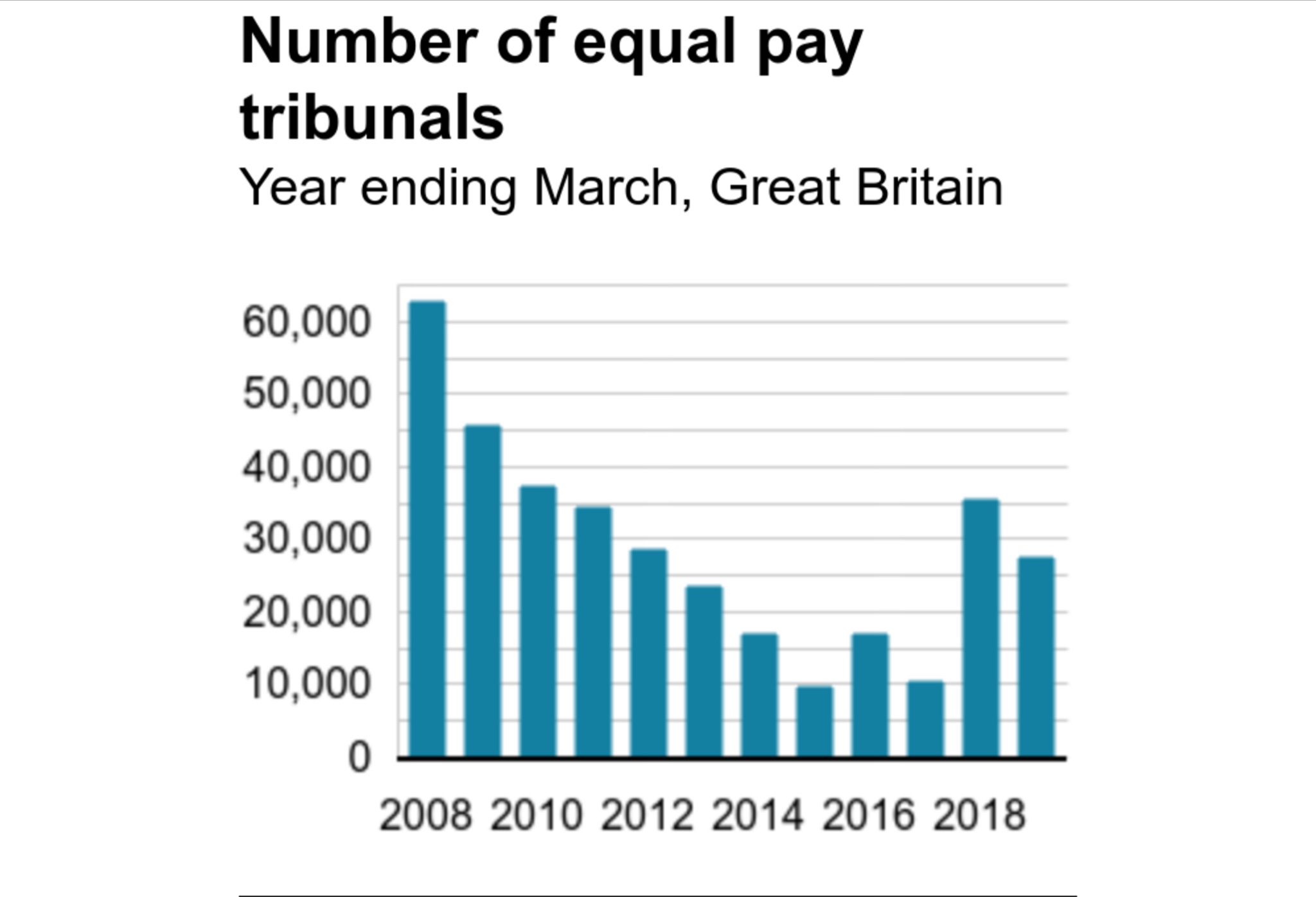
An info graphic which shows the number of Employment Tribunal cases in the UK involving equal pay claims (2008-2019) can be seen below:

Source: UK Ministry of Justice obtained from BBC News

True, the above figures show the number of equal pay claims in overall decline – effectively being halved (from a high of over 60,000 in 2008 to just over 30,000 in 2019); but my riposte to that would to say still too many.

In today’s edition of The Independent, new research, carried out by the Institute of Public Policy Research, indicates that female General Practitioners (physicians for our overseas readers) are paid up to £40,000 less than their male colleagues every year.

For each £1 that a male colleague earns, a woman earns 35 pence less. To reinforce this point, the article states that female GPs are effectively providing their services free of charge between September and December every year.

In language of the Equality Act 2010, the female GPs are carrying out ‘like work’ when comparing themselves to their male colleagues. There seems to be absolutely no lawful justification for this disparity in pay between the sexes.

A link to the article in The Independent can be found below:

https://edition.independent.co.uk/editions/uk.co.independent.issue.100120/data/9277336/index.html

The equal pay laws imply a sex or gender equality clause into every person’s contract of employment. Employers therefore have a legal duty to ensure gender equality in relation to terms and conditions of service.

It seems pretty simple, so why isn’t it happening in 2020?

An explanation for this situation in the medical profession has centred around the development of a ‘two tier’ system whereby more men are partners in GP surgeries whereas a large number of women take on the role of a salaried GP. Women tend to become salaried GPs because they feel that this allows them to work flexibly around their family commitments. So, again, what we appear to be seeing is women being penalised because they are trying to balance work and family (the so called ‘motherhood’ penalty).

Also on this day …

And purely by coincidence another equal pay story …

… Samira Ahmed, BBC journalist, wins her Employment Tribunal claim for equal pay (see below):

http://news.sky.com/story/samira-ahmed-tv-presenter-wins-sex-discrimination-equal-pay-claim-against-the-bbc-11905304

And if you’re still not convinced …

read the following article in The Independent about discrimination in pay between male and female apprentices (guess what?; it’s not the men who are the victims):

https://edition.independent.co.uk/editions/uk.co.independent.issue.150120/data/9283611/index.html

Copyright – Seán J Crossan, 10 and 15 January 2020

Pansexual

Photo by Sharon McCutcheon on Unsplash

A person’s protected characteristics in terms of the Equality Act 2010 seems to be the theme of the Blog today.

Sexual orientation is a protected characteristic in terms of Sections 4 and 12 of the Act. Most people these days are familiar with the following definitions in terms of an individual’s sexuality: e.g. heterosexual, homosexual (gay/lesbian) and bisexual.

What about a person who declares themselves to be pansexual?

According to Stonewall, the group which campaigns on behalf of the LGBTI community, this term refers to a person ‘whose romantic and/or sexual attraction towards others is not limited by sex or gender.’ Stonewall also makes the point that bisexual individuals can declare themselves to be pansexual.

An interesting story appeared in today’s British media about pansexuality. Layla Moran, Liberal Democrat MP and possible contender for the leadership of that Party, has declared herself to be pansexual. She is the first Member of the Westminster Parliament to define her sexual orientation in this way. Previously, she would have declared herself as heterosexual.

Andrew Adonis, Labour member of the House of Lords and former UK Government minister tweeted his reaction to the story:

https://twitter.com/Andrew_Adonis/status/1212872397394718720?s=19

The point that Adonis was trying to make is that it shouldn’t have been a story. As a society, the UK has supposedly become more tolerant and progressive towards people with different sexual orientations.

Ms Moran admitted herself that the decision to be open about her sexual orientation had caused friends and colleagues to worry that this might harm her career – and her aspiration to be the next or future leader of the Liberal Democrats. So much for a more tolerant and progressive society …

Explaining her reason for going public about her sexual orientation, Ms Moran stated that:

… I feel now is the time to talk about it, because as an MP I spend a lot of my time defending our community [LGBTI] and talking about our community. I want people to know I am part of our community as well.”

A link to the story in Pink News can be found below:

https://www.pinknews.co.uk/2020/01/02/layla-moran-liberal-democrats-mp-coming-our-pansexual-girlfriend-exclusive-interview/

You can also find below a link to the Sky News website where an individual discusses what pansexuality means to them:

https://news.sky.com/story/not-restricted-by-gender-or-sex-what-pansexuality-means-to-me-11900619

Copyright Seán J Crossan, 3 January 2020

No guide dogs!

Photo by Viktor Forgacs on Unsplash

Disability is a protected characteristic in terms of Sections 4 and 6 of the Equality Act 2010. In terms of Sections 20 and 21 of the Act, employers and service providers have a legal duty to make reasonable adjustments to accommodate the needs of a disabled person.

What about a new prison inmate (a sex offender) who is visually impaired and wishes to bring his assistance (or guide) dog with him?

The prison authorities have said no to this request, it is simply against the rules.

Discrimination or less favourable treatment, of course, can be perfectly legal if it is objectively justified.

It would be very interesting to see if the prison authorities were potentially in breach of the Equality Act (direct or indirect discrimination).

A link to the story on the BBC News App can be found below:

Blind sex offender cannot take guide dog to prison

Neil Nellies arrived in court with his dog, but was told he must serve his sentence without the animal.

Related Blog Articles:

/https://seancrossansscotslaw.com/2019/06/21/sickness-absence/

https://seancrossansscotslaw.com/2019/02/26/jumping-the-gun/

Copyright Seán J Crossan, 2 January 2020

Civil partner? I do!

Photo by Jason Leung on Unsplash

As of today (31 December 2019), heterosexual couples in England and Wales will be able to enter civil partnerships as an alternative to marriage.

This change does not yet extend to Scotland: the Scottish Government has introduced its own Bill to introduce civil partnerships for heterosexual couples.

An info graphic showing the current progress of this Bill in the Scottish Parliament (Stage 1) can be seen below:

When the Labour Government of Prime Minister Tony Blair originally introduced civil partnerships across the UK (as a result of the Civil Partnerships Act 2004) such legal unions were open to gay and lesbian couples only.

It was the first time in the history of Scots and English family law that gay and lesbian couples were entitled to enter a legally recognised relationship.

Fast forward a decade or so and we now have same sex marriage in Scotland, England and Wales – but not yet Northern Ireland (although the clock may be ticking here on this issue). Admittedly, same sex couples can enter civil partnerships in Northern Ireland, but since the Republic of Ireland made same sex marriage legal in 2015, pressure has been mounting for change in the North.

The case which started the ball rolling was Steinfeld and Keidan v Secretary of State for Education [2016] EWHC 128 (Admin).

In Steinfeld and Keidan, an unmarried, heterosexual couple brought a claim for unlawful less favourable treatment against the UK Government on the basis that the law (contained in the Civil Partnership Act 2004) discriminated against them by forcing them to enter marriage as opposed to their preferred option of a civil partnership arrangement. The couple had strong “ideological objections” to marriage (irrespective of whether it took a religious or civil form) and argued, amongst other things, that the failure by the United Kingdom to give them the option of entering a civil partnership was a potential breach of their Article 8 rights (the right to privacy and family life) in terms of the European Convention on Human Rights. The ban on civil partnerships for heterosexual couples was also a potential breach of the Equality Act 2010 in the sense that it represented direct discrimination on grounds of a person’s sexual orientation. 

Initially, the English High Court rejected the challenge brought by Steinfeld and Keidan, whereupon the case was allowed to proceed to the English Court of Appeal. Although expressing sympathy for Steinfeld and Keidan’s predicament, the Lord Justices of Appeal refused to overturn the ban (see Steinfeld and Keidan v Secretary of State for Education [2017] EWCA Civ 81).

The couple were then given leave to appeal to the UK Supreme Court.

On 27 June 2018, the Supreme Court issued its decision: R (on the application of Steinfeld and Keidan) (Appellants) v Secretary of State for International Development (in substitution for the Home Secretary and the Education Secretary) [2018] UKSC 32.

Lord Kerr gave the leading judgement (with which his fellow Justices concurred) and allowed Steinfeld and Keidan’s appeal:

I would allow the appeal and make a declaration that sections 1 and 3 of CPA [Civil Partnership Act 2004] (to the extent that they preclude a different sex couple from entering into a civil partnership) are incompatible with article 14 of ECHR taken in conjunction with article 8 of the Convention.

Following the Supreme Court’s decision, the UK Government of former Prime Minister Theresa May initiated steps to amend the Civil Partnership Act 2004 in respect of the law for England and Wales.

A link to an article about the change to the law in England and Wales on the Sky News website can be found below:

Civil partnerships: First mixed-sex couples celebrate union http://news.sky.com/story/civil-partnerships-first-mixed-sex-couples-celebrate-union-11898759

Related Blog Articles:

https://seancrossansscotslaw.com/2019/10/04/a-very-civil-partnership/

https://seancrossansscotslaw.com/2019/02/20/love-and-marriage/

https://seancrossansscotslaw.com/2019/02/08/the-gay-cake-row/

Copyright Seán J Crossan, 31 December 2019