
Take it or leave it …

Photo by Liviu Florescu on Unsplash

Take it or leave what?

This is the stark choice faced by thousands of Asda employees (US parent company Walmart) in the UK who have been told by their employer that they must accept new contracts of employment.

The GMB Trade Union representing many of the affected employees has publicly stated its opposition to the new contracts. The Union’s argument amounts to the claim that the new terms and conditions will leave employees in a worse position.

Asda has stated that if employees don’t agree to the new contracts of employment by 2 November 2019, they will no longer have a job with the company. Effectively, the employees will be terminating their employment with the company Asda is arguing.

What’s the legal position?

Well, Asda is stating that it wishes to terminate the existing contractual agreement with the affected employees and replace it with a new contract. In this type of situation, Section 86 of the Employment Rights Act 1996 is particularly relevant.

The Act lays down statutory minimum periods of notice that the employer must give to the employees in question. These statutory minimum periods of notice apply to all those employees who have been continuously employed for four weeks or more.

Given the amount of previous Blogs of mine where I have covered the issue of an individual’s employment status, I really shouldn’t have to remind readers that the statutory notice periods apply to employees only i.e. those individuals who work under a contract of service (as per Section 230 of the Employment Rights Act 1996).

The statutory periods are detailed below:

  • One week’s notice is required to be given to those individuals who have been employed for more than four weeks but under two years
  • If the employee has between two and 12 years’ continuous service, s/he is entitled to a week’s notice for every year of service
  • If an employee has more than 12 years’ continuous employment, the maximum notice period is 12 weeks

It is important to note that these are statutory minimum periods of notice and that contracts of employment may actually lay down a requirement for longer periods of notice.

Alternatively, some employers may choose to insert a term in the contract where they can pay off the employee immediately by giving them their full entitlement to notice pay. There is no need for the employee to work whatever notice period they are entitled to receive. This type of contractual term is known as payment in lieu of notice.

Back to Asda: the affected employees are being given their statutory notice period whether that’s 1 week, 2 weeks or up to the maximum notice period of 12 weeks (depending on the individual’s length of service) as per Section 86 of the Employment Rights Act 1996.

What if some people still refuse to sign the new contracts after their statutory period of notice has expired?

There is always the possibility that certain employees (with the requisite length of service or meeting other relevant criteria e.g. protected characteristic discrimination) may be able to raise a claim for unfair dismissal in terms of the Employment Rights Act 1996.

Asda, on the other hand, may be able to justify the dismissals as potentially fair under Section 98(2) of the Employment Rights Act 1996 i.e. for some other substantial reason (the necessity for a wide-scale reorganisation in a tough retail environment).

No doubt lawyers for both Asda and the GMB are already staking out their respective legal positions for a possible battle before the Employment Tribunal.

A link to the story on the Sky News website can be found below:

Asda refuses to remove sack threat for thousands of staff over compulsory contracts http://news.sky.com/story/asda-refuses-to-remove-sack-threat-for-thousands-of-staff-over-compulsory-contracts-11845215

Postscript

It has since been reported in the Daily Mirror newspaper that one of Asda’s longer serving employees who was sacked for refusing to accept the new contract is intending to lodge an Employment Tribunal claim.

Please see the link below to this story:

https://www.mirror.co.uk/money/asda-worker-sue-supermarket-after-20857926

The Guardian also reported that the negative publicity from this story could be costly for Asda – see the link below:

https://www.theguardian.com/business/2019/nov/10/asda-faces-backlash-enforces-new-contracts

Copyright Seán J Crossan, 26 October and 12 November 2019

A hard day’s night …

Photo by Xi Wang on Unsplash

What has European Union law done for workers in the UK?

This was a question that I found myself asking when reading about very poor working conditions and lengthy hours experienced by many Chinese teenagers working in factories in order to manufacture a product purchased and used by many Western consumers.

The answer to my question is quite a lot actually when you consider the impact of the EU Working Time Directive which was transposed into UK employment law as a result of the Working Time Regulations 1998.

The Working Time Regulations 1998 guarantees most workers (there are exceptions – aren’t there always?) the right not to be forced to work more than 48 hours per week.

It’s important to note that the category of worker has a broader meaning and is not merely confined to those people who are employees (i.e. have a contract of service as per Section 230 of the Employment Rights Act 1996). Many individuals who work under a contract for services will benefit from the protection of the Directive and the Regulations.

The Regulations also compel the employer to give workers regular breaks and they also regulate the amount of hours that the worker can be forced to work in any one day.

There is special protection for younger workers regarding breaks and the maximum daily hours that they are permitted to work.

The basic rights and protections that the Regulations provide are:

  • a limit of an average of 48 hours a week which a worker can be required to work (though workers can choose to work more if they wish by signing an opt-out) (Regulation 4)
  • a limit of an average of 8 hours work in each 24 hour period which night workers can be required to work (Regulation 6)
  • a right for night workers to receive free health assessments (Regulation 7)
  • a right to 11 hours rest a day (Regulation 10)
  • a right to a day off each week (Regulation 11)
  • a right to an in-work rest break if the working day is longer than 6 hours (Regulation 12)
  • a right to 5.6 weeks (or 28 days) paid leave per year

Admittedly, many UK and EU employers will have better working conditions than the list above, but in theory the Working Time Directive provides a basic safety net or floor of rights for workers.

It is normal practice, for many employers to have a collective or work-place agreement which governs the length of in-work rest breaks if the working day is longer than six hours.

If there is no such agreement, adult workers are entitled to a 20 minute uninterrupted break which should be spent away from the work-station and such a break should not be scheduled at the end of a shift.

Younger workers are entitled to a longer, uninterrupted break of 30 minutes if their working day is longer than four and a half hours and, similarly, this break should be spent away from a person’s workstation.

What a contrast then from conditions in Chinese factories. Although China may be on course to become the World’s largest economy, the human cost of achieving this goal is very high.

No one, of course, is saying that the situation in the UK and the EU is approaching utopia for workers. The Regulations (and ultimately the Directive) can and will be ignored by rogue employers. Furthermore, in work-places where trade unions are weak or non-existent, workers may not be aware of their rights or willing to enforce them.

Despite all this, at least UK and EU workers have some sort of legal means for challenging poor working conditions and the culture of lengthy hours.

One of the big fears about the consequences of Brexit has, of course, been the possible erosion of employment protection standards by a future UK Government and Parliament that might be committed to a more free market economic philosophy of labour relations.

A link to the story about working conditions in China can be found below:

Amazon Echo devices made by Chinese teens ‘working through night’ – reports

Copyright Seán J Crossan, 23 October 2019

Smacking: banned!

Photo by Anna Kolosyuk on Unsplash

John Finnie, a Green Party member of the Scottish Parliament introduced a Bill (Children (Equal Protection from Assault) (Scotland) Bill) on 6 September 2018.

This Bill seeks to remove the common law defence of reasonable chastisement in Scotland which permits parents and guardians (primarily) to use smacking as a punishment in relation to children in their care.

The main objective of the Bill was expressed in its accompanying Explanatory Notes:

A person charged with assault of a child will no longer be entitled to claim that a use of physical force was justifiable on the basis that it was physical punishment administered in exercise of a parental right (or a right derived from having care or charge of a child). This will give children the same protection from assault as adults.

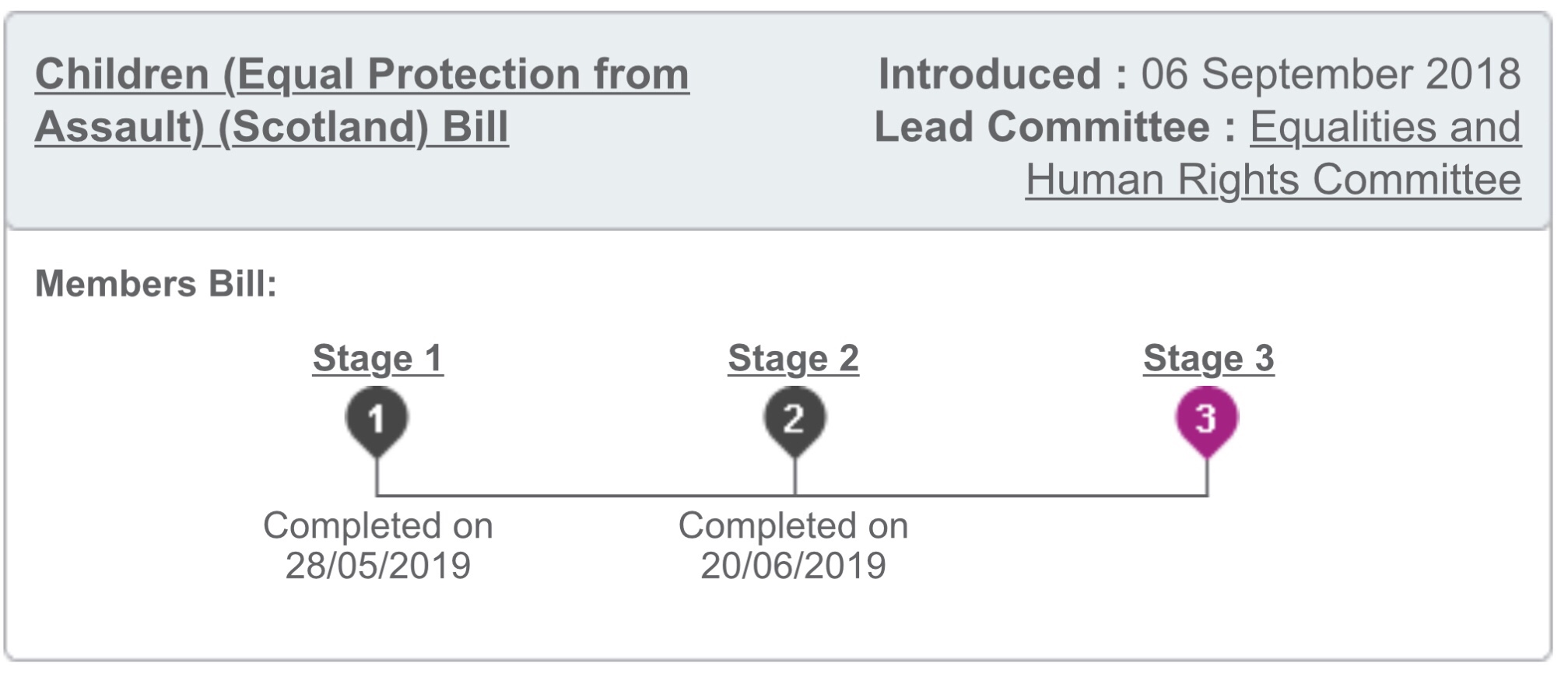
This week (beginning 30 September 2019), Mr Fannie’s Bill passed Stage 3 of the legislative process in the Scottish Parliament. The Bill will shortly receive the Royal Assent (a mere formality) thus becoming the Children (Equal Protection from Assault) (Scotland) Act 2019.

An info graphic showing that the Bill has now passed Stage 3 of the legislative process in the Scottish Parliament can be found below:

As a result of the passing of this Bill into law, Scotland will follow 54 other countries from around the world where the physical chastisement of children is now the criminal offence of assault.

A link to how the passing of the Bill was reported by The Guardian can be found below:

https://www.theguardian.com/uk-news/2019/oct/03/scotland-becomes-first-country-in-uk-to-ban-smacking-of-children

Copyright Seán J Crossan, 4 October 2019

A very civil partnership

Photo by Han-Hsing Tu on Unsplash

Love and marriage go together like a horse and carriage to paraphrase the words of the old song from the 1950s …

… but not for much longer in Scotland if the Scottish Government has its way. A new Bill lodged by the Government this week will potentially revolutionise legal unions for heterosexual couples who want commitment but not, critically, in the form of marriage.

The Civil Partnerships Act 2004 was originally passed by the UK Government of Prime Minister Tony Blair in order to permit same sex couples to enter a legally binding relationship. At the time, the Blair Government stressed that this type of legal arrangement was not open to heterosexual couples and should not be regarded as “gay marriage”.

This legislation also extended the same employment benefits that married couples already enjoyed to same sex couples who entered a civil partnership. In relation to the field of employment rights, the Act applies to employment and pension benefits e.g. a concessionary travel scheme and civil partners of an employee will be entitled to take advantage of these if existing provisions permit a heterosexual partner or spouse of an employee to claim these benefits.

In Bull and Another v Preddy and Another [2013] UKSC 73, UK Supreme Court Justice, Baroness Hale made the following remarks about civil partnerships:

“Civil partnership is not called marriage but in almost every other respect it is indistinguishable from the status of marriage in United Kingdom law. It was introduced so that same sex couples could voluntarily assume towards one another the same legal responsibilities, and enjoy the same legal rights, as married couples assume and enjoy. It is more than a contract. Like marriage, it is a status, in which some of the terms are prescribed by law, and which has consequences for people other than the couple themselves and for the state.”

Fast forward a decade or so and we now have same sex marriage in Scotland, England and Wales – but not yet Northern Ireland (although the clock may be ticking here on this issue). Admittedly, same sex couples can enter civil partnerships in Northern Ireland, but since the Republic of Ireland made same sex marriage legal in 2015, pressure has been mounting for change in the North.

This means that same sex couples have the option of entering into marriage or civil partnership. This choice is still denied to heterosexual couples – until now, hence the introduction of the Civil Partnership (Scotland) Bill.

Traditional marriage between a man and woman has been criticised on a number of grounds:

• It’s seen as very patriarchal i.e. historically it unduly favours the male partner

• It has religious associations which are not in keeping with the fact that the UK is (in 2019) a much more secular society

• Some heterosexual couples are increasingly attracted to a more equitable and modern form of legal commitment i.e. civil partnership.

Despite these criticisms of traditional marriage, until recently neither the UK or Scottish Governments had shown a desire to extend civil partnerships to heterosexual couples. That is until very recently and a UK Supreme Court decision has now made reform of the institution of marriage and civil partnership essential on the basis of a human rights challenge.

The case which started the ball rolling was Steinfeld and Keidan v Secretary of State for Education [2016].

In Steinfeld and Keidan, an unmarried, heterosexual couple brought a claim for unlawful less favourable treatment against the UK Government on the basis that the law (contained in the Civil Partnership Act 2004) discriminated against them by forcing them to enter marriage as opposed to their preferred option of a civil partnership arrangement. The couple had strong “ideological objections” to marriage (irrespective of whether it took a religious or civil form) and argued, amongst other things, that the failure by the United Kingdom to give them the option of entering a civil partnership was a potential breach of their Article 8 rights (the right to privacy and family life) in terms of the European Convention on Human Rights. The ban on civil partnerships for heterosexual couples was also a potential breach of the Equality Act 2010 in the sense that it represented direct discrimination on grounds of a person’s sexual orientation.

Initially, the English High Court rejected the challenge brought by Steinfeld and Keidan, whereupon the case was allowed to proceed to the English Court of Appeal. Although expressing sympathy for Steinfeld and Keidan’s predicament, the Lord Justices of Appeal refused to overturn the ban.

The couple were then given leave to appeal to the UK Supreme Court.

On 27 June 2018, the Court issued its decision: R (on the application of Steinfeld and Keidan) (Appellants) v Secretary of State for International Development (in substitution for the Home Secretary and the Education Secretary) [2018] UKSC 32.

Lord Kerr gave the leading judgement (with which his fellow Justices concurred) and allowed Steinfeld and Keidan’s appeal:

I would allow the appeal and make a declaration that sections 1 and 3 of CPA [Civil Partnership Act 2004] (to the extent that they preclude a different sex couple from entering into a civil partnership) are incompatible with article 14 of ECHR taken in conjunction with article 8 of the Convention.

If, post Steinfeld and Keidan, the Scottish Government continued to allow civil partnership legislation to operate in its original form, there was a very real risk that the Scottish Ministers would be taken to court and challenged by heterosexual couples (using Steinfeld and Keidan [2018]) on human rights grounds.

The solution?

Letting the status quo prevail in Scotland was not an option because of the implications for human rights, so the Scottish Government announced a public consultation on civil partnerships in September 2018:

https://www.bbc.co.uk/news/uk-scotland-45675690

This consultation closed on 21 December 2018 and presented two options:

  • Abolishing the option of future civil partnerships for all; or
  • Permitting heterosexual couples to have the option of marriage or civil partnership.

A link to the Scottish Government’s consultation paper can be found below:

https://consult.gov.scot/family-law/the-future-of-civil-partnership-in-scotland/

On the back of this consultation, the Scottish Government has now introduced the Civil Partnership (Scotland) Bill in order to implement option 2.

As the Policy Memorandum accompanying this Bill clearly states:

In Scotland, couples can marry or enter into a civil partnership, or choose to cohabit. Same sex and mixed sex couples can marry, and same sex and mixed sex couples can decide to cohabit. Civil partnership is currently available only to same sex couples, but this Bill will extend the relationship to mixed sex couples.”

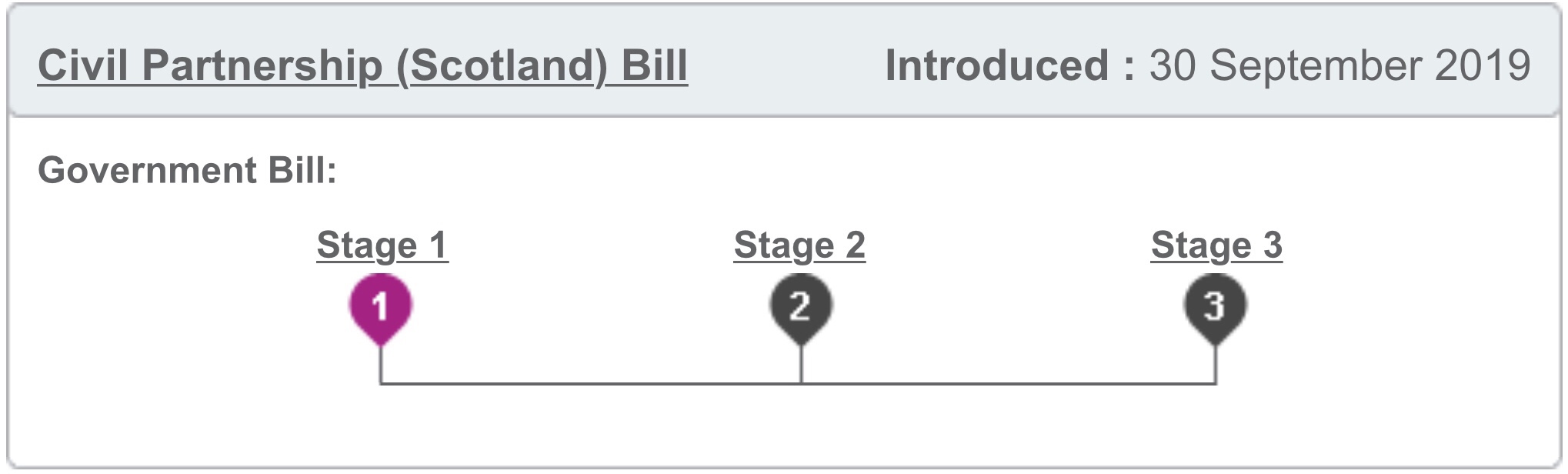
It is more than likely that this Bill will command significant support in the Scottish Parliament and will soon become law.

An info graphic showing the current progress of this Bill can be seen below:

A link to BBC Scotland’s website about the introduction of the Bill can be found below:

https://www.bbc.co.uk/news/uk-scotland-scotland-politics-49889498

Postscript

The Equalities and Human Rights Committee of the Scottish Parliament is now seeking the views of the public about the future of civil partnerships and whether allowing heterosexual couples to enter into this type of legal arrangement is desirable.

Interested members of the public have until 31 January 2020 to submit their views to the Committee.

More information about the Committee’s work in this area can be found by accessing the press release at the link below:

https://www.parliament.scot/newsandmediacentre/113453.aspx

Copyright Seán J Crossan, 4 October & 9 November 2019

I’m not your daddy!

Photo by Annie Spratt on Unsplash

In a previous blog (Who’s the daddy? published on 17 July 2019), I discussed the case of Freddy McConnell, a transgender man who wished to be named as his child’s father on the birth certificate.

Mr McConnell, it will be recalled, had been born female and decided to undergo gender reassignment. While undertaking this process, Mr McConnell discovered that he was pregnant. He eventually gave birth to the child and wished to be designated as the father or parent on the child’s birth certificate.

Sir Andrew McFarlane, President of the English High Court has now issued a ruling regarding this matter (See R (on the application of TT v The Registrar General for England and Wales and Others [2019] EWHC 2348 (Fam)).

As the summary of the High Court’s judgement states:

The issue at the centre of this case can be simply stated: where a person, who was born female, but who has subsequently undergone gender transition and acquired full legal recognition as male, becomes pregnant and gives birth to a child, is that person to be registered as their child’s ‘mother’ or ‘father’?”

Well, the simple answer is that Mr McConnell will not be permitted to insist that he be designated (or named) as the child’s father on the birth certificate.

As Sir Andrew McFarlane clearly stated in his judgement (at paragraph 279):

“… there is a material difference between a person’s gender and their status as a parent. Being a ‘mother’, whilst hitherto always associated with being female, is the status afforded to a person who undergoes the physical and biological process of carrying a pregnancy and giving birth. It is now medically and legally possible for an individual, whose gender is recognised in law as male, to become pregnant and give birth to their child. Whilst that person’s gender is ‘male’, their parental status, which derives from their biological role in giving birth, is that of ‘mother’.”

Sir Andrew McFarlane also dismissed Mr McConnell’s secondary argument that, if the court decided he could not be designated the child’s mother under English law, then this would represent a breach of Article 8 of the European Convention on Human Rights i.e. the right to private and family life. English law is not incompatible with the European Convention regarding this matter.

Interestingly, however, Sir Andrew did state (at paragraph 125) that this is an area which the UK Government and Parliament may wish to address in the future:

The issue which has most properly and bravely been raised by the Claimant [Mr McConnell] in this Claim is, at its core, a matter of public policy rather than law. It is an important matter of public interest and a proper cause for public debate. Whilst this judgment will seek to determine the issue by reference to the existing legislation and the extant domestic and ECHR caselaw, as these sources do not themselves directly engage with the central question there would seem to be a pressing need for Government and Parliament to address square-on the question of the status of a trans-male who has become pregnant and given birth to a child.”

Links to Sir Andrew McFarlane’s full judgement and the summary of this can be found below:

https://www.judiciary.uk/wp-content/uploads/2019/09/TT-and-YY-APPROVED-Substantive-Judgment-McF-25.9.19.pdf

https://www.judiciary.uk/wp-content/uploads/2019/09/TT-and-YY-Summary.pdf

A link to how the judgement was reported on Sky News can be found below:

http://news.sky.com/story/freddy-mcconnell-transgender-man-who-gave-birth-cannot-be-named-childs-father-11819195

Scotland

As Scotland is a separate legal jurisdiction from England and Wales, the registration of births is primarily governed by the Registration of Births, Deaths and Marriages (Scotland) Act 1965 (as amended).

In Scotland, transgender people can apply to have their birth certificate issued to reflect the fact that they have undergone a process of gender reassignment (as per the terms of the Gender Recognition Act 2004). There is, as yet, no provision in Scots Law for a transgender person who found themselves in Mr McConnell’s position to be designated as the father of a child to which they have physically given birth.

Although an English decision i.e. a persuasive rather than a binding precedent, R (on the application of TT v The Registrar General for England and Wales and Others [2019] EWHC 2348 (Fam) it could be argued that it is likely to be followed by the Scottish courts.

The Scottish Government is, of course, currently carrying out a consultation exercise on changes to the Gender Recognition Act 2004.

See the link to details about this consultation exercise:

https://www2.gov.scot/Topics/Justice/law/17867/gender-recognition-review

Copyright Seán J Crossan, 25 September 2019

Blond ambition? (or the prorogation game)

Photo by Annie Spratt on Unsplash

Well, its official: as of the morning of Tuesday 24 September 2019, the UK Supreme Court has ruled against the Prime Minister’s prorogation of the Westminster Parliament for 5 weeks.

In a unanimous decision, the 11 Justices of the Supreme Court have declared that the suspension of Parliament was unlawful.

The decision of the Court of Session (in the Petition of Joanna Cherry MP and Others) has been approved by the Supreme Court.

The decision of the English High Court to rule against Gina Miller has also been overturned.

As Baroness Hale succinctly stated:

It is impossible for us to conclude, on the evidence which has been put before us, that there was any reason – let alone a good reason – to advise Her Majesty to prorogue Parliament for five weeks, from 9th or 12th September until 14th October. We cannot speculate, in the absence of further evidence, upon what such reasons might have been. It follows that the decision was unlawful.

Video footage of the decision of the Court, delivered by Baroness Hale of Richmond (its President), can be found below:

The House of Commons will now reconvene on Wednesday 25 September 2019.

Links to the full judgements (and summaries of these decisions) can be found below:

R (on the application of Miller) (Appellant) v The Prime Minister (Respondent) Cherry and others (Respondents) v Advocate General for Scotland (Appellant) (Scotland) [2019] UKSC 41 (On appeals from: [2019] EWHC 2381 (QB) and [2019] CSIH 49)

Click to access uksc-2019-0192-judgment.pdf

Click to access uksc-2019-0192-summary.pdf

Click to access uksc-2019-0192-judgment.pdf

Click to access uksc-2019-0192-summary.pdf

Copyright Seán J Crossan, 24 September 2019

To prorogue or not to prorogue? (That indeed is the question)

Photo by Hugo Sousa on Unsplash

It was all meant to be so different from Theresa May’s chaotic time in Downing Street, but the last few weeks have not been kind to current UK Prime Minister, Boris Johnson.

He has been attacked for seeking the prorogation (suspension) of Parliament for 5 weeks; he has lost several (critical) parliamentary votes; he also lost his majority in the Commons; and he has been denied the General Election (which many of his critics believe that he secretly craves – despite official statements to the contrary). This last problem having arisen as a result of the restrictions imposed by the Fixed Term Parliaments Act 2011 – passed ironically with the votes of Conservative MPs in the more peaceful days of the UK Coalition Government (2010-15). The law of unintended consequences many of the Prime Minister’s supporters will no doubt lament.

The Prime Minister might have felt some relief last week when both the Queen’s Bench Division of the English High Court and the Outer House of the Court of Session ruled in two separate, but connected, cases that his decision to advise the Queen to prorogue Parliament (by using the Royal Prerogative) was not unlawful (see Gina Miller v the Prime Minister & Others; and Joanna Cherry MP and Others, Petition for Judicial Review both 2019).

That was until 11 September 2019), when the Inner House of the Court of Session (Scotland’s Supreme Civil Court) landed nothing less than a bombshell on the UK Government. Lords Carloway, Brodie and Drummond Young issued an opinion that the circumstances which surrounded the proroguing of Parliament was unlawful:

All three First Division judges have decided that the PM’s advice to the HM the Queen is justiciable, that it was motivated by the improper purpose of stymying Parliament and that it, and what has followed from it, is unlawful. …

The Court will accordingly make an Order declaring that the Prime Minister’s advice to HM the Queen and the prorogation which followed thereon was unlawful and is thus null and of no effect.

This decision clearly reverses Lord Doherty’s Opinion in the Outer House of the Court of Session which was issued on 4 September 2019.

Professor Stephen Tierney of Edinburgh University’s Law School referred to the judgement as “remarkable”.

In essence, the prorogation of Parliament was a tactical (underhand?) manoeuvre by the UK Government to make it more difficult for the UK Parliament to scrutinise and block it’s attempt to pursue a no deal Brexit by 31 October 2019. For now, the objective of the Government in this regard have been stopped in tracks.

The UK Government has been given leave to appeal against the decision of the Inner House and the matter will be now be determined by the UK Supreme Court at Guildhall, London.

A link to the full Opinion of the Inner House can be found below:

https://www.scotcourts.gov.uk/docs/default-source/cos-general-docs/pdf-docs-for-opinions/2019csih49.pdf?sfvrsn=0

Copyright Seán J Crossan, 11 & 13 September 2019

Mind your language!

Photo by Ilya Ilford on Unsplash

“Great big girl’s blouse!” or “a girly swot”. Harmless insults; a bit of banter; or perhaps an example of sexist language? Deborah Haynes, a journalist with Sky News, certainly took the view that these remarks were sexist in nature – even though men were the targets (see the link below).

https://news.sky.com/story/sky-views-girly-swot-big-girls-blouse-are-sexist-jibes-and-shouldnt-be-used-by-the-pm-11804690

The first of these remarks was uttered allegedly by Prime Minister Boris Johnson MP in the House of Commons last week and directed towards the Leader of the Opposition, Jeremy Corbyn MP. The second remark was in a memo written by the Prime Minister in which he was critical of David Cameron (one of his predecessors).

Mr Johnson is well known for his colourful language in both print and in his speeches, but he was called out last week in the House of Commons by the Labour MP, Tammanjeet Singh Dhesi who accused him in very blunt terms of making racist remarks about Muslim women who chose to wear the Islamic form of dress known as the burka as an outward sign of their religious beliefs and cultural background.

Mr Tammanjeet drew on his own experiences as a Sikh and the kinds of derogatory remarks that he had to endure. His speech was received very warmly on the Opposition benches of the House of Commons.

On the other hand, Mr Johnson attempted a defence of his language by saying that he had merely spoken up in favour of the good old fashioned liberal value of freedom of speech. It was not an entirely convincing performance from the Prime Minister and far from his finest hour at the despatch box.

The Equality Act 2010 recognises various forms of prohibited conduct such as direct discrimination (Section 13) and harassment (Section 26). Sexist, sectarian and homophobic remarks may well be taken as examples of direct discrimination. A sustained campaign of bullying to which an individual (with a particular protected characteristic) is subjected may amount to harassment.

It will be sensible for employers particularly to spell out to employees what is acceptable (and what is not) in terms of the kinds of language or behaviour in the work-place. If employers do nothing to check discriminatory remarks such as racist or sexist insults, there is a real danger that they could be held vicariously liable.

Had Mr Johnson been a mere mortal, some of his remarks may have come back to haunt him. Employers are entitled to take disciplinary action against those employees who have committed acts of discrimination. After all, they are merely protecting their position by not leaving themselves open to the threat of legal action by the victims.

From the employee’s perspective, engaging in offensive language could give the employer the right to treat this type of behaviour as gross misconduct. It should be recalled that, in terms of Section 98 of the Employment Rights Act 1998, misconduct committed by an employee can be punished by dismissal and such a termination of the employment contract may be entirely reasonable in the circumstances.

In short, no one should have to work in a place where there is a hostile, degrading or intimidating environment. Racist or sexist remarks can be highly suggestive of such a working environment if permitted to go unchecked and unchallenged. Maybe in future the Prime Minister would do well to mind his language.

Links to articles about the Prime Minister’s colourful turn of phrase can be found below:

https://news.sky.com/video/share-11802095

http://news.sky.com/story/boris-johnson-branded-david-cameron-girly-swot-leaked-document-reveals-11803807

Copyright Seán J Crossan, 7 September 2019

Barbaric!

Photo by Sharon McCutcheon on Unsplash

We may think that in Western societies we’ve come a long way regarding the advances made by women.

Then, before we get too smug, something happens which forces us to confront the fact that we’re not quite as enlightened or civilised as we like to think.

Such an incident occurred last week in the United States of America when it was reported that a the authorities were negligent when Diana Sanchez, a pregnant woman who was being held in Denver County Jail, was denied proper medical treatment. The woman’s cries for help were allegedly ignored for 5 hours and she was forced to give birth to her son in the prison cell.

Had something similar occurred in the UK, lawyers might have been looking at Section 17 of the Equality Act 2010 (pregnancy and maternity discrimination: non-work cases) to provide grounds for a legal challenge against the operators of a prison. Clearly, this sort of failure by the authorities to implement a basic duty of care could be viewed as blatant sex discrimination.

In 2019, would have been too difficult for the Denver County Jail authorities to have ensured that this particular inmate had access to to the appropriate medical facilities? Surely, given her condition, this was not asking too much?

Lawyers for Ms Sanchez are now, unsurprisingly, pursuing a civil action against Denver County Sheriff’s Department.

A link to the story as reported by Sky News can be found below:

http://news.sky.com/story/woman-who-gave-birth-alone-in-denver-prison-cell-files-lawsuit-11797438

Postscript

Lest we become judgemental about the US Penal system, on 4 October 2019, The Guardian reported that the new born child of an inmate at HM Prison Bronzefield in Surrey had died. The mother had been in an “advanced state” of pregnancy, but had been left alone in her cell overnight when she had given birth to the child.

A link to the story can be found below:

https://www.theguardian.com/society/2019/oct/04/baby-dies-in-uk-prison-after-inmate-gives-birth-alone-in-cell

Copyright Seán J Crossan, 10 September and 4 October 2019

Stop the coup …?

Photo by Samuel Zeller on Unsplash

On 28 August 2019, the UK Prime Minister, Boris Johnson MP announced that he would seek the permission of Queen Elizabeth II, the British Head of State to prorogue (suspend) the sitting of the Westminster Parliament between 10 September and 14 October 2019. The Queen duly acceded to this request – though in her defence she could not really refuse being a mere ceremonial Head of State i.e. without possessing real executive powers

The Prime Minister has argued that there was nothing untoward or sinister about this development and that it was a necessary step to introduce a new Queen’s Speech which would set out the priorities of the Government which he leads.

This did not convince opposition politicians (Jeremy Corbyn, Nicola Sturgeon and Jo Swinson et al) who predictably labelled the move a “coup” i.e. an unlawful seizure of power and the undermining of British democracy. They argued that the move to suspend Parliament for 5 weeks was more about the Prime Minister driving his Brexit agenda through without proper parliamentary scrutiny – not about a new legislative programme.

In any event, the courts have now become involved in the matter: 78 British parliamentarians (representing all strands of political tradition) petitioned Scotland’s Court of Session to have Prime Minister Johnson’s action declared invalid.

A preliminary hearing took place last week and the judge, Lord Doherty was refused to grant the petitioners an interim interdict (a temporary court order) preventing the Prime Minister from carrying out his intention to prorogue the UK Parliament. A full hearing of the Court followed on Tuesday 3 September in Edinburgh, where both sides (the petitioners and the UK Government) set out their respective legal arguments in full.

As of this morning (Wednesday 4 September 2019), Lord Doherty has made his decision whereby he has declined to uphold the petition to prevent the Prime Minister from proroguing Parliament.

A link to Lord Doherty’s opinion can be found below:

https://www.scotcourts.gov.uk/docs/default-source/cos-general-docs/pdf-docs-for-opinions/2019csoh70.pdf?sfvrsn=0

The underlying rationale of Lord Doherty’s judgement seems to be that this political and not a legal matter. In other words, it will be for members of the UK Parliament – or ultimately the British electorate – to sort out this matter.

A link to the Evening Standard’s website containing video footage of Lord Doherty delivering the substance of his opinion can be found below:

https://www.standard.co.uk/news/politics/scottish-courts-throw-out-challenge-to-boris-johnson-proroguing-parliament-a4228621.html

This will not be the final word on the matter – there are bound to be appeals against Lord Doherty’s judgement (and he may well be relieved to be exiting stage left). I would not be surprised if this matter ultimately proceeds to the UK Supreme Court for a definitive judgement.

This, of course, is one of the problems with having an unwritten British Constitution. In other countries, which have written constitutions (France, Germany, Italy and the USA), there are very clear rules about suspending Parliament or the national legislature. Only last week in Italy, the prominent politician Matteo Salvini withdrew his party (the Northern League) from the Government in an attempt to force fresh, national elections. Mr Salvini miscalculated because the Italian President (the Head of State) decided not to dissolve Parliament and call new elections. Rather the President gave Salvini’s ex-coalition partner, the 5 Star Movement, and the Democratic Party an opportunity to form a new government (which they have duly managed to achieve). President Mattarella was clearly entitled to take this action under the relevant Articles of the Italian Constitution.

This does not mean that, in political systems with written constitutions, the courts have no role. Of course they do. It is an accepted part of the political culture of these countries that a Supreme Court or a Constitutional Court will be the final arbiter of very thorny legal and political issues e.g. the role of the US Supreme Court in legalising abortion (Roe v Wade 410 U.S. 113 (1973)) or same sex marriage (Obergefell v Hodges 576 U.S. ___ (2015)). They may be controversial in nature and generate heated debate for decades to come, but very few US citizens would contest the right of the Supreme Court to make such judgements.

As a point of contrast, note the hysteria which was generated when judges of the English High Court permitted Gina Miller’s action to succeed in blocking former Prime Minister Theresa May’s attempt to trigger Article 50 of the Treaty on European Union without, first, securing UK parliamentary approval (see R (Miller) v Secretary of State for Exiting the European Union [2017] UKSC 5).

The UK tabloid newspaper, The Daily Mail ran an astonishing front page on 4 November 2016 branding the judges “enemies of the people”. More prosaically, the High Court’s judgement (later approved by the UK Supreme Court in early 2017) was merely clarifying the law surrounding the Prime Minister’s use of the Royal prerogative in foreign affairs. You would not have thought this from the media and political reaction in certain quarters.

In such circumstances, it’s hardly surprising that Lord Doherty is only too happy to pass the buck to the politicians … for now anyway …

Watch this space.

Postscript

The Inner House of the Court of Session (consisting of Lords Carloway, Brodie and Drummond Young) will now hear an appeal by the petitioners against Lord Doherty’s judgement. This is scheduled to take place the week beginning Monday 9 September 2019.

In a separate, but connected, legal challenge, the English High Court rejected a bid by the campaigner, Gina Miller, to have the prorogation of Parliament declared unlawful. Leave to appeal to the UK Supreme Court has been granted.

Copyright Seán J Crossan, 4 and 6 September 2019