Drunk and disorderly?

Photo by Bobby Rodriguezz on Unsplash

Misconduct

Several of my previous blogs have focussed on misconduct inside and outside the work place. In the most serious cases of (gross) misconduct, an employer could fairly dismiss an employee (Section 98(2)(b): Employment Rights Act 1996.

That said, employers are well advised to follow proper pre-dismissal procedures – usually in line with the latest ACAS Code of Practice on Discipline and Grievance at Work.

Summary (i.e. on the spot) dismissal can be an appropriate response to a breach of discipline by an employee, but I tend to caution employers against this. The eminent English judge, Sir Roger Megarry VC was quite correct to warn employers about the dangers of what they might perceive to be an open and shut case (see John v Rees & others [1969] 2AER 274, CD). It’s always better to be safe rather than sorry and by carrying out a procedure, the employer is minimising its exposure to risk i.e. the possibility of a successful unfair dismissal claim brought by the employee.

A typical disciplinary process usually consists of the following stages:

  • Stage 1: The investigation of the allegations
  • Stage 2: The disciplinary meeting
  • Stage 3: The appeal hearing

If the investigation uncovers clear evidence that the employee should be exonerated of all allegations of misconduct, the employer is legally bound to put a stop to the disciplinary process (see A v B [2003] IRLR 405; Salford Royal NHS Foundation Trust v Roldan [2010] EWCA Civ 522; Miller v William Hill Organisation Ltd UKEAT/0336/12/SM [2013])

It is also important to note that the employer must set out the disciplinary charges as clearly as possible so that the employee can prepare her case. The employer cannot, under any circumstances, play fast and loose with the disciplinary charges as this may undermine the integrity of the entire disciplinary procedure (see Strouthos v London Underground [2004] IRLR 636 CA and Celebi v Scolarest Compass Group UK & Ireland Ltd UKEAT/0032/10/LA [2010]).

If, however, matters proceed to a formal, disciplinary meeting, the allegations must be put to the employee and the evidence which supports them. The employee in turn has the right to present her case to the disciplinary panel or manager taking the proceedings. In terms of the Employment Relations Act 1999, the employee has a right to be accompanied by a colleague or a recognised trade union representative.

Should the disciplinary meeting arrive at a decision to dismiss the employee for misconduct, it is extremely important to allow an appeal (see West Midlands Co-operative Society v Tipton [1986] 1 ALL ER 513). An appeal can lead to the dismissal being upheld or overturned; and it can be used to cure any defects in the previous stages of the disciplinary proceedings.

Discipline at work

It’s very common (indeed essential) for employers to have detailed codes of practice or discipline which regulate the behaviour of employees inside and outside the work place. The content of disciplinary codes should be clearly communicated to employees. For new employees, this could be carried out as part of their induction process. For existing employees, a regular series of training seminars or development events could accommodate this aim. The urban myth that what happened outside the work place is no business of the employer is that exactly that: a dangerous myth. If staff misbehaviour outside working hours causes serious reputational damage to the business or the organisation, the employer is entitled to treat this as gross misconduct and to use the ultimate disciplinary sanction of dismissal.

Examples of gross misconduct might include any of the following:

  • Alcohol and drug abuse
  • Acts of bullying & harassment
  • Fraud
  • Negligent performance of duties
  • Theft
  • Persistent late-coming

The above list is by no means an exhaustive one, but it covers some of the most common examples of gross misconduct.

As I have discussed in a previous blog, It happened outside work (or it’s my private life!) (published on 7 February 2019), employers do not have an automatic right to meddle in employees’ private lives. The right to a private life is protected in terms of Article 8 of the European Convention on Human Rights (as implemented by the both the Scotland Act 1998 and the Human Rights Act 1998). Employers will have to walk a very fine line between what is a legitimate act to protect their business interests and what would otherwise be unwarranted interference in the private lives of employees.

Lloyd’s of London

So, bearing all of the above in mind, it was with some interest that I read today that Lloyd’s of London, the financial giant, was introducing a new code of conduct for employees. This is in the wake of some unpleasant allegations being disclosed about the business – sexual harassment claims and drunkenness and drug taking.

Traditionally, the serving of alcohol at business meetings in the City of London or long, boozy lunches were as much a fixture of the Square Mile as was St Paul’s Cathedral. Alcohol oiled the wheels of commerce it was thought, but it also encouraged people to behave recklessly within a work environment.

It would seem that, in other work places, employees seem to know that they can’t turn up for work under the influence of drugs or alcohol, but Lloyd’s obviously feels that it still has a problem with these issues and they need to be addressed. Admittedly, two years ago, the organisation did ban employees from drinking alcohol between 0900 and 1700 hours.

The new code of conduct at Lloyd’s will apply not only to its 800 employees, but also to any person who holds a pass to its London HQ (potentially such 40,000 individuals). Anyone attempting to enter Lloyd’s HQ who appears to be under the influence of drugs or alcohol (or both) will be denied admission to the premises.

A link to the BBC News article about the new code of conduct at Lloyd’s can be found below:

Lloyd’s of London insurance has a new code of conduct, but not everyone welcomes it.

Lloyd’s of London calls time on drink and drugs

Photo by Boris Stefanik on Unsplash

Conclusion

Misconduct by employees – both in and outwith the work place – can be used by employers as a potentially fair reason for dismissal in terms of Section 98 of the Employment Rights Act 1996. Employers must ensure that employees clearly understand what is expected of them in terms of their conduct. It is very important, however, that employers carry out proper procedures when contemplating dismissal as the ultimate sanction for breaches of the disciplinary code. By implementing a new code of conduct, Lloyd’s of London is carrying out a risk management exercise i.e. spelling out what is and isn’t acceptable behaviour in and outside the work place. This is very wise given the bad publicity which Lloyd’s has experienced in the past regarding allegations of employee misconduct.

Copyright Seán J Crossan, 9 April 2019

The future will be here sooner than you think …

Photo by Fabian Blank on Unsplash

I often say to my students that it’s never too early to start saving for retirement. This sage advice usually causes some hilarity amongst a group of individuals who, typically, are still in their late teens.

The UK Parliament passed the Pensions Act 2008 which, eventually, would compel employers to enrol their qualifying employees in a recognised occupational pensions scheme.

Historically, many employees might work for an employer without paying into a proper occupational pension scheme. This meant that, when people retired, they were almost entirely dependent on the state pension (a not particularly generous welfare state benefit). The spectre of pension poverty became a worrying concern for many.

People who worked in the public sector (e.g. civil servants, teachers, lecturers, NHS employees) were often encouraged to join superannuation (pensions) schemes which the State had set up. Individuals working in the private sector might not be so lucky: when approaching their late 30s or early 40s, they might start to think about private pension arrangements. To their shock and horror, these individuals might be faced with the prohibitive costs of setting up a private pension. Had they be encouraged to do this in their late teens or early 20s, they would have paid a lot less towards the cost of their retirement (and a more secure financial future in their old age).

The ageing society

So, for some time now, we have been faced with the reality of an ageing population in the UK. The Government has raised the state pension age to 66 which means that many people will be working for much longer than their parents. There are plans to raise the state pension age to 67 between 2026 and 2028.

The written statement of the main terms of employment – which every employee must receive within 8 weeks of commencing work – must now contain information about an occupational pensions scheme (as per Section 1 of the Employment Rights Act 1996).

From this April (2019), changes to occupational pensions schemes will mean that qualifying employees must contribute more towards their retirement (up from 3 to 5%), but employers must also pay more towards the scheme. For employers, setting up an occupational pensions scheme is a legal duty – even if you employ one qualifying individual only. Employees who earn less than £10,000 per year are not automatically enrolled in an occupational pension scheme.

A link to an article about the imminent changes to occupational pensions can be found below:

Ten million people face higher pension payments

Photo by Fancycrave on Unsplash

A bigger chunk of wages will now be automatically diverted to a pension, but employers will put in more too.

A link to the UK Government’s pension regulator website providing more information on pensions for employees and employers can be found below:

https://www.workplacepensions.gov.uk

Copyright Seán J Crossan, 6 April 2019

Don’t fly with us …

Photo by Joel Barwick on Unsplash

Yet another story in the news today about the possibility of redundancies. UK airline Flybe has cancelled many flights because of the prospect of having to make staff redundant.

This has occurred because Flybe appears to be in serious financial difficulties.

As discussed in previous blogs, redundancy is a potentially fair reason for dismissal of employees if carried out correctly. The definition of redundancy appears in Section 139 of the Employment Rights Act 1996.

Flybe cancels flights amid redundancy talks

Flights from Belfast City Airport and from Birmingham are among the dozens of flights affected.

Copyright Seán J Crossan, 3 April 2019

Hell on the High Street

Photo by kevin laminto on Unsplash

It’s been a tough time for many retailers on the UK high street over the last few years.

This has led to a succession of well known businesses going into liquidation (e.g. Maplins and Toys ‘R’ Us UK ) or being taken over by other companies (e.g. Evans Cycles and House of Fraser).

In February 2019, it was announced that the music chain HMV was being taken over by Sunrise Records, a Canadian company. Sunrise was willing to take over 100 former HMV and Fopp Records stores from the company administrators. As a result of this acquisition, nearly 1500 jobs were saved. Unfortunately, 27 stores had to close with the loss of 445 jobs. Many music and film fans will lament the loss of Fopp’s Byres Road store in Glasgow which was one of the outlets that ceased trading.

The lucky HMV and Fopp employees will have their employment transferred to Sunrise Records in terms of the Transfer of Undertakings (Protection of Employment) Regulations 2006. This protects them from dismissal and guarantees continuation of their core terms and conditions of employment.

As for the unlucky employees, they are being made redundant in terms of Section 139 of the Employment Rights Act 1996. Redundancy is a potentially fair reason for dismissal – so long as the procedure is carried out fairly and objectively.

A link to a BBC article about the takeover of HMV and Fopp by Sunrise Records can be found below:

HMV chain saved but some stores will close

The firm is to buy 100 stores out of administration, but 27 outlets will close, including the Oxford Street store

Copyright Seán J Crossan, 3 April 2019

National Minimum Wage Increase

Photo by Philip Veater on Unsplash

On 1 April 2019, many workers will see an increase in the National Minimum Wage rates (set by the Low Pay Commission and adopted by the UK Government).

As discussed in one of last Friday’s Blogs (The Living Wage), the National Minimum Wage rate for those aged 25 or over is not the same thing as the real Living Wage championed by the Living Wage Foundation, and adopted by many employers.

Minimum wage rates rise, but bills go up too

Two million UK workers on minimum wages receive a pay rise – but household bills have also increased.

Copyright Seán J Crossan, 1 April 2019

TUPE for lawyers

Photo by Melinda Gimpel on Unsplash

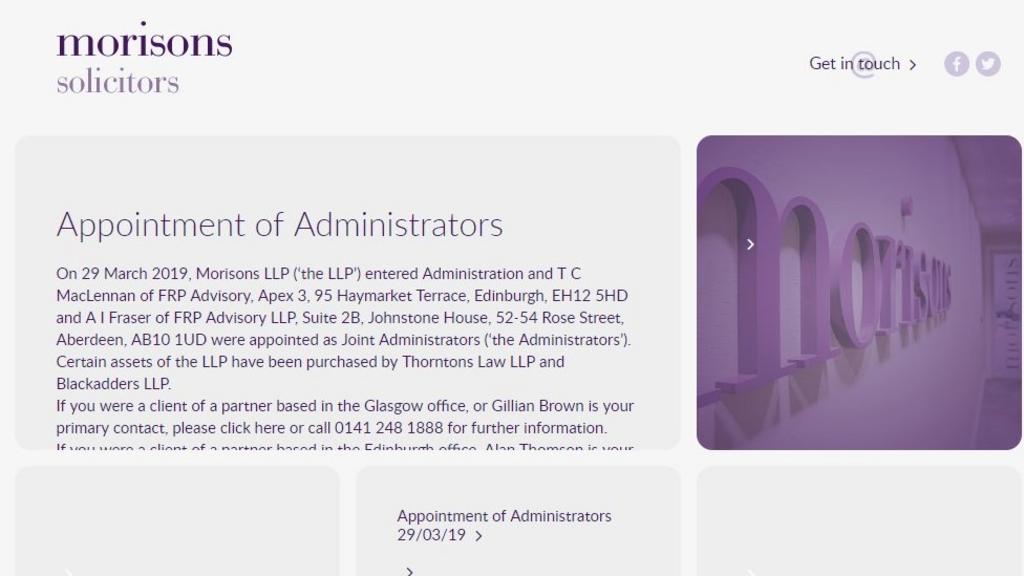
An interesting story by BBC Scotland about the demise of the well known Glasgow/Edinburgh law firm, Morisons Solicitors LLP. The story primarily concerns aspects of the transfer of an undertaking.

The majority of staff at Morisons are having their employment transferred: Blackadders Solicitors have agreed to take over the Glasgow operations and Thorntons will take over the Edinburgh side of the business.

The movement of former Morisons’ staff to their new employers will, of course, be governed by the Transfer of Undertakings (Protection of Employment) Regulations 2006. This means that the employees in question will have their employment and their core terms and conditions of employment protected by their new employers.

The prospect of staff being made for redundant, as a result of the collapse of Morisons, is not imminent for the time being.

A link to the story can be found below:

Some jobs saved after administrators appointed at law firm

The business of Morisons LLP, which has offices in Glasgow and Edinburgh, will be taken over by two firms.

A link to a video on the ACAS website dealing with TUPE can be found below:

Copyright Seán J Crossan, 31 March 2019

Mishandling redundancy?

Photo by Casey Botticello on Unsplash

An interesting story appeared in today’s Independent newspaper about allegations of racism directed against the office of Tom Watson MP, the Deputy Leader of the UK Labour Party.

The allegations (and they are allegations I would stress at this point) concern claims by a former employee of Mr Watson’s that she was unfairly selected for redundancy. Sarah Goulbourne, the former employee in question is alleging that she lost her post because of her race and/or ethnicity (she is of Afro-Caribbean descent). A person’s race is, of course, a protected characteristic in terms of the Equality Act 2010 and s/he has a right not to be subjected to unlawful discrimination or less favourable treatment.

A link to the story can be found below:


https://edition.independent.co.uk/editions/uk.co.independent.issue.270319/data/8841231/index.html

In terms of the Employment Rights Act 1996, redundancy can be a potentially fair reason for dismissing an employee – if handled correctly and fairly.

If, however, a person was selected for redundancy because they possessed a protected characteristic such as race, this would be extremely problematic for the employer. If racial discrimination could be proved by the ex-employee, the dismissal or termination of the contract on grounds of redundancy would almost certainly be automatically unfair.

Employers can access very useful advice about redundancy handling (and presumably how to get it right) from the ACAS website:

Click to access Redundancy-handling-accessible-version.pdf

It will be interesting to see if the case proceeds any further.

Copyright Seán J Crossan, 27 March 2019

Hello, I’m Lorraine and I’m definitely self-employed

Photo by Sam McGhee on Unsplash

I rarely tire of writing about employment status and today is no exception.

I never thought, however, that I would be talking about Lorraine Kelly, the well known British TV personality, and employment status in the same breath. I suppose there’s a first time for everything.

Anyway, Ms Kelly has just won an income tax dispute valued at £1.2 million with Her Majesty’s Revenue and Customs (HMRC). She was able to demonstrate to the First Tier Tax Tribunal that she was not an employee of ITV, but rather she was a freelancer or a genuinely self-employed person. If you are classified as a freelancer or a self-employed person, you will be able, quite legitimately and courtesy of a competent accountant, to pay less in income tax to the Exchequer. Clearly, this situation will be more advantageous to higher, earning individuals such as Ms Kelly.

Judge Jennifer Dean, who chaired the Tribunal, was convinced that Ms Kelly was effectively a theatrical performer who was “presenting a persona of herself … she presents herself as a brand and that is the brand ITV sought when engaging her [my emphasis].”

Significantly, Ms Kelly was also able to show that ITV did not give her any employee or worker benefits such as holiday and sickness pay. There were also no restrictions placed on her ability to carry out work for other organisations.

I think that it would be safe to say that Judge Dean would have had Section 230 of the Employment Rights Act 1996 at the forefront of her reasoning when she decided that Ms Kelly does not have a contract of service with ITV, but rather she has a contract for services.

Employment status as a real issue does matter and, in Lorraine Kelly’s case, the lack of it will mean that she pays far less in income tax to HMRC.

On another point, Lorraine Kelly’s dispute with HMRC provides an insight into the work of specialist Tribunals. Members of the public probably have little awareness of the existence of the Tax Tribunal, but this story shines a light on an otherwise obscure part of the legal system.

A link to an article about the story on the BBC website can be found below:

Lorraine Kelly wins £1.2m tax case against HMRC over ITV work

HMRC claimed she was employed by ITV, but the judge ruled that Kelly’s TV persona is a daily performance.

Copyright Seán J Crossan, 22 March 2019

It happened outside work … (or it’s my private life!)

photo-1432888622747-4eb9a8efeb07.png

Photo by William Iven on Unsplash

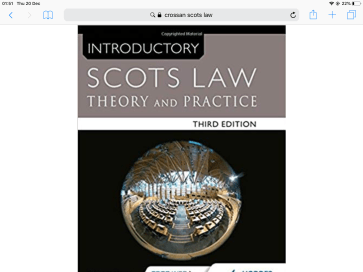
In Chapter 6 of Introductory Scots Law, I focus on the conduct of employees (or should I rephrase that and say misconduct?).

Misconduct – especially the most serious examples of bad behaviour in the workplace – might be grounds for a fair dismissal of the employee concerned.

Section 95 of the Employment Rights Act 1995 states that an employment contract could be terminated by the employer by reason of the employee’s conduct. Such a dismissal or termination of contract could be regarded as a fair dismissal (Section 98: ERA 1996).

If procedures are properly followed by the employer when contemplating dismissal as the ultimate disciplinary sanction, it will be very difficult for the employee to dispute this.

It’s very important for an employer to spell out to employees the type of conduct which could justify dismissal. This might usefully be done by having a section in the employee handbook which specifically addresses the issue of misconduct in the workplace. Additionally, a proper induction process for new employees might focus on the types of behaviour which the employer would almost certainly not condone. Regular refresher training for existing and longer term employees could also be very useful and, in bigger organisations, this would be an important function of the Human Resources or Personnel Department. The recent introduction of the EU’s General Data Protection Regulations (GDPR) in May 2018 is a case in point. Existing members of staff who handled personal or confidential data under the previous data regime would almost certainly be required to be brought up to speed about the more serious consequences of breaching the GDPR.

Misconduct outside the workplace

What about misconduct committed by employees outside working hours? There is an enduring myth amongst members of the public that what happens in your private life is no business of your employer’s. This is a very naive view to hold: employee misbehaviour – whether during working hours or outside work – can adversely affect the employment relationship. The employer will argue that misconduct committed outside working hours can have serious reputational consequences for the organisation.

As many individuals have found to their cost, extra curricular activities can lead to dismissal from employment or some other disciplinary sanction (see Pay v Lancashire Probation Service [2004] IRLR 129 where a probation officer who was part of a sado-masochistic circus act in his spare time was deemed to be fairly dismissed). On the other hand, the employer has to be careful and must not be heavy handed (see Redfearn UK [2012]  ECHR 1878 where the employee suffered unlawful discrimination when he was dismissed on the grounds of his political beliefs).

The case law is full of examples of employees getting themselves into trouble outside working hours as a result of alcohol and drugs misuse or committing criminal acts. Some examples can be seen below:

Richardson v City of Bradford Metropolitan Council[1975] IRLR 296 a senior meat inspector employed by the Council lost his claim for unfair dismissal in relation to misconduct committed outside work: he had stolen money from his local rugby club where he held the office of Treasurer. The Council argued successfully that this incident demonstrated a serious lack of integrity on the employee’s part and, thus, made him unsuitable for continuing employment.

Moore v C & A Modes [1981] IRLR 71 the employee in question was a section leader in a retail store. He had been caught shoplifting at another store and his employer decided to dismiss him. The dismissal was fair: the employee’s conduct had undermined his employer’s trust and confidence in him, not to mention the potential damage done to its reputation as a result of his criminal behaviour.

X v Y [2004] EWCA Civ 662 a charity support worker who worked with with young offenders was cautioned by police officers after committing an indecent act with another male in a public toilet at a motorway service station. He was also placed on the Sex Offenders’ Register as a result of receiving the Police caution. The employee had not been honest to the Police when asked questions about his job and, compounding this, he failed to inform his employer about the situation. The employer decided to dismiss this individual and the dismissal was deemed to be fair. The reputational damage which the employer suffered because of the employee’s failure to disclose what had happened was a significant factor here. The English Court of Appeal was of the view that the employee’s right to respect for a private life (on grounds of his sexual orientation) was not relevant here in terms of Article 8 ECHR as the indecent act in question was not of a private nature because it had been performed in a public toilet.

The right to privacy?

In particular, public sector employers or employers which discharge public functions will have to be aware of the consequences of Article 8 of the European Convention on Human Rights – the right to respect for a person’s private and family life. Unwarranted interference in a employee’s private life may cause the employer to find itself in a legal minefield. There can even be implications for free speech or freedom of expression (in terms of Article 10 ECHR) which could lead to an employee taking legal action against the employer (see Smith v Trafford Housing Trust [2012] EWHC 3221).

As a result of the Scotland Act 1998 and the Human Rights Act 1998, which implemented provisions of the ECHR directly into domestic law, the contract of employment is by no means immune from human rights considerations.

Private employers are also not exempt from the effects of the ECHR. They will be indirectly affected: the UK as a signatory to the Convention must ensure that human rights are adequately protected and this will extend to relationships between private individuals e.g. employers and employees.

The problem(s) with social media

In December 2018, Sky News reported that a Dundee United footballer, Jamie Robson had been subjected to disciplinary action for dressing in a racially offensive costume at a private party. Pictures of Mr Robson dressed in the offensive costume were posted on social media:

Dundee United defender Jamie Robson disciplined for blackface fancy dress
http://news.sky.com/story/dundee-united-defender-jamie-robson-disciplined-for-blackface-fancy-dress-11579477

With the explosion in the use of social media, there is now a much greater chance of employees being caught behaving in inappropriate ways or posting offensive comments online. In such an environment, employers will have legitimate concerns about the reputational damage done to their organisations as a result of employee misconduct which becomes widely publicised via social media platforms such as Facebook, Instagram or Whatsapp.

That said, however, we now live in a society where it is much easier for employees to be caught out in terms of misconduct committed outside of working hours. In Chapter 6 of Introductory Scots Law, I considered the implications of two Employment Tribunal judgements in relation to employee use of the popular social media platform, Facebook:

  • Stephens v Halfords plc ET Case No. 1700796/10 3rd November 2010 Torquay ET
  • Preece v JD Wetherspoons plc ET Case No. 2104806/10 18th January 2011 Liverpool ET

In Stephens, the employee was deemed to have been unfairly dismissed and was awarded compensation of over £11,350 (ouch!), whereas in Preece, the circumstances surrounding the employee’s use of social media did constitute grounds for a fair dismissal. Preece had signed the employer’s policy on the use of e-mail and social networking sites which contained the following warning that disciplinary action would be taken if comments were “….. found to lower the reputation of the organisation, staff or customers”.

In a more recent decision, Plant v API Microelectronics Ltd (ET Case No. 3401454/2016) 30th March 2016, the Norwich Employment Tribunal held that an employee’s claims that she had  been unfairly dismissed and wrongfully dismissed regarding “derogatory” remarks (which she had made on Facebook) about her employer had not been proved. Mrs Plant, the employee in question, had been with the company for 17 years and had a spotless disciplinary record.  In December 2015, the employer had introduced a very robust social media which listed the types of online behaviour which could be regarded as misconduct. In particular, employees were reminded that:

In particular, employees were reminded that:

The document also reminds employees that conversations between friends on Facebook are not truly private and can still have the potential to cause damage, reminding employees that comments can be copied forward onto others without the
permission, it stresses the need to not rely on privacy settings.

Furthermore, the Employment Tribunal noted that the new policy stated:

“… that any breach of this policy will be taken seriously and may lead to disciplinary action under the respondent’s disciplinary policy. Serious breaches will be regarded as
gross misconduct and may lead to summary dismissal under the respondent’s disciplinary procedure
.”

The Employment Judge Postle concluded that:

The Claimant [Mrs Plant] was aware of the Policy and one assumes she read it, she must have been aware what was and what was not allowed. The Claimant would have been aware of the consequences if she breached that policy despite this her profile referred to her position within respondents as an operator and dogsbody, it was clearly a description of her job with respondent clear to see it was derogatory and insulting if not to the respondents certainly to her colleagues occupying the same position. There is then that reference to that bloody place and the need to hurry up and sue them and pissing myself laughing. In the absence of an adequate explanation from the Claimant which was sadly lacking the respondents were entitled to believe that these comments were aimed at the respondent. …

I repeat that it might be that one would dismiss and another would not dismiss. It
may be seen as harsh but the respondents taking account of the Claimants long service and clear record nevertheless dismissed for a clear breach of the Policy and that would fall within the range of a reasonable response open to an employer. The dismissal was therefore not unfair and the dismissal was not wrongful
. [my emphasis]”

A link to the full Employment Tribunal judgement can be found below:

https://assets.publishing.service.gov.uk/media/5909db43e5274a06b30002d3/Mrs_E_Plant_v_API_Microelectronics_Limited_3401454.2016.pdf

Bullying and harassment via social media platforms

Social media can also be used by both managers and employees to bully and harass colleagues. In the wake of the #MeToo and Time’s Up movements, employers that ignore allegations of sexual harassment are almost playing with fire if they allow the workplace to become a degrading, humiliating or offensive environment.

Employers should have a clear policy on social media use both within and outwith working hours. Fortunately, organisations such as the Advisory Conciliation and Advice Service (ACAS) are on hand to provide useful guidelines as to employers can develop a coherent social media policy:

http://www.acas.org.uk/index.aspx?articleid=3375

Once the social media policy has been formulated, it will be the responsibility of the employer to ensure that employees are aware of its contents and that they understand the consequences of any breach of the rules contained therein.

It’s my private life!

Another issue for employers to grapple with is the personal use by employees of the internet or telecommunications equipment during working hours. Employers may have very good reasons for monitoring internet use e.g. to assess whether work is actually being done properly and to ensure that employees are not doing anything inappropriate during working hours. That said, there is a balance to be struck between the employer’s legitimate interests and the employee’s right to privacy.

In Chapter 6 of Introductory Scots Law, I discussed the implications of the European Court of Human Rights’ decision in  Bărbulescu v Romania [2016] (Application No 61496/08). It is worth restating the facts of the case:

Bărbulescuthe employee had his contract terminated by his employer because he had used his professional Yahoo Messenger email account to send messages to his brother and his fiancée. The email account had been set up for the express purpose of communication with clients of the employer. This account was not to be used for personal purposes as per the employer’s internal regulations. Furthermore, the employee was informed that communications with clients would be monitored by the employer. The employee argued that his right to privacy under Article 8 of the European Convention on Human Rights had been breached, but his legal action before the Romanian courts was dismissed. Eventually, he took his case to the European Court of Human Rights in Strasbourg.

The Fourth Chamber of the European Court of Human Rights considered the question as to whether Bărbulescu had a legitimate expectation of privacy in relation to use of the email account?: its conclusion was that he did not.

Bărbulescu’s situation was different from two previous decisions of the European Court – Halford v United Kingdom (1997) and Copland v United Kingdom (2007) – where the employers appeared to permit (to a certain extent) employee use of office telephones for personal purposes. A further question pondered by the Fourth Chamber of the Court was that although the employer had forbidden the use of work emails for personal use, did Bărbulescu still have a legitimate expectation that his account was not being monitored? The Fourth Chamber was of the opinion that employers had a legitimate right to check (during working hours) that their employees were fulfilling their job. The employer’s monitoring of Bărbulescu’s email account was far from excessive and satisfied the proportionality test.

Bărbulescu Round 2 (5 September 2017)

Since the Bărbulescu decision in 2016, the Grand Chamber of the European Court of Human Rights has overruled the judgement of the Fourth Chamber of the Court in September 2017.

At the time of the original Bărbulescu decision, I stated that it did not give employers free rein to read the private emails of employees which they had sent using company accounts as some of the British media were reporting (e.g. the BBC; The Telegraph; and The Mirror). The original judgement was not a snoopers’ charter and the moral to be taken from it was that employers had to be very clear as to how they expected employees to behave in relation to facilities like professional email accounts and company telephones (whether landlines or mobiles) and the fact that these may be monitored. An employer who failed to lay down clear guidelines could be running the risk of breaching the duty of trust and confidence and Article 8 (the right to privacy) of the European Convention.

Bărbulescu v Romania [2017] 5 September 2017 the Grand Chamber of the European Court of Human Rights held that the employer had violated Bărbulescu’s Article 8 rights.

What are the implications of the judgement for employees and employers in the UK?

Clearly, the Grand Chamber’s judgement will most obviously be welcomed by employees as bolstering the right to privacy in the workplace.

Contracting States to the European Convention on Human Rights have a positive obligation or duty to ensure that the necessary conditions exist to ensure that there is respect for the individual’s right to privacy in terms of Article 8:

“These obligations may involve the adoption of measures designed to secure respect for private life even in the sphere of the relations of individuals between themselves.” [my emphasis]

The European Court of Human Rights did, however, acknowledge that Contracting States to the Convention do enjoy a “wide” margin of appreciation (or discretion) “in assessing the need to establish a legal framework governing the conditions in which an employer may regulate electronic or other communications of a non-professional nature by its employees in the workplace”.

The Grand Chamber went on to note:

“… the Court [the Grand Chamber] is at best concerned with the protection of a core or minimum level of private life and correspondence in the workplace against interference by a private law employer.”

Conclusion

It remains something of an urban myth that employees cannot be disciplined for misconduct committed outside working hours. In extreme cases, the employer will even be entitled to use the nuclear option of dismissal. Each case will turn on its own facts and a key issue to explore will be the impact that the misconduct has on the employment relationship. If out of hours misconduct causes damage to the employer’s reputation e.g. derogatory posts on social media or downright criminal behaviour, these could, in themselves, be compelling reasons for disciplinary action (up to and including dismissal).

It is highly advisable for employers to develop a range of coherent policies which address the issue of misconduct in and outside the workplace and to ensure that employees are aware of these.

The notion that employees have an absolute right to a private life is also questionable. As we have seen, in the Bărbulescu decision, employers should be mindful of minimum rights to privacy, but this does not mean that employees will automatically be able to cry foul if they discover that their internet and telephone use is being monitored in the workplace. Again, employers should ensure that they have policies in place to address this issue clearly and that employees are aware of any rules.


Copyright Seán J Crossan, February 2019