An interesting story today about industrial action being taken by taxi drivers working for Uber. The action is taking place in the USA and in cities across the UK (including Glasgow). It is designed to draw attention to working practices within the company before it lists its shares on the New York Stock Exchange.
Quite a few of my previous blogs have looked at employment status and the steady increase in the number of individuals who provide services to organisations but, critically, not under the traditional employment contract model.
Section 230(1) of the Employment Rights Act 1996 contains the definition of who precisely is an employee i.e. someone who has a contract of service. If you don’t have this type of contractual arrangement (you’re not an employee), you may well be working under a contract for services. This is one of the most important distinctions in employment law in the United Kingdom.
Those individuals working under a contract for services – precisely because of their lack of employment status – are often denied access to the sorts of legal rights which employees routinely take for granted e.g. unfair dismissal protection, redundancy protection, family friendly rights, rights to information and consultation etc.
Admittedly, employees will not acquire these rights from day 1 of their employment, but the critical difference in relation to people working under a contract for services is that they have the potential to obtain employment rights (by completing the requisite period of continuous service e.g. 2 years’ continuous service for entitlement to protection against unfair dismissal and for entitlement to a redundancy payment.
There’s now a growing awareness on both the part of the UK Government (The Taylor Review) and the European Union (the forthcoming EU Directive on Transparent and predictable working conditions) that people on contracts for services deserve greater levels of work-place protection.
The industrial action being taken by Uber drivers today is principally an attempt by these types of workers to secure better contractual terms and conditions. The law does now appear to be recognising that individuals working for organisations such as Uber (and Lyft) are not genuinely self-employed persons. Rather they should be categorised as workers with an entitlement to a basic level of legal protection (see the English Court of Appeal’s decision in Uber BV & Orsv Aslam & Ors [2018] EWCA Civ 2748 on appeal from UKEAT/0056/17/DA).
In a previous blog (Criminal Responsibility published on 27 February 2019), I commented on the Age of Criminal Responsibility (Scotland) Bill which was then proceeding through the Scottish Parliament. At the time of writing my previous blog, this Bill had completed Stage 2 of the legislative process.
The purpose of the Bill was to raise the age in Scotland when people become responsible for acts or omissions which are deemed to be criminal in nature. Scotland had one of the lowest ages of criminal responsibility in Europe (and the rest of the world). The aim of the Bill was to raise the age of criminal responsibility from 8 years to 12.
The Bill was passed by the Scottish Parliament on 7 May 2019 (completing Stage 3 of the legislative process) and will soon become the Age of Criminal Responsibility (Scotland) Act 2019. So, the age of criminal responsibility is now going to be set at 12 years of age in Scotland.
A link to the Bill as passed by the Scottish Parliament can be found below:
The Scottish Government has stated that it will review the age of criminal responsibility in 3 years time, with a possible view to raising it.
In evidence given to Equalities and Human Rights Committee of the Scottish Parliament during the passage of the Bill, it was pointed out that the United Nations had been critical of Scotland’s longstanding position on the age of criminal responsibility and had demanded that it should be raised.
Obviously, children can commit dreadful acts – which if committed by an adult would normally be dealt with by the criminal justice system in Scotland. Murders and other awful offences have been committed by children and such situations will still have to be addressed. We only have to think about the murder of the toddler, James Bolger in 1993 in England. The Scottish Government will argue that the new Act has measures in place to deal with such situations. It will be interesting to see how the law develops in this area.
A link to an article on the BBC website which covered the passing of the Act can be found below:
MSPs unanimously back law which means primary school-aged children will no longer be arrested.
Postscript
Readers can look at a short video on the BBC News website where the Chairman of Scouts Scotland argues that it is not useful in the longer term to stigmatise some children by describing them as criminals:
SGM Distribution, a courier company, based in North-East Scotland (Aberdeen and Letham to be precise) has gone into liquidation. Thankfully, 51 of the DGM employees have had their employment transferred to another employer. These fortunate individuals will, of course, have their core terms and conditions of employment protected by the Transfer of Undertakings (Protection of Employment) Regulations 2006 (as amended).
Sadly, 16 of DGM’s employees will be having their employment terminated by reason of redundancy. Redundancy is a potentially fair reason for dismissal in terms of Section 98(2)(c) of the Employment Rights Act 1996 – assuming that such an exercise has been carried out properly by the employer.
The definition of redundancy is contained in Section 139(1) of the Employment Rights Act 1996:
“For the purposes of this Act an employee who is dismissed shall be taken to be dismissed by reason of redundancy if the dismissal is wholly or mainly attributable to—
(a) the fact that his employer has ceased or intends to cease—
(i) to carry on the business for the purposes of which the employee was employed by him, or
(ii) to carry on that business in the place where the employee was so employed, or
(b) the fact that the requirements of that business—
(i) for employees to carry out work of a particular kind, or
(ii) for employees to carry out work of a particular kind in the place where the employee was employed by the employer,
have ceased or diminished or are expected to cease or diminish.“
Conclusion
Those former DGM employees unlucky enough to be made redundant are having their contracts terminated. On the other hand, the vast majority of the former DGM employees will maintain their continuity of employment (on their existing terms and conditions) with their new employer. They have a right not to experience any detriments to their terms and conditions of employment as a result of this transfer of an undertaking. Entirely positive changes to their contracts e.g increased pay, holiday entitlement, flexible working arrangements and enhanced family friendly working benefits would be most welcome. In terms of the TUPE Regulations, the new employer has limited scope for implementing negative changes to the employment contracts of the transferred employees. Any attempted changes must be for economic, technical or organisational reasons – not an especially profitable area for employers.
Postscript
Just when you find one story about the implications of TUPE or redundancy, another pops up. Please see a link to a relevant story from BBC Northern Ireland involving the Canadian company, Bombardier:
A recent decision of the Appeal Court of the High Court Justiciary has provided further clarification on the law surrounding the issue of consent in situations where a person is accused of rape.
The decision itself is a classic example of Appeal Court judges interpreting the meaning of statutory provisions.
For many years in Scotland, rape had the following common law definition:
‘… a man having sexual intercourse with a woman by overcoming her will by force‘.
The above definition was later significantly amended by a majority decision of the Appeal Court of the High Court in Lord Advocate’s Reference No. 1 of 2001 2002 SLT 466. The effect of this ruling was the removal of the reference to force in the common law definition of rape. Thereafter, the presence (or absence) of consent to sexual conduct would be a vital issue for the prosecution’s case.
We have also moved on from the situation whereby the victims of rape are not just female. A reading of Section 1 of the Sexual Offences (Scotland) Act 2009 (the relevant legislation), which defines the crime of rape, makes it quite clear that men and women can be victims of this offence.
Section 12 provides that “consent” means “free agreement”. Section 13 states that free agreement is “absent” in certain circumstances, including where the complainer is “incapable because of the effects of alcohol or any other substance of consenting”.
I shall now turn to the case in question.
In GW v Her Majesty’s Advocate [2019] HCJAC 23 HCA/2018/423/XC, Lords Carloway, Menzies and Turnbull confirmed that a person who is asleep cannot give consent that s/he wishes to engage in sexual relations. Furthermore, their Lordships also ruled that such an individual cannot be deemed to have given prior consent to such a course of behaviour.
This appeal occurred because the partner (‘GW’) of a woman claimed that he had not raped her while she was sleeping. Part of his defence was that he had engaged in this type of conduct on previous occasions in the relationship and the woman had not objected to this behaviour. Furthermore, the partner claimed that such conduct was a continuing feature of their relationship and, therefore, as such it established a pattern of prior consent. In other words, the partner had a reasonable belief that the woman had consented to this type of sexual activity.
As previously discussed, the relevant legislation is the Sexual Offences (Scotland) Act 2009. What does consent actually mean? The judges were unambiguous in reaching their decision: a sleeping person is simply incapable of giving consent and, in such a situation, it is not possible for an accused to construe advance or prior notice of consent.
During their deliberations, the judges looked at the purpose of the Sexual Offences (Scotland) Act 2009 and considered evidence which had been presented to at Stage 2 of the passage of the Bill through the Scottish Parliament.
Lord Carloway, the Lord Justice General, in delivering the opinion of the Appeal Court stressed that the wording of Section 1(1)(a) and (b) of the Sexual Offences (Scotland) Act 2009 (which defines the crime of rape) uses the words ‘consenting’ and ‘consents’. These words are in the present tense and, therefore, a previous course of dealings between the parties is not in itself enough to establish that there is prior or actual consent to sexual relations. Consent exists in the here and now when the act of sexual intercourse is being carried out.
Section 14 of the 2009 Act which specifically addresses the issue of consent while a person is asleep is extremely unambiguous in its meaning. Subsection (2) states:
‘A person is incapable, while asleep or unconscious, of consenting to any conduct.’
A link to the judgement of the Appeal Court can be found below:
In one of my first blogs (The problem with human rights …published on 1 February 2019), I discussed the problematic nature of this area – especially when individuals who have been less than law abiding, upright citizens are attempting to argue that they deserve to have their human rights respected.
In that previous blog, I focused on people such as John Hirst (convicted for manslaughter in England); Abu Qatada (a radical Islamic preacher who promoted Jihad); and Anders Brevik (the Norwegian mass murderer); who had all pursued legal actions in terms of the European Convention on Human Rights.
See:
Hirst v UnitedKingdom (No. 2) (2005) ECHR 681
Othman (Abu Qatada) vUK (Application No. 8139/09) 12 January 2012
Hansen (formerly known as Anders Breivik)v Norway (Application No. 48852/17) 26 June 2018)
As I often remark to my students, people such as those listed above are not ideal ‘poster boys’ if you were going to run a marketing campaign to promote greater awareness of human rights in Scotland.
This year (in Scotland) marks the twentieth anniversary of the implementation of the European Convention via the Scotland Act 1998 (in 2000, the Convention was further implemented across the UK as a result of the introduction of the Human Rights Act 1998).
I doubt very much that supporters of the system of human rights protection will wish to dwell too long on those difficult cases involving murderers, terrorists, paedophiles etc. It rather tends to undermine the whole basis of human rights or, in other words, it’s a very difficult sell.
Yet the difficult cases keep on coming and certainly make this area a constant source of fascinating debate and argument about the rights and wrongs of human rights. They also tend to drive home very forcefully the notion that human rights is a contested concept. Not everyone agrees what should be protected or who should be protected.
In 2000, the former Scottish judge, Lord McCluskey was highly critical of the introduction of human rights to the legal system. As far back as 1986, he had made the following remarks (in his Reith Lectures) about Canada implementing its Charter of Rights and Freedoms, which was based on the European Convention. In his opinion, this would lead to:
“a field day for crackpots, a pain in the neck for judges and legislators, and a goldmine for lawyers.”
His Lordship would make the point that the above remarks applied equally to the then Labour Government’s decision to implement the European Convention directly into the legal systems of the United Kingdom.
Whether Lord McCluskey came to regret making these remarks publicly, we can only speculate. They did, however, come back to haunt him when counsel for a number of appellants before the Appeal Court of the High Court of Justiciary argued that Lord McCluskey (and his fellow judges) should be removed from further participation in an appeal which relied very heavily on human rights arguments, in particular, the right to a fair trial under Article 6 of the Convention (see Hoekstra & Others v Her Majesty’s Advocate [2000] ScotHC 11).
John Hirst
When Andrew Neil, the well known journalist, questioned John Hirst about prisoners being given the right to vote in elections being held in the UK, he was less than subtle when he ran through Hirst’s charge sheet on the BBC’s Daily Politics Show in 2010.
Even instinctive supporters of human rights would have found it very difficult (emotionally speaking) to sympathise with Hirst’s position that the right to vote is a human right and this should be extended to those serving prison sentences.
If you want to be reminded of how awkward an interview this was, please click on the link below:
A persistent problem
The spark ignited by John Hirst smoulders on. Amazingly, we are still talking about the issue in 2019. Last month, the European Court of Human Rights (not to be confused with the EU’s Court of Justice), ruled against the UK for failure to implement its earlier decisions which came down firmly on the side of prisoners. Although the UK was found to be in breach of the European Convention, the European Court of Human Rights decided not to award compensation to those prisoners who brought the claim.
The case in question is Miller & Others v UK 11 April 2019 (Application No 70571/14) and the European Court of Human Rights is effectively declaring that UK electoral legislation does not comply with the European Convention.
Article3 of Protocol No.1 of the European Convention states that the signatories or High Contracting Parties (i.e. those countries, including the UK, which have signed the Convention):
“… undertake to hold free elections at reasonable intervals by secret ballot, under conditions which will ensure the free expression of the opinion of the people in the choice of the legislature.”
All of the prisoners involved in this application were alleging that the UK was in breach of the above provision when they were denied the right to vote in one or more of the following elections: the European Parliament elections on 22May 2014; the elections to the Scottish Parliament on 5 May 2016; and the UK General Election on 8 June 2017.
Section 3 of the Representation of the People Act 1983 is the relevant legislation in this area. It states that:
“A convicted person during the time that he is detained in a penal institution in pursuance of his sentence … is legally incapable of voting at any parliamentary or local government election.”
The above provision is known colloquially as the ‘blanket ban’ i.e. anyone convicted of a crime and imprisoned automatically loses (or forfeits) the right to vote. This is part of the convicted person’s punishment.
A link to the European Court’s judgement in Miller & Others v UK can be found below:
As the supreme legislative body of the United Kingdom, it is up to the Westminster Parliament to rectify this situation – if it so chooses.
A political fudge
Since John Hirst won his case in 2005, successive UK Governments and Parliaments have fudged the issue. This whole area is a political hot potato because many politicians (irrespective of Party allegiance) are well aware of the dangers of standing up for the rights of prisoners. If advertising executives find it difficult to promote human rights using the inhabitants of UK prisons as exemplars, think how much more difficult it would be for politicians. They are extremely risk averse in these days of electoral volatility and they most certainly do not want to put their heads above the parapet to campaign for the rights of prisoners to be upheld. I suspect that many politicians would rather give a straight answer regarding their position raising taxes or cutting vital public services in order to avoid this particular, poisoned chalice.
Most politicians seeking re-election would not wish their opponents to level an accusation against them that they were soft on crime. Expect this story to keep on running.
Conclusion
We have been well aware for some time that the so called blanket ban on serving prisoners being denied the right to vote is a breach of the European Convention. Put simply, this provision in the Representation of the People Act 1983 is incompatible with the UK’s obligation to uphold and protect human rights.
The consequences of declaring UK parliamentary legislation incompatible with the European Convention on Human Rights can be fully appreciated if we refer to the UK Supreme Court’s decision in R (Nicklinson) v Ministry of Justice (CNK Alliance Ltd intervening)[2014] UKSC 38:
“An essential element of the structure of the Human Rights Act 1998 is the call which Parliament has made on the courts to review the legislation which it passes in order to tell it whether the provisions contained in that legislation comply with the Convention. By responding to that call and sending the message to Parliament that a particular provision is incompatible with the Convention, the courts do not usurp the role of Parliament, much less offend the separation of powers. A declaration of incompatibility is merely an expression of the court’s conclusion as to whether, as enacted, a particular item of legislation cannot be considered compatible with a Convention right. In other words, the courts say to Parliament, ‘This particular piece of legislation is incompatible, now it is for you to decide what to do about it.’ And under the scheme of the Human Rights Act 1998 it is open to Parliament to decide to do nothing.”
Postscript
Significantly, on 2 August 2019, Michael Russell MSP, the Scottish Cabinet Secretary for Constitutional Affairs, passed what is known as a remedial order to allow prisoners whose domicile (or habitual residence) – when not in prison of course – is within the Scottish parliamentary constituency of Shetland.
Why?
A by-election is taking place because Tavish Scott, the Member of the Scottish Parliament for the Shetland constituency resigned his parliamentary seat. The remedial order is a temporary measure which will remove any accusation, for the time being, that the Scottish Government is in breach of human rights laws by depriving prisoners of the right to vote. This order by the Scottish Government is the prelude to a permanent change in the law.
Again, it’s worth emphasising that the Westminster Parliament and the UK Government can ignore declarations of incompatibility made by the courts in relation to laws which fail to comply with human rights obligations. The Scottish Government and Parliament are in a completely different legal position: all Scottish legislation and policies must comply with human rights laws.
A link to a story about the remedial order on the BBC website can be found below:
The basic (statutory) entitlement to paternity leave for employees was introduced by the then Labour Government of Tony Blair in 2003.
A recent news item on the BBC highlighted the fact that Aviva, one of the UK’s leading financial institutions, has introduced improved, family friendly policies for new fathers.
The company is permitting new fathers to take up to 6 months of paid paternity leave.
This is an incredibly generous arrangement for male employees, but it is not typical. In this blog, I intend to examine the basic statutory provisions which govern this area of employment law.
I should also point out that, in all probability, Aviva will be paying male employees the statutory rate of paternity pay (more about this later in the blog).
Admittedly, the Labour Party seems to be prepared to consider the introduction of improved, family friendly policies. In a previous blog (Out of office: the work/life balance published on 25 February 2019), I mentioned that the extension of rights to flexible working arrangements was being considered by Labour. Under these proposed arrangements, employees would be entitled to access these types of arrangements from day 1 of their employment (not the current 26 weeks’ continuous service requirement).
The impact of family friendly policies in the UK
The House of Commons’ Women and Equalities Committee published a Report entitled Fathers and the workplace (on 7 March 2018) which stated in its opening paragraph that:
“The Government must reform workplace policies to support fathers to better balance their parental responsibilities and work and to ensure they meet the needs of the twenty first century family. Fathers in particular want to be supported at work to take a more equal share of childcare when children are young.”
The Report goes on to comment that:
“… we have heard evidence from employer organisations, unions, researchers, think-tanks and experts, but most importantly from fathers and mothers themselves, that the current policies supporting fathers in the workplace do not deliver what they promise, despite good intentions. This is particularly the case for less well-off fathers.”
In particular, the Committee noted that entitlement to flexible working arrangements has not led to cultural change in the workplace.
In 2015, the UK Coalition Government (2010-15) introduced Shared Parental Leave to try and encourage new fathers to share parental responsibilities with the mothers. This policy has not been a success if you look at figures reported by the Financial Times (2017) and the BBC (2018):
The figures seem to suggest that between 1-2% of eligible parents are making use of shared parental leave. This is an abject failure given that the UK Government gave evidence to the Women and Equalities Committee stating that it would like to achieve a figure of 25% of eligible men and women taking up shared parental leave. So, a lot of work still to be done here.
The sheer complexity of the legislation covering family friendly policies can also be an added difficulty for employers and employees alike.
A link to the Women and Equalities Committee Report and a link to the UK Government’s response to it can be found below:
In the UK, new fathers are entitled to take 1 or 2 weeks of statutory paternity leave following the birth of their child. The employee can choose to take either 1 or 2 weeks’ leave. You will not get additional leave if the mother is having twins or triplets (and we’ll leave it at that!).
Generally, new fathers must take paternity leave all at once – although some employers may be flexible about this.
An employee should give his employer the correct notice, but this is not about pinpointing a precise date (understandably). The leave period could be changed, but an employer would expect to receive 28 days’ notice of this intention. Paternity leave cannot be taken before the birth and any entitlement must be used up within 56 days of the child being born (or adopted).
Employees can either inform their employers in writing; complete the official SC3 form; or complete the employer’s own form.
This important employment right is subject to the following conditions:
It applies to employees only
Employees must have 26 weeks’ continuous service with the employer up to and including any day in the qualifying week
Employees must be the biological parent; adopter; or intended parent (i.e. surrogacy arrangements)
The qualifying week is 15 weeks before the child is born.
During paternity leave, the continuity of employment of new fathers is maintained and this means that they will still accrue holidays/holiday pay; have an entitlement to raise any pay rises; and they have the right to return to work.
During the actual pregnancy or adoption process, expectant fathers are entitled to accompany the mother of the child to two ante natal appointments or two adoption appointments after matching with a child. The amount of time that employees can take off to attend these types of appointment is 6.5 hours, although employers can increase this.
New fathers taking leave will be entitled to receive statutory paternity pay – which is not exactly generous (from April 2019: £148.68 per week or 90% of the employee’s average weekly earnings – whichever is the lower figure).
Again, some employers may may much more generous and operate a contractual paternity leave and pay scheme which will allow male employees to be paid their full salary while taking time off to be with their newly born or newly adopted children.
In order to qualify for paternity pay, employees must currently be earning £118 (before tax) from 6 April 2018. This is known as the Lower Earnings Limit.
Employees will receive paternity pay via the usual arrangements operated by the employer and tax, national insurance and other deductions (e.g. pension contributions) will be taken. Paternity pay should actually be paid when employees are taking their leave entitlement. It is possible to change the dates for payment of paternity pay, but the employer has a right to insist on 28 days’ notice.
Conclusion
Paternity leave and pay (in common with many other so called family friendly policies in the workplace) tends not to be particularly generous. The cultural change whereby men and women would share parental responsibilities (especially in the child’s first year of life) seems to be a pious hope. Much more is going to have to be done by the UK Government to encourage this sort of change. Perhaps getting rid of some of complexity which surrounds the law in this area could be a useful start.
Arrangements operated by employers, such as Aviva, tend to be the exception rather than the rule.
The Nordic countries (Denmark, Finland, Iceland, Norway and Sweden) tend to be the benchmark used to make criticisms of how far behind the UK is when it comes to implementing family friendly policies. Sweden, in particular, is often cited as one of the most progressive countries in the developed world in this respect:
One of the key advantages that individual Members of the Scottish Parliament have over their counterparts at Westminster is the ability to introduce and pass legislation. True, individual Westminster MPs can sponsor a Private Member’s Bill in the hope that it might became an Act of Parliament, but the vast majority of these types of Bills run out of parliamentary time or some other procedural hurdle. I shall return to the problems facing Private Member’s Bills at Westminster later in this blog.
An interesting example of a Member’s Bill being introduced to the Scottish Parliament was reported last week. Monica Lennon, a Labour MSP, introduced the Period Products (Free Provision) (Scotland) Bill on 23 April 2019.
A link to how BBC Scotland covered the story can be found below:
The aims and objectives of this Bill are set out in its accompanying Explanatory Notes:
“The aim of the Bill is to ensure that all who menstruate can have reasonably convenient
access to period products, free of charge, as and when they are required.”; and
“The Bill will:
• place a duty on Scottish Ministers to ensure that period products are made available
free of charge on a universal basis;
• require education providers to make period products available free of charge in on-site
toilets; and
• enable Scottish Ministers to place a duty on other specified public service bodies to provide free period products.”
This is a measure which commands popular support across the Chamber at Holyrood and amongst the wider Scottish public, so there is every chance that Ms Lennon’s Bill will eventually become an Act of the Scottish Parliament.
In common with Westminster, a draft law or Bill introduced in the Scottish Parliament must complete various procedures in order to become part of Scots law. It is likely that Ms Lennon’s Bill will undergo some amendments – this is typical for most draft legislation.
All Scottish Parliament Bills – no matter their origin – must be accompanied by Explanatory Notes and a Policy Memorandum detailing the rationale behind the draft legislative proposals and what impact these will have on a range of issues such as human rights and equal opportunities.
The Explanatory Notes will also contain a Financial Memorandum detailing the likely costs of the draft law on the Scottish Government and local authorities. Finally, there must be a statement from the Presiding Officer that the Bill is within the legislative competence of Parliament.
A statement of legislative competence is extremely important because Scottish legislation can be subject to challenge before national courts and European courts. An example of a successful legal challenge to the powers of the Scottish Parliament occurred as a result of the Scotch Whisky Association’s request for a judicial review (preliminary ruling) before the Court of Justice of the European Union in relation to the Alcohol (Minimum Unit Pricing) (Scotland) Act 2012.
A link to Ms Lennon’s Bill and its accompanying documents can be found by clicking on the link below:
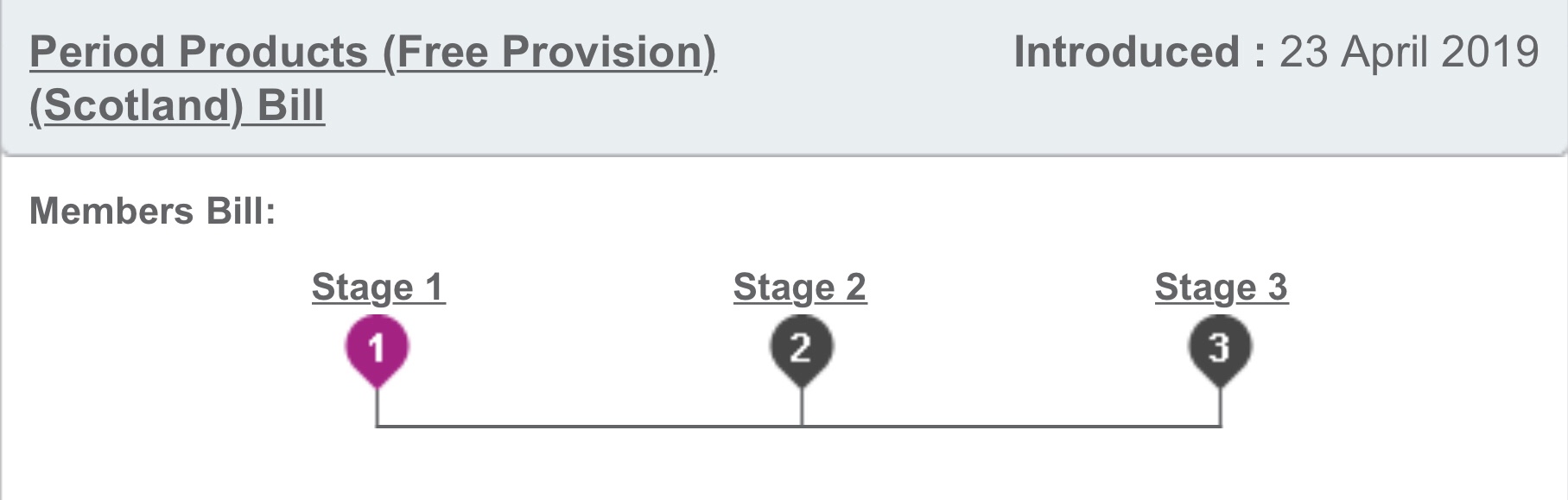
An infographic can be seen below which shows the current progress of the Bill:
The above infographic shows that the Bill is still at the first of the three legislative stages in the Scottish Parliament. Unless and until it successfully completes the other stages, it cannot become an Act of the Scottish Parliament.
Private Member’s Bills at Westminster
Although individual MPs can sponsor Bills in the House of Commons, this method of law making is fraught with difficulties – even if the proposed measure enjoys considerable support.
A recent example of a Private Member’s Bill falling foul of procedural technicalities in the House of Commons was the Voyeurism (Sexual Offences) Bill (introduced on 6 March 2018 by Wera Hobhouse, a Liberal Democrat MP). The text of the Bill can be read by accessing the link below:
This Bill aimed to make ‘upskirting’ a specific criminal offence in England and Wales (it was already a criminal offence in Scotland). This issue had received a lot of public support due to the efforts of Gina Martin, who had been the victim of ‘upskirting’ when attending a music festival in August 2017. When Ms Martin reported the matter to the Police, she was astonished to learn that there was no specific offence covering such behaviour under the criminal law of England and Wales.
A video covering Gina Martin’s campaign can be found below:
Unfortunately, the Bill was derailed by the efforts of Sir Christopher Chope (a Conservative MP sitting for the Christchurch constituency) who used a procedural mechanism to object to the Bill thus ensuring that it could not make any further progress in the House of Commons.
Following a public uproar, Sir Christopher later attempted to justify his intervention in an exclusive interview with the Bournemouth Echo newspaper:
The UK Government recognising that such a Bill commanded considerable support both publicly and in Parliament, reintroduced the Bill as an Executive Bill and the measure was finally passed as the Voyeurism (Sexual Offences) Act 2019.
Despite formidable parliamentary obstacles at Westminster, Private Member’s Bills do become law occasionally – the Abortion Act 1967 and the Sexual Offences Act 1967 are often cited as the two most high profile examples of such Bills becoming Acts of the Westminster Parliament. That said, these measures received support from the UK (Labour led) Government of the day, otherwise there would have been little chance of legislative success.
At Westminster, the Executive (the UK Government) historically controls the parliamentary timetable in the House of Commons and the Prime Minister and other ministerial colleagues will prioritise the Bills which they wish to see passed into law. This can mean that there is very little time left over in the parliamentary business timetable for Private Member’s Bills – no matter how worthy they may be.
Since the General Election of May 2017, of course, the UK Conservative led Government has not enjoyed a majority in the House of Commons and has struggled accordingly to pass contentious legislation (Brexit Alert! anyone?).
Conclusion
I remember attending an event at the University of Strathclyde in 2014 when the Right Honourable John Bercow MP, the Speaker of the House of Commons addressed staff, students and invited guests. The audience was given the opportunity to put questions to Mr Bercow. One of the questions which I posed was that, given his reputation as a reforming Speaker of the Commons, could he learn anything from the practices of the Scottish Parliament? In particular, I wanted to know if he favoured greater involvement of individual MPs and parliamentary Committees in the legislative process at Westminster? He was clearly interested in looking at these matters and admitted that Westminster could learn from the practices of the devolved parliaments and assemblies in Northern Ireland, Scotland and Wales.
It remains the case, however, that it is much more likely that an individual MSP at Holyrood – such as Monica Lennon – has a far greater chance of sponsoring a Bill and seeing it to completion, thus, ensuring meaningful, legislative change. This is something that many of her counterparts at Westminster will simply not be able to achieve.
Postscript
The Independent reports that, as of 26 September 2019, 4 men have been convicted of ‘upskirting’ in England and Wales under the Voyeurism ((Sexual Offences) Act 2019.
The difficult trading conditions on the UK high street don’t seem to be easing with news that Debenhams, one of the country’s biggest retailers, will close 50 of its stores. This will affect about 1,200 employees of Debenhams, many of whom will be facing up to the threat of redundancy.
Debenhams have just announced the names of the first 22 stores which will close in 2020.
The struggling department store chain plans to close the shops next year, affecting 1,200 staff.
Redundancy
Redundancy can be potentially fair reason for dismissal… if handled correctly by employers.
Only employees can be made redundant.
Remember: Section 230 of the Employment Rights 1996 defines who is an “employee”.
The definition of redundancy can be found in Section 139(1) of the Employment Rights Act 1996:
(1) For the purposes of this Act an employee who is dismissed shall be taken to be dismissed by reason of redundancy if the dismissal is wholly or mainly attributable to-
(a) the fact that his employer has ceased or intends to cease-
(i) to carry on the business for the purposes of which the employee was employed by him, or
(ii) to carry on that business in the place where the employee was so employed, or
(b) the fact that the requirements of that business-
(i) for employees to carry out work of a particular kind, or
(ii) for employees to carry out work of a particular kind in the place where the employee was employed by the employer,
The relevant legal provisions governing redundancy are quite extensive and can be found in:
● Trade Union and Labour Relations (Consolidation) Act 1992
● Employment Rights Act 1996
● Information and Consultation of Employees Regulations 2004
● Transfer of Undertakings (Protection of Employment) Regulations 2006
● Collective Redundancies and Transfer of Undertakings (Protection of Employment) (Amendment) Regulations 2014.
The really critical provisions of UK employment law which govern redundancy handling are to be found in the following:
● Sections 188-198 of the Trade Union and Labour Relations (Consolidation) Act 1992
(Section 188 is further supplemented by the Collective Redundancies and Transfer of Undertakings (Protection of Employment) (Amendment) Regulations 1999).
Handling redundancies
Employees should be selected for redundancy in a fair way.
The employees who are at risk for potential redundancy will be part of a group of individuals known as the redundancy pool.
Employers can manage situation in a number of ways.
How?
● LIFO
● Volunteers
● Disciplinary records
● Staff appraisal – skills, experience etc (redundancy matrices or re-applying for your job).
What is LIFO?
Last in, first out – was the most commonly used method, but it could fall foul be regarded as indirect discrimination e.g. too many young people are made redundant. So there are limitations to this approach.
Redundancy selection criteria must be objective.
Many employers will have contractual redundancy policies. Must stick with this: see John Anderson v Pringle of Scotland [1998] IRLR 64.
Appeals should be permitted.
Individuals will still be an employee until effective date of redundancy.
Avoiding redundancies
Redundancy could be avoided by:
● Short-time working
● Lay-offs
The employer needs to consult with employees or their representatives.
Both sides may not reach agreement, but consultation has occurred.
It has to be a meaningful exercise – not a paper one.
Additional rights
Employees have additional rights in redundancy situations:
● Consultation with employer
● Notice period
● Suitable, alternative employment
● Time off to find new employment
Selection for redundancy
Selection for redundancy is automatically unfair in relation to:
● Protected characteristics e.g. age, disability, gender, maternity and pregnancy etc
● Trade Union participation or acting as employee representatives
● Jury service
● Whistle-blowing & health and safety cases
● Asserting statutory rights
● Occupational pension trustees
Statutory redundancy pay
Statutory redundancy pay is most common payment. Only those employees who have 2 years or more continuous service are entitled to claim statutory redundancy pay.
It is worked out according to the following formula:
● half a week’s pay for each full year employees were under 22
● 1 week’s pay for each full year employees were 22 or older, but under 41
● 1 and half week’s pay for each full year employees were 41 or older
Length of service which can be used to calculate the amount of redundancy pay is capped at 20 years and the amount of weekly pay is capped at £525 (the maximum statutory amount claimable is £15,750) from 6 April 2019.
Employers can be more generous with redundancy pay or they can include employees with less than 2 years’ continuous service.
No tax is payable on redundancy pay less than £30,000.
Employees can calculate their entitlement to statutory redundancy pay by clicking on the link below:
Proper notice of redundancy must be given. Section 86 of the Employment Rights Act 1996 contains the relevant notice periods for termination of the employment contract.
The maximum period of notice for those employees with 12 years or more continuous service is 12 weeks.
Sometimes contractual periods of notice can be longer, but not shorter than the those laid down by the Employment Rights Act 1996.
That said, notice can be shorter if the employment contract permits employer to make a payment in lieu of notice.
Employees will receive full entitlement to redundancy pay, notice pay, holiday pay & other entitlements.
Collective redundancies?
This situation arise where more than 20 employees are going to be made redundant in a 90 day period. Fixed term contract employees do not need to be included in collective consultation, except if contract ending early because of redundancy.
The Debenhams’ situation is likely to be classified as a case of collective redundancy.
There must be consultation with with Trade Union or employee representatives.
Consultations must cover:
● ways to avoid redundancies
● the reasons for redundancies
● how to keep the number of dismissals to a minimum
● how to limit the effects for employees involved, e.g. by offering retraining
Length of consultation period?
No time limit for how long this period should be, but the minimum is:
● 20 to 99 redundancies – the consultation must start at least 30 days before any dismissals take effect
● 100 + redundancies – the consultation must start at least 45 days before any dismissals take effect
These minimum periods apply if employers are contemplating making collective redundancies within a 90 day period.
The UK Coalition Government (2010-15) substantially reduced redundancy consultation periods.
Failure to consult employees?
Dismissals will almost certainly be unfair.
In a collective redundancy situation, employers should notify the Redundancy Payments Service (RPS) by filling out form HR1. It is a (strict liability) criminal offence not to complete the HR1.
Well, there you have it: Scotland’s worst kept political secret. First Minster, Nicola Sturgeon announced this week at Holyrood that she wishes to bring legislation forward to hold a second, Scottish Independence referendum sometime in 2021.
The trouble is that this is a matter reserved to the Westminster or UK Parliament in terms of the Scotland Acts 1998 and 2016 i.e. it is a constitutional matter. In other words, the UK Parliament must agree to any request from the Scottish Parliament to hold another referendum. The referendum of 2014 was permitted because the then UK Prime Minister, David Cameron agreed to it. This was known as the Edinburgh Agreement signed by representatives of both the Scottish and UK Governments on 15 October 2012. Under Section 30 of the Scotland Act 1998, a legislative instrument (known as an Order-in-Council) was drafted permitting the referendum to proceed on terms agreed by both Governments.
Fast forward 5 years from the last independence referendum and it would seem that any permission from the UK Government, let alone the UK Parliament is most unlikely. In fact, David Liddington MP, Prime Minister Theresa May’s de facto Deputy, hit back almost immediately in response to Ms Sturgeon’s announcement to state that permission for a referendum would not be forthcoming.
Now, Mr Liddington is correct in strict legal terms. The future territorial integrity of the United Kingdom is a matter reserved to the national parliament at Westminster – not a local parliament such as Holyrood.
And yet … this is where politics rather than strict legal interpretations might come into play. The current UK Government ‘led’ by Theresa May is weak, divided, obsessed with Brexit and lacking a majority in the House of Commons. It has a limited shelf-life. This is an administration which no longer speaks with any real authority on the great political questions of our age (and that’s just the opinion of most Conservative MPs).
Mr Liddington’s refusal may well come back to haunt the Conservatives both in Scotland and nationally. Expect Ms Sturgeon to make maximum political capital here by saying that this is a deliberate attempt to thwart the political will of the Scottish people. At the last UK General Election (8 June 2017), the Conservative Party made impressive gains in the number of Scottish Westminster seats. Since then, with the mishandling of Brexit, continuing opposition to an independence referendum might mean that these electoral advances could be undermined, even reversed. It’s by no means certain that a future Jeremy Corbyn led UK Government (not a foregone conclusion) will favour a second independence referendum. There are many factors that still have to be played out here.
Ms Sturgeon (or one of her Ministers) could introduce a Referendum Bill to Holyrood, but would this be a credible legal move? Almost certainly not: Holyrood’s Presiding Officer would (rightly) be under huge pressure to declare the Bill as not having the necessary legislative competence in terms of the Scotland Acts. The Bill would have tremendous symbolic power and would almost certainly fire up independence supporters who are itching for IndyRef2.
Never mind the legal arguments, expect the action to take place on the political front.
Please find below a number of links to articles discussing the prospect of IndyRef2:
Better together? Not if you’re Asda and Sainsbury’s supermarket chains.
As of today (25 April 2019), the statutory regulator, the UK Competition and Markets Authority (CMA) has decided that the proposed merger between the two businesses should not take place.
As the above scenario demonstrates, the CMA has been given the power by the UK Parliament to make legally binding decisions of this nature. Theoretically, statutory regulators exist (in the main) to ensure that large business organisations do not acquire an overwhelmingly, dominant market position where they can ‘kill off’ competitors and substantially reduce consumer choice.
Stuart McIntosh, chair of the CMA inquiry group, said:
“It is our responsibility to protect the millions of people who shop at Sainsbury’s and Asda every week. Following our in-depth investigation, we have found that this deal would lead to increased prices, reduced quality and choice of products, or a poorer shopping experience for all of their UK shoppers. We have concluded that there is no effective way of addressing our concerns, other than to block the merger.”
The CMA press release can be read using the link below:














 Seán Crossan's Scots Law