Oh brother!

Photo by Seán J Crossan (Card design by M&S)

Apparently, the Chinese have a proverb which translates something along the following lines: the Devil gives you your family; thank all Gods that you can choose your friends!

Quite an apt statement to lead me into my next blog. Families can be great; they can also be problematic. This point is emphasised by reference to a recent decision of the Appeal Court of the High Court of Justiciary in Edinburgh.

In Michael Scott Ritchie v Her Majesty’s Advocate [2020] HCJAC 7 HCA2019/327/X, the Appeal Court had to consider whether a Sheriff sitting at Elgin had misdirected the jury and, consequently, a miscarriage of justice had occurred.

The convicted person or appellant, Michael Ritchie, certainly thought so. He had appeared at Elgin Sheriff Court in 2019, charged on indictment in respect of the following matters:

on 11 or 12 May 2018 you … did break into the dwelling house owned by [JR] … at Strathville, South Street, Forres, Moray and steal a quantity of jewellery, medals, coins and a box;

You … did commit this offence while on bail, having been granted bail on 15 June 2017 at Elgin Sheriff Court.

He was convicted of the offences libelled above after the conclusion of a solemn (jury) trial and sentenced to 21 months in prison (3 months of which were for the bail violation).

Part of the evidence put forward to convict Ritchie by the Depute Procurator Fiscal (the prosecutor for the benefit of our non-Scottish readers) was a small black torch which was found at the locus of the crime. The item was not a possession of the householder. The torch contained traces of Ritchie’s DNA and he admitted that the item belonged to him. ‘Ritchie further admitted that he had been about 150 yards from the vicinity of the crime scene, but he strongly asserted that he was not guilty of any offence.

DNA – infallible evidence?

This is where the case gets quite interesting: Ritchie stated that although his DNA was on the torch, he had not committed the crime of house-breaking (or burglary as our friends from common law jurisdictions would say). He was not responsible for leaving it at the locus.

In other words, Ritchie was contending that, merely because his DNA happened to be on the torch found at the crime scene, this in itself was not conclusive evidence of his guilt. Ritchie, of course, was using a special defence available in Scots Law known as incrimination – he was claiming that someone else [his brother] had committed the offence. Interestingly, Ritchie’s brother had previous convictions for theft, but these had involved commercial premises.

He further asserted that he may have loaned a torch to his brother in the last month or so. He contended that the torch given to his brother was a black rubber one. Unfortunately, for Ritchie the torch found at the locus was a black metallic item.

When speaking to students about the issue of corroboration in criminal law, I often ask them which sources of evidence might be used by a prosecutor to help secure a conviction? DNA evidence will almost always feature in the range of answers that I am given.

… but I should urge caution: it’s not an infallible source of evidence. It has to be put in context and the onus (or burden) about what the DNA tells the Court i.e. whether it can point the way to the accused being guilty beyond reasonable doubt remains very much the responsibility of the prosecution (or Crown).

The role of the Sheriff and the jury

In a solemn trial, there is a strict division of responsibility: the jury is regarded as Master of the facts; whereas the Sheriff is Master of the law.

The jury will, therefore, determine the guilt or innocence of the accused based upon the evaluation of the evidence presented during the trial. The burden of proof rests with the prosecutor (representing the Crown or the State) in that s/he must convince the jury that the accused is guilty of the charge(s) contained in the indictment.

When summarising the evidence that has been presented to the court, the Sheriff must do so in a way that avoids the introduction of bias. The jury must be able to come to its own determination of the facts.

If guilt is established, it is then the task of the Sheriff to impose the appropriate sentence – usually at a subsequent hearing (for which there is no need for the jury to be present).

The Appeal

The main thrust of Ritchie’s appeal to the High Court in Edinburgh was that the Sheriff had misdirected the jury which led to him being wrongly convicted.

Sadly, for Ritchie, the Appeal Court did not agree.

Statements by the Procurator Fiscal Depute concerning the veracity of Ritchie’s responses during a Police interview did not suggest that the onus was now placed on the defence to prove his innocence. An accused in a Scottish criminal trial is under no obligation to prove his/her innocence. Innocence is, after all, presumed and it remains the task for the prosecution to prove guilt.

Lord Carloway, the Lord Justice General, giving the opinion of the Appeal Court noted:

‘… that the sheriff made it clear that the onus remained on the Crown and that there was no such onus on the defence. The sheriff’s reference to hypothetical situations was merited in the circumstances. Anything said by the PFD [Procurator Fiscal Depute] was adequately covered by the sheriff in her general directions on onus; the sheriff being in the best position to determine what was required in order to correct any misconception that the jury might have had from what the PFD had said.

Regarding the presence of the torch (belonging to the accused) at the locus, this was in itself a ‘highly incriminatory’ fact. Significantly, Ritchie had not identified the item when presented during his trial as being the torch that he claimed to have previously supplied to his brother.

In reviewing the testimony of the expert witnesses who spoke to the DNA evidence at the trial, Lord Carloway had the following to say:

Expert evidence about the deposit of DNA was led by both the Crown and the defence. There were various scenarios put to the experts about how DNA can be deposited, how long it could remain, how it could be transferred and whether it was primary or secondary. The sheriff described all of this evidence as essentially common sense. There was, however, a disagreement between the experts in relation to four peaks, which had been identified from the DNA print-out upon testing.

The four peaks could either be artefacts (the Crown) or DNA belonging to an unknown person or persons (the defence).

The Crown submitted in its argument to the Appeal Court that the Sheriff had correctly emphasised to the jury “to scrutinise the evidence with care and be satisfied that there was an evidential basis for the submissions which had been made to them.”

Taking all of the above matters into consideration, there was no evidence to suggest that Michael Ritchie had suffered a miscarriage of justice and his appeal was refused.

A link to the judgement of the Appeal Court can be found below:

https://www.scotcourts.gov.uk/docs/default-source/cos-general-docs/pdf-docs-for-opinions/2020hcjac7.pdf?sfvrsn=0

Related Blog Articles:

https://seancrossansscotslaw.com/2020/01/09/down-with-corroboration-i-say/

https://seancrossansscotslaw.com/2020/01/02/presumption-of-innocence/

https://seancrossansscotslaw.com/2019/04/22/scrap-corroboration/

https://seancrossansscotslaw.com/2019/12/28/alexa-theres-been-a-murder/

https://seancrossansscotslaw.com/2019/03/01/corroboration/

https://seancrossansscotslaw.com/2017/04/04/scottish-criminal-appeals/

Copyright Seán J Crossan, 15 February 2020

Criminal evidence & vulnerable witnesses

Photo by Marco Albuquerque on Unsplash

Today, the Vulnerable Witnesses (Criminal Evidence) Scotland Act 2019 comes into force.

This piece of legislation, passed by the Scottish Parliament, was given Royal Assent in June 2019.

It represents the introduction of an innovative change to Scots criminal law. The new law will permit vulnerable witnesses to pre-record their evidence in advance of trial so that they will not be required to appear in court in person.

According to a Scottish Government press release (see link below), a vulnerable witness is defined in the following terms:

‘[if] they are likely to suffer significant risk of harm as a result of giving evidence. This includes victims of sexual assault, domestic abuse, trafficking and stalking, and those under the age of 18.’

https://www.gov.scot/policies/victims-and-witnesses/pre-recording-of-evidence-criminal-trials/

For children aged under 18, in particular, the Act permits the evidence to be taken by commissioner. This procedure will be disregarded if it would significantly prejudice the interests of justice.

The Scottish Government has noted that the new legislation consolidates changes that were made in 2014 to safeguard the rights of vulnerable witnesses i.e. the Witnesses and Victims (Scotland) Act 2014.

Links to both pieces of legislation can be found below:

http://www.legislation.gov.uk/asp/2014/1/contents

http://www.legislation.gov.uk/asp/2019/8/enacted

Related Blog Article:

https://seancrossansscotslaw.com/2019/03/20/vulnerable-witnesses/

Copyright Seán J Crossan, 20 January 2020

Down with corroboration (I say)!

Photo by Andy T on Unsplash

Who’s ‘I’? Amanda Pinto – that’s who, but more about her later.

In Scottish criminal procedure, we place a great deal of emphasis on the principle of corroboration. In a criminal trial, the prosecutor must prove that the accused is guilty of a crime beyond  reasonable doubt. This is a very strict burden and, in Scotland, the prosecution achieves this standard by corroborating its evidence against the accused. Corroboration means that there must be at least two independent sources of evidence such as witness testimony and the use of expert and forensic evidence. Reasonable doubt is a nagging doubt which would lead a reasonable person to the conclusion that it would be unsafe and unjust to find the accused guilty.

Not every legal system places such importance on the principle of corroboration: some of our English brethren seem (very) disinclined to follow us.

This week, distaste for corroboration has been voiced somewhat forcefully by Amanda Pinto QC, the incoming Chairperson of the Bar Council of England and Wales (the English equivalent of the Faculty of Advocates). Ms Pinto represents some 16,000 barristers and her views are therefore not to be dismissed easily.

Of particular concern to Ms Pinto seems to be UK Government proposals to introduce an element of corroboration into English criminal legal practice. Speaking to Jonathan Ames of The Times (of London), her main objection to the introduction of corroboration appears to be in relation to rape trials:

We’ve rightly come away from requiring corroboration [in England and Wales],” she says. “Because if you require corroboration in something that is typically between two people, then you restrict access for justice for some victims entirely.

Several years ago in Scotland, we also had a discussion on the merits of the continued use of corroboration in criminal proceedings. Lord Carloway (now the Lord Justice General), Police Scotland and the Crown Office and Procurator Fiscal Service were of the opinion that this requirement should be abolished. Significantly, the Faculty of Advocates and the Law Society of Scotland were opposed to this development. Warnings of possible miscarriages of justice were raised if this was allowed to happen. Corroboration was retained.

Nore recently (in 2019), groups representing survivors of sexual abuse made powerful and emotional submissions to the Scottish Parliament arguing that the requirement of corroboration be abolished. We still have the principle in place in Scotland.

Responding to these submissions by abuse survivors, Brian McConnochie QC, a senior member of the Faculty of Advocates went on record defending the current evidential requirement:

I know that some people consider that corroboration is something which we ought to abandon or abolish, and as often as not the argument is given that it should be abolished because nobody else has it. I’ve never been convinced by that argument. We went through a process where it was discussed at significant and considerable length, and at the end of that process the decision was taken that it should go no further.”

James Wolffe QC, the current Lord Advocate (head of the Scottish prosecution service) has openly stated that a review of corroboration could be on the cards, but Gordon Jackson QC, current Dean of the Faculty of Advocates has voiced the Faculty’s continuing opposition to such a development:

https://www.scottishlegal.com/article/lord-advocate-hints-at-renewed-attack-on-corroboration

Related Blog Articles:

Scrap corroboration?

Corroboration

Alexa, there’s been a murder!

Copyright – Seán J Crossan, 9 January 2020

The public interest?

Photo by Karl Bewick on Unsplash

We have an independent criminal prosecution service in Scotland headed by the Lord Advocate (a Scottish Government Minister). James Wolffe QC, the current Lord Advocate, has responsibility for the Crown Office and the Procurator Fiscal Service.

Yesterday, the role of the Lord Advocate came under intense media scrutiny as a result of the decision of the Crown Office not to prosecute several Police Scotland officers who had been accused of causing the death of a man who had been taken into custody in 2015.

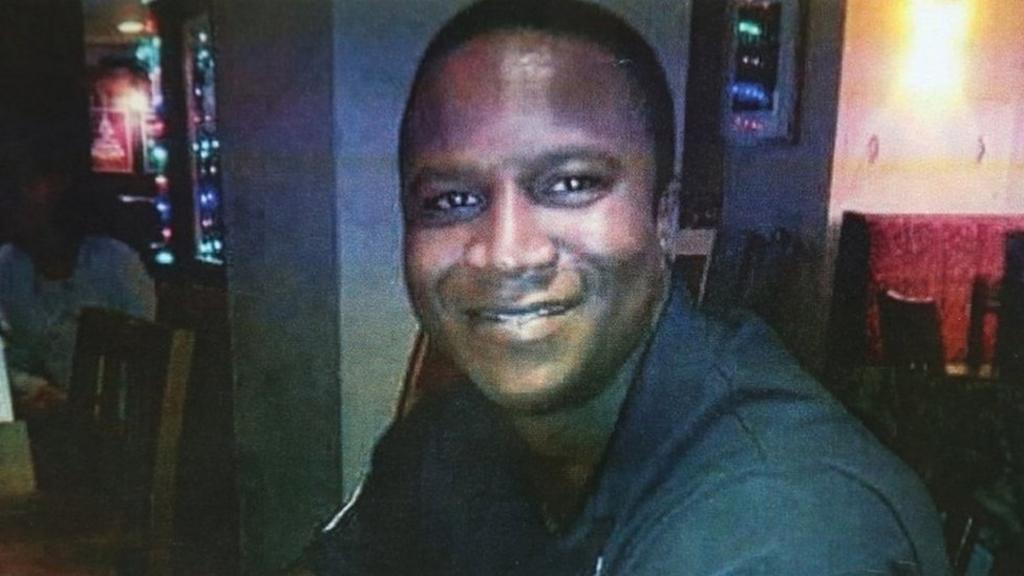
The deceased was 31 year old Sheku Bayoh, who was arrested by Police officers in the Scottish town of Kirkcaldy. It was later established in a post mortem that Mr Bayoh had consumed drugs (MDNA and Flakka).

On a more sinister level, Mr Bayoh was found to have 23 different physical injuries. The Bayoh family and their solicitor (Aamer Anwar) always maintained that the actions of Police officers had caused the death and that they should face prosecution for their actions.

To the dismay of the Bayoh family, the Lord Advocate has declined to pursue criminal charges against the Police officers as this would not be in the public interest.

Today, Humza Yousaf, the Scottish Government Cabinet Secretary for Justice decided to convene a public inquiry into the circumstances of Mr Bayoh’s death – which may be some small consolation to his still grieving family.

The Bayoh family may also be considering the possibility of a civil action for compensation against the Police officers who they are alleging have responsibility for the death.

This case is a timely reminder that it is the State (or the Crown) which has the ultimate power to determine who will be prosecuted for crimes – not the victim or the family of the victim.

The possibility of the Bayoh family being granted the right to initiate a private prosecution against the Police officers is unlikely. The High Court of Justiciary must grant permission, by way of a Bill of Criminal Letters, for any private prosecution to proceed in the first place.

It should go without saying that the prosecutor in a private prosecution will still have to prove the allegations against the accused.

Two fairly recent attempts to raise private prosecutions in Scotland have been rejected out of hand by the High Court of Justiciary (see Bill for Criminal Letters by (1) John and Linda Stewart and (2) Allan and Aileen Convey Against William Payne AND (1) Matthew McQuade and Jaceline McQuade and (2) Yvonne Reilly Against Henry Clarke [2016] HCJAC 122 HCA/16-2/XM HCA/16-3/XM).

A link to the Opinion of the High Court of Justiciary in respect of these matters can be found below:

https://www.scotcourts.gov.uk/search-judgments/judgment?id=d26a25a7-8980-69d2-b500-ff0000d74aa7

The most famous, partially successful private prosecution in Scotland in was the affair which became known popularly as the Glasgow Rape Case. In 1982, a rape victim was permitted to raise a private prosecution against three of her alleged assailants (see X v Sweeney (1982) JC 70).

Prior to this legal action, there had been one, other private prosecution in Scotland during the 20th Century and that matter had been concluded as far back as 1911 (the actual Bill of Criminal Letters was granted in 1909 – see J & P Coats Ltd v Brown 1909 6 Adam 19).

A link to a story about the Lord Advocate’s decision can be found on the BBC Scotland website:

Sheku Bayoh: Family feel ‘betrayed’ over decision not to prosecute officers

His family said they felt betrayed over the decision not to bring criminal charges against police officers.

Copyright Seán J Crossan, 12 November 2019

Doing time …?

Photo by Emiliano Bar on Unsplash

In a previous blog (“Commit the crime, do the time?” published on 4 March 2019), I examined the role of the Scottish Sentencing Council (established as a result of the Criminal Justice and Licensing (Scotland) Act 2010) in relation to the imposition of various sentences on convicted offenders. The Council took up its role from 2015 onwards.

On Monday 12 June 2019, the second most senior judge sitting in Scotland, Lady Dorrian, Lord Justice Clerk, announced that the Scottish Sentencing Council would conducting a public consultation in an attempt “to demystify” the factors by which a criminal court takes into consideration when imposing punishment on the offender.

The consultation exercise will tackle a perception which exists (rightly or wrongly) amongst the public that sentencing can be extremely inconsistent. It will address this problem by highlighting issues which are likely to be considered aggravating factors by a judge and thus lead to the imposition of a longer sentence. Aggravating factors would include whether the crime was premeditated or in situations where a weapon was used. Conversely, it is hoped that the exercise will pinpoint mitigating factors that a judge takes into account when a lighter sentence is passed e.g. genuine remorse shown on the part of the offender or any negative consequences that the offender’s children are likely to suffer.

Readers may wish to take part in the public consultation exercise and can so by clicking on the link below at the Sentencing Council’s website:

https://consultations.scottishsentencingcouncil.org.uk/ssc/the-sentencing-process/consultation/subpage.2019-05-29.0933048382/

In order to assist the public and other interested parties to complete the survey, the Council has provided a number of documents which can be accessed via the link below:

https://consultations.scottishsentencingcouncil.org.uk/ssc/the-sentencing-process/

The closing date for participation in this exercise is 6 September 2019.

A link to an article on the BBC website about the exercise can be found below:

https://www.bbc.co.uk/news/uk-scotland-48556439

The Scottish Parliament’s Justice Committee

This week, in a related matter, the Justice Committee at Holyrood (by 7 votes to 2) decided to support plans by the Scottish Government, which if carried, would extend the presumption against short prison sentences.

Currently, in Scotland, there is a presumption against the imposition of prison sentences of less than 6 months and the court will most likely impose an alternative punishment.

Interestingly, on 19 February 2019, Scottish Legal News reported that David Gauke MP, the UK Government’s Justice Minister, had stated that he would introduce legislation in England and Wales in order to follow current, Scottish criminal practice as regards sentencing i.e. a presumption against prison terms of less than 6 months:

https://www.scottishlegal.com/article/england-follows-scotland-s-lead-on-presumption-against-short-sentences

Copyright Seán J Crossan, 13 June 2019

Stalkers beware!

Photo by Jaanus Jagomägi on Unsplash

A few of my recent blogs have discussed the legislative process in the Scottish Parliament and several Bills that are already undergoing scrutiny and debate at Holyrood.

So, when quickly glancing at the Scottish Parliament’s website today, I was very interested to see a proposal for a Member’s Bill which wishes to toughen the law on stalking in Scotland.

The proposed measure (if given the green light) would take the form of a Stalking Protection (Scotland) Bill and it would have a simple rationale:

“… to increase protection for victims of stalking by giving police the power to apply for stalking protection orders on behalf of victims.”

Stalking was made a specific criminal offence as a result of Section 39 of the Criminal Justice and Licensing (Scotland) Act 2010, but Rona Mackay MSP, the proposer of the measure clearly believes that the current law needs to be tightened in order to give victims of stalking more protection.

As part of her rationale, Ms Mackay makes reference to England and Wales where the Stalking Protection Act 2019 has been introduced. This legislation gives the a Chief Constable of a Police area south of the border the power to apply to a Magistrates’ Court for a stalking prevention order. Clearly, she is of the view that Scotland should follow suit in order to protect victims of this type of crime more effectively.

A link to the English and Welsh legislation can be found below:

http://www.legislation.gov.uk/ukpga/2019/9/enacted

In a YouTube video, Ms Mackay provides some background to her proposed Bill and invites members of the public to contribute to the consultation by submitting their views by 21 July 2019.

A link to the Consultation document can be found below:

Click to access 20190425_Final_Consultation_document.pdf

Perhaps this is an issue which you feel strongly about and would like to get involved in shaping a new law for Scotland?

You can do this by completing an online survey (link below):

https://www.smartsurvey.co.uk/s/StalkingProtectionBill/

At the moment, there is no Bill – only Ms Mackay’s proposal for one and it remains to be seen whether she will be able to secure the necessary support to take the matter forward i.e. securing the support of 18 MSPs from at least half of the political parties or groups represented in the parliamentary bureau; and provided the Scottish Government does not itself intend to legislate upon the matter.

Copyright Seán J Crossan, 13 June 2019

Ban smacking!

Photo by Kat J on Unsplash

John Finnie, a Green Party member of the Scottish Parliament introduced a Bill (Children (Equal Protection from Assault) (Scotland) Bill) on 6 September 2018.

This Bill would remove the common law defence of reasonable chastisement in Scotland which permits parents and guardians (primarily) to use smacking as a punishment in relation to children in their care.

The main objective of the Bill is expressed in its accompanying Explanatory Notes:

A person charged with assault of a child will no longer be entitled to claim that a use of physical force was justifiable on the basis that it was physical punishment administered in exercise of a parental right (or a right derived from having care or charge of a child). This will give children the same protection from assault as adults.

The Bill is quite a short one – a mere 5 sections – but if passed into law it is sure to have a very significant effect.

Section 1 contains the actual provision which would abolish the defence of reasonable chastisement

Section 2 places a duty on the Scottish Ministers to raise awareness and understanding of the proposed legislation

Section 3 contains the transitional and saving provision which is essentially interim arrangements for repealing the previous legislation  and gives the Scottish Ministers the power to do anything which would bring the provisions of the new law into force

Section 4 deals with the commencement of the proposed law i.e. the day after it receives Royal Assent

Section 5 contains the short title of the Bill.

The Bill will be debated and scrutinised by other MSPs in the Chamber and in Committee and it is quite possible that amendments or changes will follow. With every Bill, there is also the possibility that it might fall at a particular stage of parliamentary proceedings or, even if passed, could be subject to legal challenge e.g. the Scottish Government’s Children and Young Person’s (Scotland) Act 2014 which the UK Supreme Court found fault with on human rights grounds in 2016 (see The Christian Institute and Others v The Lord Advocate [2016] UKSC 51).

A link to the Scottish Parliament’s website where the Bill (as introduced) and its accompanying or supporting documents (which must be submitted) can be found below:

https://www.parliament.scot/parliamentarybusiness/Bills/109156.aspx

The Bill must, of course, comply with Scotland’s international human rights obligations as contained in the Scotland and Human Rights Acts (of 1998); and it must be within the “legislative competence” of the Scottish Parliament as per the Scotland Acts of 1998 (which the Presiding Officer, Ken McIntosh MSP has indeed confirmed).

The Bill is also subject to a Financial Memorandum. This can be summed up as a cost analysis to the Scottish Administration:

The Bill does not create a new offence; rather, it removes the defence of reasonable chastisement for the assault of a child. Thus, once the Bill is in force, some prosecutions may proceed as a result of the Bill which may not have proceeded when the defence was available. The Bill may also lead to additional cases of lower level physical punishment being reported, and prosecuted, which are currently not reported due to the defence being available.

Accordingly, the Bill can be expected to have some impact and costs on the criminal justice system.” [author’s emphasis]

Progress so far

The Equalities and Human Rights Committee of the Scottish Parliament gave its unanimous backing to the Bill (as as has the Scottish Government).

In support of his Bill, Mr Finnie has emphasised that 54 countries around the world have removed the right from parents and guardians to use physical chastisement as a method of disciplining children. His contention is that, if the Bill is adopted, it would bring Scotland into line with other developed countries.

In order to become a new Scottish law, the Bill, of course, must pass through all (3) legislative stages of Scottish parliamentary procedure.

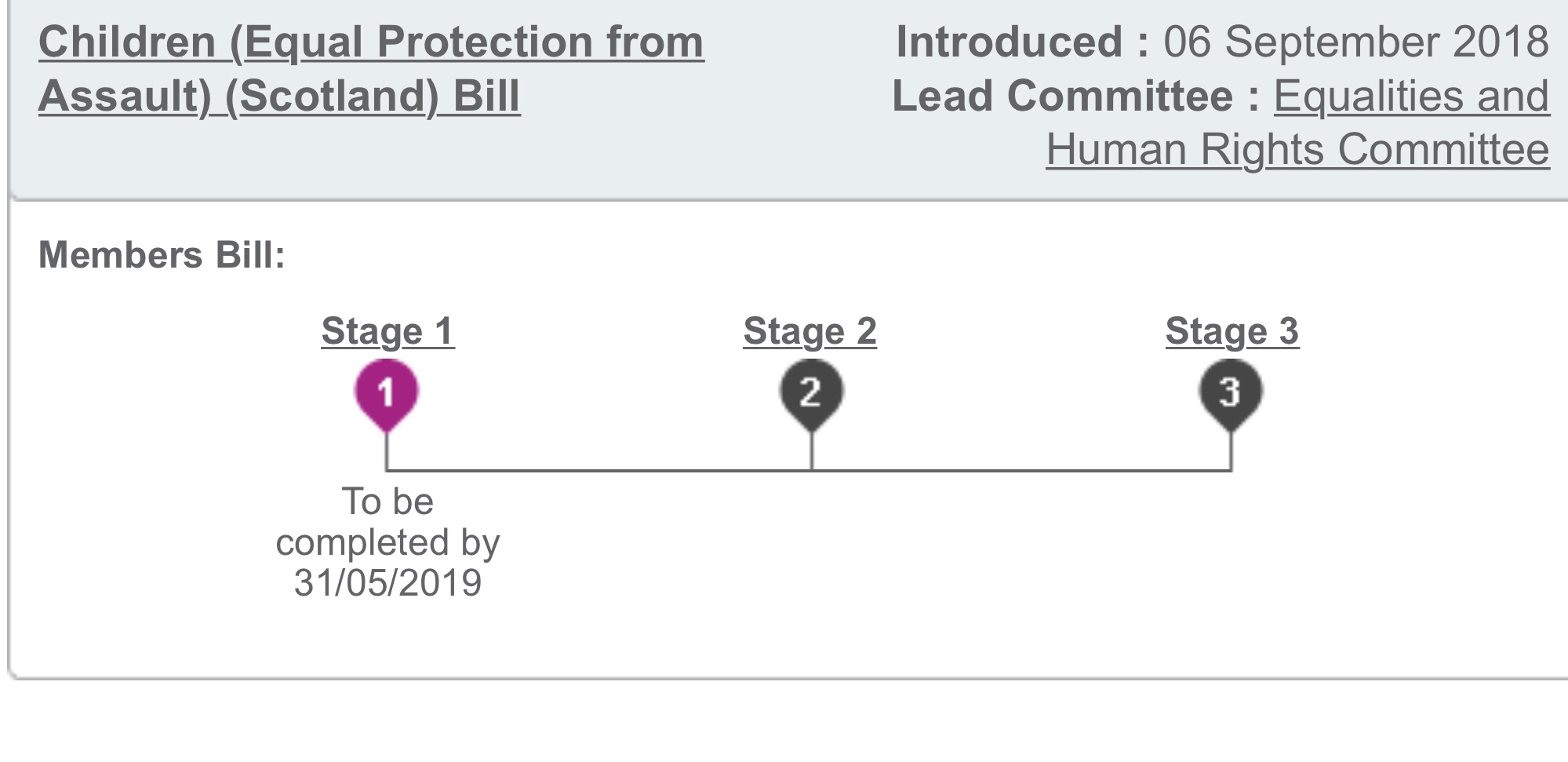
The Bill is currently at Stage 1 of proceedings. Please see the diagram below taken from the Scottish Parliament’s website which tracks the current progress of the Bill (as of today – Tuesday 28 May 2019):

In a previous Blog (Private Members’ Bills published on 29 April 2019), I drew attention to the fact that backbench members of the Scottish Parliament have a much greater ability to introduce Bills (and ultimately get them onto the Statute Book) when compared to their counterparts sitting in the House of Commons at Westminster. The term backbench or private member is a description which covers any MP or MSP who is piloting a Bill through Parliament which is not a Government Bill.

A link to an article on Mr Finnie’s Bill can be found below:

MSPs to discuss smacking ban bill in parliament debate

Postscript

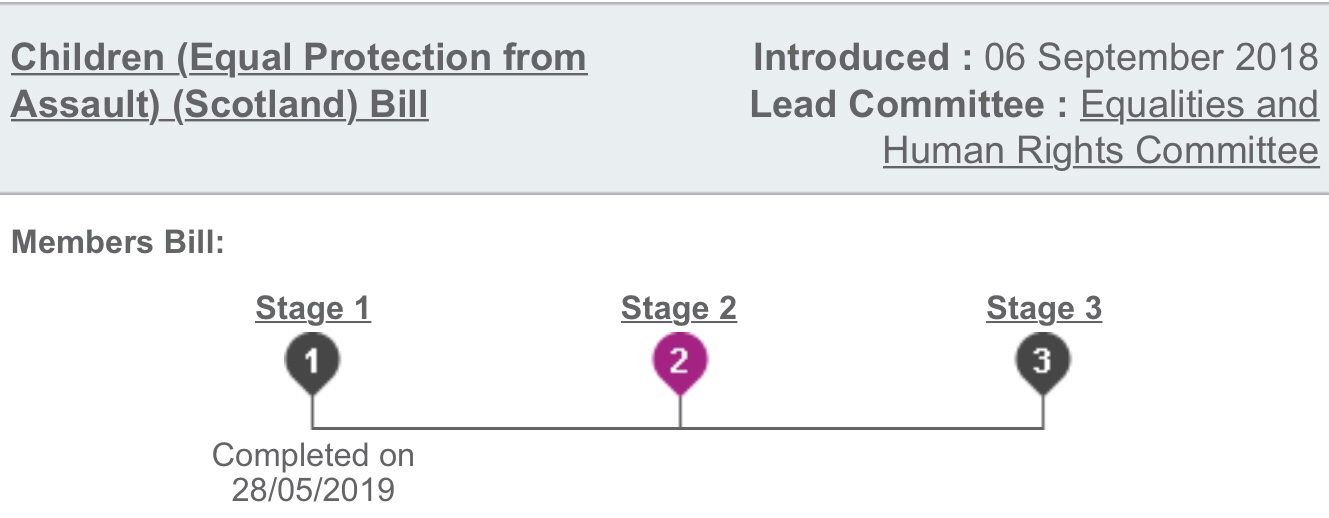
The Bill has now proceeded to Stage 2 of the legislative process in the Scottish Parliament as the infographic displayed below demonstrates:

Copyright Seán J Crossan, 28 May and 13 June 2019

Consent?

Photo by Gemma Evans on Unsplash

A recent decision of the Appeal Court of the High Court Justiciary has provided further clarification on the law surrounding the issue of consent in situations where a person is accused of rape.

The decision itself is a classic example of Appeal Court judges interpreting the meaning of statutory provisions.

For many years in Scotland, rape had the following common law definition:

… a man having sexual intercourse with a woman by overcoming her will by force‘.

The above definition was later significantly amended by a majority decision of the Appeal Court of the High Court in Lord Advocate’s Reference No. 1 of 2001 2002 SLT 466. The effect of this ruling was the removal of the reference to force in the common law definition of rape. Thereafter, the presence (or absence) of consent to sexual conduct would be a vital issue for the prosecution’s case.

We have also moved on from the situation whereby the victims of rape are not just female. A reading of Section 1 of the Sexual Offences (Scotland) Act 2009 (the relevant legislation), which defines the crime of rape, makes it quite clear that men and women can be victims of this offence.

Section 12 provides that “consent” means “free agreement”. Section 13 states that free agreement is “absent” in certain circumstances, including where the complainer is “incapable because of the effects of alcohol or any other substance of consenting”.

I shall now turn to the case in question.

In GW v Her Majesty’s Advocate [2019] HCJAC 23 HCA/2018/423/XC, Lords Carloway, Menzies and Turnbull confirmed that a person who is asleep cannot give consent that s/he wishes to engage in sexual relations. Furthermore, their Lordships also ruled that such an individual cannot be deemed to have given prior consent to such a course of behaviour.

This appeal occurred because the partner (‘GW’) of a woman claimed that he had not raped her while she was sleeping. Part of his defence was that he had engaged in this type of conduct on previous occasions in the relationship and the woman had not objected to this behaviour. Furthermore, the partner claimed that such conduct was a continuing feature of their relationship and, therefore, as such it established a pattern of prior consent. In other words, the partner had a reasonable belief that the woman had consented to this type of sexual activity.

As previously discussed, the relevant legislation is the Sexual Offences (Scotland) Act 2009. What does consent actually mean? The judges were unambiguous in reaching their decision: a sleeping person is simply incapable of giving consent and, in such a situation, it is not possible for an accused to construe advance or prior notice of consent.

During their deliberations, the judges looked at the purpose of the Sexual Offences (Scotland) Act 2009 and considered evidence which had been presented to at Stage 2 of the passage of the Bill through the Scottish Parliament.

Lord Carloway, the Lord Justice General, in delivering the opinion of the Appeal Court stressed that the wording of Section 1(1)(a) and (b) of the Sexual Offences (Scotland) Act 2009 (which defines the crime of rape) uses the words ‘consenting’ and ‘consents’. These words are in the present tense and, therefore, a previous course of dealings between the parties is not in itself enough to establish that there is prior or actual consent to sexual relations. Consent exists in the here and now when the act of sexual intercourse is being carried out.

Section 14 of the 2009 Act which specifically addresses the issue of consent while a person is asleep is extremely unambiguous in its meaning. Subsection (2) states:

A person is incapable, while asleep or unconscious, of consenting to any conduct.’

A link to the judgement of the Appeal Court can be found below:

https://www.scotcourts.gov.uk/docs/default-source/cos-general-docs/pdf-docs-for-opinions/2019hcjac23.pdf?sfvrsn=0&utm_source=Scottish+Legal+News&utm_campaign=f980cdec20-EMAIL_CAMPAIGN_2019_04_29_12_17&utm_medium=email&utm_term=0_07336e1dbf-f980cdec20-66775629

Copyright Seán J Crossan, 2 May 2019

Scrap corroboration?

Photo by Matthew T Rader on Unsplash

Should we scrap the requirement of corroboration in Scots criminal law?

Well … BBC Scotland reported that Speak Out, a group of survivors of sexual abuse think that this is an area ripe for urgent reform. Victims of this type of crime doubtless feel that the requirement of corroboration (a unique feature of Scots criminal law) acts as a barrier or an obstacle to them achieving some sort of justice in the courts.

A link to the BBC Scotland report can be found below:

Abuse survivor calls for end to corroboration

Sex abuse survivors are campaigning for the need for two separate sources of evidence to be scrapped.


Petition to the Scottish Parliament

A Petition has also been submitted to the Scottish Parliament by Maryanne Pugsley (PE1717: Inquiry into the abuse of children in Scottish state schools) calling for a review of the current requirement of corroboration.

Ms Pugsley addressed a Scottish Parliamentary Committee this week about her experiences of abuse in the 1970s while she was at school and the fact that the requirement of corroboration meant that her abuser was never convicted.

A link to BBC Scotland’s website contains footage of Ms Pugsley addressing MSPs about her experiences:

‘The abuse I suffered in the 1970s affects me to this day’

A link to Ms Pugsley’s Petition can be found below:

https://www.parliament.scot/GettingInvolved/Petitions/PE01717

Prospects for reform?

The prospect of reform is something of a forlorn hope on the part of Speak Out and Ms Pugsley because the Scottish Government has, again, recently ruled out any changes to the law.

Additionally, Brian McConnochie QC, a senior member of the Faculty of Advocates has also gone on record (in the first link to the BBC Scotland website above) defending the current evidential requirement:

I know that some people consider that corroboration is something which we ought to abandon or abolish, and as often as not the argument is given that it should be abolished because nobody else has it. I’ve never been convinced by that argument. We went through a process where it was discussed at significant and considerable length, and at the end of that process the decision was taken that it should go no further.”

In a criminal trial, the prosecutor must prove that the accused is guilty of a crime beyond  reasonable doubt. This is a very strict evidential burden in that the prosecution must be able to corroborate its evidence against the accused.

Corroboration means that there must be at least two independent sources of evidence such as witness testimony and the use of expert and forensic evidence. Reasonable doubt is a nagging doubt which would lead a reasonable person to the conclusion that it would be unsafe and unjust to find the accused guilty.

In one of my previous blogs (Corroboration published on 1 March 2019), I examined some of the practical issues involved with corroboration by referring to a recent decision of the Appeal Court of the High Court of Justiciary (see Jacqueline Shuttleton v Procurator Fiscal, Glasgow [2019] HCJAC 12 HCA/2019/20/XC).

Mutual corroboration

Just this week, another decision of the Appeal Court of the High Court of Justiciary was reported – Khalid Jamal Her Majesty’s Advocate [2019] HCJAC 22; HCA/2018/330/XC – which concerned the principle of corroboration.

In this decision, which involved an appeal against conviction, the Appeal Court rejected the argument that an act of penetration (in a sexual assault case) does not have to be corroborated by scientific or medical evidence.

The act of sexual violence (rape) could be corroborated by reliance on other facts and circumstances. This approach is, of course, entirely in keeping with that famous Scottish criminal case – Moorov v HM Advocate 1930 JC 68 – which established the principle of mutual corroboration.

Moorov involved a shopkeeper who sexually assaulted at least 19 young women who worked for him over a period of 4 years. There were no witnesses to these incidents – except for the victims. The accused was successfully convicted because the testimony of the various victims was deemed adequate for the purposes of corroboration.

A link to Khalid Jamal’s appeal can be found below:

https://www.scotcourts.gov.uk/docs/default-source/cos-general-docs/pdf-docs-for-opinions/2019hcjac22.pdf?sfvrsn=0

Postscript
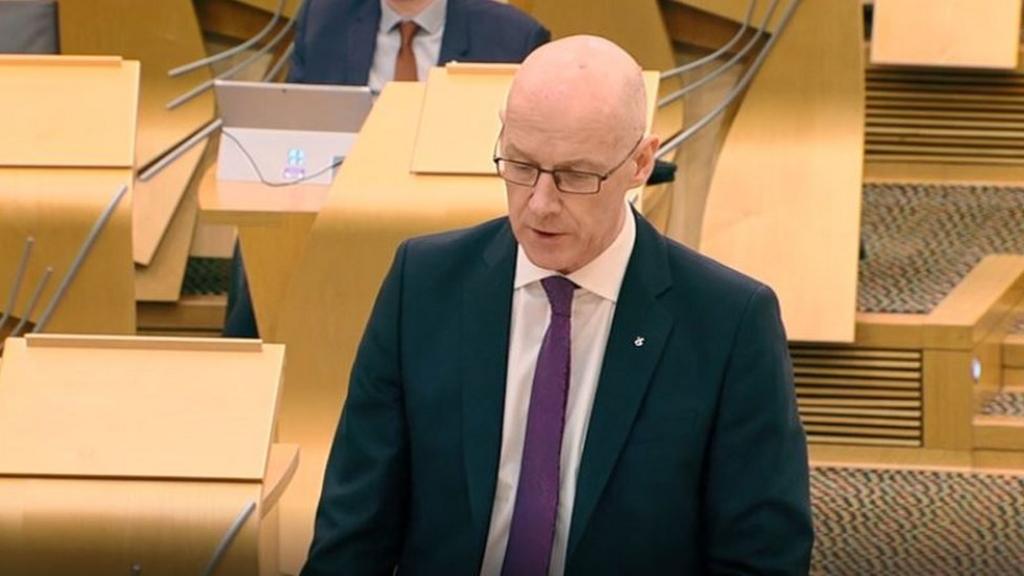
On a more positive note, on 25 April 2019, John Swinney MSP, Deputy First Minister announced in the Scottish Parliament that child abuse victims who are elderly or terminally ill can make an application for compensation.
This is a simplified scheme and involves completing a very straightforward application form.
Please see a link to the story below:

Advance payment scheme for abuse victims opens

Survivors of childhood abuse who are elderly or terminally ill can apply now for compensation payments.
Copyright Seán J Crossan, 22 & 26 April 2019

Victims of crime

Photo by Cristian Newman on Unsplash

Crime is a hugely emotive issue – particularly so for the victims and their families. It is important to remember, however, that the primary purpose of the criminal justice system is to punish offenders who break the collective rules of society as a whole. It is the State which takes vengeance on behalf of the community or society. It is not about the individual rights of victims and, as such, we have a public system of prosecution in Scotland. As discussed in Chapter 1 of Introductory Scots Law, the State is extremely unwilling to allow private prosecutions to proceed and these remain very rare in practice.

In two previous Blogs (“Commit the crime, do the time” published on 4 March 2019; and “Life should mean life?” published on 22 March 2019), I discussed the issues of sentencing by the Scottish criminal courts and, specifically, what exactly a life sentence entails.

I now want to turn my attention to the matter of prisoners making an application to the Scottish Parole Board for release.

The Parole Board is a statutory Tribunal independent of the Scottish Ministers.

Should the victims of crime or their family members have a say in whether the Parole Board decides that a prisoner ought to be released?

This issue has received some media attention because, on 27 March 2019, the Scottish Government closed its Consultation into the Parole system (Transforming Parole in Scotland).

A link to the Consultation can be found below:

https://www.gov.scot/publications/consultation-transforming-parole-scotland/

The Faculty of Advocates responded to the Consultation and agreed, with certain reservations, that the opinions of victims should be taken into account at parole hearings, but on a limited basis and within clear terms of reference.

Essentially, the Faculty believes that any input from victims in parole proceedings should be restricted to the submission of a Victim Personal Statement which would be considered by the Board. The Faculty had misgivings about allowing victims or their families to attend parole hearings and for the Board to release detailed reasons for its decisions.

As the Faculty noted, the primary purpose of the Board “is assessment of risk, and that should remain central in consideration of any reform.”

A link to the Faculty’s response to the Scottish Government’s Consultation can be found below:

http://www.advocates.org.uk/media/3060/final-faculty-response-28-march-2019-3.pdf?utm_source=Scottish+Legal+News&utm_campaign=74a64823a5-EMAIL_CAMPAIGN_2019_04_01_08_23&utm_medium=email&utm_term=0_07336e1dbf-74a64823a5-66775629

Conclusion

The response by the Faculty of Advocates to the Government’s Consultation is unlikely to please everyone, but it does recognise that victims of crime and their families have a role to play (albeit a somewhat limited one). As the Faculty, critically, argues the role of the Parole Board is to assess the risk to the public of releasing a prisoner from incarceration. The opinions of the victims and their families must necessarily take second place here.

Copyright Seán J Crossan, 2 April 2019