Not Proven? Not wanted!!!

Photo by Joshua S https://unsplash.com/@joshuamachtfotos

It’s a New Year and we already have a seismic shift in Scottish legal practice.

On 1st January 2026, the not proven verdict (one of three possible verdicts in a Scottish criminal trial) was abolished. This verdict was often used to emphasise the unique nature of the Scottish legal system. If we look at our nearest neighbours in England and Wales, Northern Ireland and the Republic of Ireland, the not proven verdict is strikingly absent. Judges and jurors in these neighbouring jurisdictions have a pretty stark choice: to determine whether the Accused was guilty or not guilty.

In Scotland, we had three possible verdicts – the not guilty and not proven verdicts being acquittal verdicts. In Scottish legal parlance, the Accused had tholed his or her assize (trial) and the Crown had failed to convince either a judge or a jury of their guilt. In other words, the standard of proof placed on the prosecutor i.e. to demonstrate guilt beyond reasonable doubt had not been satisfied.

A guilty verdict, of course, is self-explanatory: the prosecution has proved beyond reasonable doubt that the Accused has committed the crime(s).

Now, Scottish judges (in summary trials) and jurors (in solemn trials) will have the same choice as their counterparts in other parts of the British and Irish Isles.

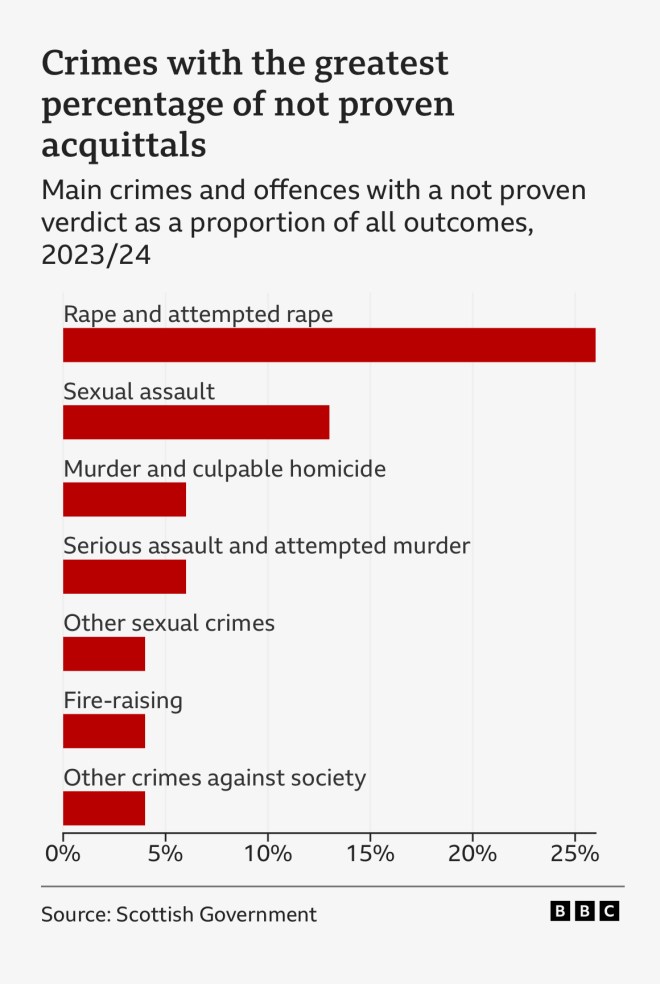
BBC Scotland, in its reporting of this historic event, obtained figures from the Scottish Government for 2023-24 which provide a breakdown of the use of the not proven verdict in criminal cases in the Scottish courts (please see diagram below):
That bastard verdict?

Sir Walter Scott (1771-1832), the famous Scottish novelist and Depute Sheriff of Selkirkshire referred to the not proven verdict as “that bastard verdict” suggesting that it was alien to Scottish legal tradition. This wasn’t quite true as Professor Douglas J Cusine, another well known Scottish writer and former Sheriff points out. Professor Cusine states that the not proven verdict was recorded as being in use in Scottish criminal courts from as early as 1732. If anything, the not guilty verdict may (possibly) lack legitimacy and be more deserving of Sir Walter Scott’s soubriquet.

A link to an article written by Professor Cusine about the verdict can be found below:


https://www.scottishlegal.com/articles/douglas-j-cusine-not-proven-debate-lacks-clarity

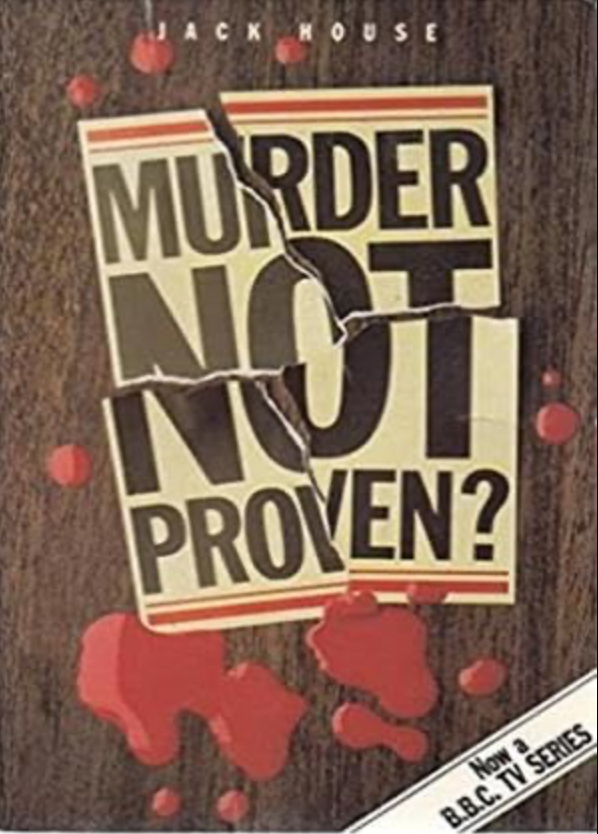
The undeniable fascination with the verdict even led to BBC Scotland broadcasting a short drama series of 3 episodes (in 1984) called Murder Not Proven?. This series was based on the book of the same name by the novelist and journalist, Jack House.

The Long Road to Abolition

The Thomson Committee, in its Second Report on Criminal Procedure in Scotland (as far back as 1975) chaired by Lord Thomson, a Senator of the College of Justice, did consider abolition of the not proven verdict. Ultimately, the Committee felt that the verdict should be retained and even suggested that its removal could lead to an increase in guilty verdicts. More recently in 1999, the late Professor Peter Duff (formerly of the University of Aberdeen) took issue with this finding of the Thomson Committee in his paper, The Scottish Jury: a very peculiar institution.

A link to Professor Duff’s paper can be found below:

On 27 November 2013, Michael McMahon, a Labour Party MSP, introduced the Criminal Verdicts (Scotland) Bill, which had, as its main aim, the abolition of the not proven verdict. The Bill fell on 25 February 2016 due to a lack of support among MSPs and, consequently, the three verdicts remained in place in Scotland until this week.

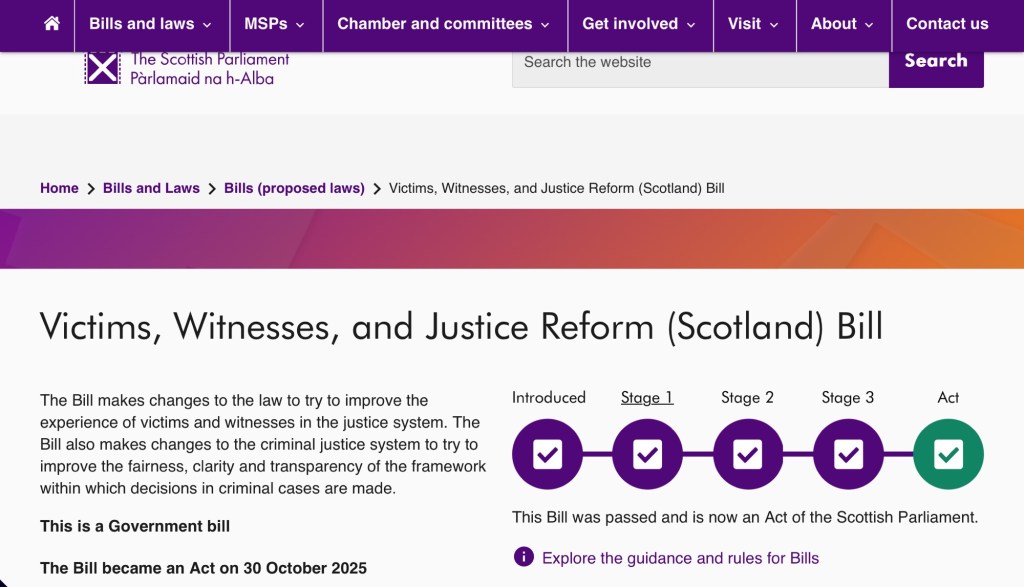
The abolition of the not proven verdict came about as a result of the introduction of the Victims, Witnesses, and Justice Reform (Scotland) Act 2025 which was passed by the Scottish Parliament (as can be seen in the diagram below).
Angela Constance MSP, Justice Secretary in the Scottish Government commented on the change to the law:

Victims, families and support organisations campaigned long and hard for the abolition of the not proven verdict and I am pleased that this historic change will take effect for all new criminal trials from 1 January.

Not proven is a widely misunderstood verdict and one with no statutory definition. I have heard compelling evidence about the devastating impact that the not proven verdict can have on complainers because of its lack of clarity or lack of closure for them, and it can leave a lingering stigma for the accused. Such a verdict risks undermining public confidence, while the two opposing verdicts of guilty and not guilty are unambiguous and clear.

Source: New year brings justice reforms in Scotland by Public Sector Executive (2025)

Available at:

https://www.publicsectorexecutive.com/articles/new-year-brings-justice-reforms-scotland#:~:text=Scotland’s%20“not%20proven”%20verdict%20has,witnesses%20and%20accused%20persons%20alike.


Critics of Abolition

Doubtless, Professor Cusine would disagree with Ms Constance’s main assertion that the verdict is “widely misunderstood”. As the Professor points out, in his aforementioned article, we simply don’t know what jurors think because the Contempt of Court Act 1981 forbids us from asking these basic questions.

What goes on in the jurors’ room is shrouded in secrecy and no amount of reconstructions can guide us as to the group dynamics of the jury. In 2024, Channel 4 Television broadcast a programme called The Jury: Murder Trial which attempted to examine the dynamics of the jury (admittedly under the English criminal justice system). All very interesting, but how accurate or useful was this programme? I am not doubting the sincerity of the volunteers who took part in this experiment, but it’s a very different proposition when you are called to serve on a jury for real. Nonetheless, Channel 4 seem to have had a hit on its hands and a second series of the programme has been commissioned.

Ms Constance also undermines her position by claiming that the verdict does not have a “statutory definition”. Perhaps the Minister, who after all is responsible for justice and the legal system in Scotland, needs to learn that not all legal principles are grounded in statute?

Other notable opponents of abolition of the verdict were the Faculty of Advocates and the Law Society of Scotland. Stuart Munro, Chair of the Law Society’s Criminal Law Committee stated:

We argued strongly for the not proven verdict to be retained as a proven and longstanding safeguard against miscarriages of justice in Scotland, and will be closely monitoring whether these new arrangements strike the right balance to achieve just outcomes.”

Source: Concerns remain as new era begins with not proven abolition – Law Society of Scotland

Available at:

https://www.lawscot.org.uk/news-and-events/law-society-news/concerns-remain-as-new-era-begins-with-not-proven-abolition/

Another significant reform

Interestingly, the Victims, Witnesses, and Justice Reform (Scotland) Act 2025 also brings into force a major change for jury (solemn) trials in Scotland. It will now be a requirement for at least two thirds of the members of a Scottish jury in a criminal trial to find the Accused guilty. Previously, a simple majority (8 jurors out 15) could return a guilty verdict. It is worth highlighting to our non-Scottish readers that, for the time being, juries in Scottish criminal trials comprise 15 members of the public – not 12 as in common law jurisdictions.

New Year, big changes for Scottish criminal procedure.

Copyright Seán J Crossan – 2 January 2026.

It’s not about the bike!

Photo by Munbaik Cycling Clothing on Unsplash

Lance Armstrong, the now disgraced United States former cyclist wrote an bestselling autobiography called “It’s not about the bike: My Journey Back to life“. A very apt title for this Blog article which does involve a cyclist, but it’s also much more than that: it addresses the eternal question in employment law as to who is an employee?

In 2019, I started this Blog by writing about Jess Varnish, the former British and Olympic cycling champion who took British Cycling and Sport UK to an Employment Tribunal alleging wrongful dismissal. Ms Varnish lost that particular round, but she was then given the right to appeal against the original Tribunal decision.

Wrongful dismissal (which is distinct from unfair dismissal) occurs when a person has their employment contract terminated and such a termination is a breach of the contract. Such situations commonly occur where, for example, the employer dismisses the employee without the proper notice period being given.

Only individuals with a contract of employment as defined by Section 230(1) of the Employment Rights Act 1996 can bring a claim for wrongful dismissal against the employer. Such individuals are said to have a contract of service as opposed to a contract for services.

If you are an employee you either have entitlement to certain legal rights and protections – or the ability to acquire these e.g. the right not to be unfairly and/or wrongfully dismissed; the right to a redundancy payment; the right to request flexible working patterns etc.

If, however, you are engaged (not employed) by an organisation, you enjoy none of these rights or the ability to acquire them. This situation applies to an increasing number of people who are engaged on contracts for services e.g. the genuinely self-employed; freelancers; zero hours workers; piece workers; and so called Gig Economy workers.

Fast forward to 2021 and the Employment Appeal Tribunal has now issued its ruling in Ms Varnish’s case. It is a disappointing result for Jess Varnish as the Appeal Tribunal finds itself in agreement with the Employment Tribunal that she was not an employee and, therefore, she did not have a contract of service with either British Cycling or UK Sport. Her appeal is therefore dismissed.

A link to the Employment Appeal Tribunal decision can be found below:

https://www.judiciary.uk/wp-content/uploads/2020/07/Ms-J-Varnish-v-British-Cycling-Federation-ta-British-Cycling-UKEAT-0022-20-LA.pdf

You will also find a link to an article in The Guardian about the case:

https://www.theguardian.com/sport/2020/jul/14/jess-varnish-loses-appeal-against-wrongful-dismissal-by-british-cycling

Copyright Seán J Crossan, 13 January 2021

Grindhouse Day (or Man with an International Travel Ban)

Photo by Nathan Wright on Unsplash 

An interesting story appeared in the Scottish and national UK media on Wednesday 26 February 2025 about a case at Wick Sheriff Court which has made legal history.

Chief Constable of Police Scotland v Kevin Booth [2025] SC WCK 8

A link to the judgement (issued by Sheriff Neil Wilson) on the British and Irish Legal Information Institute (BAILII) can be found below:

https://www.bailii.org/cgi-bin/format.cgi?doc=/scot/cases/ScotSC/2025/2025scwck008.html&query=(Chief)+AND+(Constable)+AND+(of)+AND+(Police)+AND+(Scotland)+AND+(v)+AND+(Kevin)+AND+(Booth)+AND+(.2025.)+AND+(SC)+AND+(WCK)+AND+(8)

When I heard the first account of this story on BBC’s Six ‘o’ Clock News and, immediately afterwards on BBC Reporting Scotland, I assumed that the Sheriff Court had issued its Order under its criminal jurisdiction. I was wrong, but more about that later.  

A word of warning to anyone contemplating reading Sheriff Wilson’s judgement, it contains graphic accounts of violence carried out by Booth against his victims. The judgement is not for the faint hearted.

Totally by coincidence, this story was reported around the time that a major Hollywood film, Heretic (starring Hugh Grant) had just been released; the plot of which featured a misogynist running a torture dungeon under his suburban home. Although the real life setting of Booth’s remote, baronial mansion in the Scottish Highlands definitely won out over Hollywood for its sheer spookiness factor.

A link to the BBC Scotland report can be found below:

https://www.bbc.co.uk/news/articles/cy9dld3jgx8o

The Man with an International Travel Ban

The case centred around Kevin Booth who had been accused of physically abusing women in a private dungeon located in the cellars of his Highland home. Adding to the Grindhouse Movie atmosphere of this story, Booth was in the habit of filming these encounters. It later transpired that many of Booth’s victims were employed by him as domestic servants at his Highland home. Many of these women were foreign nationals who had been lured to the UK by promises of well paid employment with Booth. They were highly vulnerable to abuse and exploitation. These women were to be bitterly disappointed: the golden future that Booth had painted was a deception and, little did they know it, but they were about to enter a nightmare.

At first, I thought, nothing unusual about this story as violence against and the abuse of women and girls is still shockingly and depressingly common in Scotland (and the rest of the UK). Just that week, The Metro had run a front page story detailing the fact that the incidence of the crime of upskirting on trains had rocketed across the UK (see the link below). 

Back to Mr Booth: he is a millionaire (apparently) who owns a remote Scottish Baronial mansion located at the end of a 10 mile private road in the Highlands. The Police, acting on complaints received from several women who had worked for Booth, gathered evidence against him of potential, criminal wrongdoing e.g. torture (referred to as punishment beatings) and human trafficking, but the Crown Office and Procurator Fiscal Service (COPFS) later abandoned criminal proceedings against Mr Booth. 

When the average person hears phrases like human trafficking and punishment beatings, you can’t blame them for arriving at the completely justifiable conclusion that this will involve breaches of the criminal law.  

From knowledgeable sources of mine, it has been speculated that the Crown abandoned proceedings against Booth because it was not in the public interest (yes amazingly); there may have been some level of ‘consent’ given by Booth’s victims; and there was not a sufficiently high chance of securing a conviction against him.

That said, there are limits placed upon physical abuse that an adult may agree to undergo as the House of Lords made very clear in its decision of R v Brown [1993] UKHL 19 [1994] 1 AC 212. This case made headlines at the time because of the types of physical abuse which went way beyond the types of sado-masochostic sexual practices that would be deemed legally permissible.  

At this point, it is worth restating that we have a system of public prosecution in Scotland (private prosecutions are extremely rare). It is the Crown Office and Procurator Fiscal Service (COPFS) which make decisions about whether an accused person will face trial in a criminal court.  Police Scotland can charge a person with a crime (in this case Mr Booth), but it will be up to COPFS to green light a prosecution.

As we have seen, a criminal prosecution against Booth was attempted, but was later abandoned. This development, however, did not deter Police Scotland from taking further civil action against Booth at Wick Sheriff Court by applying for a Trafficking and Exploitation Prevention Risk Order (TERO).

Mr Booth is now the subject of an international travel ban to last for a duration of 5 years. This Order is the first of its kind in Scottish legal history.  The ban or was made in terms of section 26 of the Human Trafficking and Exploitation (Scotland) Act 2015. The official name for this type of ban is a Trafficking and Exploitation Prevention Risk Order or TERO for short.

In relation to his activities, Booth, however, has not been convicted of any criminal acts and the travel ban was imposed by a civil court. The Police actively sought this civil order. There are other restrictions imposed on Booth by the Sheriff Court. He will, for instance, have to notify Police Scotland in advance if he proposes to employ women at his home. This Order is more about controlling Booth in the future as opposed to punishing him (in the criminal sense) for his past treatment of the victims in the story. 

It has to be said that Mr Booth has a rap sheet that would turn most people’s hair white: physical abuse of pupils at a school in Africa where he worked as a teacher; further physical abuse of young children of school age in the North East of England; and, more worryingly, allegations of rape of a woman in the Republic of Ireland. Clearly, Booth is not a nice person – to put it mildly.  

The Police have had significant involvement with Booth and have investigated him after a number of complaints were received from women who stated that they had been physically abused by him.

On BBC Scotland, the reporter likened the abuse to “punishment beatings”. Booth is still a free man for now – although the Police will continue to monitor his activities.  At the time of writing, Booth was the subject of a criminal trial at Wick Sheriff Court for allegedly making indecent communication s to a woman (please see link to article on the BBC website below).

https://www.bbc.co.uk/news/articles/cd7v27nnv9go

The question being asked is “Why is this man not in jail?”  

This is clearly a question for COPFS to answer because it is the relevant legal authority for determining whether a public prosecution of an accused should proceed.  

The decision not to proceed against Booth is going to be particularly controversial given high profile campaigns about violence against women and attempts by the authorities to reduce these types of incidents.  

What about the victims pursuing private prosecutions against Booth?  

Well, this Blog has previously discussed the problems associated with these types of legal action in Scotland. It is theoretically possible, but highly unlikely in practice as the victims would have to make an application to the High Court of Justiciary for a Bill for Criminal Letters which would permit them to initiate a private prosecution against Booth. It’s worth remembering that the last successful private prosecution in Scotland was over 40 years ago (X v Sweeney [1982] JC 70

A civil action, for the time being, might be the only effective remedy for the victims. 

That said, the Police and COPFS are monitoring the situation and, if significant new, evidence comes to light, Booth may well have to face his day in a criminal court. 

In conclusion, Sheriff Neil Wilson had this to say about Booth’s conduct (at paragraph 102 of his judgement):

… the evidence of Mr Booth’s egregious conduct, as presented in court, was, at times, utterly harrowing. The graphic video footage, combined with the context and background provided by supporting documentary evidence in various forms, was redolent of a level of cruelty and depravity which, whilst extreme, one can only hope is rare. It might be thought that the use of such value-laden language in a legal judgment is inappropriate. I would beg to differ, and make no apologies for including it. This judgment may be primarily concerned with the legal issues before the court, but it is important not to lose sight of the human suffering giving rise to this case.” 

Recent Update About Mr Booth

On 28 October 2025, at Wick Sheriff Court, Mr Booth was found guilty of making an indecent communication to a woman who had been employed by him. Booth will return to Court at a later date to be sentenced by the Sheriff.

A link to the story on the BBC website can be found below:

https://www.bbc.co.uk/news/articles/cwyp392jx2do

Explanatory Note About Grindhouse Movies

According to Wikipedia: A grindhouse or action house[1] is an American term for a theatre that mainly shows low-budget horror, splatter, and exploitation films for adults.

According to historian David Church, this theater type was named after the “grind policy”, a film-programming strategy dating back to the early 1920s that continuously showed films at cut-rate ticket prices that typically rose over the course of each day. This exhibition practice was markedly different from the era’s more common practice of fewer shows per day and graduated pricing for different seating sections in large urban theatres, which were typically studio-owned.

Copyright Seán J Crossan, 26 February 2025 and 28 October 2025

A voluntary union or Albatraz (Indyref2 derailed)?

This is a relatively short article about today’s major constitutional law story which relates to the future of the United Kingdom as a unitary state.

The U.K. Supreme Court has finally ruled that the Scottish Parliament does not have the legislative power to hold a referendum (either a legally binding one or a purely advisory one).

A link to the judgement can be found below:

https://www.supremecourt.uk/cases/uksc-2022-0098.html

This clearly represents a significant set back for supporters of independence for Scotland and the casual observer may arrive at the lazy conclusion that the matter is decided for the foreseeable future.

I think this is somewhat premature. The judgement of the Supreme Court contains difficulties for the U.K. Parliament and the Government of Prime Minister Rishi Sunak in the sense that the Union of the Scottish and English Parliaments in 1707 is clearly not one of a voluntary nature.

By implying this, the judgement may represent something of a red rag to the bull for many pro-independence Scots. It will certainly give the SNP/Green Government in Edinburgh a rather large stick to beat whichever British Government happens to be in power over the next few years.

In any event, there are legal precedents for dissolution of the union of nations within the framework of the British and Irish State (as I have previously argued in The Long and Winding Irish Road).

It should not be forgotten that 26 Irish counties (now the sovereign state of the Republic of Ireland) are obviously no longer in union with the United Kingdom. In fact, the original Acts of Parliament which led to the Union of Great Britain and Ireland stated:

The First Article of the Act of Union (Ireland) 1801 (above)

This piece of legislation (and it’s Westminster counterpart) contained the (very) ambitious statement that Great Britain and Ireland were to be united for ever. The ancient Greeks had a word for this type of mindset – hubris. This word means an excess of pride or over confidence.

Unfortunately, for the parliamentary draftsmen of both pieces of legislation, they could not possibly foresee that this permanent union would be seriously undermined by the Government of Ireland Act 1920. I shouldn’t have to say this, but 119 years is self evidently not a union for ever.

It is also worth highlighting that the remaining six counties of the North of Ireland are still part of the political framework of the United Kingdom, but it is not a racing certainty that this will continue. The rise of Sinn Fein as the largest political party in the Northern Ireland Assembly has raised huge question marks about the constitutional status of the six counties. I don’t think it’s a stretch of the imagination to say that the future of the United Kingdom of Great Britain and Northern Ireland looks very uncertain.

Even the Soviet Union (the USSR) explicitly gave its constituent Republics the right to secede in its 1977 Constitution (a right which had existed in previous versions). This right, of course, was more apparent than real as long as the Cold War endured. With the fall of Communism in the late 1980s and early 1990s, the political space was created for the Soviet Republics to chart their own courses. Admittedly, this hasn’t always been plain sailing as the current war in Ukraine and other conflicts in Armenia, Azerbaijan and Georgia amply demonstrate).

Interestingly, when the Brexit Referendum of 23 June 2016 produced a narrow majority in favour of the U.K. leaving the European Union, there was no clear constitutional process for a member state to secede. Yet, on 31 January 2020, the U.K. became a former EU State.

This really leads me to the conclusion of this very short article: independence for Scotland is a political question rather than a legal question. The Supreme Court has answered a relatively easy question in the sense that the architecture of the Scotland Act 1998 does not currently permit the Scottish Parliament to hold a binding or non-binding referendum. As with the Irish Question over a century ago, permanent unions between countries or political units tend to be anything but.

One door closes and another opens …

The link to my previous article, The Long and Irish Winding Road can be found below:

https://seancrossansscotslaw.com/2021/01/10/the-long-and-winding-irish-road/

Copyright Seán J Crossan, 23 November 2022

The Queen’s Speech

Recently, I have been discussing with my students the creation of statutory criminal offences i.e. those created by Parliament (whether the U.K. or Scottish Parliaments). In particular, the group discussions have centred around the issue of whether the offence requires the accused to have mens rea (criminal intent or the guilty mind) when carrying out or attempting the actus reus (the wrongful act). Alternatively, the offence may be one of strict liability where mens rea is largely irrelevant. Strict liability offences include non-payment of a TV licence and some road traffic offences.

In relation to strict liability offences, the Crown (the prosecutor) merely has to prove beyond reasonable doubt that the accused committed the actus reus.

These issues were particularly pertinent because the Queen’s Speech had just taken place at Westminster on Tuesday 10 May 2022 (delivered by Prince Charles this year in his mother’s absence). This is a ceremonial occasion in the life of the U.K. Parliament, but it isn’t just for the tourists to come and gawp at. It’s the occasion where the U.K. Government sets out its legislative or law making proposals for the next year.

It used to be a very important occasion for Scotland, but since the Scottish Parliament was set up in 1999 (the Devolution process), it has become less so. Many laws for Scotland are now made in Edinburgh.

That’s not to say that the U.K. Parliament can no longer pass laws for Scotland. That would be giving you a totally false impression: the U.K. or Westminster Parliament remains the supreme law making or legislative authority in Scotland, England, Northern Ireland and Wales. That is a legal fact.

One of the Bills that was mentioned in the Queen’s Speech this year was the Public Order Bill. This is a very controversial Bill because it aims to target and control the conduct and extent of public protests – particularly protests by environmental groups such as Insulate U.K. and Extinction Rebellion.

The section of the Queen’s Speech referring to the Public Order Bill

A link to the text of this year’s Queen’s Speech can be found below:

https://www.gov.uk/government/speeches/queens-speech-2022

When I was speaking to the students several days after the Queen’s Speech, I was saying that I would have to go and look at the text of the Public Order Bill in order to establish a number of things:

a) Does it apply to Scotland? The answer would appear to be no as the text of the Bill mentions England and Wales only.

b) Does it create strict liability criminal offences in relation to the practice of ‘locking on’; ‘obstruction etc of major transport works’; and ‘interference with use or operation of key national infrastructure’?

For locking on offences, the intention of the accused still seems to be critical, but regarding obstruction etc of major transport works, there could possibly be an element of strict liability.

Some screenshots from the text of the Public Order Bill can be seen below:

Front page of the Public Order Bill 2022
The proposed offence of locking on. Note the use of the words intend and reckless which are underlined in red

When the language of a Bill or an Act of Parliament uses words such as ‘wilfully’, ‘recklessly’ or ‘intentionally’ in connection with a criminal offence, it’s a fairly safe bet to conclude that the Crown must be able to demonstrate that the accused had the necessary mens rea when the actus reus occurred.

Some of the media commentary around the Public Order Bill was misleading to say the least – particularly in relation to the proposed offence of ‘locking on’. I picked up from several media outlets that this proposal involved the creation of a strict liability offence and, yet, the language of the Bill seems to suggest otherwise.

Section 2 (the proposed offence of being equipped for locking on). Note that the word intention appears in the text.
Section 3 of the Public Order Bill 2022. Note that the text does not contain any words or phrases which suggest that the mens rea of the accused is essential.

That said, Section 3 of the Bill (obstruction etc of major transport works), lacks clear references to the intention of the accused and this might suggest that Parliament intends to create a strict liability offence. Further clarity can, of course, be sought by studying the explanatory notes which accompany the Bill. It is worth pointing out that, even if this is an attempt by Parliament to create a strict liability offence, it could be blocked or amended as the Bill makes it way through the Commons and the Lords.

Sweet v Parsley [1969] UKHL 1

In the above (and often quoted) decision of the House of Lords, Lord Reid (in paragraph 6 of the judgement) made the following observations regarding statutory offences which require mens rea and those which are ‘absolute’ or ‘strict’:

“Our first duty is to consider the words of the Act: if they shew a clear intention to create an absolute offence that is an end of the matter. But such cases are very rare. Sometimes the words of the section which creates a particular offence make it clear that mens rea is required in one form or another. Such cases are quite frequent. But in a very large number of cases there is no clear indication either way. In such cases there has for centuries been a presumption that Parliament did not intend to make criminals of persons who were in no way blameworthy in what they did. That means that whenever a section is silent as to mens rea there is a presumption that, in order to give effect to the will of Parliament, we must read in words appropriate to require mens rea.”

A link to the decision of the House of Lords can be found below:

https://vlex.co.uk/vid/sweet-v-parsley-794063145

Conclusion

The Public Order Bill must now pass through the House of Commons and then the House of Lords before receiving the Royal Assent. Once the formality of the Royal Assent has taken place, the Bill becomes an Act of Parliament i.e. part of the law of the land (for England and Wales in any case).

I am jumping the gun somewhat: the Bill might have a stormy passage through Parliament. As if to prove my point, please see a recent Tweet from Caroline Lucas, the Green Party MP:

We’ll just have to wait and see how matters develop.

Copyright Seán J Crossan, 23 May 2022

Revolutionary Road?

Photo by Robert Ruggiero on Unsplash

Last weekend (more specifically Saturday 29 January 2022) saw a really significant overall of the UK’s Highway Code which means that pedestrians and cyclists will be given far greater protection.

I was originally going to entitle this Blog either Code of Silence or Code Unknown, purely on the grounds that the changes seem to have crept up without any real awareness on the part of the British public. The reason I say this is because I was listening to BBC Radio 2 during the week running up to the changes. Jeremy Vine, the host of the eponymous show, was discussing the impending reforms with a panel of interested parties. One of the guests, Leo Murray, from the climate charity Possible, basically remarked that the UK Government had been remiss in failing to publicise these important changes.

I have to admit that I had only become aware of these changes a few days previously when I happened to come across an article from a Scottish regional newspaper which had appeared on social media.

As a pedestrian, cyclist and motorist, I’m pretty glad that I did find out in time. I also have more than a passing interest in this area as someone who has been knocked off my bike twice in less than 18 months by motorists (who were both at fault). Drivers ,who don’t cycle or walk that much, often forget how vulnerable pedestrians and cyclists actually are.

The main outcome of the new rules is the creation of a hierarchy of road users where the most vulnerable individuals – pedestrians, followed by cyclists, and then horse riders will be given priority over motorists, buses and heavy goods vehicles.

This past week alone, I’ve had to make a conscious effort to slow down when turning my car left into junctions in order to give pedestrians priority. I also take greater care when I’m turning right into junctions or leaving roundabouts. I’m quite happy to do this because as an occasional pedestrian and, as a more regular cyclist, I understand that I will benefit from the changes to the Highway Code?

One of the features of the new Code – which I particularly support – is the right of cyclists to use the middle of the road in order to avoid potholes (and other debris), enjoy greater visibility and making it easier to turn right. There are also new rules about giving cyclists greater space when being overtaken by motorists.

Some driving commentators such as the former BBC presenter, Alan Douglas (speaking to Radio Clyde) , have expressed their misgivings about the new rules saying that they are great in theory, but less so in practice. We’ll just have to wait and see.

I do think, however, that this is a timely reminder to the (pure) motorist community ( i.e. those individuals absolutely wedded to the idea of the car as being the sole, legitimate form of road transport) that our highways are a shared space. I often enjoy debunking the old myth or chestnut when talking to (pure) motorists that cyclists do not pay vehicle excise duty. As a driver who also happens to be a cyclist, I do pay several hundred pounds a year in vehicle excise duty for the privilege of using the roads. As a matter of fact, a lot of motorists who drive electric cars and lower emissions vehicles are exempt from this form of taxation. In any case, the sum collected from vehicle excise is not used to pay for road building and maintenance. This comes from general taxation (see link to article below):

https://www.pressandjournal.co.uk/fp/pj-investigations/2477257/the-road-tax-debate-can-drivers-claim-to-own-the-roads/

When motorists use the term of abuse “bloody cyclists!”, they are actually falling into a false dichotomy or “them and us” mindset because many cyclists are in fact car drivers.

Heading towards stricter liability?

The new rules will certainly be the go to reference point in both criminal prosecutions for careless and dangerous driving (Sections 2 and 3 respectively of the Road Traffic Act 1988) and for civil claims in delict and tort involving personal injury and property damage.

Personally and professionally speaking, I’m more interested in the civil aspects of road accidents. In the second, more serious road accident that I was involved in, the driver was charged with careless driving (which was not contested) and probably received a fine and penalty points. I, on the other hand, was left with injuries – necessitating a lengthy course of physio – and a racing bike which had to be written off.

An out of court settlement with the driver’s insurance company eventually followed after my solicitors had raised the prospect of a civil claim. This outcome to the matter was much more satisfying for me than any action taken against the driver under the criminal law.

One area of controversy that surrounds the burden of proof in relation to delictual liability occurs in road traffic accidents involving pedal cyclists and motorists.

Currently, a cyclist who is injured in a road traffic accident must prove that the vehicle driver was at fault or to blame. Most European countries have reversed the burden of proof so that a motorist involved in a collision with a cyclist must prove that s/he was not to blame or at fault for the accident.

Only the United Kingdom, Cyprus, Malta, the Republic of Ireland and Romania operate a system whereby the cyclist must prove fault. This proposed reform, supported by many cycle organisations, has ignited passions and it remains to be seen whether it will find favour with British legislators.

Conclusion

Although the reforms to the Highway Code are certainly revolutionary in some respects, I would hesitate to say that we have arrived at a destination of strict liability in relation to road accidents. The changes do represent a new philosophy in road use whereby whoever you are you should always be thinking about those individuals who are more vulnerable than you.

A guide to the main changes brought in by the updated Highway Code can be viewed by clicking on the link below:

https://www.gov.uk/government/news/the-highway-code-8-changes-you-need-to-know-from-29-january-2022

Postscript

In April 2022, Neil Greig, Policy and Research Director at IAM Roadsmart, claimed that:

An alarming number of motorists are driving on British roads without awareness of key changes which fundamentally shift the dynamics of shared use.

This is a serious safety risk which could actually see the updated code causing more conflict on our roads rather than less.”

A survey carried out by Mr Greig’s organisation concluded that one in five drivers was not aware of the recent changes to the Highway Code. A large reason for this ignorance was the fact that the U.K. Government had failed to advertise adequately the changes to the Code. Apparently, a new information campaign to be carried out in the Spring will hopefully rectify this unfortunate situation.

A link to the IAM Roadsmart’s website can be found below:

https://www.iamroadsmart.com/media-policy/media-enquiries/news-details/2022/04/08/uncertainty-over-new-hierarchy-of-road-users-could-cause-more-conflict-on-our-busy-shared-streets

Copyright Seán J Crossan, 5 February & 9 April 2022

The future is … feudal

Photo of the author’s copy of Dune

The latest big screen adaptation of Frank Herbert’s seminal science fiction novel, Dune, finally received its U.K. cinema release on 22 October 2021. The movie is the latest work by Canadian director, Denis Villeneuve and has been very warmly received by critics and fans. On the back of this success, the studio has just given the go ahead for Villeneuve to film Part 2 of Herbert’s novel.

I’ve been a big fan of Herbert’s novel since first reading it as a teenager. I’m going to stick my neck out and also say that I still have a tremendous affection for David Lynch’s 1984 film adaptation of the novel.

The received wisdom is that Lynch made a real mess of this version. As a counter argument, I would urge you to watch the fan edit of Lynch’s movie which demonstrates, in my humble opinion, that he had a clear vision for the project. Tellingly, the studio hadn’t given Lynch the right of final cut in his contract in relation to the movie and a much shorter version was shown in cinemas. At one point, Lynch had his name removed from the credits in certain versions of the movie and he is on record that the whole experience remains a great source of sadness for him.

If you are interested in the fan edit version of Lynch’s Dune, check it out on YouTube at the link below:

https://youtu.be/faHQA_0d9Mo

A place beyond your dreams ..

This was the first part of the marketing tag line used by the studio to market Lynch’s version of Dune. True, Herbert’s plot is set 10,000 years into the future. From what we can gather, Planet Earth no longer exists and the human race has spread out to colonise other planets far, far beyond our known universe.

The planet Arrakis (or Dune) is an extremely harsh desert world where water is at a premium. Herbert tells us in the early stages of his novel, that labourers go out before dawn to gather in the dew. As Duke Leto Atreides reflects:

“Perhaps this planet could grow on one. Perhaps it could become a good home for my son. And it could be a hideous place.”

More importantly, the planet is the only source of the spice, Melange which makes interstellar travel achievable, increases human longevity and can give certain individuals the gift (or curse) of prescience. For these reasons, control of Arrakis – despite its barrenness and the hostility of the native Fremen – is fiercely sought and often contested. This desire to control the planet is one of the most important plot drivers in the novel, but more about that later.

Yet, was Herbert’s universe really so strange and beyond our dreams?

Yes – and no. Any student of history would tell you that the institutions and concepts that Herbert uses to give structure to his universe have a long pedigree in human existence.

What struck me most about Herbert’s novel was the fact that democracy or rule by and of the people doesn’t even get a look in. Readers can safely assume that democracy is extinct – rather like Earth. What we have in its place is monarchical government or – more accurately – imperial government. Prime Ministers and Presidents are very much in the past and Emperors, Dukes, Barons, Counts and their various retainers are the order of the day.

The Padishah Emperor

What we have is an imperium headed by the Padishah Emperor Shaddam IV of Noble House Corrino. This family has controlled the Golden Lion throne for thousands of years. Below Shaddam IV are the various noble families (Atreides and Harkonnen to name two of the most significant Houses). Like a medieval monarch or Roman Emperor, Shaddam IV retains control through a mixture of coercion and patronage. The iron hand in the velvet glove might be a useful metaphor here.

In this imperium – strange and yet so familiar – we have a rigid class hierarchy known as the faufreluche system which Herbert tells us lives by the motto, “A place for every man and every man in his place.”

To any Scots lawyer who remembers their sources of law lectures will doubtless recognise this system – admittedly by another name – feudalism.

It’s worth noting that women, in this system, don’t have many rights. Although Duke Leto Atreides is portrayed as an honourable man, he keeps a bound concubine, the Lady Jessica. We are told in the novel that the Old Duke, sent his buyers to acquire Jessica as a concubine for his son. Although Jessica is not the wife of Duke Leto, she wields huge influence due to the fact that she has given him a son and heir (Paul Atreides).

In many respects, this aspect of Dune, is similar to one of the plot devices in director, Ridley Scott’s latest historical epic, The Last Duel. In the feudal system, women are regarded as the chattels (moveable property) of their fathers, husbands or other male relatives. In The Last Duel, Matt Damon’s character is perhaps most outraged by the fact that Adam Driver’s character has interfered with his proprietorial rights over his wife.

Feudal law

The feudal system is described as a multi-tiered system of land ownership and, consequently, it can be very complex.

Yet, it wasn’t a Scottish invention: the credit or the blame for this social hierarchy lies elsewhere. To paraphrase Dune, be careful to locate feudalism in its rightful place: England.

It was introduced to Scotland during the reign of King David I (1124–53). David had spent his youth at the English court (probably as a hostage to secure the good behaviour of the Scottish King) and was clearly influenced by the effectiveness of feudalism.

The first Norman King of England, William the Conqueror (1066-87) brought feudalism to his new kingdom primarily as a means of controlling an often hostile populace who would never be reconciled to their new masters. William had seized control of England after defeating the last English or Saxon king, Harold Godwinson at the Battle of Hastings (1066). Grim Norman keeps would spring up all over England from which battle hardened warriors would (and could) sally out to keep uppity locals in their place and to safeguard the King from any foreign threats to his power.

From the earliest days of the system, it operated, however, on very simple principles. The King (the Superior) would grant parcels of land to his supporters (vassals) who, in return, would administer the land (very often in the role of Sheriff – another English practice) and, more importantly, they would provide the King with soldiers in times of war or civil unrest.

In other words, the feudal system was all about maintaining royal power in England and Scotland (i.e. land for loyalty). The land was never granted absolutely – if a vassal (i.e. the person who held the land) failed to keep his side of the bargain, the King would remove all his rights to the land and appoint someone in his place. These supporters would in turn distribute parts of the land to their followers in order to retain their loyalty.

Under the feudal system, property was divided into two categories:

♦    Heritable property 

♦    Moveable property 

The fundamental principle of the feudal system always centred around tenure. This means that the land was granted according to certain conditions which the vassal had to carry out dutifully.

It may be rather hard to believe, but remnants of the feudal system survived in Scotland into the early twenty-first century before it was finally abolished on 28 November 2004 when the provisions of the Abolition of Feudal Tenure etc. (Scotland) Act 2000 took effect.

Feudalism as a plot device in Dune

The initial stages of the novel are driven by the Emperor’s command that House Atreides take control of Arrakis from their mortal enemies, House Harkonnen. Although Duke Leto Atreides suspects that the Emperor’s motives are less than pure when conferring Arrakis on him as new fiefdom, he has no choice but to obey this order.

You might be forgiven for thinking that Duke Leto could refuse, but this would invite punitive military action at the hands of the dreaded Sardaukar – the Emperor’s terror troops. Even Baron Harkonnen, a partner in the Emperor’s scheme to destroy House Atreides, is fearful of the Sardaukar, knowing only too well that they could turn on his own troops at the click of the imperial fingers.

Like many historical monarchs, Shaddam IV fears the growing power of rival noble houses in his imperium and Arrakis is the bait which will bring the Atreides down. William the Conqueror, while still a mere Duke of Normandy, had an often fractious relationship with his cousin in law, the King of France. William also had a difficult relationship with his eldest son, Robert Curthose, which eventually degenerated into open warfare.

The Conqueror’s successors (the Kings of England) would make repeated bids to seize control of the French throne during the period known as The Hundred Years’ War (1337-1453). It is often forgotten that Paris was, at one point, an English possession which French military, heroine, Jeanne d’Arc tried to wrest back (unsuccessfully) for the King of France.

Perhaps the most infamous example in Scottish history where a monarch dispatched a serious rival was when King James II personally murdered William, 8th Earl of Douglas, at a banquet held at Stirling Castle on 22 February 1452. George R R Martin has stated that it had provided the inspiration for his Red Wedding in his Game of Thrones’ series of novels.

You can read more about this event and the background to it by clicking on the link below:

https://blog.stirlingcastle.scot/2021/02/22/douglas-murder/

The transfer of fiefdoms by a monarch is a key feature of feudalism. You might hold a fief at the Emperors behest, but tenure is never absolute. Don’t ever forget this …

Copyright Seán J Crossan, 19 November, 2021

Burn the witch!

Photo by Kayla Maurais on Unsplash

It’s Halloween today and it seems perfectly natural to be talking about witches and the supernatural. It’s a day of fun for a lot of people – young and old.

That said, to call someone a witch – specifically – a woman, would likely be regarded as an example of misogyny or hatred of women. It would be intended as an insult.

Several hundred years ago, in Scotland, you would not be dressing up as a witch or a warlock (the male counterpart). There was a very real fear of witches and their ability to carry out evil deeds against well doing members of the community.

These sorts of beliefs may seem very strange to modern readers, but Scotland was a very different place some 400 years ago. Even the American colonies were susceptible to claims about witchcraft e.g. the Salem Trials (1692-93) which the playwright, Arthur Miller so marvellously and disturbingly brought to life in The Crucible. In Miller’s play, the authorities cynically use the trials to extend their control over the populace (it was no coincidence that the play was written at the time of the McCarthyite Anti-Communist witch hunts in fifties’ America).

European and American Society was markedly more religious in its outlook. These were pre-Enlightment times after all – before science and reason was in the ascendancy. Everything was either the handiwork of God – or his sworn enemy, the Devil. The evidence of this eternal struggle could be seen all around: a good harvest would be a sign of God’s favour, whereas times of famine would be a portent of evil stalking the land.

The Devil (or Deil in Scotland) was omnipresent and always on the lookout for followers to advance his agenda. This is where witches, warlocks, covens and familiars enter the story.

Thou shalt not suffer a witch to live

The Book of Exodus, in the Old Testament, was particularly strong on the issue of witchcraft:

“Thou shalt not suffer a witch to live.”

The above verse – tellingly – comes from the King James Bible (chapter 22 verse 18). I use the word tellingly because King James (VI of Scotland and I of England) had a special interest, not to say primal fear, in and of witches.

There were similar exhortations in other books of the Old Testament (e.g. Leviticus, 19:26 & 20:27 and Deuteronomy, 18:10-11 about the consequences of practising witchcraft.

In 1590, James was convinced that some 200 witches had cast spells against him in an attempt to sink the vessel he was travelling on when he returned from Denmark with his new bride, Anne. The ship had run into a serious storm and the crew and passengers were lucky to make landfall safely. Only divine intervention, so it seemed, had thwarted the malevolent designs of the coven who had set out to ensnare the Royal couple.

https://www.nationalgeographic.co.uk/history-and-civilisation/2019/10/royal-obsession-black-magic-started-europes-most-brutal-witch

Fears about witchcraft in Scotland did not begin with James. In 1563, the Scottish Parliament had passed the Witchcraft Act which made such practices a capital offence i.e. practitioners of the dark arts could expect the death penalty to be imposed (‘pane of deid’ in the language of the statute). The guilty parties (and there were rather a lot of them) would first be strangled and then burned. For the pious executioners this punishment was merely symbolic because eternal hellfire was the real and awful fate awaiting the newly deceased.

During his reign, James – who fancied himself something of an expert on the subject – would take the campaign against witches to a new level. Rooting out the followers of the Devil would be officially sanctioned by the Church and the State (which were really one and the same thing) according to Claire Mitchell QC. In fact, the King went so far as to record his thoughts on the occult in his Treatise called Daemonologie.

The Witchcraft Act would remain on the statute books in Scotland until 1736, but it would claim thousands of victims.

The area around the modern town of Dumbarton in Scotland was regarded as a centre of witchcraft several hundred years ago as an article from BBC Scotland makes clear:

https://www.bbc.co.uk/news/articles/cdxr0ez1py1o

Pardoning the victims?

Claire Mitchell KC is one of the driving forces behind a campaign to have the existing Scottish Parliament issue a pardon to the estimated 3837 victims of the witchcraft trials. Most of the victims were women. As Claire explained, during an interview with Jeremy Vine on BBC Radio 2 last week, we have an idea of the numbers of victims and their profiles because of the existence of Parish Records and the records of witchcraft trials from the period.

Claire became aware of this gruesome period in Scottish history when:

Doing research in the Advocates Library on ‘Bloody Mackenzie’, a Lord Advocate during the Witchcraft Act, I read a quote from a poor woman who had been convicted of witchcraft. She was so confused that she asked, ‘Can you be a witch and not know it?’ I was very angry and decided to find out more about Scotland’s witches.

For more information about Claire Mitchell’s campaign, click on the links below:

https://scottishlegal.com/article/claire-mitchell-qc-seeks-posthumous-justice-for-scotland-s-witches

https://www.witchesofscotland.com

The issuing of general pardons by Parliament to redress historical miscarriages of justice are not a new development. Just this month, the Scottish Government published a Bill which aims to pardon people who took part in the 1984-85 Miners’ Strike in relation to three specific criminal offences.

For more information about this issue, please click on the link below:

https://www.lawscot.org.uk/news-and-events/legal-news/miners-strike-pardons-bill-brought-to-holyrood/

In 2018, the Scottish Parliament passed the Historical Sexual Offences (Scotland) Act which issued pardons to all those men who had been convicted of the offence of same sex activity. Homosexual activity – even between consenting male partners – was unlawful in Scotland until 1981.

Opposition to the pardons

Despite the above precedents, some legal commentators are not as enthusiastic about a general pardon being issued to the victims of the Witchcraft Act. Professor Douglas J. Cusine was firmly of the view that such gestures were using up valuable parliamentary time which could be concentrated on more pressing issues. In some respects, the pardons for gay men and the proposed ones for the miners are more logical and can be more easily justified in that many of the victims are still alive – or at least the injustices took place within living memory.

A link to a letter submitted to Scottish Legal News by Professor Cusine can be found below:

https://www.scottishlegal.com/article/letter-witch-pardon-risks-making-a-mockery-of-holyrood

That said, at time of greater awareness of violence against women and general misogyny, perhaps Professor Cusine is missing a trick (no pun intended).

For some recent stories about generalised misogyny, please click on the links below:

http://news.sky.com/story/johnny-depp-libel-trial-star-called-amber-heard-a-witch-in-text-messages-court-hears-12024026

http://news.sky.com/story/nhs-scandals-review-women-verbally-abused-by-clinicians-after-raising-concerns-12024212

Conclusion

We live in very different times when someone who says that they are a practitioner of witchcraft or the occult might well cause some curiosity on the part of his/her listeners.

Section 10 of the Equality Act 2010 may, arguably, now protect such an individual on the basis of their philosophical beliefs. We also have a far greater respect for a person’s private and family life in terms of Article 8 of the European Convention on Human Rights. In the 16th Century, individuals who seemed to be a bit left field or eccentric would not have appeared harmless or endearing to most members of the community. The stereotypical old woman who lived alone in the woods and who was a healer, could very quickly become the subject of communal hostility. It might even cost her her life.

For information about a modern witch or a pagan practitioner, please click on the link below:

https://www.bbc.co.uk/news/uk-scotland-58852476

Copyright Seán J Crossan, 31 October 2021 and 31 October 2025

It’s official: I’m a worker!

Photo by Daniel Monteiro on Unsplash

Almost two years ago, I mentioned the English Court of Appeal’s decision in Uber BV & Ors v Aslam & Ors [2018] EWCA Civ 2748 on appeal from UKEAT/0056/17/DA), where individuals working as taxi drivers for Uber were to be classified as workers not self-employed individuals.

This decision was a significant defeat for Uber, but it was hardly going to be the last word in the story and so it proved. An appeal to the U.K. Supreme Court was always going to be on the cards and, on Friday 19 February, the Justices issued their judgement (see Uber BV & Ors v Aslam & Ors [2021] UKSC 5).

The Supreme Court was asked to consider two questions by Uber:

  1. Whether the drivers (the Respondents) were “workers” providing personal services to the Second Appellant.
  2. If the Respondents were “workers”, what periods constituted their “working time”.

The result? Uber drivers are workers not self-employed individuals. Essentially, the Supreme Court has approved the earlier decision of the English Court of Appeal.

Although Uber drivers won’t acquire full employment status, this decision is, nonetheless, highly significant. It will, for example, mean that Uber drivers will be protected under the National Minimum Wage legislation and the Working Time Regulations.

Paragraphs 94 to 102 of the Supreme Court’s decision are really instructive. The Court found the following matters extremely significant:

  • The rates of pay for taxi drivers was set solely by Uber
  • The contractual terms were dictated solely by Uber
  • Uber constrained or restricted the ability of drivers to decline jobs
  • Uber strictly vetted the type of vehicle which drivers could use for jobs and the technology used by drivers was “wholly owned” by Uber
  • The communication between a driver and a passenger was severely restricted by Uber in order “to prevent drivers from establishing any relationship with a passenger capable of extending beyond an individual ride.”

As Lord Leggatt (who delivered the unanimous judgement of the Court) stated at paragraph 102:

Taking these factors together, it can be seen that the transportation service performed by drivers and offered to passengers through the Uber app is very tightly defined and controlled by Uber. Furthermore, it is designed and organised in such a way as to provide a standardised service to passengers in which drivers are perceived as substantially interchangeable and from which Uber, rather than individual drivers, obtains the benefit of customer loyalty and goodwill. From the drivers’ point of view, the same factors – in particular, the inability to offer a distinctive service or to set their own prices and Uber’s control over all aspects of their interaction with passengers – mean that they have little or no ability to improve their economic position through professional or entrepreneurial skill. In practice the only way in which they can increase their earnings is by working longer hours while constantly meeting Uber’s measures of performance.

A link to the judgement can be found below:

https://www.supremecourt.uk/cases/docs/uksc-2019-0029-judgment.pdf

Workers or independent contractors?

Worker is a term which is widely used in EU equality and employment law, but a single definition does not exist. As a result of the U.K.‘s long relationship with the EU, the term has entered the British legal systems and, in the interim period, Brexit will not change this fact.

In Allonby v Accrington and Rossendale College (Case C-256/01) [2004] ICR 1328; [2004] ECR I-873 the Court of Justice made the following observation:

“… there must be considered as a worker a person who, for a certain period of time, performs services for and under the direction of another person in return for which he receives remuneration …”

In Syndicatul Familia Constanta v Directia Generala de Asistenta Sociala si Protectia Copilului Constanta (Case C-147/17) EU:C:2018:926; [2019] ICR 211, the Court of Justice of the EU was strongly of the opinion that the relationship between employer and worker was of a “hierarchical” nature. This was a view echoed by Lord Clarke in the Supreme Court’s decision of Hashwani v Jivraj [2011] UKSC 40; [2011] 1 WLR 1872 where he identified the relationship as one of “subordination” in favour of the person receiving the services.

That said, Baroness Hale in a later Supreme Court decision – Clyde and Co LLP and Anor v Bates van Winkelhof [2014] UKSC 32 – stated that “while subordination may sometimes be an aid to distinguishing workers from other self-employed people, it is not a freestanding and universal characteristic of being a worker”. This remark was quoted with approval by Lord Leggatt in the Uber decision at paragraph 74 of his judgement.

In other words, such a feature is merely to be deployed as one of the many possible tests that can be used by the courts to analyse a relationship between two parties.

The Employment Rights Act 1996

Section 230(1) of the Employment Rights Act 1996 contains the definition of who precisely is an employee i.e. someone who has a contract of service. If you don’t have this type of contractual arrangement (you’re not an employee), you may well be working under a contract for services. This is one of the most important distinctions in employment law in the United Kingdom.

Section 230(3) of the Act also defines in law an individual who is a ‘worker’. This can include someone who provides services under an employment contract – and, crucially, some individuals who fall into the self-employed category.

Conclusion

Individuals working under a contract for services – precisely because of their lack of employment status – are often denied access to the sorts of legal rights which employees routinely take for granted e.g. unfair dismissal protection, redundancy protection, family friendly rights.

There are notable exceptions (aren’t there always?): high earning British television celebrities (e.g. Lorraine Kelly) or a number of BBC news journalists have preferred to be treated as freelancers or self-employed persons. Why? They can then minimise their exposure to income tax liability in a way (often via the medium of personal service companies) that would not be possible because if they were employees they would almost certainly be taxed at source on a PAYE (pay as you earn) basis. 

We have seen an explosion in the type of work that is often characterised or labelled as the ‘gig economy’. This work is often characterised by a distinct lack of employment rights; irregular working patterns; chronic insecurity; lack of long term career progression; and low pay. It is often impossible for such individuals to complete the necessary periods continuous service to acquire employment rights. 

Companies such as Deliveroo, Lyft and Uber have become synonymous with the ‘gig economy’, as have whole sectors of the employment

There’s now a growing awareness on both the part of the UK Government (The Taylor Review) and the European Union (the forthcoming EU Directive on Transparent and predictable working conditions) that people on contracts for services deserve greater levels of work-place protection.

It’s not just in the UK that debates about employment status are currently playing out. At the tail end of 2019, it was with particular interest that, in 2019/20, I was following a story from the United States which highlighted many of the issues which I have just been discussing in this Blog.

The US State of California enacted a law, Assembly Bill 5 2019 or AB5 (known more popularly as the gig economy law) giving those individuals working in the gig economy more employment rights. The law came into force on 1 January 2020.

The Covid-19 pandemic has also exposed the lack of employment protection for workers and the self-employed. Only last March, I was writing about the fact that the U.K. Government’s reforms to Statutory Sick Pay would would not include approximately 2 million individuals – a situation that Frances O’Grady, General Secretary of the TUC was quick to highlight.

Related Blog articles:

https://seancrossansscotslaw.com/2019/03/25/strippers-are-workers-too-discuss/

https://seancrossansscotslaw.com/2020/02/13/california-dreamin/

https://seancrossansscotslaw.com/2020/03/05/state-of-emergency/

https://seancrossansscotslaw.com/2020/03/04/sick-pay-or-the-coronavirus-conundrum/

https://seancrossansscotslaw.com/2019/04/19/the-gig-economy/

https://seancrossansscotslaw.com/2019/07/22/good-work/

https://seancrossansscotslaw.com/2019/03/22/hello-im-lorraine-and-im-definitely-self-employed/

https://seancrossansscotslaw.com/2019/12/21/employee-or-not/

https://seancrossansscotslaw.com/2019/01/17/employment-status/

https://seancrossansscotslaw.com/2019/05/08/call-me-an-uber/

https://seancrossansscotslaw.com/2019/03/25/strippers-are-workers-too-discuss/

https://seancrossansscotslaw.com/2019/02/14/horses-for-courses-the-equine-flu-

Copyright Seán J Crossan, 21 February 2021

Sex or gender?

Photo by Dainis Graveris on Unsplash

Sex or gender: which term do you prefer? Can they be used inter-changeably?

These questions have now come into sharp focus as a result of an amendment to the Forensic Medical Services (Victims of Sexual Offences) (Scotland) Bill.

Our understanding of the terms “sex” and “gender” may now have to evolve as a result of the debate surrounding aspects of the Bill, but before we discuss this Bill it’s worth looking at the current legal position surrounding gender recognition issues.

The Equality Act 2010

Section 11(1) of the Equality Act 2010 defines a person’s “sex” in the following terms:

In relation to the protected characteristic of sex — a reference to a person who has a particular protected characteristic is a reference to a man or to a woman

In other words, current UK equality law means that your sex is determined at birth when you will be categorised as ‘Male’ or ‘Female’ and this will be entered on your birth certificate. We, therefore, do not have a choice about our sex when we are born. It is a matter of biology.

What about a person’s gender? Section 7(1) of the Equality Act 2010 provides us with guidance on this matter:

A person has the protected characteristic of gender reassignment if the person is proposing to undergo, is undergoing or has undergone a process (or part of a process) for the purpose of reassigning the person’s sex by changing physiological or other attributes of sex.

The Gender Recognition Act 2004

In April 2005, the Gender Recognition Act 2004 came into force. This Act, which received the Royal Assent on 1 July 2004, currently provides people who have undergone gender reassignment procedures with legal recognition in relation to their newly acquired gender identity. The legislation applies across the United Kingdom and was passed by the Westminster Parliament.

Legal recognition of a person’s decision to reassign the sex or gender they have had from birth will follow from the issuing of a full gender recognition certificate by a Gender Recognition Panel. The individual applying for such a certificate must be able to satisfy certain criteria – the most important criterion will centre around the submission of medical evidence of physiological changes by the applicant.

The Scottish Government was intending to reform the 2004 Act, but in the teeth of strong opposition within the Scottish National Party, such proposals have been dropped for the time being.

Self-identification

Under the Scottish Government’s proposals, an individual would have been permitted effectively to self-identify as a person of the opposite sex without having to undergo invasive medical procedures and provide the evidence of this fact in order to obtain recognition from the Panel.

This meant that an individual wishing to undergo gender reassignment in Scotland would have to have met the following criteria:

  • A statutory declaration to the effect that they have decided to change gender or sex;
  • The declaration will contain a statement that the individual has been living as a man or a woman for at a minimum of 3 months;
  • The individual will have to undertake a compulsory or mandatory period of 3 months to reflect on the decision to undergo gender reassignment (no gender recognition certificate will be issued until this period has been completed).

Forensic Medical Services (Victims of Sexual Offences) (Scotland) Bill

This Bill has proved to be another flashpoint in the often fierce debate over gender recognition.

The Bill, which passed Stage 3 in the Scottish Parliament on Thursday 10 December 2020, has reignited the debate about the terms “sex” and “gender” and their use in legislation.

The Bill passes Stage 3 in the Scottish Parliament

The purpose of the Bill is set out below:

“… to improve the experience, in relation to forensic medical services, of people who have been affected by sexual crime. It does this by providing a clear statutory duty for health boards to provide forensic medical examinations to victims and to ensure that an individual’s healthcare needs are addressed in a holistic way in the context of any such examination (or where such an examination is not proceeded with). As well as placing a duty on health boards to provide forensic medical examinations when a victim is referred for such an examination by the police, the Bill allows victims to “self-refer”. Self-referral means that a victim can request a forensic medical examination without having reported an incident to the police. The Bill provides a statutory framework for the retention by health boards of samples obtained during a forensic medical examination, which may support any future criminal investigation or prosecution. In self-referral cases, this allows the victim time to decide whether to make a police report.

A controversial amendment?

At first glance, no one could possibly object to the aims of the Bill, but Johann Lamont MSP, a former leader of the Scottish Labour Party, saw an opportunity to introduce an amendment to the Bill.

Such a development is not an unusual practice for parliamentarians to introduce amendments to Bills proceeding through Parliament. The introduction of amendments to Bills often permit reform to earlier pieces of legislation. In this case, the Lamont amendment was directed towards changing the wording of Section 9(2) of the Victims and Witnesses (Scotland) Act 2014.

As things currently stand, Section 9(2) of the 2014 Act states that:

Before a medical examination of the person in relation to the complaint is carried out by a registered medical practitioner in pursuance of section 31 of the Police and Fire Reform (Scotland) Act 2012, the constable must give the person an opportunity to request that any such medical examination be carried out by a registered medical practitioner of a gender specified by the person.

This could mean, under current law, that a victim of a sexual assault e.g. a biological or cis woman might have to undergo an examination by a medical professional who is a transgender female.

The Lamont amendment (which has now been accepted overwhelmingly by the Scottish Parliament) will ensure that the word “gender” will be replaced with the word “sex”.

Johann Lamont’s amendment will remove an anomaly in the law which currently permits a transgender person who is a medical professional to examine a victim of a sexual assault.

Further controversy

When one flashpoint is resolved, another disagreement about sex and gender is never far away in Scotland.

An organisation called forwomen.scot is raising a legal action in the Court of Session in Edinburgh for the express purpose of challenging the Scottish Government’s attempt to redefine the word ‘woman’ (see below):

“… We are challenging the Scottish Ministers over the redefinition of “woman” in the Gender Representation on Public Boards (Scotland) Act 2018 which we believe is outside the legislative competency of the Scottish Parliament under the Scotland Act 1998 and in contravention of the Scottish Ministers’ duties under equality legislation… The new definition includes some men, while, remarkably, excluding some women. This cannot be allowed to stand… The Equality Act 2010 states that a woman is “a female of any age” and maintaining this definition is key to maintaining women’s rights and protections in law…”

forwomen.scot describes rationale on its website in the following terms:

– sex is immutable and is a protected characteristic;
– women are entitled to privacy, dignity, safety and fairness;
– women’s rights should be strengthened.

https://forwomen.scot

All quiet on the Western Front? Hardly … expect this issue to run and run.

Copyright Seán J Crossan, 4 February 2021