

For those in peril on the sea

Photo by Lawrence Hookham on Unsplash

The avoidable death of Annang Neurtey

As someone who works more in the civil rather than the criminal legal tradition, I tend to focus more on the outcome of obtaining damages or compensation for the victim of an industrial or work-place accident.

It’s simply a matter of horses for courses i.e. you stick to what you know or what you’re trained to do. Admittedly, most of the victims of industrial accidents that I have represented are perhaps more focused on obtaining compensation for their injuries – especially if these are life changing. Any criminal liability that the employer may have is purely incidental i.e. something of a side issue. Then again, I suppose you could say that about most civil actions where the criminality of the pursuer remains firmly in the background (think dangerous and careless driving incidents).

The victim of a work-place delict (or tort) may get some satisfaction from their employer or its officers and managers appearing in the dock at a subsequent criminal trial, but this is unlikely to be satisfying in the long term. It will not allow them to get their lives back on track or to move on; payment of compensation is perhaps a more satisfactory conclusion to things. I make that last statement fully in the knowledge that no amount of money can truly give victims back what they have lost.

Yet, every so often, I come across a story or an incident which underlines the importance of criminal law regarding industrial or work-place accidents.

In 2015, one such incident occurred onboard Aquarius, a fishing trawler which operated out of the North East Scottish fishing port of Banff. Serious failings in the operation of the vessel led to the death of a crewman. The victim, 47 year old, Annang Neurtey from Ghana, was swept overboard: his body has never been recovered – adding immensely to the grief of his family.

Anyone who has read Sebastian Junger’s 1997 novel, The Perfect Storm (or viewed the film adaptation of 2000) will be readily familiar with the dangers that fishing folk face at sea. That said, the tragedy which befell Annang Neurtey was entirely avoidable. If the skipper of the Aquarius had properly supervised the crew and followed basic safety procedures, the accident would not have occurred.

Following Mr Neurtey’s death, MB Aquarius Ltd of Buckie, the company which owned and operated the vessel, was investigated by Police Scotland and the Marine and Coastguard Agency. The conclusions reached by investigators were that basic risk assessments had not been properly carried out and that the employer had failed to put a safe system of working in place.

At a subsequent criminal prosecution against Mr Neurtey’s employer for health and safety breaches at Aberdeen Sheriff Court, the company pleaded guilty to breaches of marine safety laws, namely, Regulation 5(1) of the Merchant Shipping and Fishing Vessels (Health and Safety at Work) Regulations 1997 and Sections 85 and 86 of the Merchant Shipping Act 1995.

A fine of £50,000 was imposed on the employer – it would have been £75,000 had an early plea of guilty not been entered by the company.

Mr Neurtey’s family will doubtless be contemplating a civil action for recovery of damages – unless of course his employer does the decent thing and quickly settles such a claim.

A link to the Marine and Coastguard Agency’s Report of its findings concerning Mr Neurtey’s death can be found below:

https://assets.publishing.service.gov.uk/media/57f3c2d7ed915d06fa000030/MAIBInvReport18_2016.pdf

A link to an article in the The Press & Journal about the trial can be found below:

https://www.pressandjournal.co.uk/fp/news/aberdeen/2011786/buckie-based-fishing-company-fined-50000-following-death-of-crew-member/

Those dark satanic mills …

Have concerns about health and safety gone mad? The former British Prime Minister, David Cameron certainly thought so when his Coalition Government (2010-15) introduced the Enterprise and Regulatory Reform Act 2013 (in particular, Section 69 of the said legislation) which removed the right to bring a civil claim for breaches of the Health and Safety at Work Act 1974.

It does not mean that employees can no longer bring a civil claim if an employer breaches its duty of care, but significantly claimants will no longer benefit from the presumption of strict liability previously imposed on organisations. Since this reform, it will be essential for claimants to prove negligence on the part of their employers for breaches of health and safety.

We would, however, do well to remember our history: concerns about health and safety were often ignored in the not so distant past.

The phrase “dark satanic mills” comes from the poem, And did those feet in ancient time by William Blake. The phrase has been interpreted as a searing indictment of the wickedness and exploitative practices of 19th Century British industrialists who most certainly put profit before people. This is why rare individuals such as the Welsh born industrialist, Robert Owen and his New Lanark Mills we’re regarded as truly radical and progressive employers.

The words of Blake’s poem were later put to music by the composer, Hubert Parry, and is better known as Jerusalem – an alternative English National Anthem for many because of its rallying call for social justice for the poor and the oppressed.

Over time, admittedly, the UK Parliament did intervene by bringing in legislation to curb some of the frankly dangerous and disreputable practices which had been tolerated in British factories, shipyards and mines. With the industrial revolution, Britain did indeed become the ‘workshop of the world’, but this accolade disguised the terrible human cost which could be measured in countless deaths, terrible injuries and overwhelmingly misery.

Some months ago, I saw a photograph by Bill Brandt in The Independent’s Saturday Magazine which documented life in an East Durham mining community. I was pretty shocked by what I saw: the houses of the miners had no windows. Think of it: these workers spent their days down the pit in almost total darkness. More shocking, was the fact that Brandt had taken the photograph as recently as 1937.

Photograph by Bill Brandt (1937)

Yet surely, the bad old days are long gone? The British work-place has become a much safer place? Undoubtedly, as we shall see, employers have become much more aware of their responsibilities to their employees and workers in respect of the issue of health and safety.

That said, if you look at the info graphic produced below from the UK Health and Safety Executive, poor conditions and practices in British work-places still result in unacceptably high levels of injuries and illness – in 2019!
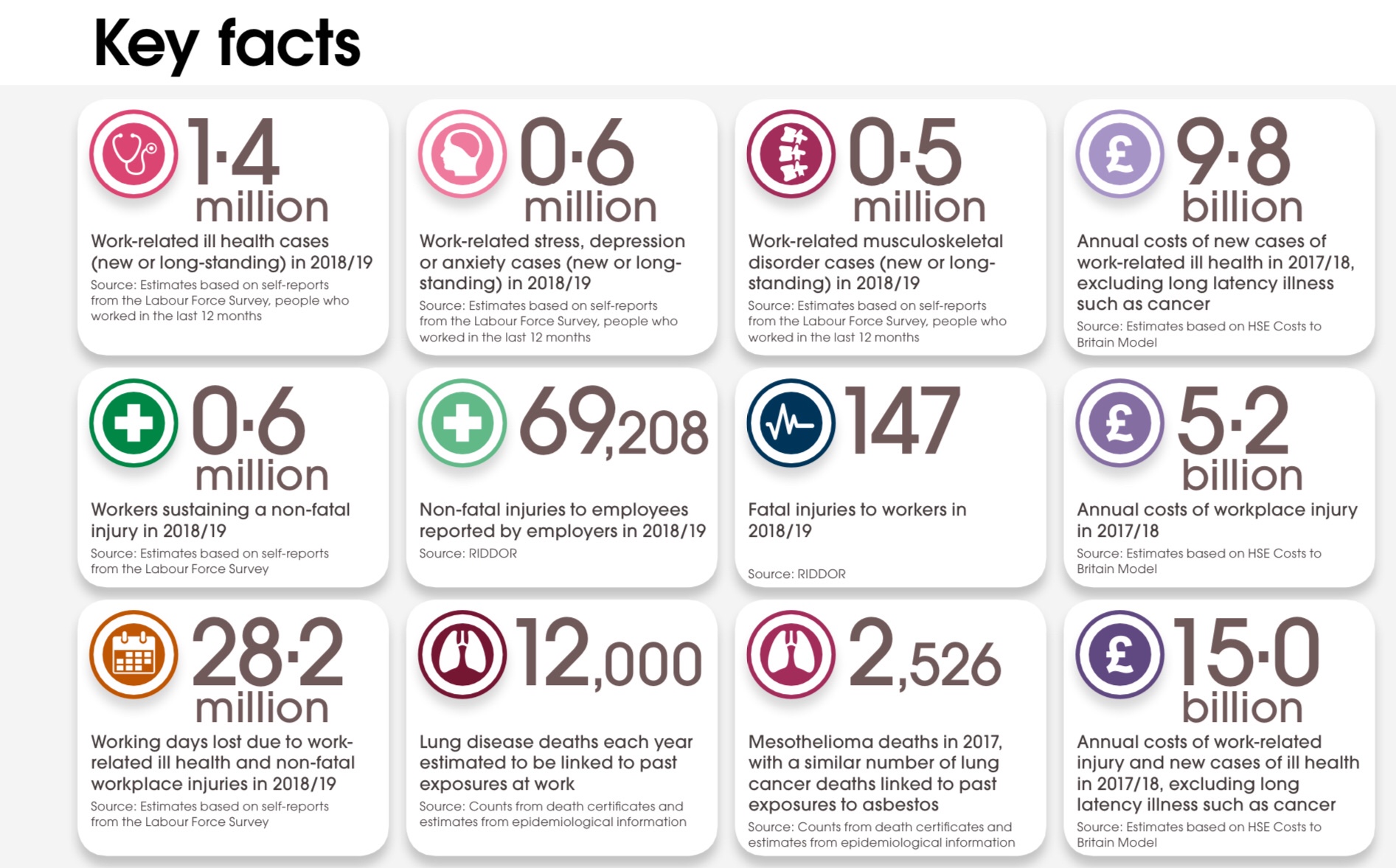
Key facts for Great Britain 2019
Source: http://www.hse.gov.uk/statistics/

Recently, Amazon, the global internet retailer, received very unwelcome media attention about the number of industrial injuries which have occurred in its UK premises. It’s probably fair to say that Amazon UK does not enjoy a particularly good reputation amongst trade unions regarding its employment practices and the recent media stories only compound this state of affairs.

Links to stories about Amazon UK on Sky News and Channel 4 News can be found below:

http://news.sky.com/story/hellish-conditions-at-amazon-warehouses-seriously-hurt-hundreds-11936881

https://youtu.be/gYUJjpIxkCU

Health and Safety at Work Act 1974

It is worth noting that the employer’s common law duties which aim to protect the health and safety of employees establishes a regime of civil liability. In other words, should the employer breach these duties, he will most likely face a civil action by the injured employee who will be attempting to recover compensation.

The Health and Safety at Work Act 1974, on the other hand, makes an employers criminally liable if they fail to take reasonably practicable steps to protect the health and safety of their employees. An employer will, therefore, face penalties in a criminal court for breaches of the Act.

The Health and Safety (Offences) Act 2008

The provisions of this Act came into force on 16 January 2009 and apply to offences committed after this date by employers. Scottish criminal courts will now have the power to impose maximum fines of £20,000 on employers who breach health and safety rules. In the most serious cases where health and safety rules have been breached or ignored, the courts may also have the right to imprison those responsible.

The Criminal Justice and Licensing (Scotland) Act 2010

Sections 65-68 of the Criminal Justice and Licensing (Scotland) Act 2010 should make it easier for organisations to face prosecution in Scotland in relation to allegations of criminal wrongdoing. According to Section 65, the term “organisation” applies to any of the following bodies:

  • a body corporate;
  • an unincorporated association;
  • a partnership;
  • a body of trustees;
  • a government department;
  • a part of the Scottish Administration;
  • any other entity which is not an individual

Such proceedings against organisations may be on indictment (Section 66) or on complaint (Section 67).

For a long time, it has been argued that an organisational culture which promotes lax practices or downright dangerous behaviour can lead to the commission of criminal offences. This an attempt to make organisations more accountable under the criminal law for conduct which causes harm to members of the public.

Overall, this means that an employer could face both a criminal action and a civil action for damages where he has neglected to obey the criminal law and the common law in respect of the employee’s health and safety.

Conclusion

If only we need reminding that health and safety remains a major issue in the work-place, we need only look to a story from Scotland which appeared in national media outlets just this week.

Workers at the Mossmorran and Ineos chemical plants took unauthorised industrial action (wildcat strikes) which was motivated by serious concerns about the lack of health and safety in the work-place. Happily, the employers seem to be listening to the concerns and the employees are now back at work.

Failure by employers to take health and safety issues seriously can leave themselves open to both civil and criminal liability. During Britain’s Industrial Revolution (from the 18th to the early 20th Centuries), it’s true to say that there was no such thing as a culture of health and safety in the work-place. Industrialists like Robert Owen were remarkable because they broke with the paradigm of British industrial practice i.e. workers were resources to be used up and tossed aside when no longer needed.

The growth of the trade union movement and the emergence of the British Labour Party (itself a creation of the union movement) led to pressure for change and tangible improvements were made to working practices. Despite these advances, cases such as the death of Annang Neurtey and the figures from the Health and Safety Executive surely caution us against complacency.

Links to reports on the BBC Scotland website about the industrial action can be found below:

Union GMB said the workers had “continuously raised their concerns about conditions and safety on-site”.

Mossmorran: Walkout at chemical plant over working conditions

Union officials said that concerns over health and safety and pay had been resolved following talks.

Mossmorran: Workers to return after wildcat strike in Fife

Related Blog Articles:

https://seancrossansscotslaw.com/2019/10/23/a-hard-days-night/

https://seancrossansscotslaw.com/2019/04/19/dont-stop-the-music/

https://seancrossansscotslaw.com/2019/02/22/stress-kills/

Copyright Seán J Crossan, 21 February 2020

You’ve got (e)mail! … or will I ever get out of this place?!!!

Photo by Kon Karampelas on Unsplash

Email can be a wonderful form of communication. It can also be, quite frankly, something of a curse for many employees and workers. Essentially, you’re never too far away from the work-place and bosses/clients/service users expect to receive an instant reply.

The expectation by bosses and managers that employees and workers should be monitoring their emails (constantly) does tend to be a contributory factor in the rising number of cases of work-related stress. Employers: please note that you have a duty of care to provide a safe working environment and part of this obligation includes monitoring unacceptably high levels of stress in the work-place.

There is a perception (rightly or wrongly) that UK employees suffer from some of the longest working hours in Europe. In 2019, data from the EU’s Eurostat Agency seemed to support this contention but, interestingly, the Organisation for Economic Co-operation and Development (OECD) took a more sceptical approach by questioning the method of data collection (the old adage about lies, damned lies and statistics springs to mind here).

Links to a BBC article about this issue and the Eurostat figures (and OECD response) can be found below:

https://www.bbc.co.uk/news/uk-politics-49795179

https://ec.europa.eu/eurostat/databrowser/view/tps00071/default/table?lang=en

https://www.oecd-ilibrary.org/economics/international-productivity-gaps_5b43c728-en;jsessionid=c_2XYmRNoOJLRgHdT0TJPQqs.ip-10-240-5-115

UK employees are, of course, entitled to receive a written statement of the main terms and particulars of their employment as per Section 1 of the Employment Rights Act 1996. This statement must contain a provision which addresses the employee’s normal weekly working hours.

Despite Brexit (which did occur on 31 January 2020 – in case you missed it), the UK is still following EU rules until the end of this year … One EU Law with particular relevance to this debate is the Working Time Directive ((2003/88/EC) which was transposed into UK employment law by way of the Working Time Regulations 1998.

In theory, the Directive and the Regulations cap the number of hours that employees (and workers) can work at 48 hours per week (technical point: this figure can be averaged out over a reference period – 17 weeks normally). Crucially, however, UK employees and workers can opt out of the 48 hour maximum by signing a declaration (opt-out) that they wish to do so. If they change their minds, they are entitled to do so by giving the employer a minimum seven days’ notice (or in certain cases – 3 months) of this intention.

The legal rules on working hours are all very well in theory, but what about the culture of organisations which may (at an informal level) promote the idea that long hours spent at work (or just working) are a sure fire way to get ahead in your career?

This is where the influence of email (and other instant messaging services) can be quite insidious (pernicious even?). Employees feel under pressure to deal with this work load at weekends, during holidays and evenings. Parents of young children and carers of elderly relatives, who may have negotiated flexible working arrangements, may be under acute pressure to deal with emails etc when they are outside the work-place. In this way, the work-place becomes like the Eagles’ song, Hotel California (‘You can check out any time you like, But you can never leave!‘).

Interestingly, in some of our ex-EU partner countries, there have been initiatives at both the organisational and legal level to curb the smothering influence of email outside the work-place.

There is a real danger here for employers that, by encouraging employee use of email outside working hours, it may constitute a policy, criterion or practice (PCP) – no matter how informal – which could open themselves up to accusations of indirect discrimination on grounds of sex (women are still the primary carers for children and elderly dependents) and disability (by reason of a person’s association with a disabled person) in terms of Section 19 of the Equality Act 2010.

Furthermore, employees might feel that they are under constant surveillance by the employer because it becomes easier to keep tabs on individuals when they are logging in and out of the company’s IT network. For employers, this could lead to legal challenges from employees who are concerned that the right to privacy and family life as enshrined in Article 8 of the European Convention on Human Rights has been violated.

Is there a better way of doing things? Yes, is the short answer.

In 2011, the German multinational car manufacturer, Volkswagen (VW) introduced major changes to its working practices by curbing the use of emails when employees were off duty. This agreement was negotiated by the company and trade union/labour organisations.

In France, in August 2016, they went further and passed the El Khomri Law (named after the French Government Minister for Labour who introduced the proposal). This law gave employees a right to disconnect from email. In one particular case which involved the French arm of the British company, Rentokil, an employee was awarded €60,000 because his right to disconnect from email had been breached.

Links to stories about the changes to VW’s working practices and the French El Khomri Law can be found below:

https://www.telegraph.co.uk/news/2018/08/01/british-firm-ordered-pay-60000-french-court-breaching-employees/

The debate about the right of employees to disconnect from email – whether this is negotiated via some sort of collective agreement or underpinned by law – now seems to have penetrated the British consciousness. Rebecca Long-Bailey MP, one of the leading contenders for leadership of the British Labour Party has thrown her hat into the ring by backing a trade union campaign to introduce a legal right to disconnect in the UK.

One small problem: the Labour Party lost the last British General Election on 12 December 2019 to the Conservatives and is, therefore, in no position to deliver. Over to you Prime Minister Johnson? (a man fond of the populist gesture).

A link to an article in The Independent about Rebecca Long Bailey’s support for the trade union campaign to introduce a law guaranteeing the right to disconnect can be found below:

https://edition.independent.co.uk/editions/uk.co.independent.issue.110220/data/9327866/index.html

Related Blog Articles:

https://seancrossansscotslaw.com/2019/10/23/a-hard-days-night/

https://seancrossansscotslaw.com/2019/02/25/the-work-life-balance-or-utopia-reimagined/

https://seancrossansscotslaw.com/2019/02/22/stress-kills/

https://seancrossansscotslaw.com/2019/02/11/employment-contracts-read-them-or-weep/

Copyright Seán J Crossan, 11 February 2020

EU Law? There’s still life in the old dog yet …

Photo by Brunel Johnson on Unsplash

At 2300 hours GMT today (or 0000 hours CET if you prefer), the United Kingdom will set a precedent and become an ex-member state of the European Union.

The European Union (Withdrawal Agreement) Act 2020 was given Royal Assent on 23 January 2020 and, earlier this week, the European Parliament overwhelmingly ratified the Withdrawal Agreement of November 2019 between the UK and the EU.

Click on the link below for the text of the Agreement:

https://eur-lex.europa.eu/legal-content/EN/TXT/?uri=uriserv:OJ.CI.2019.384.01.0001.01.ENG&toc=OJ:C:2019:384I:FULL

Job done; back to normal then (whatever that is); the British have taken back control? Well not quite. The Withdrawal Agreement was always going to be the first part of the equation that needed resolving i.e. setting the terms on which the UK would leave the organisation. This has been popularly referred to as the divorce agreement e.g. dealing with the UK’s agreed financial contribution to projects and initiatives to which it had agreed when it was a member state.

The more difficult task will be to figure out what kind of future relationship the EU and the UK will have e.g. about future trading arrangements. UK Prime Minister, Boris Johnson wants such an agreement to be finalised by 31 December 2020; leading figures on the EU side (e.g. Ursula Von der Leyen, the Commission President) have been more cautious.

The fact that Brexit Day has finally arrived does not, however, mean that EU Law will cease to have effect in the UK.

We have now entered what is known as the transition period (31 January 2020 until 31 December 2020) and Article 127 of the Withdrawal Agreement explicitly states:

Unless otherwise provided in this Agreement, Union law shall be applicable to and in the United Kingdom during the transition period.’ [My emphasis]

In any event, as I have previously observed, EU Law is hardwired into the UK legal domestic systems. Areas such as consumer law; employment law; discrimination and equality law; environmental protection law and family law have all been extensively influenced by European legal principles. Any lawyer with some knowledge of EU Law knows this to be a question of fact. After 47 years of involvement with the European Project, this should be blindingly obvious.

Even this last week, documents published by the European Commission demonstrated that there will be import/export checks between the Island of Ireland and the UK. The Court of Justice of the EU will have the final say in relation to any disputes – despite what Prime Minister Johnson believes or says.

As Lord Denning opined many years ago in Bulmer (HP) Ltd v Bollinger SA [1974] 1 Ch 401, [1974] 3 WLR 202, [1974] 2 All ER 1226:

But when we come to matters with a European element, the Treaty [of Rome] is like an incoming tide. It flows into the estuaries and up the rivers. It cannot be held back. Parliament has decreed that the Treaty is henceforward to be part of our law. It is equal in force to any statute.

Or to use another metaphor: perhaps Brexit is a case of building the legal equivalent of the Thames Barrier after the deluge. Too little, too late. Whether the British Government likes it or not, by dint of Brexit, this country is no longer a rule maker and has assumed the status of rule taker.

Related Blog articles:

https://seancrossansscotslaw.com/2020/01/18/so-long-to-eu/

https://seancrossansscotslaw.com/2020/01/12/banning-smoking-in-the-streets-of-paris/

https://seancrossansscotslaw.com/2019/11/15/club-rules-or-the-hotel-california-syndrome/

https://seancrossansscotslaw.com/2019/03/29/happy-brexit-day/

Copyright Seán J Crossan, 31 January 2020

Words can be deadly … literally

Pictures at the Yad Vashem Holocaust Museum in Jerusalem

Photo by Yang Jing on Unsplash

Sometimes words can kill: the 15 high ranking members of the Nazi Party certainly knew this when they met at a villa in Berlin’s up market suburb of Wannsee. The villa would have had an interesting history irrespective of this meeting: built by Ernst Marlier, a corrupt and violent German industrialist; sold to Friedrich Minoux (another German industrialist and swindler); and finally sold to the Nazi Party’s Stiftung Nordhav (run by the notorious Reinhard Heydrich – one of Adolf Hitler’s henchmen and potential successor).

As Professor Mark Rosen stated, the objective of this ultra secret meeting, which took place on 20 January 1942, was nothing less than a ‘signpost’ on the road to the ‘Final Solution’ regarding the Jewish People (or question as the Nazis would have posited things – language, after all, is important here).

A sobering thought, on this Holocaust Memorial Day in the UK, is that many of the participants were lawyers or had some form of legal education. They certainly knew the meaning of words and that words have meaning.

Lawyers are used to jokes about their lack of integrity, but many members of the profession regard law as a noble profession, a civilising force or a discipline firmly rooted in the humanities. Precious little humanity would be shown to millions of Jewish People following the discussions at Wannsee.

During the summit, there was an almost comical incident: the participants got bogged down in what seems to be an arcane discussion about levels of Jewishness that a person might have. The discussion was deadly serious – quite literally. The outcome would decide who would live and who would die.

This was, of course, to be entirely expected: the Nazi regime (1933-1945) had already started the process of dehumisation of the Jewish People when the Nuremberg Decrees were passed in 1935. This led to the wholesale removal of Jews from the public square in Germany (and later throughout the expanded Reich and Occupied Territories). Jewish businesses and property were confiscated; Jews were forced out of the professions; they were stigmatised and ghettoised. To be Jewish in Hitler’s Germany would simply become unbearable.

The Nuremberg Decrees and the Wannsee Protocol demonstrate that there is a darker side to the law: in the wrong hands, it can be used to stigmatise and oppress certain groups of people.

At the end of the meeting (which had lasted for about 90 minutes), the participants were served Cognac, fine wines, food and cigars. Reinhard Heydrich, the Nazi who chaired the proceedings, ordered that all copies of the minutes be destroyed. Some copies survived as damning evidence of the criminal conspiracy to murder an entire race.

You can find out more about the Nuremberg Decrees at and the Wannsee Conference at the links below:

https://www.archives.gov/publications/prologue/2010/winter/nuremberg.html

https://encyclopedia.ushmm.org/content/en/article/wannsee-conference-and-the-final-solution

Wannsee reminds us of the importance of the meaning of words and that words have meaning:

Poets, priests and politicians
Have words to thank for their positions
Words that scream for your submission
And no one’s jamming their transmission
‘Cos when their eloquence escapes you
Their logic ties you up and rapes you

(Lyrics by Gordon Thomas Matthew Sumner (or ‘Sting’); 1980 taken from the track “De Do Do Do, De Da Da Da”)

Further reading

The Villa, The Lake, The Meeting: Wannsee and the Final Solution by Mark Roseman (Allen Lane/Penguin Press: 2002)

Related Blog Articles:

https://seancrossansscotslaw.com/2019/10/08/holocaust-denial/

https://seancrossansscotslaw.com/2019/02/01/the-problem-with-human-rights/

Copyright Seán J Crossan, 27 January 2020

The plumber’s arm

Photo by pan xiaozhen on Unsplash

The latest Blog title sounds like the name of a quaint English or Scottish public house, but as you might expect it relates to matters legal.

This last week, I have just begun to teach my First Year university students about the law of delict (or tort in other common law jurisdictions) and, as always, I’m looking for relevant cases or stories in the news to illustrate this area.

Obligingly enough, a report of a case came through on Friday 17 January 2020 about a plumber called Darren Conquer who has just been awarded £540,000 in damages by the Outer House of the Court of Session as a result of being the victim of medical negligence (see Darren Conquer v Lothian Health Board [2020] CSOH 8).

As I often say to students the basis of the law of delict is loss or injury wrongfully caused (or as the Romans would have said: damnum injuria datum).

Mr Conquer had injured his arm while playing football and he had, subsequently, undergone medical treatment for this. This is where it gets interesting: the injury had occurred some 16 years ago, but Conquer was not suing the person or persons who had injured him during the football match.

This is, of course, where the issue of volenti non fit injuria arises. When you engage in a physical sport, like football, you must accept the risk of possible injury – on the proviso that all of the players conduct themselves properly and within the rules of the game.

The basis of the pursuer’s claim was that the Health Board, as the employer of the doctors who treated him, was vicariously liable because the injury to the arm been misdiagnosed and, consequently, the proper medical procedures had not been followed. Put simply, the pursuer was arguing that the Health Board was culpable or at fault for his losses.

Had the correct diagnosis been made by the doctors and the correct treatment applied, the pursuer would have made either a full recovery or nearly a full recovery and would have been able to return to his job within 6 months of sustaining the injury. The real issue seems to have centred around the failure by the doctors to carry out surgery on the pursuer at a much earlier and vital stage of his treatment.

In short, the medical negligence was the primary cause (the causa causans) of the pursuer’s losses i.e. his inability to work at his chosen trade of plumber (a skilled trade where he had the potential to make a good living).

The doctors treating Conquer owed a duty of care to him and they had been negligent in the manner of both the diagnosis of the severity of the injury and the treatment which followed (or didn’t follow perhaps more accurately).

A link to the opinion of Lady Carmichael in the Outer House can be found below:

https://www.scotcourts.gov.uk/docs/default-source/cos-general-docs/pdf-docs-for-opinions/2020csoh8.pdf?sfvrsn=0

More medical negligence

For another recent case on medical negligence, please see the Opinion of Lord Pentland in George Andrews v Greater Glasgow Health Board [2019] CSOH 31.

In the above case, the pursuer, the partner of a woman who died as a result of medical negligence, was successful in his claim for damages.

Lord Pentland noted:

Since I have found that (a) Dr Izzath failed to advise the deceased that she should be admitted; (b) that his failure to give her that advice was negligent; and (c) that the deceased would have accepted the advice had it been given, I need not make any separate finding as to the deceased’s mental state.”

His Lordship went on to observe that:

I would merely reiterate that I am in no doubt that if
Dr Izzath had advised the deceased that she required to be admitted to hospital, she would have accepted his advice
.”

A link to Lord Pentland’s Opinion can be found below:

https://www.scotcourts.gov.uk/docs/default-source/default-document-library/2019csoh31.pdf?sfvrsn=0

Related Blog Articles:

https://seancrossansscotslaw.com/2019/04/03/where-theres-blame-theres-a-claim/

https://seancrossansscotslaw.com/2019/08/05/an-unfortunate-error/

https://seancrossansscotslaw.com/2019/12/09/howzat-or-volenti-again/

https://seancrossansscotslaw.com/2019/12/13/joint-and-several-liability/

https://seancrossansscotslaw.com/2019/12/10/post-traumatic-stress-or-psychiatric-injuries/

https://seancrossansscotslaw.com/2019/02/15/i-wish-i-hadnt-done-that/

https://seancrossansscotslaw.com/2019/11/19/i-wish-i-hadnt-done-that-continued/

https://seancrossansscotslaw.com/2019/02/22/stress-kills/

https://seancrossansscotslaw.com/2019/12/23/act-of-god/

https://seancrossansscotslaw.com/2019/04/19/dont-stop-the-music/

https://seancrossansscotslaw.com/2019/01/25/foreign-objects-or-ive-got-a-bone-to-pick-with-you/

https://seancrossansscotslaw.com/2019/12/30/foreign-objects-or-ive-got-a-bone-to-pick-with-you-part-2/

https://seancrossansscotslaw.com/2019/01/26/volenti-non-fit-injuria-or-hell-mend-you/

Copyright Seán J Crossan, 20 January 2020

No gun to the head

Photo by Max Kleinen on Unsplash

A contract will seldom be formed as a result of actual violence but threats of violence are more probable. Violence or the threat of violence must be of such a nature that they are enough to overwhelm a mind of ordinary firmness. Colloquially, one might say that there should be no literal gun placed to the head of another person in order to get them to enter a contract. Force and fear will have the effect of making the putative contract void. Threats to take legitimate legal action against someone do not fall into the category of force and fear.

I was reminded of this area of contract law today when reading a report of the activities of the Sicilian Mafia which is responsible for a €10 million agricultural fraud involving European Union subsidies. The Mafia has become particularly adept at creaming off these subsidies over many decades.

One of the features of the most recent fraud to be exposed is the time honoured Mafia practices of extortion and intimidation: law abiding Sicilian landowners are pressurised to sell their land to criminal enterprises which then go on to ‘milk’ the seemingly bottomless pit of EU subsidies. In the parlance of The Godfather, these law abiding citizens are made an offer they can’t refuse and, in the absence of effective law enforcement combined with the traditional weakness of the Italian State, what else are they supposed to do? It would take an extremely brave person (perhaps foolhardy) to stand up to such threats.

A link to the story about the activities of the Sicilian Mafia as reported in The Independent can be found below:

https://edition.independent.co.uk/editions/uk.co.independent.issue.160120/data/9285206/index.html

When introducing students to the law of contract, one of the first Scottish cases that I discuss with them is several hundred years old – Earl of Orkney v Vinfra (1606) Mor 16481.

It tends to stick in their minds – possibly – because of its particularly lurid details. I often say to the students that the story reads like something from either The Godfather Trilogy or The Sopranos TV series.

Andrew Vinfra was summoned to the Earl’s castle. He was presented with a deed (a formal document) by the Earl, the feudal overlord of the Islands, and he was ordered to sign it. The document was an agreement that Vinfra was to pay the Earl the sum of 2,000 Merks. Vinfra had no intention of agreeing to this proposition, whereupon the Earl started to curse and swear at him. The Earl then bluntly declared to Vinfra that he would drive his whinger (dagger or dirk) into Vinfra’s skull. The terrified Vinfra’s resolve completely crumbled at this point and he signed the document. He was wise to do so: the Earl had a notorious reputation for thuggery and violence. Murder was well within his capabilities.

Later, when at a safe distance from the Earl, Vinfra took steps to have the contract declared void on the grounds that he had signed the document because the Earl had used force and fear. The Earl attempted to pass off the incident as high jinks, but Vinfra was able to prove that his fear of being murdered was genuine. The court declared that the agreement was void: it had not been entered into voluntarily by Vinfra. It could not be enforced by the Earl against Vinfra. It was treated as if it had never existed.

The students, of course, love the drama of Vinfra’s ordeal and they naively scoff that this situation wouldn’t happen today …

My riposte to that attitude is to remind them that there are places not too far from Scotland where organised crime is a feature of daily life. The latest report of events from Sicily tends to bear this out.

Further reading about the Italian Mafia organisations and its ‘business’ activities can be found below:

  • Mafia Business: The Mafia Ethic and the Spirit of Capitalism by Pino Arlacchi (1986: Verso Books)
  • Cosa Nostra: A History of the Sicilian Mafia by John Dickie (Hodder: 2007)
  • Mafia Republic: Italy’s Criminal Curse. Cosa Nostra, ‘Ndrangheta and Camorra from 1946 to the Present by John Dickie (Sceptre: 2014)
  • The Sicilian Mafia: the Business of Private Protection by Diego Gambetta (Harvard University Press: 1996)
  • Gomorrah: Italy’s Other Mafia by Roberto Saviano (Picador Classic: 2012)

Copyright Seán J Crossan, 17 January 2020

Crown Court

Photo by NeONBRAND on Unsplash

More years have passed than I care to remember, but ITV would broadcast a television series called Crown Court made by Granada (one of the ITV companies). The programme was basically involved dramatic reconstructions of criminal trials which had taken place in the real Crown Court. It was very popular with viewers – as unsurprisingly these types of dramas tend to be – running for a total of 11 series (or seasons as our North American friends might say) from 1972 until 1984. 

I’m going to say that I’m far too young to remember the original broadcasts and it was the repeats that I saw during the school lunch break when I would be at my recently retired great aunt’s house. 

If readers are so minded, there is a link below to one of the episodes on the Youtube:

https://youtu.be/ALmzO-S1Klw

The reason why I’m recalling Crown Court is due to the fact that permission will soon be granted which will permit television cameras to be used in the real Crown Court in England and Wales. This is part of a push to increase public awareness of the criminal justice system in England and Wales.

The Crown Court (Broadcasting and Recording) Order 2020 will soon be ratified by the UK Government which will permit the limited broadcasting of certain proceedings – primarily sentencing statements of judges.

Please see a link below to a press release issued by the UK Government in this regard:

https://www.gov.uk/government/news/cameras-to-broadcast-from-the-crown-court-for-first-time

I did not know until today that it has been over 100 years since cameras were allowed into an English criminal court – the trial for murder of Doctor Harvey Hawley Crippen in 1910 at the Old Bailey in London (or the Central Criminal Court).

The Crown Court is the location for trials which proceed on indictment before a jury (or as we would say in Scotland, it is a court of solemn procedure). In some respects, this court is a hybrid of the Scottish Sheriff Court and the High Court of Justiciary. 

Overseas readers – those in North America particularly – will probably shake their heads in disbelief about this story. After all, both civil and criminal cases are regularly televised in that part of the world. What’s the fuss?

I must confess that I don’t really share the excitement about this development in the Crown Court. It’s not because I have any major objections to television broadcasts of trials – subject of course to safeguards being put in place for vulnerable witnesses and victims. As someone who principally deals with Scots Law, I just have a feeling of déjà vu. In Scotland, we have been here before and our English brethren, it seems, are left playing catch up.

Back in the 1990s, BBC Scotland made a ground-breaking television series called The Trial which consisted of 6 episodes looking at a particular aspect of Scottish criminal justice. Our library had a copy of the series and I would often show a particular episode – The Loan Path Murder – to my First Year law students. It was an excellent educational tool because it involved a real murder trial consisting of court-room footage (i.e. cross-examinations of the accused and the principal witnesses); and the defence and prosecuting counsel had an input (as well as the defence solicitor for the accused). The programme makers avoided sensationalism and the viewers got a realistic and measured insight into the world of Scots criminal law.

Over the last few decades, BBC Scotland has made further forays into the Scottish legal system (with varying success it has to be remarked). That said, in January 2020, the television station has just broadcast a programme called Murder Trial: The Disappearance of Margaret Fleming. Over two episodes. the background to a murder trial involving the disappearance of a vulnerable young woman is explored with contributions from Police Scotland, the Crown prosecutor, defence counsel and journalists who covered the story. All episodes are currently available on the BBC iPlayer. 

A link to the trailer for the programme can be found below:

https://www.bbc.co.uk/programmes/p07zn7jp

In any event, sentencing statements by Scottish judges in the High Court of Justiciary are regularly available on broadcast media and I often use this as learning resource for my students when trying to explain to them how the judges decide what sentence should be imposed on the now guilty party. 

Even the UK Supreme Court has permitted cameras and no doubt many members of the public were gripped by the prorogation of the UK Parliament proceedings at Guildhall, London in September 2019.

I do want to finish on a positive note: anything that demystifies the criminal law (and the legal system more generally) is to be welcomed. The court room is still to be regarded as a serious place and, if programme makers behave sensibly and sensitively, there is no reason why this should be undermined. When I arrange visits to the High Court of Justiciary for my students, from time to time, I do remind them that court is not about entertainment and one of the ground rules that we go over is no filming or taking photographs while they are on the premises. There are limits to some things.

Links to the story about the announcement that TV cameras are to be permitted into certain Court Court proceedings can be found below on the Sky News website:

http://news.sky.com/story/tv-cameras-to-be-allowed-to-film-high-profile-cases-in-crown-courts-within-months-11909503

http://news.sky.com/story/after-a-century-long-ban-cameras-capture-courtroom-drama-again-11909487

Copyright Seán J Crossan, 16 January 2020

Cash flows?

Photo by Didier Weemaels on Unsplash

Here, in the United Kingdom, the Brexit saga seems to be drawing to the end of stage 1 i.e. ratification of the withdrawal agreement that the EU and British Government of Boris Johnson have negotiated. The European Union (Withdrawal Agreement) Bill is likely to pass through the House of Lords this week or early next week.

Meanwhile in the rest of the EU, business seems to be going on fairly normally and, it was with some relief this week that I read about a forthcoming decision of the Court of Justice concerning the operation of the Single European Market – and not about Brexit.

The Republic of Hungary, a fellow EU member state – for the present time anyway, may be on course to lose this case which, at its heart, addresses the free movement of capital. Essentially, Hungarian law may well be incompatible with the operation of the Single European Market and, as well we know, EU Law enjoys primacy over domestic law:

  • Case 26/62 Van Gend en Loos v Nederlandse Administratie der Belastingen [1963] ECR 1
  • Case 6/64 Costa v ENEL [1964] ECR 585, 593
  • HP Bulmer Ltd & Anor v J. Bollinger SA & Ors [1974] EWCA Civ 14
  • Case 148/78 Pubblico Ministero v Ratti (1979) ECR 1629
  • Defrenne v Sabena [1976] ECR 455, [1976] ICR 547, [1981] 1 All ER 122
  • C-106/77 Simmenthal [1978] ECR 629
  • C-106/89 Marleasing [1991] ECR I-7321

‘Stop Soros’

In 2017, Hungary passed a law which compelled non governmental organisations (NGOs) to declare their sources of funding to the Government (this information would then be available via a publicly accessible website). If a group received funding from a foreign individual or organisation above the value of 500,000 Hungarian Forints (or €1500 euros), this had to be made public. Furthermore, groups finding themselves in receipt of such funding had to declare themselves as ‘organisations in receipt of support from abroad’ on their websites and in their official communications.

The measure became popularly known in Hungary as the ‘Stop Soros’ Law – a reference to the antipathy of the Government of Hungary towards George Soros, the Hungarian-American billionaire. Soros is an energetic supporter of liberal social values which are often at complete odds with the right wing and ultra conservative views of the Hungarian Government.

A link to a story about the background to the Law can be found on the Reuters’ website below:

https://uk.reuters.com/article/uk-hungary-orban-ngos/civil-organisations-in-hungary-brace-for-government-crackdown-on-ngos-idUKKBN1HW1ZL

The Advocate General’s Opinion

Advocate General Campos Sánchez-Bordona has just issued an Opinion about the legality of Hungarian law in this respect. The controversial Hungarian Prime Minister, Viktor Orbán, has long been hostile to groups in civil society who are opposed to his Government’s aims and objectives and which receive funding from abroad.

According to the Advocate General, Hungarian law potentially breaches the free movement provisions of the Single European Market in relation to capital – as well as data protection, freedom of association and privacy rules contained in the European Charter of Fundamental Rights (see Case C-78/18 European Commission v Hungary).

A link to the Advocate General’s Opinion can be found below:

http://curia.europa.eu/juris/document/document.jsf?text=&docid=222223&pageIndex=0&doclang=en&mode=req&dir=&occ=first&part=1&cid=15406

This Opinion is not the end of the matter because it is always worth remembering that the Court of Justice may not approve it when it makes its decision on the matter. As the Advocate General currently sees things, Hungarian law disproprotionately discriminates against those individuals and organisations who are not Hungarian. It is a barrier to the legitimate, free flow of capital across the borders of EU member states.

Project 1992

The Single Market (or Project 1992) came into existence on 1 January 1993. The Project saw the 12 member states of what was then the European Communities (the Coal and Steel Community, Euratom and the EEC collectively) implement ambitious plans to ensure frictionless trade. It was said that British businesses would find it as easy to sell goods or to provide services in Madrid as they presently were able to do so in Manchester.

The Single Market was based on 4 fundamental principles:

  • Free movement of persons
  • Free movement of goods
  • Free movement of services
  • Free movement of capital

Over the years, a huge amount of case law has built up around free movement of persons, goods and services, but it is rarer to see a decision of the Court of Justice regarding free movement of capital or money. Yet, free movement of capital is an essential corollary to the smooth operation of the Single Market.

How, for example, would consumers of goods and services in one member state pay for these if legitimate or honest money cannot flow back and forth across borders? Please note that I am not advocating the removal of all barriers to free movement – I am all too aware of the necessity to combat the money laundering activities of organised crime. Anyone who has read Misha Glenny’s excellent and terrifying book, McMafia: Seriously Organised Crime (2017: Vintage), will appreciate the real challenges that free movement of capital represents for law enforcement agencies across the EU.

Put simply, the 3 more prominent freedoms of the Single Market would grind to a halt if money was subject to all sorts of unrealistic barriers e.g. member states being able to impose very restrictive limits on the amount of money citizens could move in and out of the country. With the globalisation of financial services, many of us will either have forgotten these types of restrictions – or never experienced them.

When speaking to younger people, it often strikes me that many of them, who do travel regularly to Europe, have any real concept about things like tariff barriers, currency restrictions or passport controls. Brexit (and all its ramifications) may well be something of a wake -up call.

Admittedly, the original founding Treaty of the European Economic Community or the EEC (the Treaty of Rome) did envisage free movement of capital.

One of the first cases that I remember from my studies in EEC Law was Case 286/82 Luisi and Carbone v Ministero del Tesoro [1984] ECR -00377. At that time, Italy operated currency restrictions which meant that its citizens were limited to the amount of money that they could take out of the country. Luisi and Carbone were both fined by the authorities for taking more money out of the country than they were permitted under current domestic law. They argued that Italian law was in breach of the Treaty of Rome because it prevented them from going to another member state in order to receive services (and to pay for these). The Court of Justice was of the view that the restrictions imposed by Italy were unduly excessive.

Conclusion

In the 21st Century, we often forget that restrictions on movements of people, goods, services and capital were very common place. It is the direct influence of the European Single Market that consigned many of these barriers to trade to the status of historical curiosities.

Copyright Seán J Crossan, 15 January 2020

Down with corroboration (I say)!

Photo by Andy T on Unsplash

Who’s ‘I’? Amanda Pinto – that’s who, but more about her later.

In Scottish criminal procedure, we place a great deal of emphasis on the principle of corroboration. In a criminal trial, the prosecutor must prove that the accused is guilty of a crime beyond  reasonable doubt. This is a very strict burden and, in Scotland, the prosecution achieves this standard by corroborating its evidence against the accused. Corroboration means that there must be at least two independent sources of evidence such as witness testimony and the use of expert and forensic evidence. Reasonable doubt is a nagging doubt which would lead a reasonable person to the conclusion that it would be unsafe and unjust to find the accused guilty.

Not every legal system places such importance on the principle of corroboration: some of our English brethren seem (very) disinclined to follow us.

This week, distaste for corroboration has been voiced somewhat forcefully by Amanda Pinto QC, the incoming Chairperson of the Bar Council of England and Wales (the English equivalent of the Faculty of Advocates). Ms Pinto represents some 16,000 barristers and her views are therefore not to be dismissed easily.

Of particular concern to Ms Pinto seems to be UK Government proposals to introduce an element of corroboration into English criminal legal practice. Speaking to Jonathan Ames of The Times (of London), her main objection to the introduction of corroboration appears to be in relation to rape trials:

We’ve rightly come away from requiring corroboration [in England and Wales],” she says. “Because if you require corroboration in something that is typically between two people, then you restrict access for justice for some victims entirely.

Several years ago in Scotland, we also had a discussion on the merits of the continued use of corroboration in criminal proceedings. Lord Carloway (now the Lord Justice General), Police Scotland and the Crown Office and Procurator Fiscal Service were of the opinion that this requirement should be abolished. Significantly, the Faculty of Advocates and the Law Society of Scotland were opposed to this development. Warnings of possible miscarriages of justice were raised if this was allowed to happen. Corroboration was retained.

Nore recently (in 2019), groups representing survivors of sexual abuse made powerful and emotional submissions to the Scottish Parliament arguing that the requirement of corroboration be abolished. We still have the principle in place in Scotland.

Responding to these submissions by abuse survivors, Brian McConnochie QC, a senior member of the Faculty of Advocates went on record defending the current evidential requirement:

I know that some people consider that corroboration is something which we ought to abandon or abolish, and as often as not the argument is given that it should be abolished because nobody else has it. I’ve never been convinced by that argument. We went through a process where it was discussed at significant and considerable length, and at the end of that process the decision was taken that it should go no further.”

James Wolffe QC, the current Lord Advocate (head of the Scottish prosecution service) has openly stated that a review of corroboration could be on the cards, but Gordon Jackson QC, current Dean of the Faculty of Advocates has voiced the Faculty’s continuing opposition to such a development:

https://www.scottishlegal.com/article/lord-advocate-hints-at-renewed-attack-on-corroboration

Related Blog Articles:

Scrap corroboration?

Corroboration

Alexa, there’s been a murder!

Copyright – Seán J Crossan, 9 January 2020

Pansexual

Photo by Sharon McCutcheon on Unsplash

A person’s protected characteristics in terms of the Equality Act 2010 seems to be the theme of the Blog today.

Sexual orientation is a protected characteristic in terms of Sections 4 and 12 of the Act. Most people these days are familiar with the following definitions in terms of an individual’s sexuality: e.g. heterosexual, homosexual (gay/lesbian) and bisexual.

What about a person who declares themselves to be pansexual?

According to Stonewall, the group which campaigns on behalf of the LGBTI community, this term refers to a person ‘whose romantic and/or sexual attraction towards others is not limited by sex or gender.’ Stonewall also makes the point that bisexual individuals can declare themselves to be pansexual.

An interesting story appeared in today’s British media about pansexuality. Layla Moran, Liberal Democrat MP and possible contender for the leadership of that Party, has declared herself to be pansexual. She is the first Member of the Westminster Parliament to define her sexual orientation in this way. Previously, she would have declared herself as heterosexual.

Andrew Adonis, Labour member of the House of Lords and former UK Government minister tweeted his reaction to the story:

https://twitter.com/Andrew_Adonis/status/1212872397394718720?s=19

The point that Adonis was trying to make is that it shouldn’t have been a story. As a society, the UK has supposedly become more tolerant and progressive towards people with different sexual orientations.

Ms Moran admitted herself that the decision to be open about her sexual orientation had caused friends and colleagues to worry that this might harm her career – and her aspiration to be the next or future leader of the Liberal Democrats. So much for a more tolerant and progressive society …

Explaining her reason for going public about her sexual orientation, Ms Moran stated that:

… I feel now is the time to talk about it, because as an MP I spend a lot of my time defending our community [LGBTI] and talking about our community. I want people to know I am part of our community as well.”

A link to the story in Pink News can be found below:

https://www.pinknews.co.uk/2020/01/02/layla-moran-liberal-democrats-mp-coming-our-pansexual-girlfriend-exclusive-interview/

You can also find below a link to the Sky News website where an individual discusses what pansexuality means to them:

https://news.sky.com/story/not-restricted-by-gender-or-sex-what-pansexuality-means-to-me-11900619

Copyright Seán J Crossan, 3 January 2020