A step closer? Indyref2?

Photo by Seán J Crossan

Can you contain your excitement? Indyref2 (or a second Scottish Independence Referendum) is definitely on the horizon…

… except that it isn’t, but this is the impression given by sections of the Scottish and UK media.

On 28 May 2019, Michael Russell MSP, a senior Scottish Government Minister introduced the Referendums (Scotland) Bill in the Scottish Parliament.

Does this pave the way for more constitutional upheaval (as if Brexit woes aren’t enough at the moment?) across Scotland and the rest of the UK?

Well … actually, no it doesn’t.

Are we on the cusp of a political event approximating the Apocalypse or the Second Coming? Hardly.

From a cursory glance of the Bill and its accompanying documents, it’s very hard to see any mention of Indyref2. In fact, the aims of the Bill are incredibly modest:

This Bill provides a legislative framework for referendums. It provides a power for the Scottish Ministers, by regulations, to provide for the holding of referendums throughout Scotland within the legislative competence of the Scottish Parliament.”[my emphasis]

Critically, even Ken MacIntosh MSP, Presiding Officer of the Scottish Parliament has stated:

In my view, the provisions of the Referendums (Scotland) Bill would be within the legislative competence of the Scottish Parliament.

The Bill is very limited in scope (or timid depending upon your viewpoint). There’s nothing problematic about a future Scottish Government wishing to consult the people of Scotland through the medium of direct democracy (i.e. a referendum) on issues that are firmly within the legislative competence of the Scottish Parliament. Off the top of my head, I can think of several matters which might be suitable for direct democracy e.g. local government, NHS reorganisation, Police and Fire Services reform; education and more thorny, ethical and moral matters such as abortion and euthanasia. 

In terms of the Scotland Acts 1998 and 2016, the Scottish Parliament is confined to legislating upon matters or issues which are deemed to be “devolved”. It is not permitted to legislate upon matters which are deemed to be “reserved” to the Westminster Parliament.

In a previous blog (“Bring it on! (or Indyref2?)” published on 26 April 2019), I emphasised that the last Referendum on the question of Scottish Independence (held on Thursday 18 September 2014) was permitted to go ahead because the then UK Government and Parliament gave their consent. This constitutional arrangement became known as the Edinburgh Agreement of 15 October 2012 and operated under the auspices of Section 30 of the Scotland Act 1998.

Currently, it does not seem likely that the UK Government and the next British Prime Minister (who we know will come from the Conservative Westminster Parliamentary Party) are likely to agree to Indyref2 going ahead.

So, what does the Scottish Government hope to achieve?

Be in no doubt: this is about the political long game and the Scottish Government is attempting to shame the UK Government into giving it the right to hold a second referendum.

Scotland’s First Minister, Nicola Sturgeon MSP is calculating that she can portray the refusal of the UK Government to approve another referendum as a deliberate denial of the Scottish people’s fundamental democratic rights. If a UK led Conservative Government becomes even more unpopular, SNP activists and other independence supporters are hoping that it will become politically costly for the Conservatives to continue to oppose a second referendum.

Where will it all end? At the moment, who can really predict the future with any degree of certainty. 

Interesting times indeed!

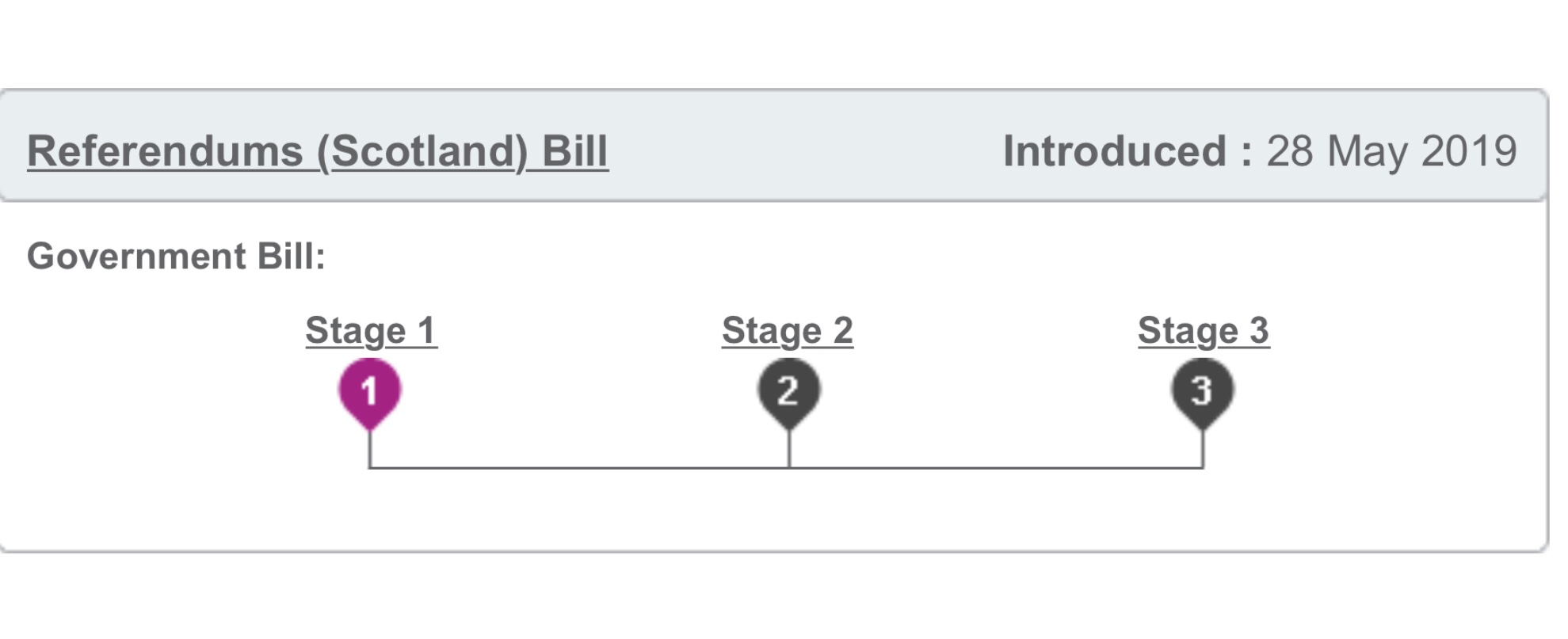
An infographic (taken from the Scottish Parliament’s website) showing the introduction of the Referendums (Scotland) Bill can be seen below:

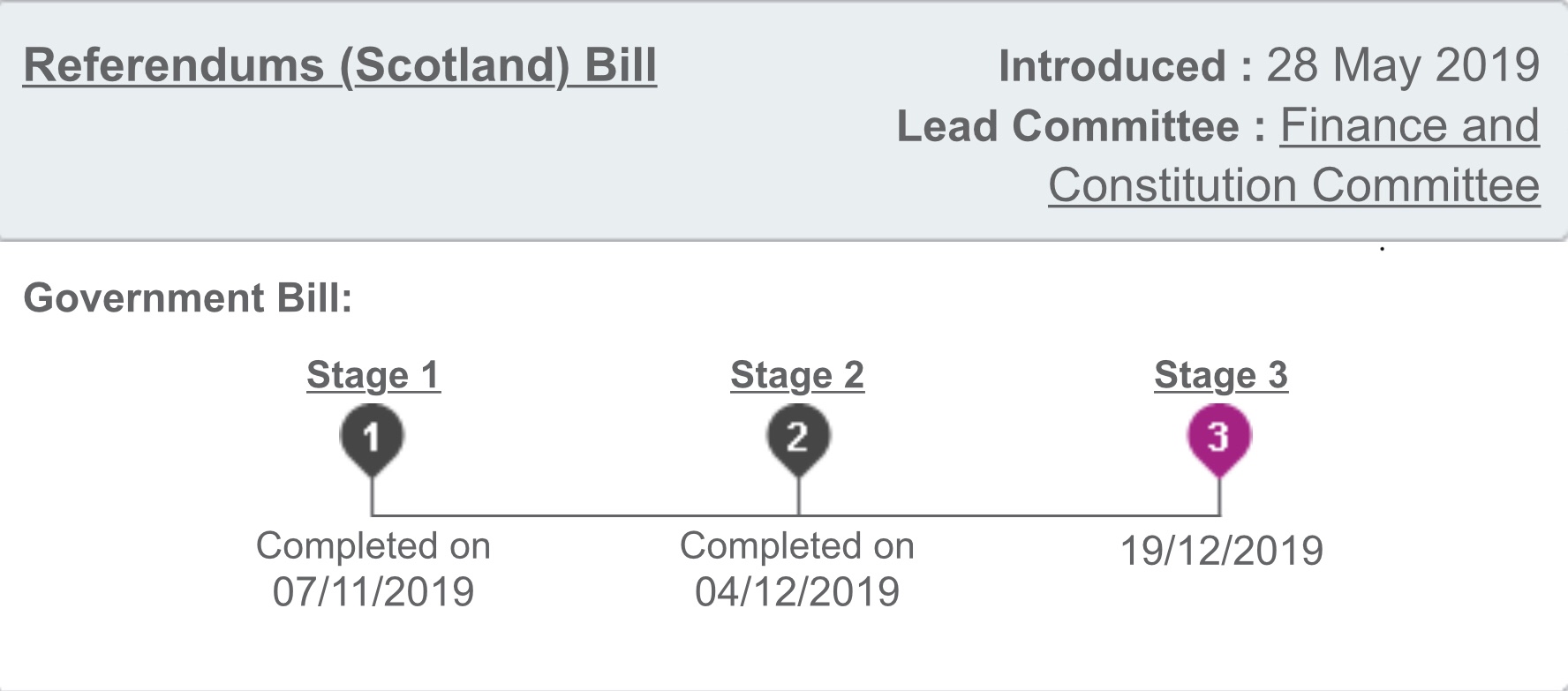
The subsequent progress of the Bill can be seen in the info graphic below:

A link to the Bill and its accompanying documents can be found below:

https://www.parliament.scot/parliamentarybusiness/Bills/111844.aspx

Finally, you can find links to some news articles below which discuss the implications of the Bill:

https://news.sky.com/story/nicola-sturgeon-clashes-with-tory-hopefuls-over-second-independence-referendum-11731033

Indyref2 ‘framework’ bill published at Holyrood

The Scottish government wants to hold a new independence referendum in the second half of 2020.

Postscript

On Friday 6 December 2019, 6 days before the UK General Election, Nicola Sturgeon MSP, First Minister of Scotland conceded that a legal Indyref2 was a ‘hard fact’ that some supporters of Scottish independence would have to accept.

What Ms Sturgeon was alluding to was a question of fact as we like to say in the law: the power to hold a future referendum on Scottish independence lies with the Westminster or UK Parliament in terms of Section 30 of the Scotland Act 1998.

Boris Johnson, the current UK Prime Minister has emphatically ruled out any second independence referendum if a majority Conservative Party Government is re-elected next Thursday.

Some Scottish independence activists have advocated a Catalan style independence referendum i.e. going ahead with a poll without legal authority. Understandably, this not a popular option where the First Minister is concerned when one remembers the chaotic (not to say) violent events in October 2017 during the independence referendum in Catalunya

A link to a discussion on the BBC website about the tensions over tactics in the Scottish pro-independence movement can be found below:

General election 2019: Sturgeon says legal indyref2 is a ‘hard truth’

The first minister says the only way to win a second indyref is for any vote to be legally-binding.

Copyright Seán J Crossan, 3 June and 6 December 2019

Private prosecutions

Photo by Jannes Van den wouwer on Unsplash

The bookies’ favourite to be the next UK Prime Minister, the Right Honorable Alexander Boris de Pfeffel Johnson MP (or simply ‘Boris’) is to face a private prosecution for misconduct in a public office. 

The misconduct relates to claims (or ‘lies’ depending on your viewpoint) which Mr Johnson allegedly made about the amount of money  the UK would save if it ceased to be a member state of the European Union. These claims were allegedly uttered by Mr Johnson during and immediately after the Brexit referendum campaign in early summer 2016 (apparently somewhere in the region £350 million per week would be saved by UK taxpayers following a successful UK exit from the EU). 

This blog is not really about the ins and outs of Mr Johnson’s current legal difficulties, but it highlights the fact that the concept of a private prosecution is something of a cultural and legal oddity in Scotland.

In Scotland, we take a somewhat rigid view that criminal prosecutions are very much the responsibility of the Crown or the state. It is very rare (and highly unusual) for private prosecutions to be permitted in Scotland. In any event, the High Court of Justiciary must grant permission, by way of a Bill of Criminal Letters, for any private prosecution to proceed in the first place. It should go without saying that the prosecutor in a private prosecution will still have to prove the allegations against the accused. 

Two fairly recent attempts to raise private prosecutions in Scotland have been rejected out of hand by the High Court of Justiciary (see Bill for Criminal Letters by (1) John and Linda Stewart and (2) Allan and Aileen Convey Against William Payne AND (1) Matthew McQuade and Jaceline McQuade and (2) Yvonne Reilly Against Henry Clarke [2016] HCJAC 122 HCA/16-2/XM HCA/16-3/XM).

A link to the Opinion of the High Court of Justiciary in respect of these matters can be found below:

https://www.scotcourts.gov.uk/search-judgments/judgment?id=d26a25a7-8980-69d2-b500-ff0000d74aa7

The Glasgow Rape Case

The most famous, partially successful private prosecution in Scotland in  was the affair which became known popularly as the Glasgow Rape Case. In 1982, a rape victim was permitted to raise a private prosecution against three of her alleged assailants (see X v Sweeney (1982) JC 70). Prior to this legal action, there had been one, other private prosecution in Scotland during the 20th Century and that had been concluded as far back as 1911 (the actual Bill of Criminal Letters was granted in 1909 – see J & P Coats Ltd v Brown 1909 6 Adam 19).

A system of public prosecution

The main characteristic of the Scottish criminal prosecution system is that it is a public prosecution system i.e. completely controlled and supervised by the state authorities i.e. the Crown Office and the Procurator Fiscal Service (COPFS). The following news stories demonstrate quite clearly that it will be COPFS that have the final say as to whether an individual faces prosecution in a Scottish criminal court:

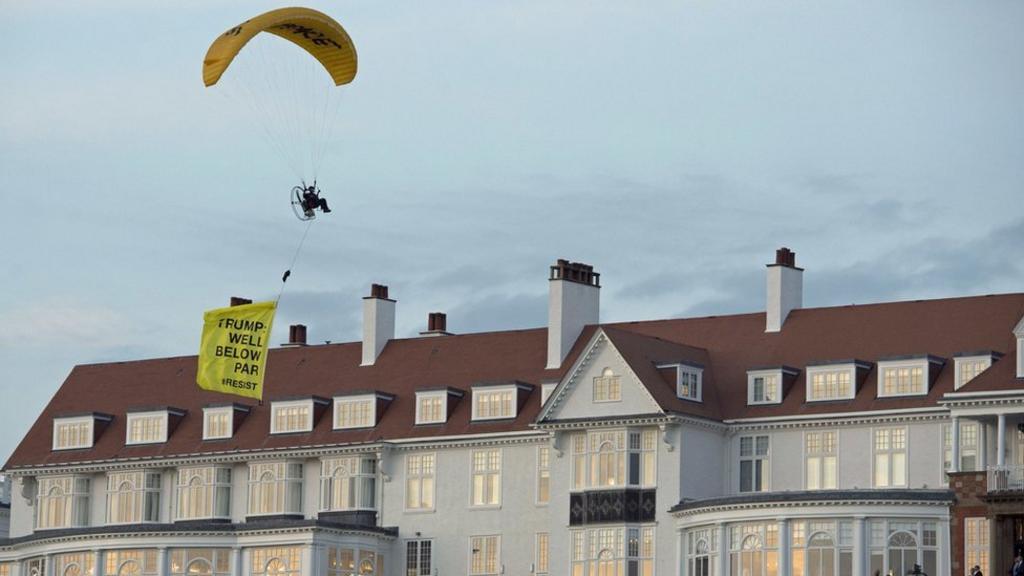
Trump paraglider protester to face no criminal charges

The protester was arrested after an air exclusion zone was breached at Mr Trump’s Ayrshire golf resort.


Nancy Glen sinking: Police investigation dropped

Duncan MacDougall and Przemek Krawczyk died when the fishing boat sank in Loch Fyne in January 2018.


That said, most prosecutions in England and Wales (not to forget about Northern Ireland) will be initiated by the respective Crown Prosecution Services in each of these neighbouring jurisdictions. 

Not all societies throughout history have employed a system of public prosecution to punish wrong-doers who have threatened the safety and security of their fellow citizens. In the Ancient Rome of Julius Caesar, the principles of criminal law were highly developed but their enforcement relied on a system of private prosecution whereby lawyers were commissioned (and petitioned) by interested parties to take on the role of prosecutors. There was no such thing as an office of State Prosecutor.

In one of the most famous examples of a successful private prosecution commissioned in Ancient Rome, Marcus Tullius Cicero, the lawyer, was approached by leading members of several Sicilian communities in 70 BC who wished him to commence a prosecution against the incredibly corrupt Roman Governor of Sicily, Gaius Verres. Undoubtedly, Verres had committed terrible crimes against the people of Sicily (this seemed to be a prerequisite for most Roman officials), but Cicero’s decision to prosecute him in the Roman law courts was not entirely altruistic. Cicero calculated that, if he won the extortion case against Gaius Verres (which he duly did in 69 BC), he would inherit Verres’ patrician status and wealth, not to mention the fame and the hordes of potential clients any victory would almost certainly bring him. Cicero also had his eyes on a political career and coveted one of the supreme offices of the Roman Republic, the Consulship or Chief Magistrate (in fact there were normally two Consuls at any one time). On such private prosecutions were the foundations of successful political careers established and Cicero became a Consul in 63 BC.

Even famous Roman citizens such as Cicero’s contemporary and rival, Julius Caesar were not immune from prosecution in the law courts. Caesar’s many political enemies used the threat of prosecution against him in order to prevent him from participating fully in the political life of Rome. For many years, Caesar was effectively an exile in Gaul (much of modern day France) where he was Governor until, in 49 BC, he crossed the River Rubicon and returned to Rome at the head of his army to seize power.

The point of this history lesson is to demonstrate that systems of private criminal prosecution can be easily manipulated by the desires and designs of individuals or special interest groups in a way that a system wholly controlled by a truly democratic State based on the rule of law (where everyone in theory at least is equal) cannot.

It has been said that the private prosecution against Mr Johnson is an attempt by highly partisan “Remain” supporters to halt Brexit. 

To be sure there will be lots of legal arguments and procedural hurdles to be negotiated by both prosecution and defence lawyers in the Johnson Affair. It will be interesting to see how this case plays out. At a basic level, it provides a useful contrast for students of criminal law in relation to the difference in procedure north and south of the border.  

A link to the story on the Sky News website about the private prosecution of Mr Johnson can be found below:

Boris Johnson to face court over alleged EU referendum misconduct
http://news.sky.com/story/boris-johnson-to-face-court-over-alleged-eu-referendum-misconduct-11730747

An interesting article written by John Macauley, the solicitor acting for the victim in the Glasgow Rape Case can be found below:

http://www.journalonline.co.uk/Magazine/62-1/1022696.aspx#.XO_hZMhKiM8

Postscript

On Friday 7 June 2019, Lady Justice Rafferty and Mr Justice Supperstone sitting in the English High Court quashed the attempt to bring a private prosecution against Boris Johnson. The matter will go no further.

A link to the story on the BBC News site can be found below:

Brexit: Boris Johnson £350m claim case thrown out by judges

Tory leadership contender denied acting improperly in saying the UK gave the EU £350m a week.

Copyright Seán J Crossan, 30 May & 7 June 2019

Ban smacking!

Photo by Kat J on Unsplash

John Finnie, a Green Party member of the Scottish Parliament introduced a Bill (Children (Equal Protection from Assault) (Scotland) Bill) on 6 September 2018.

This Bill would remove the common law defence of reasonable chastisement in Scotland which permits parents and guardians (primarily) to use smacking as a punishment in relation to children in their care.

The main objective of the Bill is expressed in its accompanying Explanatory Notes:

A person charged with assault of a child will no longer be entitled to claim that a use of physical force was justifiable on the basis that it was physical punishment administered in exercise of a parental right (or a right derived from having care or charge of a child). This will give children the same protection from assault as adults.

The Bill is quite a short one – a mere 5 sections – but if passed into law it is sure to have a very significant effect.

Section 1 contains the actual provision which would abolish the defence of reasonable chastisement

Section 2 places a duty on the Scottish Ministers to raise awareness and understanding of the proposed legislation

Section 3 contains the transitional and saving provision which is essentially interim arrangements for repealing the previous legislation  and gives the Scottish Ministers the power to do anything which would bring the provisions of the new law into force

Section 4 deals with the commencement of the proposed law i.e. the day after it receives Royal Assent

Section 5 contains the short title of the Bill.

The Bill will be debated and scrutinised by other MSPs in the Chamber and in Committee and it is quite possible that amendments or changes will follow. With every Bill, there is also the possibility that it might fall at a particular stage of parliamentary proceedings or, even if passed, could be subject to legal challenge e.g. the Scottish Government’s Children and Young Person’s (Scotland) Act 2014 which the UK Supreme Court found fault with on human rights grounds in 2016 (see The Christian Institute and Others v The Lord Advocate [2016] UKSC 51).

A link to the Scottish Parliament’s website where the Bill (as introduced) and its accompanying or supporting documents (which must be submitted) can be found below:

https://www.parliament.scot/parliamentarybusiness/Bills/109156.aspx

The Bill must, of course, comply with Scotland’s international human rights obligations as contained in the Scotland and Human Rights Acts (of 1998); and it must be within the “legislative competence” of the Scottish Parliament as per the Scotland Acts of 1998 (which the Presiding Officer, Ken McIntosh MSP has indeed confirmed).

The Bill is also subject to a Financial Memorandum. This can be summed up as a cost analysis to the Scottish Administration:

The Bill does not create a new offence; rather, it removes the defence of reasonable chastisement for the assault of a child. Thus, once the Bill is in force, some prosecutions may proceed as a result of the Bill which may not have proceeded when the defence was available. The Bill may also lead to additional cases of lower level physical punishment being reported, and prosecuted, which are currently not reported due to the defence being available.

Accordingly, the Bill can be expected to have some impact and costs on the criminal justice system.” [author’s emphasis]

Progress so far

The Equalities and Human Rights Committee of the Scottish Parliament gave its unanimous backing to the Bill (as as has the Scottish Government).

In support of his Bill, Mr Finnie has emphasised that 54 countries around the world have removed the right from parents and guardians to use physical chastisement as a method of disciplining children. His contention is that, if the Bill is adopted, it would bring Scotland into line with other developed countries.

In order to become a new Scottish law, the Bill, of course, must pass through all (3) legislative stages of Scottish parliamentary procedure.

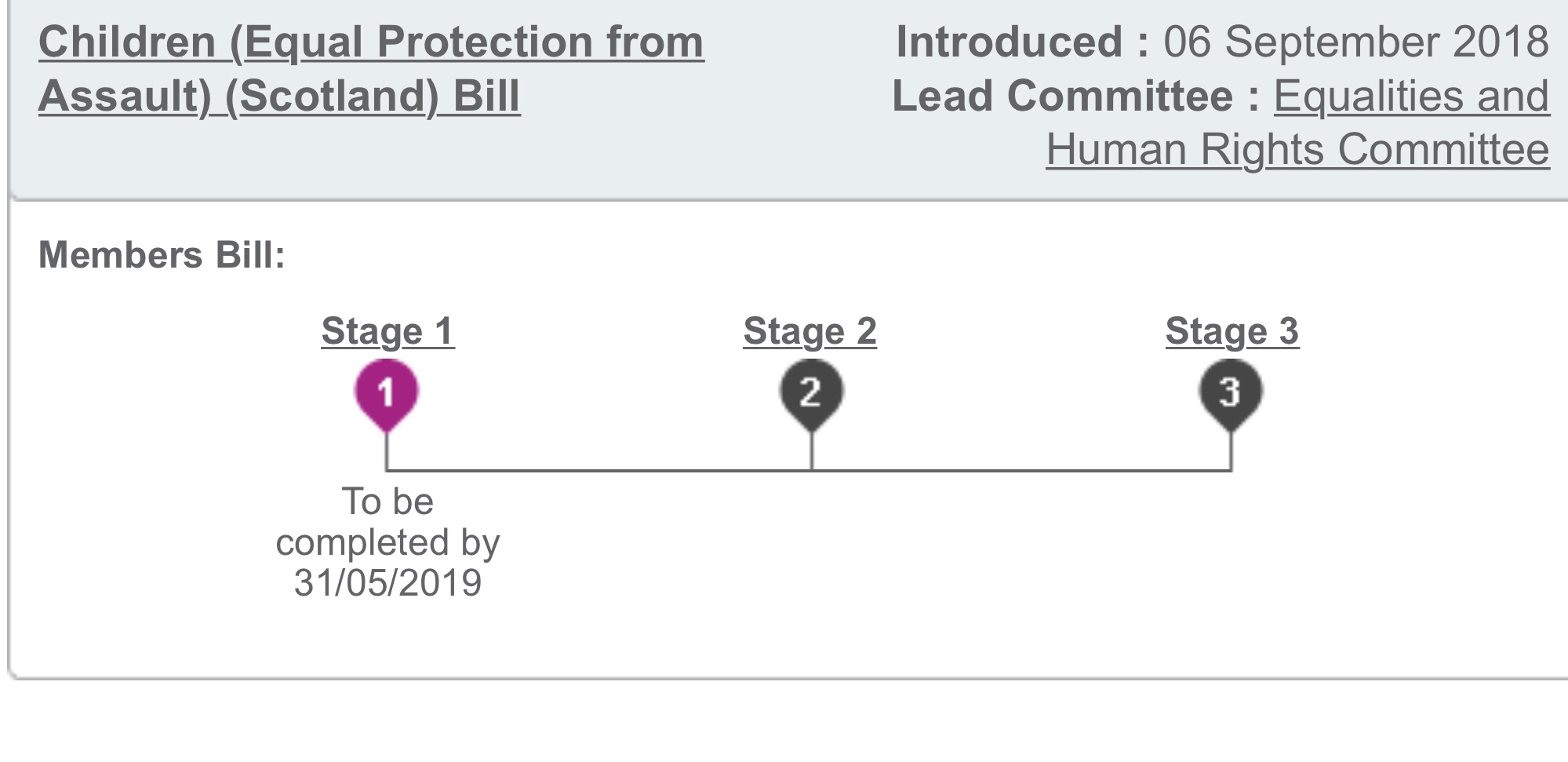
The Bill is currently at Stage 1 of proceedings. Please see the diagram below taken from the Scottish Parliament’s website which tracks the current progress of the Bill (as of today – Tuesday 28 May 2019):

In a previous Blog (Private Members’ Bills published on 29 April 2019), I drew attention to the fact that backbench members of the Scottish Parliament have a much greater ability to introduce Bills (and ultimately get them onto the Statute Book) when compared to their counterparts sitting in the House of Commons at Westminster. The term backbench or private member is a description which covers any MP or MSP who is piloting a Bill through Parliament which is not a Government Bill.

A link to an article on Mr Finnie’s Bill can be found below:

MSPs to discuss smacking ban bill in parliament debate

Postscript

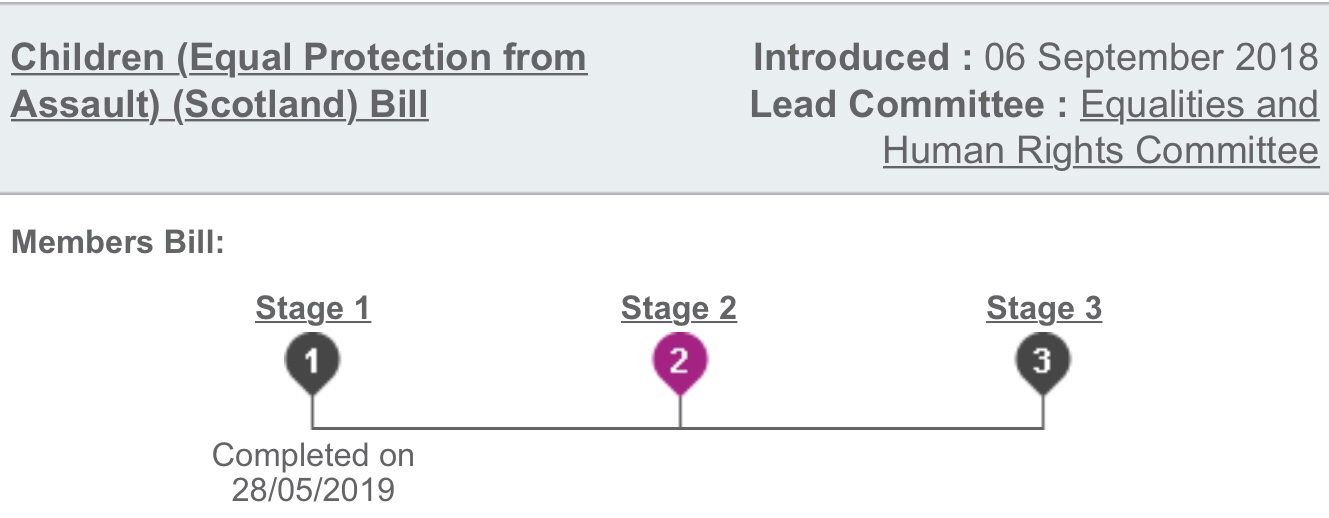
The Bill has now proceeded to Stage 2 of the legislative process in the Scottish Parliament as the infographic displayed below demonstrates:

Copyright Seán J Crossan, 28 May and 13 June 2019

No vote for you if you’re from the EU!

Photo by Element5 Digital on Unsplash

On 23 June 2016, the British electorate voted to leave the European Union. Almost 3 years later, the UK remains a member state of this organisation – despite the fact that 31 March 2019 was supposed to be “Brexit Day” as laid down in the European Union (Withdrawal) Act 2018.

This date has now been pushed back to 31 October 2019 by agreement with the other 27 member states.

As I have stated in previous blogs, while the UK remains an EU member state it must continue to comply with its membership obligations.

This has meant that the UK had to hold European Parliamentary elections on Thursday 23 May 2019 – something which the British Government had hoped to avoid.

This was not the only controversy which dogged this election: a large number of European citizens reported that they had been denied the right to vote last Thursday. Was this a case of the conspiracy or cock-up theory? Probably the latter, but it has meant that a lot of people who should have been allowed to exercise their democratic right were prevented from doing so last Thursday. A number of reasons for this chaos have been suggested: lack of preparation by electoral officials; incomplete paperwork; and a lack of clarity from the UK Government.

The Maastricht Treaty 1992 (official title: the Treaty on European Union) established the concept of a common European citizenship. Part of this would entail the right of European citizens living in another member state to participate in certain elections.

EU citizens ordinarily resident in the UK, and in Scotland particularly, are entitled to vote in council, Scottish Parliament and European Parliament elections. In 2014, the Scottish Government also permitted EU citizens to participate in the Scottish Independence Referendum.

In order for these rights to be implemented, the Representation of the People Act 1983 had to be amended by the Westminster Parliament in order to comply with our European legal obligations. As a point of interest, all the other member states would have had to amend their domestic legislation governing elections to implement the rights given to European citizens by the Maastricht Treaty.

Extending the right to vote in national, general elections was opposed by many member state governments at the time of the negotiations which led to the Maastricht Treaty. It has always been the case that EU citizens living in the UK have not been allowed to cast a vote in a British General Election. This was taking the concept of shared European citizenship just a little too far – even back in the heady days of the Maastricht Treaty when Brexit seemed unthinkable.

Admittedly, the UK and the Republic of Ireland have, for a very long time, permitted their citizens to vote in each state’s elections. Ironically, this arrangement will continue to function even after Brexit has been achieved.

The failure to ensure that European citizens were able to vote in last Thursday’s elections might also represent a potential breach of Article 18 of the Treaty on the Functioning of the European Union i.e. no discrimination on the grounds of a person’s nationality. If this is the case, expect the European Commission to initiate enforcement proceedings, in terms of Article 267 TFEU, against the UK for failure to uphold the civil and political rights of European citizens living in this country.

A link to a report about EU citizens being denied their right to vote in the European Parliamentary elections can be found below:

EU citizens in UK complain of being denied vote in European elections
http://news.sky.com/story/eu-citizens-in-uk-complain-of-being-denied-vote-in-european-elections-11727020

Copyright Seán J Crossan, 25 May 2019

Social media and dismissal

Photo by Alex Haney on Unsplash

Regular readers of this Blog will know that I have written several articles over the last few months about the legal consequences of social media (mis)use and the effects on relationships in the work place. Comments or images posted on social media by employees can have serious reputational consequences for their employers.

The Israel Folau case

In a blog published on 11 April 2019 (Social Media Misuse), I discussed the story about Israel Folau, the Australian rugby player who had posted homophobic comments on social media. Folau has now been dismissed by Australia for these remarks.

Please see a link to the story on the Sky News website:

Israel Folau: Australian rugby star sacked over anti-gay social media post
http://news.sky.com/story/israel-folau-australian-rugby-star-sacked-over-anti-gay-social-media-post-11721930

The employer must, of course, be able to prove reasonably that the employee’s misuse of social media will cause it to suffer reputational damage.

In Taylor Somerfield Stores Ltd ETS/107487/07 an employee was dismissed after posting a video on Youtube which involved a mock fight using Somerfield carrier bags in the work place. The video was uploaded to Youtube for a mere 3 days and only 8 people had viewed it – 3 of whom were managers conducting the disciplinary investigation. The Employment Tribunal was firmly of the view that the dismissal was unfair because the employer was not able to prove that it had suffered serious reputational damage.

As I have emphasised in previous blogs, employees will be very naive if they think that it is a competent defence to say that the social media posts occurred outside working hours. Employers are still very much entitled to treat such behaviour as an example of a breach of work place discipline. In serious cases of social media misuse, employers will be entitled to consider dismissal of employees on the grounds of misconduct (as per Section 98(4) of the Employment Rights Act 1996).

Admittedly, this area represents something of a tightrope for employers to walk: they will have to operate a clear and comprehensive social media policy and employees must be made aware of any restrictions or expectations.

In the unreported Employment Tribunal decision of Grant and Ross Mitie Property Services Ltd (2009), the employer had a policy which restricted employee internet access. Unfortunately, for the employer, the phrase which permitted employee’s personal use of the internet to times that were “outside core working hours”, was deemed by the Tribunal to be ‘vague’ and lacking in certainty. This meant that the employees who had been dismissed because the employer was of the view that they had breached its policy on internet use had been unfairly dismissed.

There is also the matter of the rights that employees reasonably have to privacy and freedom of expression (as per their Article 8 and 10 rights respectively to be found in the European Convention, the Human Rights Act 1998 and the Scotland Act 1998) (see Bărbulescu v Romania Application no. 61496/08 5 September 2017; and Smith v Trafford Housing Trust [2012] EWHC 3221 (Ch)).

I have also pointed out in previous blogs, the importance for employers in carrying out disciplinary proceedings which comply with current ACAS Guidance. Using the (current) ACAS Guidance is a critical risk management exercise for employers:

https://beta.acas.org.uk/investigations-for-discipline-and-grievance-step-by-step

Employers who act recklessly or swiftly and ignore proper procedures may well have cause to regret their actions down the road. As Sir Robert Megarry VC, the eminent English judge, remarked decades ago in John Rees [1970] 1 Ch 345:

When something is obvious, they may say, why force everyone to go through the tiresome waste of time involved in framing charges and giving an opportunity to be heard?As everybody who has anything to do with the law well knows, the path of the law is strewn with examples of open and shut cases which, somehow, were not; …

The above remarks are as valid in 2019 as they were in Sir Robert Megarry’s day.

Atherton v Bensons Vending Ltd ET/2411749/2018

This is a recent decision of the Manchester Employment Tribunal which raises some very interesting issues about employee use of social media specifically and the conduct of disciplinary proceedings more generally.

Darren Atherton (aged 55) worked for Bensons Vending Ltd, a small company. As a result of his employer making changes to its discretionary Christmas bonus scheme, Atherton made some very negative comments about the company’s Managing Director, Ken Haselden via a colleague’s Facebook page:

Comment 1

We’ve all just bought Ken a new dog with our Christmas bonus!!!”

Comment 2

“He spends a few grand on a new dog then we get told ‘no bonus this year’ but we can have a bottle!!! 

Comment 3

“Well, he can stick his bottle where the sun doesn’t shine because I refuse to be insulted in this way!!!

Atherton’s colleague, Simon Minshull had initially objected to the changes to the bonus scheme by posting comments on his Facebook page:

Comment 1

Just when you thought staff morale couldn’t get any worse, hey f***ing presto #insult #disgusted.”

Comment 2

The only difference between McDonalds and where I work is McDonalds has only one clown running the show.” (This second comment was accompanied by a picture of Ronald McDonald).

The changes to the bonus scheme were part of a cost cutting and efficiency savings exercise by the company and, from any reading of the above comments, Atherton and Minshull clearly disagreed with this new approach by their employer.

Negative remarks about the Managing Director were also made by Atherton and another colleague in the workplace. Several colleagues informed Haselden about these remarks stating that they had been very aggressive and vitriolic in nature.

Atherton’s colleague, Simon Minshull, was subsequently questioned about the posts on his Facebook account by Haselden. Minshull stated that he did not agree with them – they were Atherton’s opinions – and he apologised for any offence caused to Haselden. He was later suspended for the Facebook posts, but critically this suspension was lifted in the light of his swift apology to Haselden (and the fact that it was established that he had not made these comments). Minshull was permitted to return to work upon the conclusion of the disciplinary proceedings against him.

Atherton was called to a meeting with Mr Haselden in December 2017 to address the allegations which had been made against him and to investigate the social media posts. This was not a disciplinary meeting, but more in the way of an investigatory meeting. The actual disciplinary meeting took place in January 2018.

Dismissal without notice pay

The outcome of the disciplinary meeting was that Atherton should be dismissed without notice pay for gross misconduct in terms of Section 98(4) of the Employment Rights Act 1996. This was despite the fact that Atherton had a clean disciplinary record (until now) and had enjoyed a good relationship with his employer. Atherton’s comments on Facebook were “extremely derogatory” and Mr Haselden stated that he would find it “extremely difficult” to continue working with him. Atherton appealed against his dismissal, but the decision was upheld.

The fairness of the disciplinary proceedings

As part of his claim against the employer, Atherton challenged the fairness of the disciplinary proceedings taken against him. In particular, he objected to the fact that Haselden conducted the disciplinary meeting against him. Atherton’s contention was that he would not receive a fair hearing because Haselden was personally involved in the matter and, therefore, could not be relied upon to act objectively. This type of issue frequently arises where smaller employers are concerned. In an ideal world, a manager (such as Haselden) who has been involved personally in an issue involving alleged breaches of work place discipline should not be a participant in the disciplinary panel. This is, of course, easier in practice to ensure in larger organisations where there is a pool of experienced managers who will have had no personal involvement in the matter (or in other words: a particular axe to grind).

The appeals process

In situations involving smaller employers, this is where the appeals process takes on a critical significance. Appeals can often be used to cure actual or perceived defects in the conduct of the original disciplinary meeting. Although Haselden (with two others – an operations manager and a company engineer) had conducted the disciplinary meetings, he had not involved himself in the actual appeals hearing. This part of the company’s disciplinary procedure had been conducted by a Ms Pedley, a trained auditor and, as stated, above, Atherton’s dismissal was upheld.

At this point, Atherton also raised the difference in treatment between himself and Simon Minshull (who had kept his job after disciplinary proceedings against him had been concluded). Pedley refused to comment on individual cases on the grounds of confidentiality. She stated in her letter to Atherton upholding the dismissal that:

Length of service and clean disciplinary record are taken into consideration during all grievance procedures. However, given the
nature of the comment and the reluctance to remedy the grievance the
relationship between yourself and senior management has broken down
irretrievably”.

The Employment Tribunal’s decision

The Tribunal held that Atherton had been fairly dismissed in terms of Section 98(4) of the Employment Rights Act 1996.

He had made extremely derogatory comments via Facebook about Haselden. They were “personal” and they suggested “some impropriety” on Mr Haselden’s part (though more in the nature of “penny-pinching impropriety” suggesting Scrooge like behaviour rather than any financial misdeeds). Any member of the public who knew the company and reading Atherton’s comments on Simon Minshull’s Facebook site, would have a very negative view of Haselden. It was accepted by the Tribunal that Haselden would, therefore, potentially suffer reputational damage. It was also accepted that in a small company, it would be very difficult for Atherton and Haselden to work with one another again (the employment relationship had irretrievably broken down).

The Tribunal also addressed Atherton’s claim that the disciplinary procedure had been biased or lacking in objectivity because of Haselden’s involvement in the decision to dismiss him from employment. This indeed could have been a problem for the employer and may have prejudiced proceedings against Atherton. That said, however, the saving grace for the employer was the fact that Ms Pedley had been kept in reserve for an appeal hearing.

The Employment Tribunal Judge made the following observations about Pedley’s involvement in the appeal stage:

Ms Pedley is by profession an auditor and had clearly gone through the matters in great detail. Notes (page 95 and onwards) show how she dealt with the matter. … Because of that safeguard of the deployment of Ms Pedley, who I am satisfied went about her task objectively and exhaustively and independently, although regrettably for the claimant she came to the same conclusion, I am not satisfied that the determination by Mr Haselden at the dismissal stage rendered the dismissal unfair. The appeal was thorough, it was a re-hearing. Ms Pedley considered all the points that were being raised and came, I am satisfied, to an independent conclusion.”

As for the difference in outcomes between Atherton and Simon Minshull, a key justification for this was that Minshull had “apologised shortly after being challenged regarding his Facebook comments even though he had been suspended.” This was something that Atherton had failed to do – apologising only at the disciplinary meeting in January 2018. Furthermore, it was significant that the nature of Atherton’s comments were specifically directed against Haselden, whereas Minshull’s comments (although also negative) were much more generalised.

The failure to pay notice pay

This was an aspect of the employer’s decision that the Employment Tribunal disagreed with. Atherton, therefore, had a right to receive his entitlement to notice pay. In this sense, he had been wrongly dismissed by his employer. The Employment Tribunal judge stated very clearly that in order for an employee to lose his entitlement to notice pay there the employer must be able to demonstrate that the gross misconduct complained of crosses over a “very high hurdle”. In the judge’s opinion, the employer had not been able to overcome this hurdle and, therefore, Atherton was entitled to claim notice pay.

A link to the Employment Tribunal’s judgement in Atherton Bensons Vending Ltd can be found below:

https://assets.publishing.service.gov.uk/media/5c4712dfe5274a6e6b6716e1/Mr_D_Atherton_v_Bensons_Vending_Limited_-_2411749_2018_-_Reasons.pdf

Conclusion

What have we learned about the decision of the Employment Tribunal in Atherton Bensons Vending Ltd?

Quite a lot actually:

  1. Employees will have to be extremely careful when posting material or comments on social media platforms – irrespective of whether this is about the employers or not.
  2. The case is yet another good example that misconduct committed inside or outside the work place or working hours can have reputational consequences for the employer. It can also lead to relationships in the work place breaking down irretrievably (especially in smaller organisations).
  3. Employers do not have a free hand to police employee use of social media. There must be clear guidelines laid down by the employer as to what constitutes acceptable and appropriate behaviour. At the same, employees have reasonable expectations that their rights to privacy and expression (as per the European Convention on Human Rights) will be upheld.
  4. The conduct of disciplinary proceedings by the employer is a critical issue. We have noted that potential conflicts of interest can occur in smaller employers or organisations where a manager can be investigator, dismissing officer and appeals officer. How does the employer address these issues and ensure objectivity in the disciplinary process?
  5. As with Atherton and Minshull, the employer was entitled to treat them differently: Atherton was dismissed while Minshull retained his job. There was nothing inconsistent or inherently unfair about this when the personal circumstances and behaviour of the two employees was examined.
  6. Finally, even in situations where gross misconduct has been proved by the employer, and the dismissal is deemed to be fair (in terms of Section 98(4): Employment Rights Act 1996), it will not necessarily mean that the employee loses his or her right to notice pay. The employer will have to overcome an extremely high hurdle in order to be entitled to invoke such a disciplinary sanction. As we have seen in Atherton, the Tribunal was not convinced that the employer had been able to prove that this was an appropriate punishment: the dismissal was fair; the failure to pay notice was not.

Copyright Seán J Crossan, 20 May 2019

Don’t do it!

george-pagan-iii-624417-unsplash.jpg

Don’t do what? Get pregnant, it would seem if you’re a female athlete who receives sponsorship from one of the planet’s most visible sporting brands.

Just this week, allegations have been made by a number of female athletes that Nike withdrew sponsorship after they discovered that they were pregnant.

Now, if the allegations are true, this would certainly represent an example of unlawful, less favourable treatment. Pregnancy and maternity discrimination are prohibited in terms of Sections 17 (non-work cases) and 18 (work cases) of the Equality Act 2010. They are very specific forms of sex discrimination (a person’s sex or gender is a protected characteristic in terms of Section 11 of the Act).

In 2019, you might have been forgiven for thinking that pregnancy discrimination was a thing of the past…

The Sex Discrimination Act 1975

The (now repealed) Sex Discrimination Act 1975, which was held up as a significant advance for woman’s equality, was fundamentally flawed when it addressed the issue of pregnancy and maternity discrimination.

When the Act of 1975 was first introduced, cases involving alleged discrimination connected to a woman’s pregnancy encountered an unexpected problem, which the Parliamentary draftsmen had not taken into account: how could it be valid to attempt a comparison between that of a pregnant woman’s situation with that of a man? A strict application of the legislation meant that this was not a valid comparison and, therefore, many of the earliest sex discrimination claims failed because some judges applied the literal approach to the interpretation of the Act – even if this made the law something of an ass and, more seriously, led to blatant injustice.

This Act made it very clear that central to the success of any claim was the complainant’s ability to compare his or her allegedly less favourable treatment to an actual or hypothetical male/female comparator. If he or she could not do this, the claim would fail. A woman claiming that she had suffered discrimination on the grounds of her sex must have been able to carry out a like with like comparison.

The woman’s circumstances and those of her male comparator must have been broadly the same (they should not have been materially different) otherwise a meaningful comparison could not be made.

The European Union

This situation really continued into the 1990s and, it was only when the Court of Justice of the European Union resolved the matter in Dekker v Stichting Vormingscentrum voor Jonge Volwassen Plus (1991), that things started to improve. Dekker clearly established that there was no requirement for pregnant women to identify a male comparator when they were alleging that they had experienced unlawful, less favourable treatment.

The Equality Act 2010 now, in theory, affords pregnant women and mothers much stronger legal protection than the Sex Discrimination Act 1975 ever did, but yet examples of pregnancy and maternity discrimination still arise.

It was as recently as 2016 that the Equalities and Women Committee of the House of Commons exposed the shocking extent of pregnancy and maternity discrimination in the UK. Maria Miller MP, chair of the Committee stated:

Our 2016 report laid bare the significant discrimination and poor treatment faced by 54,000 pregnant women and mothers at work each year.”

A link to the Committee’s Report can be found below:

https://www.parliament.uk/business/committees/committees-a-z/commons-select/women-and-equalities-committee/news-parliament-2017/pregnancy-maternity-discrimination-2-statement-17-19/

Just do it?

Being deadly serious, the above slogan (of Nike) will hardly sit well with those female athletes in receipt of sponsorship from the company. That said, should we really be surprised that stories of this nature emerge when read against the Report of the Women and Equalities Committee?

A link to the article about alleged pregnancy discrimination as reported by Sky News can be found below:

Pregnant athletes ‘punished’ by Nike, says champion British runner Jo Pavey
http://news.sky.com/story/pregnant-athletes-punished-by-nike-says-champion-british-runner-jo-pavey-11721817

In 2018, Nike was praised for endorsing Colin Kaepernick, the former African American Football star who had actively campaigned to raise awareness of racial inequality. Now with these sex discrimination allegations, is it a case of one step forward, ten steps back for Nike?

Postscript

On 26 May 2019, The Independent reported that Nike had promised not to impose financial penalties on those female athletes who became pregnant and who were in receipt of sponsorship from the corporation. This was undoubtedly due to the considerable, adverse publicity which the story had generated around the world.

A link to the article in The Independent can be found below:


https://edition.independent.co.uk/editions/uk.co.independent.issue.260519/data/8930341/index.html

On 17 August 2019, the BBC reported that Nike had removed the offensive clause from its contracts with female athletes.

A link to the story can be found below:

Allyson Felix: Nike changes policy for pregnant athletes

Six-time Olympic gold medallist Allyson Felix says female athletes will “no longer be financially penalised for having a child” after Nike changed its sponsorship contracts.

Copyright Seán J Crossan, 17 & 26 May and 17 August 2019

The biased arbiter?

Photo by Tim Gouw on Unsplash

Parties to a civil legal dispute may not wish to go to court or a tribunal for a variety of different reasons e.g. adverse publicity; commercial secrecy; or the negative impact on a company’s share value. Instead, as an effective alternative, they may wish to use the services of a neutral third party to help them resolve the disputes. In these situations, the parties often make the choice of taking responsibility for dispute resolution upon themselves rather than relying upon a court which will impose its own judgement.

In a commercial dispute, the parties may wish to use an arbitration procedure to come to some sort of agreement. Arbitration allows the parties to appoint a neutral person, known as an arbiter in Scotland (arbitrator in England), who will hear both sides of the argument and who will then suggest a solution which hopefully will be broadly acceptable to both sides. The mechanism for appointing an arbiter is simple. The parties may have anticipated a dispute occurring and they have taken steps to address this by inserting an arbitration clause in the contract that they have formed with one another.

An example of such a clause can be found below:

ARBITRATION CLAUSE

Any dispute or difference arising out of or relating to this contract, its interpretation or the breach thereof, shall be settled by arbitration before an Arbiter selected and appointed by the President or Vice-President for the time being of the Law Society of Scotland from the panel of Arbiters maintained by the Law Society of Scotland and conducted in accordance with the Arbitration Rules of the Law Society of Scotland current at the date of the appointment of the Arbiter; and we consent to registration hereof for preservation and execution.

Alternatively, when a dispute first arises, the parties may agree to use arbitration instead of the courts. Once the parties have chosen arbitration over the courts, they are committed to this procedure and they cannot withdraw unless the arbitration process is seriously flawed (to which I shall return later in this blog).

Arbitration is not permitted, however, in criminal matters or in family law (divorce, separation or custody of children). Arbitration is often preferred in business as it is private (as opposed to public court hearings); it might be faster than using the courts; it may be less expensive than court; and the parties can decide the most appropriate procedures that will be used.

The Advisory, Conciliation and Arbitration Service (ACAS) promotes the extensive use of arbitration to resolve many disputes which have legal consequences (see link below).

https://www.acas.org.uk/arbitration

Arbitration can even be used when a legal dispute has gone to court or a tribunal. In a simple procedure action in the Sheriff Court, for example, the Sheriff has a duty to make enquiries of the parties in dispute as whether they are willing to consider the option of having the claim referred to an independent expert (an arbiter) whose decision in the matter is final. Usually, the Sheriff will give the litigants this choice when they meet formally for the first time in court. Once the litigants have decided that they wish to have the matter decided by an independent expert, they cannot later choose to ask the Sheriff to become involved in the case.

What if the arbiter (or arbitrator in England) was deemed to be biased in favour of one of the parties in the dispute? I often use this an example where the outcome of the arbitration proceedings could be challenged in court. Whether the bias is actual or where there is a perception of bias, it does not really matter because the parties to the dispute must have complete confidence in the neutrality and objectivity of the arbiter (or panel of arbiters).

The issue of the perception of bias on the part of an arbiter arose in the following case which was dealt with by the English High Court (Queen’s Bench Division):

Cofely Limited v Bingham & Knowles Limited [2016] EWHC 240 (Comm) Cofely objected to the continued involvement of Bingham as an arbitrator in a commercial dispute in the construction industry involving the provision of energy services to the Olympic Park and Westfield Shopping Centre in Stratford, London.

Bingham’s action was raised under Section 24(1)(a) of the Arbitration Act 1996 (which applies in England and Wales) on the grounds that Bingham was perceived by Cofely not to be sufficiently impartial. On the face of it, Bingham was a highly experienced arbitrator and adjudicator (being a qualified barrister of many years standing).

The main thrust of Cofely’s objections to Bingham’s involvement in proceedings was that it had emerged that there appeared to be a sufficiently close working relationship between Bingham and Knowles Limited. It was established that Bingham had received 18% of his arbitral appointments and 25% of his income from disputes involving Knowles Limited. Cofely had wanted to find more information about the exact nature of the relationship between Bingham and Knowles, but when this topic had been raised during arbitration proceedings, the arbitrator refused to provide satisfactory answers to these questions. In fact, Bingham was later accused of conducting himself “aggressively and in a hostile manner” which did nothing to reassure Cofely in respect of its concerns about his objectivity and neutrality – which a truly independent arbitrator should be displaying.

Held: by Mr Justice Hamblen sitting in the English High Court that, if Bingham did not voluntarily resign from further involvement in arbitration proceedings, an Order would be issued by the court removing him from his role. It was found

As Mr Justice Hamblen wisely stated:

Where there is actual or apparent bias there is also substantial injustice and there is no need for this to be additionally proved …

It is important to note that this case concerns the perception of bias rather than actual bias on the part of Bingham towards Knowles Ltd. It is essential to appreciate that a party involved in arbitration proceedings (such as Cofely) is absolutely entitled to demand that there should be complete confidence in an arbitrator’s (or arbiter’s) impartiality. Significantly, the judge did find that no bias concerning the making of a Partial Award and the conduct of the arbitration had been fair up until the point at which Cofely had started to make enquiries about the precise nature of Bingham’s relationship with Knowles Ltd.

Or … if we want to paraphrase a well known saying from Shakespeare’s Julius Caesar: an arbiter/arbitrator must be like Caesar’s wife – above suspicion.

A link to the High Court’s judgement in Cofely Limited v Bingham & Knowles Limited [2016] EWHC 240 (Comm) can be found below:

https://www.trans-lex.org/312060/_/cofely-limited-v-anthony-bingham-et-al-%5B2016%5D-ewhc-240-/

Copyright Seán J Crossan, 14 May 2019

Inequality in the UK

Photo by Søren Astrup Jørgensen on Unsplash

So much for equality of opportunity in 21st century Britain. It looks as if this country is becoming more unequal, if the latest research is to be believed.

True, we have legislation such as the Human Rights Act 1998; the Equality Act 2010; and EU legal principles such as (Article 157) of the Treaty on the Functioning of the European Union (TFEU) which embed anti-discrimination laws. Parliaments and the EU can pass all manner of laws, but this of itself does not guarantee the conditions of true equality to flourish. Equal pay laws have been in force since 1975 in the UK, but tell that to Glasgow City Council female employees who had to struggle every step of the way to win their battle for pay equality in January 2019.

Since the inception of the Scottish Parliament in 1999, Scottish Governments have introduced various initiatives to tackle the scourge of child poverty. The latest attempt can be found in the Child Poverty (Scotland) Act 2017 which aims to combat some of the causes of this problem by 2030. In a recent blog (Food for thought? published on 16 April 2019) I discussed the suggestion, in a report by the Scottish Human Rights Commission, that the right to food security should be recognised as a fundamental human right. This proposal was made against a background of increased use of food banks in Scotland.

Everywhere you go organisations proclaim their commitment to equality and diversity and, if you take things at face value, you might allow yourself to be fooled into thinking that great progress is being made.

We can have a plethora of events such as Black History Month; Disability Awareness Month; World AIDS Day; International Women’s Day; and Day Against Homophobia, Transphobia and Biphobia, but if they are to be judged in any way successful they must lead to real change.

And yet … something is clearly not working when the UK Government’s own Social Mobility Commission concludes (in its latest Report) that levels of inequality in this country remain stubbornly persistent.

Now, the Institute of Fiscal Studies has weighed in with its own take on the matter. Professor Sir Angus Deaton will chair a Review which will examine the causes of inequality in modern Britain. The Institute of Fiscal Studies, a leading UK Think Tank, has stated that rising levels of inequality and exclusion threaten the very foundations of democracy in this country.

In April 2010, Nick Clegg, then Leader of the Liberal Democrats, trumpeted his Party’s manifesto commitment which would ensure that fairness was ‘hardwired’ into British society. I wonder if, from the comfort of his executive office at Facebook HQ in Silicon Valley, Mr Clegg now sees his time as UK Deputy Prime Minister (2010-15) as a wasted opportunity?

In her column in last Saturday’s edition of The Independent, Janet Street Porter spoke of the lack of diversity at the BBC as a working class person

… who managed (against all the odds) to make a living out of working for the BBC, an organisation where (even in 2019) the over-educated and middle class dominate. We’re proof that in modern Britain, social mobility still moves at a glacial pace. …

… For all the BBC trumpets its ethnic, gay and gender-fluid presenters, one category is conspicuously absent on the radio and television – white working class people.”

This inequality can be traced from “birth to work” according to the Social Mobility Commission’s findings:

“In this our sixth State of the Nation report we lay bare the stark fact that social mobility has stagnated over the last four years at virtually all stages from birth to work. Being born privileged in Britain means that you are likely to remain privileged. Being born disadvantaged, however, means that you will have to overcome a series of barriers to ensure that you and your children are not stuck in the same trap.

At a time when our country needs to be highly productive and nimble we impede our own progress as a nation if we do not maximise the talent of all our citizens – especially those that start the furthest behind. We fail if we do not make it possible for every individual to have choices about where they go and what they do in life.

This report shows that more needs to be done to support the most vulnerable. Our analysis finds that, too often, well intentioned policies fail to reach those who would benefit most, while cuts to other provisions disproportionately impact the most vulnerable.

Clearly a lot still has to be done to make the UK a fairer society.

A link to the Social Mobility Commission’s Report can be found below:

https://assets.publishing.service.gov.uk/government/uploads/system/uploads/attachment_data/file/798404/SMC_State_of_the_Nation_Report_2018-19.pdf

A link to the Institute of Fiscal Studies’ website can be found below:

Home

Postscript

Another facet of inequality in the UK was revealed by Sky News on 2 July 2019. A survey revealed that LGBT workers were more likely to be paid less compared to their straight colleagues and were still afraid of revealing their sexual orientation in the work-place:

LGBT+ workers earn less and are still afraid to come out – survey
http://news.sky.com/story/lgbt-workers-earn-less-and-are-still-afraid-to-come-out-survey-11752927

Copyright Seán J Crossan, 13 May & 2 July 2019

Veganism = Discrimination?

Photo by Ivana Milakovic on Unsplash

Regular readers of this Blog will be aware that several of my previous articles have examined whether veganism could be a protected characteristic (a philosophical belief) in terms of Section 10 of the Equality Act 2010.

We still await the decision of the London Employment Tribunal in relation to the case of Jordi Casamitjana v League Against Cruel Sports (lodged in December 2018) which will give us a first indication as to whether veganism is capable of being a protected characteristic in terms of the Equality Act.

A link to an article on the BBC website about Mr Casamitjana’s claim can be found below:

Sacked vegan claims discrimination in landmark case

A landmark tribunal will decide whether veganism is a “philosophical belief” akin to a religion.

In the meantime, Crossland Solicitors (an Oxfordshire based law firm) have carried out some really interesting research concerning the issue of vegan beliefs and work-place discrimination.

Nearly 1,000 employees and 1,000 employers took part in the research. The conclusions from this exercise are that nearly 45% of employees are of the opinion that they have experienced less favourable treatment due to their beliefs and nearly a third of respondents felt that they had been actively victimised by their employers because of their veganism. It seems to be the case that a large number of employers take the view that veganism is a fashion trend or a fad as opposed to an ethical and philosophical set of views which guides people in their daily lives.

Hopefully, the London Employment Tribunal will issue it’s decision in the very near future about Mr Casamitjana’s claim in order to provide some needed clarity to this area of the law.

A link to the research on Crossland’s website can be found below

https://www.crosslandsolicitors.com/site/cases/nearly-half-of-vegans-feel-discriminated-against-at-work

Copyright Seán J Crossan, 12 May 2019

How dare you mention my age!

Photo by Elena Saharova on Unsplash

The above picture may conjure up blissful images of a well deserved retirement, but the reality can be very different for many older employees and workers. Financial necessity and a higher state pension age may mean that many individuals will have to remain in work for much longer than they would like.

In October 2011, the UK Parliament issued a PostNote entitled “An Ageing Workforce” which made the following observations in its introduction:

Over the next decade, the changing age profile of the workforce will be the most significant development in the UK labour market, as a third
of workers will be over 50 by 2020Employers will be expected to respond to this demographic shift by making work more attractive and feasible for older workers, enabling them to work up to and beyond State Pension Age (SPA) if they are capable.”  

Significantly, this PostNote went on to state:

Within 20 years, nearly a quarter of the UK population will be aged 65 or over. People are now spending an average of 7 years longer in retirement than in the 1970s …

A link to this PostNote can be found below:

Click to access postpn391_Ageing-Workforce.pdf

Not much has changed for the better it would seem. Some 7 years later, the above conclusions would also be mirrored by a Report issued by the Women and Equalities Committee of the House of Commons on 17 July 2018 which stated:

“The talents of more than a million people aged over 50 who want to work are being wasted because of discrimination, bias and outdated employment practices. … Government and the Equality and Human Rights Commission (EHRC) are failing to enforce the law on age discrimination and must be clearer that prejudice, unconscious bias and casual ageism in the workplace are all unlawful under the Equality Act 2010.”

A link to the Committee’s Report can be found be found below:

https://www.parliament.uk/business/committees/committees-a-z/commons-select/women-and-equalities-committee/news-parliament-2017/older-people-employment-report-published-17-19/

It’s all very well going on about the need for people to work beyond state pension age, but what if older employees and workers find themselves being actively discriminated against by employers? What rights (if any) do they have? Admittedly, age discrimination is not just problem for older people; younger people can often find themselves victims of this type of discrimination (see Hutter v Technische Universität Graz (2009)). 

Age discrimination in the news

I was thinking about unlawful age discrimination this week after reading a story on BBC Northern Ireland’s website. It was reported that the Arts Council of Northern Ireland had been sued by its former Chief Executive, Roisin McDonough who was alleging age discrimination. Ms McDonough has now settled her claim with the Arts Council for £12,000. It was alleged by Ms McDonough that the issue centred around the failure by the Arts Council to consider giving her the option of flexible retirement arrangements. She had requested that she be allowed to work 4 days instead of 5 from 1 April 2017. Apparently, this request was never dealt with properly and Ms McDonough was subsequently asked to name a date when she intended to leave her employment. 

A link to the BBC Northern Ireland article can be found below: 

Age discrimination: Arts chief Roisin McDonough awarded £12,000

Roisin McDonough claimed the Arts Council had discriminated against her because of her age.


The Equality Act 2010

It was only with the introduction of the Employment Equality (Age) Regulations 2006 that unjustified age discrimination became illegal across the UK. Please note that I have deliberately used the word ‘unjustified’ in my first sentence because there can be situations where discrimination on the grounds of a person’s age can be be quite lawful (more about that later in this blog). 

The 2006 Regulations have now been replaced by the Equality Act 2010. For dedicated Brexit followers, these Regulations were introduced because, in 2000, the European Union passed Council Directive 2000/78/EC of 27 November 2000 which established a general framework for equal treatment in employment and occupation. Interestingly, this Directive also spawned new legal protection in relation to a person’s sexual orientation and religion and belief. Admittedly, the scope of the Directive was limited to the area of employment. It did not cover these types of discrimination in relation to the provision of goods and services. 

We have since moved on and many of the key principles of the Directive are now to be found in the Equality Act 2010. 

Section 5 of the Equality Act states that in relation to the protected characteristic of age:

(1) (a) a reference to a person who has a particular protected characteristic is a reference to a person of a particular age group;

(b) a reference to persons who share a protected characteristic is a reference to persons of the same age group.

(2) A reference to an age group is a reference to a group of persons defined by reference to age, whether by reference to a particular age or to a range of ages.

It is, therefore, unlawful for employers and service providers to discriminate against an individual on the grounds of that person’s age. Employers must be particularly careful in relation to recruitment policies and procedures, terms and conditions of employment, promotion and training opportunities and termination of the employment relationship. Practically speaking, this will mean that employers will have to be especially careful when recruiting workers to their organisations.

Any advertisements or recruitment criteria which seem to suggest a preference for one age category over another should be discouraged – unless there is a sound legal reason for this. It’s probably very unwise for recruiters to use phrases like ‘Mature person sought for post’; ‘Dynamic individual preferred’ or ‘Youthful enthusiasm’ or ‘Are you still hungry enough to succeed?’ (see Canadian Imperial Bank of Commerce v Beck 2010; McCoy v James McGregor and Sons Limited and others 2007; and Hutter v Technische Universität Graz (2009)).

That said, there are situations where the law will permit differences in treatment based on a person’s age. The National Minimum Wage Act 1998 and the associated Statutory Regulations, for example, continue to operate meaning that workers can be paid different minimum and living wage rates depending on their age. In situations involving redundancy, those employees with 2 or more years’ continuous service will be entitled to receive a statutory redundancy payment. It is very likely that older employees may have longer service than their younger colleagues and will, therefore, be better off financially under the employer’s redundancy arrangements.

A case where an employer attempted unsuccessfully to justify direct age discrimination occurred in O’Reilly v (1) BBC & (2) Bristol Magazines Ltd (2010) Miriam O’Reilly, a very experienced and well regarded radio and television journalist, lost her job as one of the main presenters of the BBC’s popular Countryfile television programme (which has been broadcasting since 1989 until the present day). Ms O’Reilly was then 51 years of age. This was part of a strategy by the BBC to appeal to a much younger audience. The new presenters who had been recruited to work on the programme were all in their 30s. 

Held: by the Employment Tribunal (unanimously) that O’Reilly had been subjected by the BBC to direct age discrimination and that the BBC and Bristol Magazines Ltd had subjected her to age victimisation. Claims for sex discrimination were not proved. The Tribunal was strongly of the opinion that had O’Reilly been 10 or 15 years younger, she had would have been in a strong position to retain her presenting post on the programme. In fact, it was heard during the evidence that the BBC had considered offering Michaela Strachan (a well known television presenter who had guest presented on the show) a permanent presenting job. Strachan was then aged 42 as opposed to O’Reilly who was 51. 

Health and safety considerations might seem like a fairly straightforward way of justifying age discrimination in relation to certain jobs which rely on the person displaying a high level of technical competence e.g. an airline pilot, but employers will have to be very careful here that they do not use this issue as a blunt instrument as the Court of Justice of the EU decided in Case C-447/09 Prigge and Others v Lufthansa [2011].

In Prigge, Lufthansa, the German national airline operated a compulsory retirement age of 60 for its pilots. Prigge and a number of other pilots who had either reached or were approaching this age, objected to the policy on the grounds that it was an example of age discrimination. Lufthansa, amongst other things, argued that the policy could be objectively justified on the grounds of health and safety.

Held: by the Court of Justice that Lufthansa’s mandatory retirement age of 60 could not be objectively justified and was not a proportionate means of achieving a legitimate aim. The airline had committed unlawful discrimination on the grounds of age by operating the compulsory retirement age.

For many years, the UK in common with many other EU member states permitted employers to operate compulsory retirement ages. Until 2011, the default UK retirement age for both men and women was 65. This has now been abolished and people have the right to request that they permitted to work on. 

As a consequence of major demographic change i.e. a rapidly ageing population in this country, it will be necessary for people to work for longer than previous generations. A person’s entitlement to receive a state and/or occupational pension scheme has been raised to 66 years of age if you intend to retire by October 2020 (and then to age 67 between 2026 and 2028). These projections may still be overly optimistic given the UK’s demographic time bomb and, in 2016, the Independent Review of Retirement Income, chaired by Professor David Blake of Cass Business School, submitted that people would have to work into their seventies in order to avoid hardship and poverty in their old age. This research was also supported by a study by Royal London which suggested a retirement age of 77!  

The Court of Justice of the European Union gave cautious approval to the UK’s then default or mandatory retirement age of 65 (see Incorporated Trustees of the National Council on Ageing (Age Concern England) v Secretary of State for Business, Enterprise and Regulatory Reform (2009)). Compulsory retirement ages set by EU member states were essentially a proportionate means of achieving a legitimate aim i.e. the orderly management of a country’s labour market and the opening up of employment opportunities for younger people.

Having said that, with the abolition of the UK’s default retirement age, employers will still have to be careful how they handle the issue of older employees. Requests to continue working by those individuals in the older age demographic will have to be considered seriously by employers. Employers may be justified in refusing to continue employment if they can demonstrate that an older employee falls short of a basic (objective) standard of mental or physical abilities required to perform the job; or in situations where the law lays down the retirement age. Finally, we should also be aware that younger people can also be the victims of age discrimination. 

ACAS Guidance on Age Discrimination

In March 2019, ACAS helpfully produced new guidance on how to prevent age discrimination in the workplace.

Some of the ACAS examples can be found below:

Example 1 – Ordinary direct discrimination (Section 13: Equality Act 2010)

Manager Louise is looking to fill a role which will require the successful applicant to then complete difficult training. She instructs her HR manager to discount her team’s younger members, presuming they will not want the hard work. She also tells HR to discount older members, thinking they will not adapt to the change. Instead she shortlists Bruce and Mikel, believing people in their mid-thirties are more likely to have the necessary blend of ambition and sense of responsibility. Her actions are likely to be discriminatory.

Example 2 – Direct discrimination by association (Section 13: Equality Act 2010)

Senior manager Jurgen decides not to invite employee Sarah and her partner Claude to a business party because Claude is much older than her. Jurgen feels Claude would not fit in with the party mood. This is likely to be discriminatory.

Example 3 – Direct discrimination by perception (Section 13: Equality Act 2010)

Siobhan is turned down for a supervisor’s job because her bosses decide she does not look mature enough for the role. They think she looks about 20. In fact, she is 30. Her bosses’ decision is likely to be discriminatory.

Example 4 – Indirect discrimination (Section 19: Equality Act 2010)

City centre gym manager Esme tells employees she needs two more staff to work on reception. She adds that anyone interested needs to look ‘fit and enthusiastic’ as the gym is trying to encourage more young people to join. Her requirement may indirectly discriminate against older staff unless it can be objectively justified.

Example 5 – Harassment (Section 26: Equality Act 2010)

Sixty-year-old Margaret feels humiliated and undermined at the store where she works because of her age. Despite her extensive experience in retailing and recently gaining a qualification as a visual merchandiser, her manager Darren regularly tells her in front of other staff that she is ‘out of touch’ and that the store needs ‘fresh blood’. Darren’s behaviour is likely to be harassment.

Example 6 – Victimisation (Section 27: Equality Act 2010)

Manager Alan tells apprentice Reyansh he is happy with his progress and performance. Reyansh then feels confident enough to tell Alan that some of the older employees regularly make fun of him because of his age and play pranks such as leaving toys where he’s working. Reyansh wants this to stop. Alan tells Reyansh to toughen up and that the firm has no time for complainers. Some weeks later Alan punishes Reyansh for complaining by cancelling his training course. This is likely to be victimisation.

The ACAS Guidance can be accessed using the link below:

Click to access Age_discrimination_key_points_for_the_workplace.pdf

Copyright Seán J Crossan, 9 May 2019