
Sickness absence

Photo by Ali Yahya on Unsplash

An issue which many employers will have to deal with is that of long-term sickness and/or frequent absences of certain employees.

In terms of Section 98(2) of the Employment Rights Act 1996, it is open to employers to argue that a dismissal was fair when they terminated the employment relationship by reason of an individual’s sickness absences. The employer would justify such a dismissal on grounds of capability (meaning “in relation to an employee, means his capability assessed by reference to skill, aptitude, health or any other physical or mental quality”).

This is subject, however, to the requirements laid down in Section 98(4) of the Act as to whether the employer has acted reasonably or unreasonably and also having regard to the “equity and substantial merits of the case”.

I also stress to students and to members of the wider public, that an employer does not have a blank cheque (or an automatic right) to dismiss an employee on the basis of sickness absences. Many employers will rightly argue that they have a business to run and they must monitor sickness absence amongst employees.

A particularly problematic issue is the use by many employers of sickness absence trigger points. This is where employers designate a set number of days (usually within a 12 month period) and affected employees may find themselves being summoned to a meeting which, in reality, is a thinly disguised disciplinary action which could ultimately lead to dismissal on capability grounds.

The problem here for employers is that the use of such trigger points can be entirely arbitrary in nature. In other words, they are blunt instrument which take little or no account of individual personal circumstances.

What if the employee in question has a disability in terms of Section 6 of the Equality Act 2010? In such cases, employers would be well advised to tread extremely carefully when dealing with members of the workforce who have (or might have) the protected characteristic of disability. Additionally, a female employee who is pregnant (and is suffering from short term ill health e.g. morning sickness) may fall foul of the trigger point. Again, caution should be exercised here because a pregnant employee will be entitled to the protection of Section 18 of the Equality Act 2010.

Let’s also discuss employees who are undergoing gender reassignment and, as this involves a prolonged medical process, it may be the case that this will involve a significant amount of absences from work for the person undergoing this process.  Section 16 of the Equality Act 2010 makes it very clear that an employer who treats such an individual less favourably by, perhaps, subjecting them to disciplinary action on account of these absences will be acting unlawfully.Let’s also discuss employees who are undergoing gender reassignment.

Indirect discrimination

When applying policies (practices or criteria) to the workforce, employers will have to be very much aware of straying into the perilous territory of the prohibited conduct known as indirect discrimination (Section 19: Equality Act 2010).

The Equality and Human Rights Commission provides guidance on what constitutes indirect discrimination in its Statutory Code of Practice on Employment:

Example 1

An employer has a ‘no headwear’ policy for its staff. Unless this policy can be objectively justified, this will be indirect discrimination against Sikh men who wear the turban, Muslim women who wear a headscarf and observant Jewish men who wear a skullcap as manifestations of their religion.

Example 2

Requiring a UK-based qualification, when equivalent qualifications obtained abroad would also meet the requirement for that particular level of knowledge or skill, may lead to indirect discrimination because of race, if the requirement cannot be objectively justified.

The concept of indirect discrimination in Section 19 of the Equality Act applies to all of the protected characteristics with the exception of pregnancy and maternity (which are specifically addressed elsewhere in the Act (Sections 17 and 18)).

A gung ho or insensitive approach by the employer may be very costly in the longer term as regards dealing with sickness absences (especially as an injury to feelings element could be part of an Employment Tribunal award).

A disability, for example, will affect not only the individual’s ability to perform her job, but also her ability to perform normal day-to-day activities. If this is the case, the employer will have a duty to make reasonable adjustments, in terms of Section 20 of the Equality Act 2010 to the employee’s working conditions, in order to aid her return to work.

A failure to consider reasonable adjustments or to dismiss out of hand certain adjustments may constitute disability discrimination in terms of the Act.

Furthermore, it may be extremely ill advised for employers to place employees with disabilities on some sort of attendance monitor system. This could be an example of harassment (Section 28: Equality Act) and, if the employee in question was eventually dismissed, it may represent a breach of Section 15 of the Act i.e. discrimination arising from disability.

Section 15 is an area where many employers may be caught out and, consequently, they may treat a disabled person less favourably. The issue often arises when employers monitor attendance and time-keeping of employees. It may be the case that disabled employees face greater difficulty when it comes to maintaining an acceptable level of attendance and time-keeping and are thus placed at a disadvantage in comparison with their non-disabled colleagues.

Typically, employers will impose sanctions on all employees who do not meet attendance and time-keeping targets and they will doubtless argue that the issue disability has nothing to do with the way in which they treated an individual.

An example from the Equality and Human Rights Commission’s Statutory Code on Employment makes it very clear the dangers of such a blanket approach being taken by employers (which could leave them open to legal action under Section 15):

Example

A disabled worker periodically requires a limited amount of time off work to attend medical appointments related to the disability. The employer has an attendance management policy which results in potential warnings and ultimately dismissal if the worker’s absence exceeds 20 days in any 12-month period. A combination of the worker’s time off for disability-related medical appointments and general time off for sickness results in the worker consistently exceeding the 20 day limit by a few days. The worker receives a series of warnings and is eventually dismissed. This is likely to amount to disability discrimination.

Discrimination arising as a consequence of disability

Some of the pitfalls which employers face when dealing with employees who are disabled and who have accumulated a number of sickness absences which may trigger the organisation’s intervention policy was demonstrated in a case from 2018.

DL Insurance Ltd v O’Connor Appeal No. UKEAT/0230/17/LA [2018]

O’Connor, a disabled employee, was disciplined by DL Insurance because she had accumulated 60 days sickness absence during a 12 month period (she had been given a final written warning). Her employer had fallen foul of Section 15 of the Equality Act 2010 because both the Employment Tribunal and the Employment Appeal Tribunal were of the view that disciplinary action to deal with her level of sickness was not a proportionate response given that she was a disabled person within the meaning of the Act. Her employer was aware (and had accepted previously) that O’Connor was a disabled person. Reasonable adjustments (principally flexible arrangements) had been put in place by the employer as per their duty under the Act.

Significantly, the employer had failed to involve an independent occupational health service in the matter before it made the decision to discipline O’Connor AND the manager charged with carrying out disciplinary action had not bothered to obtain a full grasp of the facts of the situation i.e. by going to discuss how what impact the absences were having on O’Connor’s colleagues. In particular, the failure by the employer to involve occupational health services in O’Connor’s case was a breach of the company’s own procedures.

In the employer’s defence, however, the Employment Appeal Tribunal did note that O’Connor had been treated sympathetically in the past and that more latitude had been given to her personally in relation to the number of sickness absences she had accrued. This was not enough and by placing O’Connor under disciplinary sanctions, the employer had subjected her to unlawful. less favourable treatment in that she would not receive contractual sick pay if she was absent from work in the future.

The Employment Appeal Tribunal placed particular emphasis on the fact that the employer had failed to explain how a written warning (with all the implications for O’Connor) would actually lead to an improvement in her attendance at work. It was noted that the employer accepted that O’Connor’s absences were genuine and unavoidable and were caused by her disability.

https://assets.publishing.service.gov.uk/media/5b191137ed915d2cb78ace3a/DL_Insurance_Services_Ltd_v_Mrs_S_O_Connor_UKEAT_0230_17_LA.pdf

Conclusion

Dealing with employee sickness absence (whether of a short or long term nature) can be extremely problematic for employers. The blunt instrument approach where arbitrary trigger points are used to monitor and deal with sickness absence can store up problems for employers over the distance. Quite simply, such policies, criteria or practices (PCPs) may have a disproportionately, adverse effect on certain groups of people within the workforce e.g. individuals with disabilities. There is a very real danger for employees that they end up breaching provisions of the Equality Act 2010 and their argument that a capability dismissal was fair will fall foul on deaf ears at any subsequent Employment Tribunal hearing. Proceed with caution might be the best advice when dealing with employees who have poor sickness records.

Copyright Seán J Crossan, 21 June 2019
Sexism in the UK

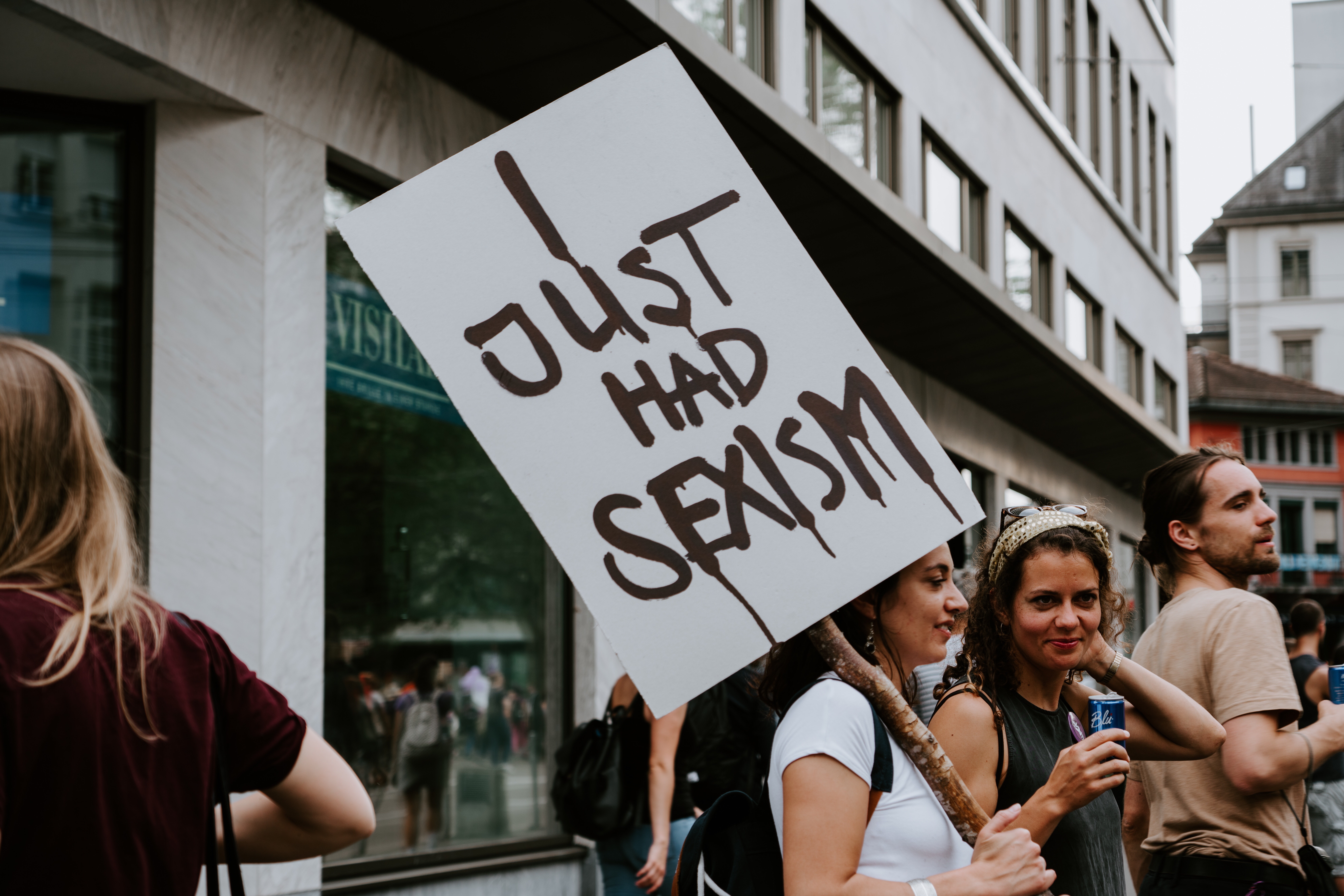
Photo by 🇨🇭 Claudio Schwarz | @purzlbaum on Unsplash

If you read this Blog fairly regularly, you will be aware that the issue of equality (or should that be the lack of equality?) is a common theme.

Depressingly in 2019, print and online media are full of stories which reinforce the fact that, as a society, the UK still has a long way to go in terms of gender equality. From the entrenched gender pay gap; to pregnancy and maternity discrimination; and the prevalence of incompetent male leaders, it still looks very much like a man’s world.

If you don’t believe me or think that I’m painting an overly bleak picture, please read about the latest research carried out by the Young Women’s Trust which found that 2 out of every 5 female managers believes that the place where the work suffers from sexism.

Despite the presence of legislation, such as the Equality Act 2010, women still struggle for equality in the work-place. Still don’t believe me? Just ask the female employees of City of Glasgow Council who had to fight tooth and nail to achieve equal pay earlier this year.

A link to a press release from the Young Women’s Trust can be found below:

https://www.youngwomenstrust.org/what_we_do/media_centre/press_releases/987_two_in_five_female_bosses_say_their_workplace_is_sexist

A link to an article in The Independent about the Trust’s research can be found below:

https://edition.independent.co.uk/editions/uk.co.independent.issue.200619/data/8965916/index.html

CopyrighSeán J Crossan, 20 June 2019

Is it cos I is black?

Ali G was (and still is) the memorable creation of the comedian, Sacha Baron Cohen. Ali G’s catchphrase was “Is it cos I is black?” and the comedian famously put this to a senior British police officer when he gatecrashed a political protest during a sketch for one of his TV shows on Channel 4.

Sacha Baron Cohen was making a very serious point when he wrote and planned such escapades: he was satirising the widespread racist sterotyping of Black and Minority Ethnic (BME) groups in the UK by their fellow White British citizens. When the character of Ali G first made appearances on Channel 4’s The 11 o’clock Show in 1999, it’s worth remembering that it was less than 6 years after the murder of the black teenager, Stephen Lawrence, in London.

Coincidentally, in 1999, Sir William Macpherson, a retired judge of the English High Court, had published his Report on the Stephen Lawrence murder and one of his most famous conclusions concerned the levels of “institutional racism” in the Metropolitan Police Service (paragraphs 4.45 – 6.63).

https://assets.publishing.service.gov.uk/government/uploads/system/uploads/attachment_data/file/277111/4262.pdf

Several years ago, I attended an event for Black History Month and members of the panel were recounting their experiences of racism in the UK. Glasgow City Councillor, Graham Campbell told the story of his cousin who worked at Ford’s Dagenham car plant who constantly had his locker broken into and vandalised by his white, work colleagues. More often than not, his work tools were stolen from the locker. Eventually, this young man started to carry his tools to and from the Ford plant in order to avoid having to replace them. He was stopped and searched regularly by the same police officers who asked him each time if the tools were for burglaries. This was the kind of harassment that black people typically experienced in Britain of the 1970s.

Racial stereotyping which leads to people from certain ethnic groups suffering (unlawful) less favourable treatment is an example of direct discrimination in terms of Sections 9 and 13 of the Equality Act 2010. Repeated examples of harassment on grounds of race would also constitute breaches of Sections 9 and 26 of the Equality Act 2010.

So, it was with some interest that I read an article in The Independent on Saturday 15 June 2019 which recounted an incident which had taken place in Maidstone in Kent whereby a white police officer had assumed that a black man must be a criminal just because he happened to be in an area which was perceived to be ‘white’.

In England and Wales, you are much more likely to be stopped and searched by the police if you happen to come from the black community:

It doesn’t seem as if attitudes to race in certain sections of the police have moved on much from the 1970s.

A link to the story in The Independent can be found below:

Officer assumed black man was criminal in ‘white area

https://edition.independent.co.uk/editions/uk.co.independent.issue.150619/data/8959141/index.html

Not much change in 2025 or that will be the Déjà vu

My article is now over 6 years’ old and it doesn’t appear that much has changed in the Metropolitan Police. True, the current Commissioner, Sir Mark Rowley has managed to dismiss 1400 officers who were the subject of misconduct allegations, but allegations of racism, Islamophobia and misogyny continue to dog the UK’s largest Police force.

On 7 November 2025, it was reported by the BBC and other media outlets that a review carried out by consultants, HR Rewired, had uncovered “systemic racism” in the Metropolitan Police and that anti-Black racism was “baked” into the force.

Readers will find a link to the BBC Article below:

https://www.bbc.com/news/articles/c1lq711n2e2o

This absolutely withering Review of London’s Police Service comes off the back of recent revelations by the BBC’s Panorama programme, where an undercover journalist exposed the discriminatory attitudes of many serving officers at London’s Charing Cross Police Station. Six of these officers have since been dismissed by the Met for misconduct and, surely, more dismissals must follow given the pressure that Sir Mark Rowley is under.

Links to articles on the BBC website about the Panorama programme and its aftermath can be found below:

https://www.bbc.co.uk/news/articles/c1dqvp1exxxo

https://www.bbc.co.uk/news/articles/c77zm84m5jlo


Regarding Police Stop and Search powers, statistics from the House of Commons Library shows that people identifying as Black or Black British “were searched at a rate 3.7 times higher than those from a White ethnic group across England and Wales in the year to March 2024.”

A link to the figures from the House of Commons Library can be found below:

https://commonslibrary.parliament.uk/research-briefings/cdp-2025-0057/#

Related Blog Articles:

https://seancrossansscotslaw.com/2020/06/10/when-black-lives-didnt-matter/

https://seancrossansscotslaw.com/2020/04/13/no-blacks-no-irish-no-dogs-we-like-to-think-that-such-signs-are-a-thing-of-the-bad-old-days-in-housing-law-what-about-no-dss-tenants-some-recent-legal-actions-suggest-that-such/

Copyright Seán J Crossan, 18 June 2019 and 7 November 2025

Help! The tumble dryer’s on fire!

Photo by Dinh Ng. on Unsplash

It was reported by The Independent on 13 June 2019 that the domestic appliance manufacturer and supplier, Whirlpool had been instructed by the UK Government’s Office for Product Safety and Standards to recall 500,000 of its tumble dryers which may have potentially dangerous defects. In an 11 year period, it was thought that 750 fires had been caused by defective Whirlpool products.

A link to a press release from the Office for Product Safety and Standards can be found below:

https://www.gov.uk/government/news/safety-advice-for-unmodified-whirlpool-tumble-dryers

Eighteen months ago, the House of Commons’ Business, Energy and Industrial Strategy Committee had recommended that these Whirlpool dryers should be recalled. The consumer lobby group, Which?, had also vociferously campaigned over this issue.

From a consumer law perspective, companies such as Whirlpool have to grapple with the implications of two major pieces of legislation:

• Consumer Protection Act 1987

• Consumer Rights Act 2015

The Consumer Protection Act 1987 (Part 1) was introduced as a result of the European Community Product Safety Directive. Part 1 of the Act establishes a regime of strict liability in relation to defective products and provides a civil remedy for those individuals who have suffered injury, loss or damage caused by a defective product. Although liability is said to be strict, a claimant or pursuer must demonstrate that the dangerous product caused loss or injury.

Under the 1987 Act, a claimant does not have to prove that s/he has a contract of sale with the seller of the goods. This was an extremely significant drawback with the Sale of Goods legislation (the Acts of 1893 and 1979) and why Mrs Donoghue in Donoghue v Stevenson [1932] could not raise a civil claim against Mr Minchella, owner of Paisley’s Wellmeadow Café who sold the contaminated lemonade bottle to her friend (although it was Mrs Donoghue who consumed the product). As anyone familiar with this case knows, Mrs Donoghue had to pursue a claim (which was ultimately successful) against the manufacturer (Stevenson) of the defective product. At the time, it was by no means certain that her claim would succeed, but by bringing the action she broke new legal ground.

It is very important to appreciate that Part 1 of the Consumer Protection Act 1987 safeguards the rights of consumers and does notprotect traders or businesses from the consequences of damage or injury caused by dangerous and defective products (see Renfrew Golf Club v Motocaddy Limited [2015]).

Turning now to the Consumer Rights Act 2015, Section 1 of this legislation makes it clear that covers agreements between traders and consumers for the supply of goods (e.g. a tumble dryer), digital content or services. The agreement between a trader and a consumer must be a contract. Contracts can be written, oral or implied or a combination of all three.

So, in relation to potential liability to consumers for dangerous and defective products, a trader/manufacturer such as Whirlpool could face two principal scenarios:

Scenario 1

A legal claim brought by a consumer buyer who has entered into a contract with Whirlpool directly in terms of the Consumer Rights Act 2015. This is a breach of contract claim. If, however, the consumer purchased a dangerous Whirlpool product from a retailer e.g. Currys, the claim should be taken against the retailer under the 2015 Act – not Whirlpool directly. I shall address the retailer’s remedy against Whirlpool towards the end of this Blog.

Scenario 2

A claim for reparation brought by a bystander (so long as they are a consumer) who has been injured or has had property damaged as a result of coming into proximity with the dangerous and defective product ultimately supplied by Whirlpool. Bystanders could be family members in a household or even someone visiting the premises.

It should be appreciated that Scenario 2 is not about a breach of contract because the victim has not entered such an agreement with the supplier. Any legal remedy sought by the victim must be obtained under the Consumer Protection Act 1987. Admittedly, the victim may also have to pursue a delictual remedy at common law if the value of the claim was less than £275 as the Act does not apply in such situations.

A further scenario

What is the legal situation if Whirlpool does not have a direct contractual relationship with the ultimate consumer of the product i.e. it merely supplies the product in question to a trader which will then supply the goods to a consumer? Well, as discussed above in relation to Scenario 1, the consumer has a contract with the trader and any remedy should be sought in terms of the Consumer Rights Act.

Where does this leave the trader? They will have to pursue a contractual claim for a refund (and presumably damages) against Whirlpool in terms of Section 14 of the Sale of Goods Act 1979.

This Act continues to apply to contracts for the sale of goods in business to business (B2B) transactions; consumer to consumer (C2C) transactions; and consumer to business (C2B) transactions.

A link to the story in The Independent can be found below:

‘Recall 500,000 dryers over fire risk, Whirlpool told’

https://edition.independent.co.uk/editions/uk.co.independent.issue.130619/data/8955366/index.html

Postscript

In early July 2019, Which? subsequently gave evidence to the Business, Energy Industrial Strategy Select Committee of the House of Commons criticising the UK Government’s response to the problem of defective Whirlpool tumble dryers. Whirlpool has since agreed to identify all those products which may represent a risk to the public.

Read more about the work of Which? in relation to this issue by accessing the link below:

https://conversation.which.co.uk/home-energy/whirlpool-opss-review-doubts-evidence/

On 12 July 2019, Which? reported that Whirlpool had decided to recall the products which are deemed to be potentially dangerous:

https://www.which.co.uk/news/2019/07/whirlpool-issues-product-recall-of-unmodified-tumble-dryers/?utm_source=whichcouk&utm_medium=email&utm_campaign=recallupdate120719

By 22 July 2019, Whirlpool had agreed to recall nearly 500,000 of it’s tumble dryers:

http://news.sky.com/story/whirlpool-in-recall-of-500000-fire-risk-tumble-dryers-11768073

Copyright Seán J Crossan, 14 June & 22 July 2019


Doing time …?

Photo by Emiliano Bar on Unsplash

In a previous blog (“Commit the crime, do the time?” published on 4 March 2019), I examined the role of the Scottish Sentencing Council (established as a result of the Criminal Justice and Licensing (Scotland) Act 2010) in relation to the imposition of various sentences on convicted offenders. The Council took up its role from 2015 onwards.

On Monday 12 June 2019, the second most senior judge sitting in Scotland, Lady Dorrian, Lord Justice Clerk, announced that the Scottish Sentencing Council would conducting a public consultation in an attempt “to demystify” the factors by which a criminal court takes into consideration when imposing punishment on the offender.

The consultation exercise will tackle a perception which exists (rightly or wrongly) amongst the public that sentencing can be extremely inconsistent. It will address this problem by highlighting issues which are likely to be considered aggravating factors by a judge and thus lead to the imposition of a longer sentence. Aggravating factors would include whether the crime was premeditated or in situations where a weapon was used. Conversely, it is hoped that the exercise will pinpoint mitigating factors that a judge takes into account when a lighter sentence is passed e.g. genuine remorse shown on the part of the offender or any negative consequences that the offender’s children are likely to suffer.

Readers may wish to take part in the public consultation exercise and can so by clicking on the link below at the Sentencing Council’s website:

https://consultations.scottishsentencingcouncil.org.uk/ssc/the-sentencing-process/consultation/subpage.2019-05-29.0933048382/

In order to assist the public and other interested parties to complete the survey, the Council has provided a number of documents which can be accessed via the link below:

https://consultations.scottishsentencingcouncil.org.uk/ssc/the-sentencing-process/

The closing date for participation in this exercise is 6 September 2019.

A link to an article on the BBC website about the exercise can be found below:

https://www.bbc.co.uk/news/uk-scotland-48556439

The Scottish Parliament’s Justice Committee

This week, in a related matter, the Justice Committee at Holyrood (by 7 votes to 2) decided to support plans by the Scottish Government, which if carried, would extend the presumption against short prison sentences.

Currently, in Scotland, there is a presumption against the imposition of prison sentences of less than 6 months and the court will most likely impose an alternative punishment.

Interestingly, on 19 February 2019, Scottish Legal News reported that David Gauke MP, the UK Government’s Justice Minister, had stated that he would introduce legislation in England and Wales in order to follow current, Scottish criminal practice as regards sentencing i.e. a presumption against prison terms of less than 6 months:

https://www.scottishlegal.com/article/england-follows-scotland-s-lead-on-presumption-against-short-sentences

Copyright Seán J Crossan, 13 June 2019

Stalkers beware!

Photo by Jaanus Jagomägi on Unsplash

A few of my recent blogs have discussed the legislative process in the Scottish Parliament and several Bills that are already undergoing scrutiny and debate at Holyrood.

So, when quickly glancing at the Scottish Parliament’s website today, I was very interested to see a proposal for a Member’s Bill which wishes to toughen the law on stalking in Scotland.

The proposed measure (if given the green light) would take the form of a Stalking Protection (Scotland) Bill and it would have a simple rationale:

“… to increase protection for victims of stalking by giving police the power to apply for stalking protection orders on behalf of victims.”

Stalking was made a specific criminal offence as a result of Section 39 of the Criminal Justice and Licensing (Scotland) Act 2010, but Rona Mackay MSP, the proposer of the measure clearly believes that the current law needs to be tightened in order to give victims of stalking more protection.

As part of her rationale, Ms Mackay makes reference to England and Wales where the Stalking Protection Act 2019 has been introduced. This legislation gives the a Chief Constable of a Police area south of the border the power to apply to a Magistrates’ Court for a stalking prevention order. Clearly, she is of the view that Scotland should follow suit in order to protect victims of this type of crime more effectively.

A link to the English and Welsh legislation can be found below:

http://www.legislation.gov.uk/ukpga/2019/9/enacted

In a YouTube video, Ms Mackay provides some background to her proposed Bill and invites members of the public to contribute to the consultation by submitting their views by 21 July 2019.

A link to the Consultation document can be found below:

Click to access 20190425_Final_Consultation_document.pdf

Perhaps this is an issue which you feel strongly about and would like to get involved in shaping a new law for Scotland?

You can do this by completing an online survey (link below):

https://www.smartsurvey.co.uk/s/StalkingProtectionBill/

At the moment, there is no Bill – only Ms Mackay’s proposal for one and it remains to be seen whether she will be able to secure the necessary support to take the matter forward i.e. securing the support of 18 MSPs from at least half of the political parties or groups represented in the parliamentary bureau; and provided the Scottish Government does not itself intend to legislate upon the matter.

Copyright Seán J Crossan, 13 June 2019

Ungagged?

Photo by Igor Rand on Unsplash

Should employers be permitted to insist on the inclusion of a “gagging clause” or non disclosure agreement (NDA) when they settle a claim outside court or tribunal for alleged harassment or discrimination?

Maria Miller MP, Chair of the Women and Equalities Committee of the House of Commons certainly doesn’t think so. Ms Miller is firmly of the view that the UK Parliament should introduce legislation, at the earliest opportunity, to outlaw the widespread use of “gagging clauses” or non-disclosure agreements.

A link to the Committee’s Report can be found below:

https://www.parliament.uk/business/committees/committees-a-z/commons-select/women-and-equalities-committee/inquiries/parliament-2017/nda-inquiry-17-19/

In April 2019, the BBC revealed that Ulster University in Northern Ireland had paid out approximately £226,000 as part of 6 settlement agreements involving former members of staff who had brought claims for discrimination and harassment while employed at the institution. These settlement agreements contained confidentiality clauses, “gagging” clauses or NDAs (the reader is free to decide which term is preferred). The BBC also discovered that 96 UK universities had used NDAs representing £87 million in value. A truly staggering figure and one can only wonder what would be the figure for settlements in privately run businesses.

Confidentiality clauses are often a staple feature of cases brought to the Employment Tribunal. The parties may well decide to settle the claim privately before proceedings are concluded. It tends to be the case that the employer party is keen to include a confidentiality clause in the settlement agreement as a condition of making a payment to the ex-employee. It should be said of course that in these types of settlement agreements, the employer is making the payment without admission of liability and the reason for choosing this method to resolve the claim can often be purely about simple economics i.e. you weigh how much it would cost you in legal expenses and disruption to your organisation for representation at a 5 day Tribunal hearing as opposed to settling the claim quickly.

NDAs started life as a way of ensuring that former employees who had previously worked for organisations were not tempted to disclose trade secrets (or other information) to their new employers which they had acquired in their old jobs.

Admittedly, the common law imposes a number of duties on employees such as:

  • to provide loyal service;
  • to act in good faith;
  • to ensure confidential information remains secure

Now, it would be something of a stretch for employers to argue that the above duties permitted them to ‘gag’ employees who had been the victims of discrimination and harassment in the work-place – hence the rise of the NDA. This is where employers get the victims to enter into a legally binding settlement agreement where, in return for a compensation payment (and sometimes an agreed reference), the victim promises not to discuss their situation with anyone other than his or her legal advisers.

Since the rise of the #MeToo and Time’s Up movements, there has been much more interest in these types of settlement agreements as more and more allegations about sexual harassment in the work-place have come to light. It has been alleged that individuals such as the disgraced American film producer, Harvey Weinstein and the British retailer, Sir Philip Green made use of NDAs to prevent people discussing how they were treated when they worked for these individuals. These agreements are seen as a sinister attempt to buy the victim’s silence by rich and powerful men who have seemingly bottomless pockets and inexhaustible legal resources.

Maria Miller and her colleagues on the Women and Equalities Committee are now saying time’s up for these types of arrangements.

Links to the stories about the work of the Women and Equalities Committee and the use of NDAs at Ulster University can be found below:

NDAs: MPs call for ban on ‘gagging clauses’ over ‘cover-up’ fears

https://www.bbc.co.uk/news/uk-northern-ireland-47981244

Postscript

In July 2019, the UK Government announced that it plans to introduce a Bill to Parliament in order to ban the widespread use (and abuse) of non disclosure agreements in employment contracts.

A link to this story on the BBC news site can be found below:

NDAs: New laws to crack down on ‘gagging’ clauses

A ban will be placed on NDAs that stop people speaking to police, doctors or lawyers, ministers say.
The scale of the problem of alleged harassment in the work-place and how employers deal with this can be seen in the article below which appeared in The Independent:

Copyright Seán J Crossan , 12 June and 21 July 2019

(In)Equality in the EU?

Photo by Markus Spiske on Unsplash

Have member states of the European Union made progress this last year in the protection of minority groups?

It would seem that the answer to this question is not particularly straightforward if you read the EU’s Fundamental Rights Report 2019.

Michael O’Flaherty, Director of the EU’s Fundamental Rights Agency presents a fairly gloomy picture across Europe:

Fundamental rights alarm bells are ringing across the EU as inequalities, harassment and prejudices continue to grow. … We need robust responses outlining how rights benefit us all and provide the answers to the inequalities that are holding us back from a fair and just society where everyone can prosper.”

Across the EU, there are Governments in power (Hungary and Italy particularly) which promote strongly anti-immigrant messages. Until recently, the far-right Freedom Party was part of the coalition government of former Federal Chancellor Sebastian Kurz in Austria. In France, Germany and Spain, we have witnessed rising levels of support for far right parties such as the Front National, AfD and Vox respectively.

Other European countries have witnessed similar trends and did well in the recent European Parliament elections in May 2019.

We are not immune from such trends in the UK with many people being suspicious of the motivations of the Brexit Party and UKIP (despite denials to the contrary by the leaderships of these organisations that they are not far right movements).

In essence, the conclusions of the Fundamental Rights Report 2019 are as follows:

  • The levels of racial discrimination and harassment across the EU remain stubbornly high e.g. Black, Jewish and Roma people continue to report discrimination and harassment in their daily lives;
  • A significant percentage of Europeans (40%) consider immigration to be a problem and these individuals over-estimate the levels of (actual or true) immigration to the EU;
  • The number of children in poverty has decreased, but at 25% this figure is a still a cause for concern with certain groups (Roma children) being particularly affected.

A link to the Fundamental Rights Report 2019 can be found below:

https://fra.europa.eu/en/publication/2019/fundamental-rights-2019

Copyright Seán J Crossan, 10 June 2019

I’m a political activist: don’t sack me!

Photo by Oprea Marius on Unsplash

Over the last few months, several of my blog entries have examined the impact of conduct or behaviour of employees which occur outside working hours. The focus of these blogs has largely centred upon social media use (or misuse if you prefer) by employees and the likely consequences of reputational damage which the employer might suffer.

The overwhelming conclusion that visitors to this site should now have is that I take the view that what employees do in their private lives can have a significant impact on work-place relations. Yes, primarily we do  have rights to privacy, expression and association as enshrined in Articles 8, 10 and 11 respectively of the European Convention on Human Rights (amongst other things), but does this does not give us a blank cheque or free pass to behave badly or engage in downright  dubious activities outside working hours. In other words, our Convention rights are not absolute.

I decided to write this recent blog entry on the back of a story which appeared in The Independent last month in conjunction with the lead up to the European Parliamentary elections held in Germany on 26 May 2019. It was reported that a German national – Dr Gunnar Beck – was a candidate for a far right political party in Germany called the AfD (the Alternative for Germany).

Dr Beck is currently employed as a law lecturer at SOAS, University of London and many of his colleagues and the students were outraged when they learned that he was running as an AfD candidate for one of Germany’s seats in the European Parliament. There were calls for Dr Beck to be dismissed from his post at SOAS.

As it happened, Dr Beck was one of 10 German MEPs elected for the AfD Party.

This story is a very good example of issues such as freedom of speech versus the employer’s duty to prevent discrimination and intolerance in the work-place.

What should employers do if they stand accused of being complicit in the spread of extremist views or beliefs by one of their employees? It can be a very difficult call to make.

A link to the story about Dr Beck as reported by The Independent can be found below:

https://edition.independent.co.uk/editions/uk.co.independent.issue.180519/data/8919156/index.html

Section 98(4) of the Employment Rights Act 1996 gives the right to dismiss employees (quite fairly) for misconduct – whether in the work-place or outside.

Furthermore, we live in times where political extremism of all shapes is much more prevalent. Again, the Employment Rights Act 1996 gives employers – primarily agents of the State e.g. the Police and the intelligence services (and other sensitive posts) – the right to dismiss employees on national security grounds (see Home Office v Tariq [2011] and Kiani v The Secretary of State for the Home Department [2015]). Such a dismissal – even where the evidence against the employee in question might be fairly tenuous – would still constitute an automatically fair dismissal.

Section 10 of the Equality Act 2010 does protect an individual’s philosophical beliefs, but this does not mean that all sorts of extremist views will necessarily be tolerated (or should be tolerated) by employers.

In Redfearn v Serco t/a West Yorkshire Transport Services (2005) the  employer dismissed Mr Redfearn on health and safety grounds because of his membership of the racist British National Party (BNP). Redfearn’s political affiliations might lead to violence arising in the workplace.

This was not the last word on the matter and Redfearn took his claim to the European Court of Human Rights on the basis that the then United Kingdom equality laws did not provide sufficient protection to individuals like him who suffered discrimination on grounds of their philosophical (political) beliefs.

In Redfearn v UK [2012] the European Court of Human Rights stated that Redfearn had been dismissed on account of his membership of the British National Party and this was an example of unlawful discrimination. This decision effectively ensured that the protected characteristic of a person’s philosophical beliefs (now contained in the Equality Act 2010) is capable of including political beliefs.

In Grainger plc v Nicholson (2009), the Central London Employment Tribunal stated that individuals seeking the protection of the law [now contained in Section 10 of the Equality Act] must prove that the belief was “a weighty and substantial aspect of human life and behaviour”.

A belief which demonstrates “a certain level of cogency, seriousness, cohesion and importance” and this belief is ultimately “worthy of respect in a democratic society, [that it] be not incompatible with human dignity and not conflict with the fundamental rights of others”.

This would seem to rule out protection for extremist beliefs, but as Redfearn UK [2012] clearly established employers will have to tread carefully. Essentially, the upshot of Redfearn is that employees are entitled to hold views which a large group within society may well find abhorrent and objectionable, but nonetheless such views fall within the protected characteristic of philosophical beliefs. Turning now to the employee holding such views or beliefs, the European Court of Human Rights made it very clear that such individuals did not have a right to act on these beliefs. So, for a person such as Mr Redfearn, he undoubtedly espoused racist beliefs by virtue of his BNP membership, but critically he had never acted upon these during his employment by, for example, subjecting a person from an ethnic minority group to unlawful, less favourable treatment.

In 2018, Councillor Christopher McEleny of the Scottish National Party took legal action against his former employer, the UK Ministry of Defence for alleged discrimination and constructive dismissal  by reason of his political beliefs. An Employment Tribunal Judge, Frances Eccles ruled that McEleny’s beliefs in Scottish independence should be treated as a philosophical belief in terms of Section 10 of the Equality Act 2010.

Whether McEleny ultimately wins his Employment Tribunal claim on what exactly motivated his ex-employer to act in the way that it did towards him remains to be seen. It is a decision or outcome in which many people are undoubtedly interested.

Copyright Seán J Crossan, 5 June 2019

More Bills …

Photo by Maja R. on Unsplash

Over the last few weeks, the blog has focused on Bills (draft laws) introduced in the Scottish Parliament.

Not all Bills will become the law of the land i.e. Acts of the Scottish Parliament. Although it is much easier for an individual MSP to promote a Bill successfully than is the case for a backbench MP at Westminster, we shouldn’t overstate things.

Certain Bills will fall or encounter difficulties at various stages of the legislative process at Holyrood.

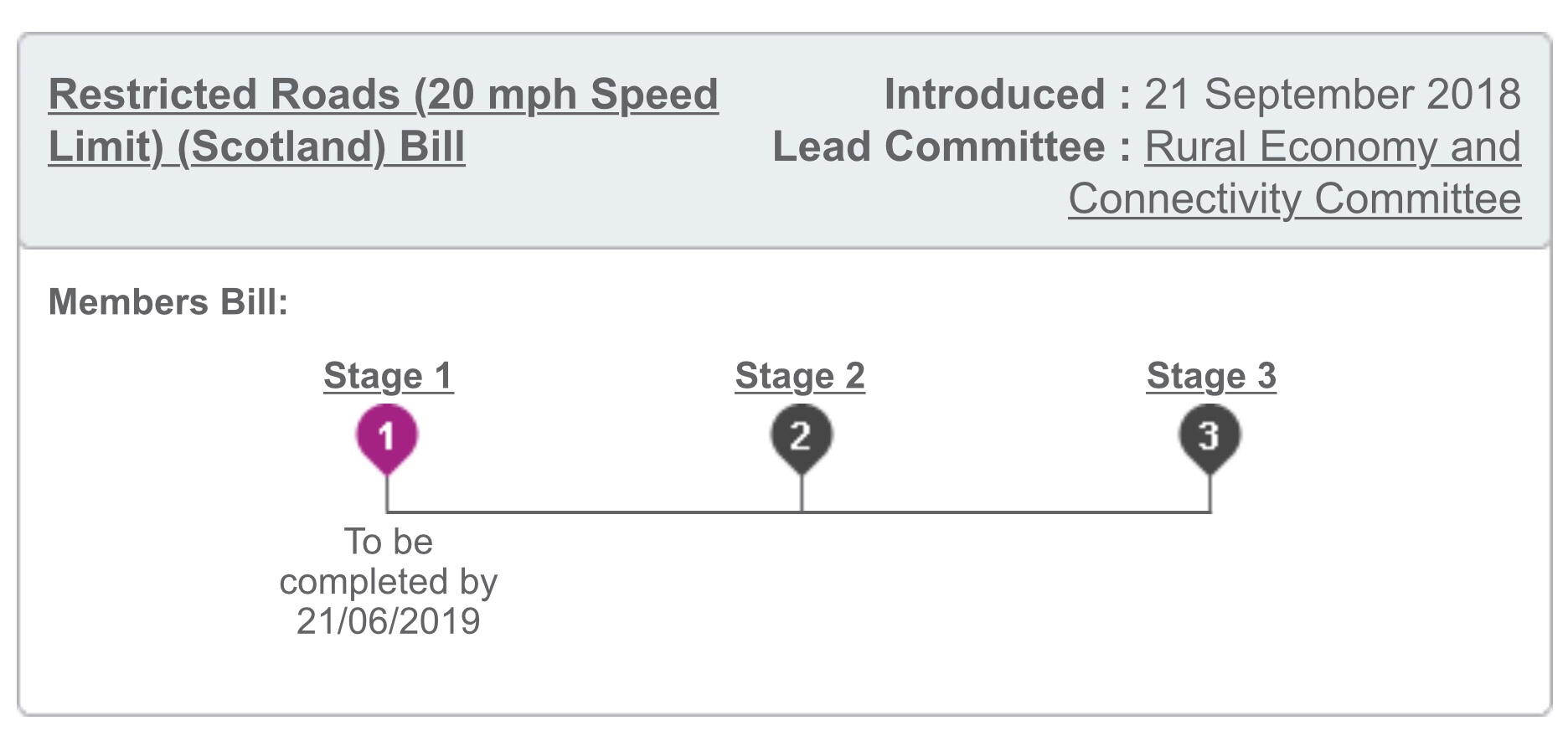
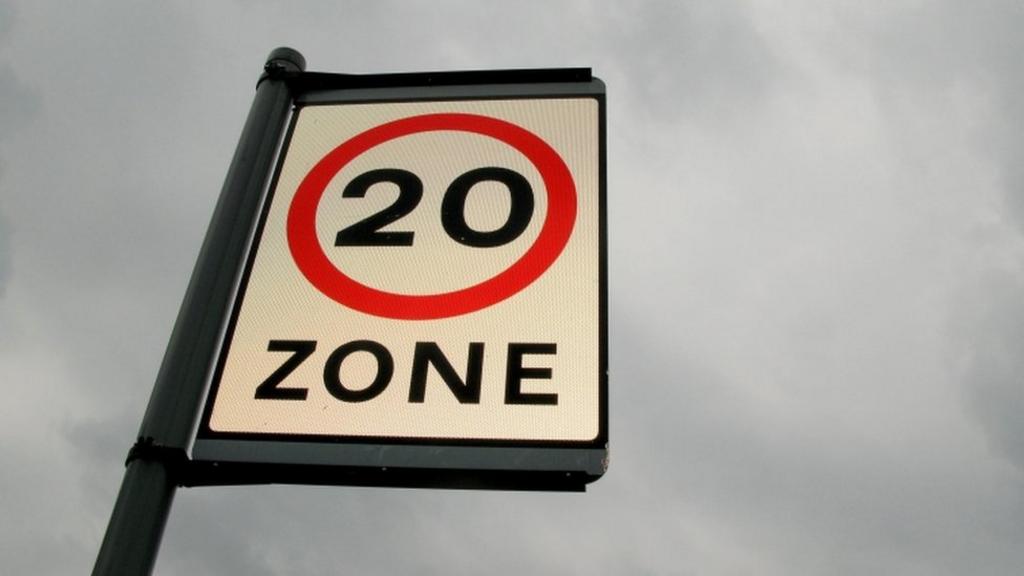
An interesting example of a Bill encountering difficulties in the Scottish Parliament is the Restricted Roads (20 mph Speed Limit) (Scotland) Bill which was introduced by Green Party MSP, Mark Ruskell on 21 September 2018.

The objective of the Bill is:

The purpose of the Bill is to reduce the general speed limit on a ― restricted road from 30 mph to 20 mph.

A link to the Bill as introduced and its accompanying documents can be found below:

https://www.parliament.scot/parliamentarybusiness/Bills/109191.aspx

On 31 May 2019, a majority of the members comprising Parliament’s Rural Affairs Committee were not prepared to recommend the general principles of the Bill:

After considering the evidence presented, the majority view of the Committee is that the default, ‘one-size-fits all’ approach proposed in the Bill is not appropriate, as it does not give local authorities the flexibility to devise 20mph limits that they consider appropriate for their areas.

This does not mean that the Bill is certain to fail, but the opinion of the Rural Affairs Committee may accurately reflect the wider view of MSPs at Holyrood. At the very least, this Bill may be subject to substantial amendment or change if it is to have a realistic chance of making it on to the Statute Books.

A parliamentary debate on the Bill has been scheduled for Thursday 13 June 2019.

An info graphic charting the current progress of the Bill can be seen below:

A link to an article on the BBC News site about the Bill can be found below:

Holyrood committee rejects 20mph speed limits bill

A Holyrood committee declines to endorse a bill which would set a 20mph speed limit in residential areas.

Copyright Seán J Crossan, 4 June 2019