Go to jail?

Photo by 🇨🇭 Claudio Schwarz | @purzlbaum on Unsplash

Young offenders?

Well, not if you’re under 25 according to recent proposals published by the Scottish Sentencing Council as part of a public consultation process. The main function of the Scottish Sentencing Council is to demystify sentencing decisions and, therefore, educate the public about these matters.

The current proposal might seem very provocative and is bound to divide public opinion. Crime, after all, is a very emotive issue and everyone has an opinion about it whether you have been the victim or the criminal. The purpose of criminal law is about the State punishing those individuals who have broken the rules of the community by engaging in dangerous and/or anti-social activities.

The rationale for the Scottish Sentencing Council’s proposal is that scientific research (carried out by the University of Edinburgh) seems to show that the brains of people aged under 25 years have not fully developed i.e. matured.

Now, it is by no means certain that such a proposal will be implemented and the Scottish Sentencing Council is urging members of the public to respond to its consultation with their opinions on the matter.

https://consultations.scottishsentencingcouncil.org.uk/ssc/young-people/

It is certainly part of a wider strategy which fits in with attempts by the Scottish Government to reduce the numbers of people who are sent to prison each year. There is now perhaps a recognition that prison doesn’t always work. There has been a presumption operating for several years in Scotland, that people will not be sent to prison if the offence would normally be punished by a sentence of less than 6 months. Obviously, this presumption would be ignored if, for example, the offender was a person who persistently broke the rules.

Over the last year, this Blog has looked at a number of initiatives which have taken place which have been about taking different approaches to crime prevention or the rehabilitation of offenders.

In the Autumn (or Fall), I spoke to a group of students about an initiative called the “Call-In-Scheme” where Avon and Somerset Police in England were targeting first offenders aged between 16 and 21 who have been caught dealing drugs. The choice: go to court, be convicted with all the consequences this outcome will entail or go straight. Participants in the scheme were be selected by a panel. Predictably, such an approach sharply divided my audience.

Crime and kindness?

Last March, two American judges – Victoria Pratt and Ginger Lerner-Wren we’re invited to Scotland by Community Justice Scotland, a publicly funded body, where they were hoping to meet hundreds of people who deal with the Scottish criminal justice system.

The two judges were keen to emphasise that there should be more compassion in the criminal justice system when dealing with offenders. They pointed to impressive results in the United States – a New York court alone has seen a dramatic decrease of 20% in youth crime and a 10% reduction in crime overall by using radical methods to deal with offenders. One of the judges, Ginger Lerner-Wren established one of the first mental health courts anywhere in the world. The aim of this court (based in Florida) was to promote treatment of offenders as an alternative to traditional forms of punishment. Judge Pratt, on the other hand, specialises in “procedural justice” which works on the basis “that if people before the courts perceive they are being treated fairly and with dignity and respect, they’ll come to respect the courts, complete their sentences and be more likely to obey the law.”

The Glasgow Alcohol Court

This type of approach has already being piloted in Scotland: Sheriffs in Glasgow deal with cases where alcohol is a ‘contributory factor’ in crime. The Sheriff Alcohol Court has been operating since 2018 and its lifespan was extended in 2019. It now deals with domestic abuse cases involving alcohol. Punishments other than prison sentences are handed out by this court e.g. drug and alcohol treatment orders and community service orders. This approach recognises that criminals can turn their lives around and can become law abiding members of society. Being given a drug treatment order is not an easy option. Participants in schemes such as these are regularly tested and monitored. Break the rules and you will go to jail.

Age of criminal responsibility

In Scotland, in common with many penal systems around the world, we do use a person’s age to determine criminal responsibility. Currently, the age of criminal responsibility is 12 and there is a debate about whether this should be raised even higher. It is worth remembering that, for many years (until 2019 in fact), Scotland had one of the lowest ages of criminal responsibility anywhere in the Western World i.e. 8 years of age.

Somewhat mitigating this feature of Scottish criminal law was the fact that children were not tried in adult courts. The Children’s Hearing or Panel system was primarily set up for this very purpose. It was considered a revolutionary approach because it recognised that by stigmatising (and criminalising) children at a very early age, society could set them on a path from which there was no means of redemption. If you effectively abandoned a child at an early age, you were condemning them to a very grim future where they could (potentially) be in and out of prison for the rest of their lives.

Conclusion

The Scottish Sentencing Council’s proposal is very interesting and it will certainly form part of a lively discussion on how we continue to deal with crime in this country. The public now has 12 weeks to get involved in the consultation by giving their opinions on the matter.

It is important to appreciate that, under the proposals, judges will still be able to send people under 25 to prison if they think this is an appropriate punishment. What the proposals are allowing judges to do is to look more closely at a young person’s background e.g. mental health issues before sentence is passed. It remains the case that, where certain crimes are concerned, the imposition of a prison sentence will be most the appropriate action to take because the issue of public safety will be paramount. Clearly, someone like the notorious child killer Aaron Campbell, will not benefit from the proposals merely because they are under the age of 25.

A link to an article on the BBC News app about theScottish Sentencing Council’s proposal can be found below:

Draft sentencing guidelines say younger offenders should be treated differently because their brains are still developing.

Scottish courts urged not to jail ‘immature’ under-25s

Related Blog Articles:

https://seancrossansscotslaw.com/2019/05/08/the-age-of-criminal-responsibility/

https://seancrossansscotslaw.com/2019/02/27/criminal-responsibility/

https://seancrossansscotslaw.com/2019/03/12/crime-and-kindness/

https://seancrossansscotslaw.com/2019/02/19/dealing-with-alcohol-abuse/

https://seancrossansscotslaw.com/2019/08/30/once-a-criminal/

https://seancrossansscotslaw.com/2019/03/04/commit-the-crime-do-the-time/

https://seancrossansscotslaw.com/2019/04/02/victims-voices/

https://seancrossansscotslaw.com/2019/06/13/doing-time/

https://seancrossansscotslaw.com/2019/03/22/life-should-mean-life/

https://seancrossansscotslaw.com/2017/04/04/scottish-criminal-appeals/

https://seancrossansscotslaw.com/2019/01/29/crime-and-punishment-in-scotland/

Copyright Seán J Crossan, 28 February 2020

For those in peril on the sea

Photo by Lawrence Hookham on Unsplash

The avoidable death of Annang Neurtey

As someone who works more in the civil rather than the criminal legal tradition, I tend to focus more on the outcome of obtaining damages or compensation for the victim of an industrial or work-place accident.

It’s simply a matter of horses for courses i.e. you stick to what you know or what you’re trained to do. Admittedly, most of the victims of industrial accidents that I have represented are perhaps more focused on obtaining compensation for their injuries – especially if these are life changing. Any criminal liability that the employer may have is purely incidental i.e. something of a side issue. Then again, I suppose you could say that about most civil actions where the criminality of the pursuer remains firmly in the background (think dangerous and careless driving incidents).

The victim of a work-place delict (or tort) may get some satisfaction from their employer or its officers and managers appearing in the dock at a subsequent criminal trial, but this is unlikely to be satisfying in the long term. It will not allow them to get their lives back on track or to move on; payment of compensation is perhaps a more satisfactory conclusion to things. I make that last statement fully in the knowledge that no amount of money can truly give victims back what they have lost.

Yet, every so often, I come across a story or an incident which underlines the importance of criminal law regarding industrial or work-place accidents.

In 2015, one such incident occurred onboard Aquarius, a fishing trawler which operated out of the North East Scottish fishing port of Banff. Serious failings in the operation of the vessel led to the death of a crewman. The victim, 47 year old, Annang Neurtey from Ghana, was swept overboard: his body has never been recovered – adding immensely to the grief of his family.

Anyone who has read Sebastian Junger’s 1997 novel, The Perfect Storm (or viewed the film adaptation of 2000) will be readily familiar with the dangers that fishing folk face at sea. That said, the tragedy which befell Annang Neurtey was entirely avoidable. If the skipper of the Aquarius had properly supervised the crew and followed basic safety procedures, the accident would not have occurred.

Following Mr Neurtey’s death, MB Aquarius Ltd of Buckie, the company which owned and operated the vessel, was investigated by Police Scotland and the Marine and Coastguard Agency. The conclusions reached by investigators were that basic risk assessments had not been properly carried out and that the employer had failed to put a safe system of working in place.

At a subsequent criminal prosecution against Mr Neurtey’s employer for health and safety breaches at Aberdeen Sheriff Court, the company pleaded guilty to breaches of marine safety laws, namely, Regulation 5(1) of the Merchant Shipping and Fishing Vessels (Health and Safety at Work) Regulations 1997 and Sections 85 and 86 of the Merchant Shipping Act 1995.

A fine of £50,000 was imposed on the employer – it would have been £75,000 had an early plea of guilty not been entered by the company.

Mr Neurtey’s family will doubtless be contemplating a civil action for recovery of damages – unless of course his employer does the decent thing and quickly settles such a claim.

A link to the Marine and Coastguard Agency’s Report of its findings concerning Mr Neurtey’s death can be found below:

https://assets.publishing.service.gov.uk/media/57f3c2d7ed915d06fa000030/MAIBInvReport18_2016.pdf

A link to an article in the The Press & Journal about the trial can be found below:

https://www.pressandjournal.co.uk/fp/news/aberdeen/2011786/buckie-based-fishing-company-fined-50000-following-death-of-crew-member/

Those dark satanic mills …

Have concerns about health and safety gone mad? The former British Prime Minister, David Cameron certainly thought so when his Coalition Government (2010-15) introduced the Enterprise and Regulatory Reform Act 2013 (in particular, Section 69 of the said legislation) which removed the right to bring a civil claim for breaches of the Health and Safety at Work Act 1974.

It does not mean that employees can no longer bring a civil claim if an employer breaches its duty of care, but significantly claimants will no longer benefit from the presumption of strict liability previously imposed on organisations. Since this reform, it will be essential for claimants to prove negligence on the part of their employers for breaches of health and safety.

We would, however, do well to remember our history: concerns about health and safety were often ignored in the not so distant past.

The phrase “dark satanic mills” comes from the poem, And did those feet in ancient time by William Blake. The phrase has been interpreted as a searing indictment of the wickedness and exploitative practices of 19th Century British industrialists who most certainly put profit before people. This is why rare individuals such as the Welsh born industrialist, Robert Owen and his New Lanark Mills we’re regarded as truly radical and progressive employers.

The words of Blake’s poem were later put to music by the composer, Hubert Parry, and is better known as Jerusalem – an alternative English National Anthem for many because of its rallying call for social justice for the poor and the oppressed.

Over time, admittedly, the UK Parliament did intervene by bringing in legislation to curb some of the frankly dangerous and disreputable practices which had been tolerated in British factories, shipyards and mines. With the industrial revolution, Britain did indeed become the ‘workshop of the world’, but this accolade disguised the terrible human cost which could be measured in countless deaths, terrible injuries and overwhelmingly misery.

Some months ago, I saw a photograph by Bill Brandt in The Independent’s Saturday Magazine which documented life in an East Durham mining community. I was pretty shocked by what I saw: the houses of the miners had no windows. Think of it: these workers spent their days down the pit in almost total darkness. More shocking, was the fact that Brandt had taken the photograph as recently as 1937.

Photograph by Bill Brandt (1937)

Yet surely, the bad old days are long gone? The British work-place has become a much safer place? Undoubtedly, as we shall see, employers have become much more aware of their responsibilities to their employees and workers in respect of the issue of health and safety.

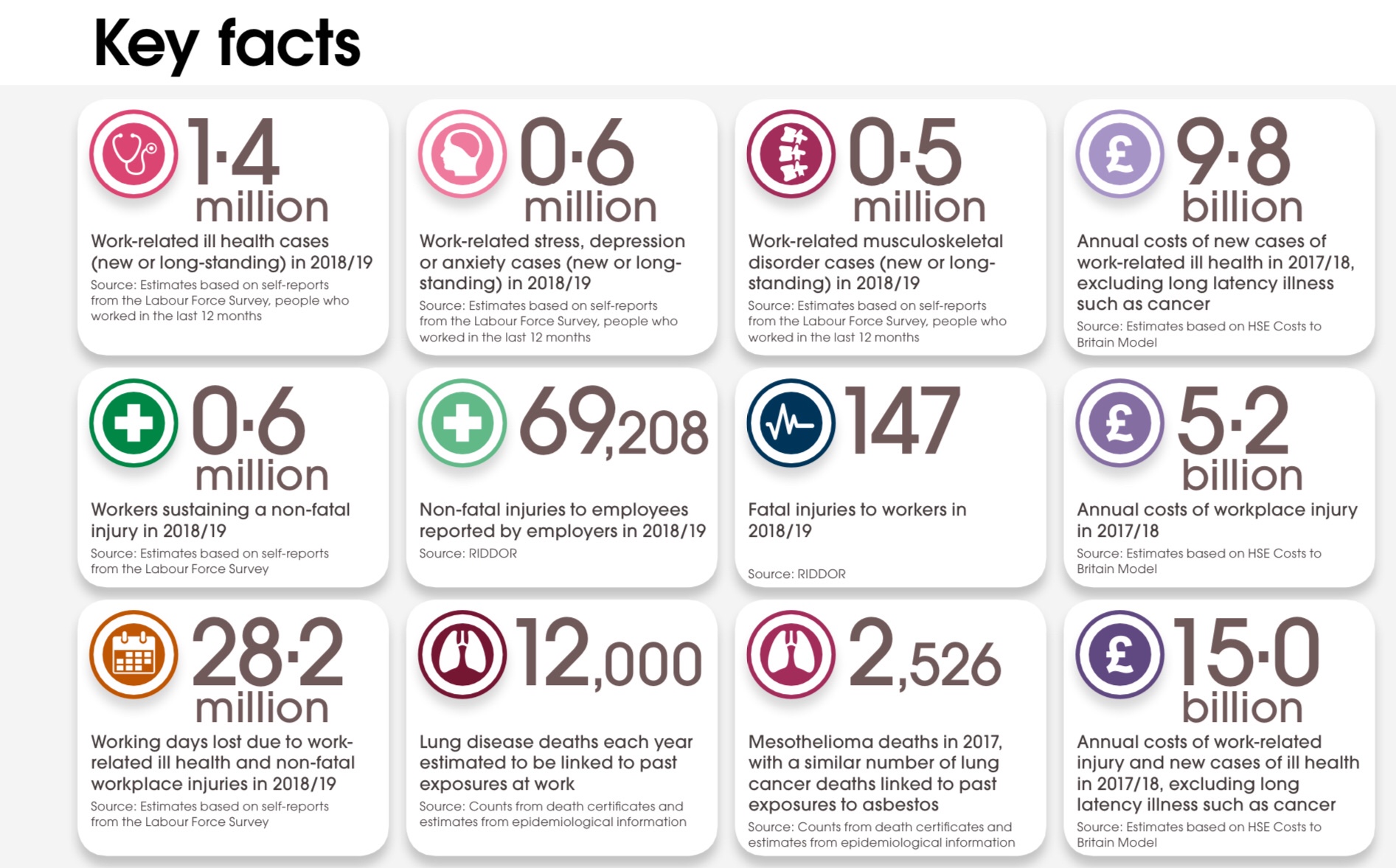
That said, if you look at the info graphic produced below from the UK Health and Safety Executive, poor conditions and practices in British work-places still result in unacceptably high levels of injuries and illness – in 2019!

Key facts for Great Britain 2019
Source: http://www.hse.gov.uk/statistics/

Recently, Amazon, the global internet retailer, received very unwelcome media attention about the number of industrial injuries which have occurred in its UK premises. It’s probably fair to say that Amazon UK does not enjoy a particularly good reputation amongst trade unions regarding its employment practices and the recent media stories only compound this state of affairs.

Links to stories about Amazon UK on Sky News and Channel 4 News can be found below:

http://news.sky.com/story/hellish-conditions-at-amazon-warehouses-seriously-hurt-hundreds-11936881

https://youtu.be/gYUJjpIxkCU

Health and Safety at Work Act 1974

It is worth noting that the employer’s common law duties which aim to protect the health and safety of employees establishes a regime of civil liability. In other words, should the employer breach these duties, he will most likely face a civil action by the injured employee who will be attempting to recover compensation.

The Health and Safety at Work Act 1974, on the other hand, makes an employers criminally liable if they fail to take reasonably practicable steps to protect the health and safety of their employees. An employer will, therefore, face penalties in a criminal court for breaches of the Act.

The Health and Safety (Offences) Act 2008

The provisions of this Act came into force on 16 January 2009 and apply to offences committed after this date by employers. Scottish criminal courts will now have the power to impose maximum fines of £20,000 on employers who breach health and safety rules. In the most serious cases where health and safety rules have been breached or ignored, the courts may also have the right to imprison those responsible.

The Criminal Justice and Licensing (Scotland) Act 2010

Sections 65-68 of the Criminal Justice and Licensing (Scotland) Act 2010 should make it easier for organisations to face prosecution in Scotland in relation to allegations of criminal wrongdoing. According to Section 65, the term “organisation” applies to any of the following bodies:

  • a body corporate;
  • an unincorporated association;
  • a partnership;
  • a body of trustees;
  • a government department;
  • a part of the Scottish Administration;
  • any other entity which is not an individual

Such proceedings against organisations may be on indictment (Section 66) or on complaint (Section 67).

For a long time, it has been argued that an organisational culture which promotes lax practices or downright dangerous behaviour can lead to the commission of criminal offences. This an attempt to make organisations more accountable under the criminal law for conduct which causes harm to members of the public.

Overall, this means that an employer could face both a criminal action and a civil action for damages where he has neglected to obey the criminal law and the common law in respect of the employee’s health and safety.

Conclusion

If only we need reminding that health and safety remains a major issue in the work-place, we need only look to a story from Scotland which appeared in national media outlets just this week.

Workers at the Mossmorran and Ineos chemical plants took unauthorised industrial action (wildcat strikes) which was motivated by serious concerns about the lack of health and safety in the work-place. Happily, the employers seem to be listening to the concerns and the employees are now back at work.

Failure by employers to take health and safety issues seriously can leave themselves open to both civil and criminal liability. During Britain’s Industrial Revolution (from the 18th to the early 20th Centuries), it’s true to say that there was no such thing as a culture of health and safety in the work-place. Industrialists like Robert Owen were remarkable because they broke with the paradigm of British industrial practice i.e. workers were resources to be used up and tossed aside when no longer needed.

The growth of the trade union movement and the emergence of the British Labour Party (itself a creation of the union movement) led to pressure for change and tangible improvements were made to working practices. Despite these advances, cases such as the death of Annang Neurtey and the figures from the Health and Safety Executive surely caution us against complacency.

Links to reports on the BBC Scotland website about the industrial action can be found below:

Union GMB said the workers had “continuously raised their concerns about conditions and safety on-site”.

Mossmorran: Walkout at chemical plant over working conditions

Union officials said that concerns over health and safety and pay had been resolved following talks.

Mossmorran: Workers to return after wildcat strike in Fife

Related Blog Articles:

https://seancrossansscotslaw.com/2019/10/23/a-hard-days-night/

https://seancrossansscotslaw.com/2019/04/19/dont-stop-the-music/

https://seancrossansscotslaw.com/2019/02/22/stress-kills/

Copyright Seán J Crossan, 21 February 2020

Oh brother!

Photo by Seán J Crossan (Card design by M&S)

Apparently, the Chinese have a proverb which translates something along the following lines: the Devil gives you your family; thank all Gods that you can choose your friends!

Quite an apt statement to lead me into my next blog. Families can be great; they can also be problematic. This point is emphasised by reference to a recent decision of the Appeal Court of the High Court of Justiciary in Edinburgh.

In Michael Scott Ritchie v Her Majesty’s Advocate [2020] HCJAC 7 HCA2019/327/X, the Appeal Court had to consider whether a Sheriff sitting at Elgin had misdirected the jury and, consequently, a miscarriage of justice had occurred.

The convicted person or appellant, Michael Ritchie, certainly thought so. He had appeared at Elgin Sheriff Court in 2019, charged on indictment in respect of the following matters:

on 11 or 12 May 2018 you … did break into the dwelling house owned by [JR] … at Strathville, South Street, Forres, Moray and steal a quantity of jewellery, medals, coins and a box;

You … did commit this offence while on bail, having been granted bail on 15 June 2017 at Elgin Sheriff Court.

He was convicted of the offences libelled above after the conclusion of a solemn (jury) trial and sentenced to 21 months in prison (3 months of which were for the bail violation).

Part of the evidence put forward to convict Ritchie by the Depute Procurator Fiscal (the prosecutor for the benefit of our non-Scottish readers) was a small black torch which was found at the locus of the crime. The item was not a possession of the householder. The torch contained traces of Ritchie’s DNA and he admitted that the item belonged to him. ‘Ritchie further admitted that he had been about 150 yards from the vicinity of the crime scene, but he strongly asserted that he was not guilty of any offence.

DNA – infallible evidence?

This is where the case gets quite interesting: Ritchie stated that although his DNA was on the torch, he had not committed the crime of house-breaking (or burglary as our friends from common law jurisdictions would say). He was not responsible for leaving it at the locus.

In other words, Ritchie was contending that, merely because his DNA happened to be on the torch found at the crime scene, this in itself was not conclusive evidence of his guilt. Ritchie, of course, was using a special defence available in Scots Law known as incrimination – he was claiming that someone else [his brother] had committed the offence. Interestingly, Ritchie’s brother had previous convictions for theft, but these had involved commercial premises.

He further asserted that he may have loaned a torch to his brother in the last month or so. He contended that the torch given to his brother was a black rubber one. Unfortunately, for Ritchie the torch found at the locus was a black metallic item.

When speaking to students about the issue of corroboration in criminal law, I often ask them which sources of evidence might be used by a prosecutor to help secure a conviction? DNA evidence will almost always feature in the range of answers that I am given.

… but I should urge caution: it’s not an infallible source of evidence. It has to be put in context and the onus (or burden) about what the DNA tells the Court i.e. whether it can point the way to the accused being guilty beyond reasonable doubt remains very much the responsibility of the prosecution (or Crown).

The role of the Sheriff and the jury

In a solemn trial, there is a strict division of responsibility: the jury is regarded as Master of the facts; whereas the Sheriff is Master of the law.

The jury will, therefore, determine the guilt or innocence of the accused based upon the evaluation of the evidence presented during the trial. The burden of proof rests with the prosecutor (representing the Crown or the State) in that s/he must convince the jury that the accused is guilty of the charge(s) contained in the indictment.

When summarising the evidence that has been presented to the court, the Sheriff must do so in a way that avoids the introduction of bias. The jury must be able to come to its own determination of the facts.

If guilt is established, it is then the task of the Sheriff to impose the appropriate sentence – usually at a subsequent hearing (for which there is no need for the jury to be present).

The Appeal

The main thrust of Ritchie’s appeal to the High Court in Edinburgh was that the Sheriff had misdirected the jury which led to him being wrongly convicted.

Sadly, for Ritchie, the Appeal Court did not agree.

Statements by the Procurator Fiscal Depute concerning the veracity of Ritchie’s responses during a Police interview did not suggest that the onus was now placed on the defence to prove his innocence. An accused in a Scottish criminal trial is under no obligation to prove his/her innocence. Innocence is, after all, presumed and it remains the task for the prosecution to prove guilt.

Lord Carloway, the Lord Justice General, giving the opinion of the Appeal Court noted:

‘… that the sheriff made it clear that the onus remained on the Crown and that there was no such onus on the defence. The sheriff’s reference to hypothetical situations was merited in the circumstances. Anything said by the PFD [Procurator Fiscal Depute] was adequately covered by the sheriff in her general directions on onus; the sheriff being in the best position to determine what was required in order to correct any misconception that the jury might have had from what the PFD had said.

Regarding the presence of the torch (belonging to the accused) at the locus, this was in itself a ‘highly incriminatory’ fact. Significantly, Ritchie had not identified the item when presented during his trial as being the torch that he claimed to have previously supplied to his brother.

In reviewing the testimony of the expert witnesses who spoke to the DNA evidence at the trial, Lord Carloway had the following to say:

Expert evidence about the deposit of DNA was led by both the Crown and the defence. There were various scenarios put to the experts about how DNA can be deposited, how long it could remain, how it could be transferred and whether it was primary or secondary. The sheriff described all of this evidence as essentially common sense. There was, however, a disagreement between the experts in relation to four peaks, which had been identified from the DNA print-out upon testing.

The four peaks could either be artefacts (the Crown) or DNA belonging to an unknown person or persons (the defence).

The Crown submitted in its argument to the Appeal Court that the Sheriff had correctly emphasised to the jury “to scrutinise the evidence with care and be satisfied that there was an evidential basis for the submissions which had been made to them.”

Taking all of the above matters into consideration, there was no evidence to suggest that Michael Ritchie had suffered a miscarriage of justice and his appeal was refused.

A link to the judgement of the Appeal Court can be found below:

https://www.scotcourts.gov.uk/docs/default-source/cos-general-docs/pdf-docs-for-opinions/2020hcjac7.pdf?sfvrsn=0

Related Blog Articles:

https://seancrossansscotslaw.com/2020/01/09/down-with-corroboration-i-say/

https://seancrossansscotslaw.com/2020/01/02/presumption-of-innocence/

https://seancrossansscotslaw.com/2019/04/22/scrap-corroboration/

https://seancrossansscotslaw.com/2019/12/28/alexa-theres-been-a-murder/

https://seancrossansscotslaw.com/2019/03/01/corroboration/

https://seancrossansscotslaw.com/2017/04/04/scottish-criminal-appeals/

Copyright Seán J Crossan, 15 February 2020

Down with corroboration (I say)!

Photo by Andy T on Unsplash

Who’s ‘I’? Amanda Pinto – that’s who, but more about her later.

In Scottish criminal procedure, we place a great deal of emphasis on the principle of corroboration. In a criminal trial, the prosecutor must prove that the accused is guilty of a crime beyond  reasonable doubt. This is a very strict burden and, in Scotland, the prosecution achieves this standard by corroborating its evidence against the accused. Corroboration means that there must be at least two independent sources of evidence such as witness testimony and the use of expert and forensic evidence. Reasonable doubt is a nagging doubt which would lead a reasonable person to the conclusion that it would be unsafe and unjust to find the accused guilty.

Not every legal system places such importance on the principle of corroboration: some of our English brethren seem (very) disinclined to follow us.

This week, distaste for corroboration has been voiced somewhat forcefully by Amanda Pinto QC, the incoming Chairperson of the Bar Council of England and Wales (the English equivalent of the Faculty of Advocates). Ms Pinto represents some 16,000 barristers and her views are therefore not to be dismissed easily.

Of particular concern to Ms Pinto seems to be UK Government proposals to introduce an element of corroboration into English criminal legal practice. Speaking to Jonathan Ames of The Times (of London), her main objection to the introduction of corroboration appears to be in relation to rape trials:

We’ve rightly come away from requiring corroboration [in England and Wales],” she says. “Because if you require corroboration in something that is typically between two people, then you restrict access for justice for some victims entirely.

Several years ago in Scotland, we also had a discussion on the merits of the continued use of corroboration in criminal proceedings. Lord Carloway (now the Lord Justice General), Police Scotland and the Crown Office and Procurator Fiscal Service were of the opinion that this requirement should be abolished. Significantly, the Faculty of Advocates and the Law Society of Scotland were opposed to this development. Warnings of possible miscarriages of justice were raised if this was allowed to happen. Corroboration was retained.

Nore recently (in 2019), groups representing survivors of sexual abuse made powerful and emotional submissions to the Scottish Parliament arguing that the requirement of corroboration be abolished. We still have the principle in place in Scotland.

Responding to these submissions by abuse survivors, Brian McConnochie QC, a senior member of the Faculty of Advocates went on record defending the current evidential requirement:

I know that some people consider that corroboration is something which we ought to abandon or abolish, and as often as not the argument is given that it should be abolished because nobody else has it. I’ve never been convinced by that argument. We went through a process where it was discussed at significant and considerable length, and at the end of that process the decision was taken that it should go no further.”

James Wolffe QC, the current Lord Advocate (head of the Scottish prosecution service) has openly stated that a review of corroboration could be on the cards, but Gordon Jackson QC, current Dean of the Faculty of Advocates has voiced the Faculty’s continuing opposition to such a development:

https://www.scottishlegal.com/article/lord-advocate-hints-at-renewed-attack-on-corroboration

Related Blog Articles:

Scrap corroboration?

Corroboration

Alexa, there’s been a murder!

Copyright – Seán J Crossan, 9 January 2020

Presumption of innocence?

Photo by Kay on Unsplash

A deeply embedded principle?

Should the accused in a criminal trial enjoy the presumption of innocence?

This is a long established principle of criminal law in the Western World that I have taken for granted since my first days at university. I always remember Professor Kenny Miller (of Strathclyde University’s Law School) correcting students who spoke in error about the ‘guilty’ person in a Scottish criminal trial. They were quickly admonished and reminded of the maxim that everyone is innocent until proven guilty.

Indeed, Article 11 of the United Nations’ Universal Declaration of Human Rights takes the view that the presumption of innocence is a fundamental human right.

Furthermore, Article 6 of the European Convention on Human Rights establishes the right to a fair trial and this includes the presumption of innocence. In the United Kingdom, this very important right has been incorporated into Scots, English and Northern Irish law via the Human Rights Act 1998. In Scotland, we, of course, have an additional layer of protection with the Scotland Act 1998.

Article 48 of the EU Charter of Fundamental Rights also echoes Article 6 of the European Convention.

Going back to the historical record, the Byzantine or Roman Emperor Justinian I emphasised the presumption of innocence for the accused as part of codification of Roman Law between 529-534 CE. Admittedly, Justinian was building on previous Roman legal practice as the Emperor Antoninus Pius (he of the less well known Wall for our Scottish readers) had introduced the principle during his reign between 138 and 161 CE.

The Romans would say Ei incumbit probatio qui dicit, non qui negat; translated as Proof lies on him who asserts, not on him who denies.

Jewish and Islamic scholars have, historically, also placed huge importance on the presumption of innocence as a cornerstone of their legal practices. Both the Jewish Talmud and Islamic Hadiths (sayings or practices of the Prophet) testify to this.

The Carlos Ghosn Affair

So, why am I reflecting on this area this dull and rainy second day of the New Year?

The escape from Japan of Carlos Ghosn brought the principle forcibly to mind this New Year. Mr Ghosn is the former Chief Executive of Nissan who has been accused of defrauding his former employer.

Mr Ghosn was under effective house arrest in Japan until a few days ago. Allegedly, with the help of his wife, he escaped from that country to the Republic of Lebanon (of which he is a citizen) The escape reads like something from a Hollywood movie script (the Mission: Impossible series anyone?) with Mr Ghosn hiding in a musical instrument case (presumably not a violin case) in order to make good his unauthorised exit from Japan.

A link to an article about Mr Ghosn’s escape in The Independent can be found below:

https://edition.independent.co.uk/editions/uk.co.independent.issue.020120/data/9266461/index.html

A link to a YouTube film about the Affair can be found below:

https://youtu.be/BAxwWW5Ldqo

What is Mr Ghosn’s motivation for leaving Japan in this dramatic way? He claims to have no faith in Japanese justice in that the legal system of that country presumes his guilt.

The Japanese criminal justice system

Not possessing a great deal of knowledge about Japanese criminal practice, I admit that I was somewhat intrigued by Mr Ghosn’s assertions.

I had also just finished reading Owen Matthew’s excellent biography* of Richard Sorge, probably the most successful spy in modern history (and a possible role model for James Bond). Sorge had been spying for the Soviet Union in Japan in the 1930s and 1940s until he was unmasked and arrested in 1941. The treatment of Sorge at the hands of the Japanese criminal justice authorities forms part of the climax to the book.

As Owen Matthews notes:

Japanese justice, surprisingly, for an authoritarian state, turned out to be both thorough and scrupulous. The three volumes of investigative documents prepared by the Tokko [the Japanese Police] are exhaustive, far more professional than the cursory evidence which the NKVD [the forerunner of the Soviet KGB] assembled to convict hundreds of thousands of suspected spies in the 1930s.’ [p345]

Does the Japanese criminal code presume the guilt of persons on trial, as opposed to their innocence?

I decided to investigate …

… what I discovered was something rather more subtle.

The Japanese legal system does recognise the right of the accused to be presumed innocent until proven otherwise – despite Mr Ghosn’s claims. The burden of proof rests on the prosecution to demonstrate the guilt of the accused (as in Scotland, England, the United States etc).

There are indeed criticisms of the Japanese legal system that could be made (but no legal system is immune from criticism). In particular, the practice of not allowing suspects to have access to a lawyer during Police interrogation has been highlighted as a weakness of the system.

Before Scots lawyers get too smug, we would do well to remember the Peter Cadder case which led to an overhaul of Scottish criminal practice (see Cadder v HMA [2010] UKSC 43).

Another criticism of the Japanese legal system seems to centre around the practice of prosecutors rearresting an accused when s/he has been acquitted by a lower court. The accused is then taken before a superior criminal court for a further trial and, possibly, conviction.

That said, in Scotland (and in England), we have abolished the double jeopardy rule, but this does not mean that prosecutors have free range to do what they like.

Finally, an accused who maintains his/her innocence under the Japanese legal system, is often not granted bail and can therefore be expected to undergo a lengthy period of detention until the case is brought to trial (Mr Ghosn was perhaps luckier than most being under house arrest). Critics of this aspect of the legal system have pointed out that it puts suspects under duress making them more likely to make an admission of guilt. Mr Ghosn had apparently spent 120 days in detention before bail (with very strict conditions) was granted last year.

Links to articles about the Japanese legal system from the local media can be found below:

https://www.nippon.com/en/japan-topics/c05403/at-the-mercy-of-the-system-criminal-justice-and-capital-punishment-in-japan.html

https://mainichi.jp/english/articles/20190109/p2a/00m/0na/015000c

https://www.japantimes.co.jp/community/2003/12/09/issues/burden-of-proof-impossible-to-bear/#.Xg456i-nyhA

https://www.japantimes.co.jp/news/2019/01/05/national/media-national/international-scrutiny-japans-criminal-justice-system-fair/#.XhUY0S-nyhA

Conclusion

The principle of presuming the innocence of the accused in a criminal trial until proven otherwise is a deeply rooted one in the Western World. It is a cornerstone of our justice systems. The United Nations regards it as a fundamental human right in terms of the Universal Declaration of Human Rights.

Yet, to assume that it is a Western concept alone, would be a monstrous conceit. Jewish and Islamic legal scholarship have both emphasised the importance of this principle.

Japan, as a member of the United Nations, also recognises the importance of the principle – which makes some of Mr Ghosn’s claims somewhat misjudged. Yes, the operation of the Japanese criminal justice system can and is the subject of criticism, but this observation also applies to every other legal system in the World.

* “An Impeccable Spy – Richard Sorge – Stalin’s Master Agent” by Owen Matthews (Bloomsbury Publishing: 2019)

Copyright Seán J Crossan, 2 January 2020

Serious drugs

Photo by George Pagan III on Unsplash

Petitions for judicial review in respect of alleged breaches of Article 8 of the European Convention (right to respect for private and family life) submitted by serving prisoners seem to be very much in vogue.

At the beginning of December, we had the Court of Session dismissing a petition for judicial review submitted by William Beggs (the notorious ‘Limbs in the Loch’ killer (see William Frederick Ian Beggs v The Scottish Ministers [2019] CSOH 95).

Some weeks later, another petition has been disposed of by the Court of Session which raised many of the same legal principles. David Gilday, another inmate of Her Majesty’s penal establishments, has proved to be no luckier than Beggs.

Gilday was complaining about a breach of his Article 8 rights when correspondence (a greetings card) addressed to him was seized by the prison authorities on suspicion that it was impregnated with unlawful (psychoactive) drugs. Suspicions had been raised when a sniffer dog gave the package more than usual attention.

Article 8 of the European Convention is not an absolute right and it may be limited by State authorities (in this case the Scottish Prison Service) for:

“… the prevention of disorder or crime and for the protection of health or morals.”

Lord Pentland in the Outer House of the Court of Session noted:

“… that prison officers sometimes come into inadvertent contact with psychoactive substances in prison and the view had been taken that the SPS has a duty not knowingly to expose its officers to the risk of being exposed to such substances. That stance seems to me to be responsible and proportionate. In my opinion, a wide margin of discretion should be extended to the SPS to identify what constitutes a risk in a prison setting and to determine how best to address that risk … As I have already explained, the petitioner will become entitled to receive the card in the sealed bag at the stage when he eventually comes to be liberated from custody. I am satisfied that retention of the card until then serves the legitimate aim of controlling the use and distribution of drugs in prison.”

Consequently, the petition submitted by Gilday should be dismissed as the prison authorities had acted quite legitimately in interfering with the prisoner’s rights under Article 8 of the European Convention.

A link to Lord Pentland’s Opinion (Petition of David Gilday for Judicial Review of the actions of the Scottish Ministers [2019] CSOH 103) can be found below:

https://www.scotcourts.gov.uk/docs/default-source/cos-general-docs/pdf-docs-for-opinions/2019csoh103.pdf?sfvrsn=0

Related Blog Article:

For your eyes only?

https://seancrossansscotslaw.com/2019/12/04/red-letter-day/

Copyright Seán J Crossan, 23 December 2019

From 8 to 12

Photo by Michael Skok on Unsplash

Blink and you might have missed it.

Missed what?

From today (29 November 2019), the age of criminal responsibility in Scotland rises from 8 to 12. This Act of the Scottish Parliament was only passed in May.

Before introducing the original Bill, the Scottish Government had previously carried out a public consultation about raising the age of criminal responsibility. This exercise opened on 18 March 2016 and closed on 17 June 2016.

The Scottish Government heralded the results of the consultation exercise as demonstrating overwhelming support for its proposal (95% of respondents agreed), but only 74 responses were received in total.

True, important organisations which are involved in the criminal justice system (such as Police Scotland, the Faculty of Advocates and the Law Society of Scotland) did respond, but many local authorities did not.

Links to a press release from the Scottish Government about the consultation and the report which resulted from it can be found below:

https://consult.gov.scot/youth-justice/minimum-age-of-criminal-responsibility/

https://www2.gov.scot/Resource/0051/00510795.pdf

Historically, Scotland had one of the lowest ages of criminal responsibility in the Western World. The Act now means that Scotland falls more into line with other countries.

Not everyone thinks the Act goes far enough: Bruce Adamson, the Scottish Children’s Commissioner had argued that the reform should go further and that the age of responsibility for criminal behaviour should be raised to 14. Mr Adamson argued that this would bring Scotland into line with the international standard.

https://www.scottishlegal.com/article/children-s-commissioner-argues-12-is-not-an-acceptable-age-of-criminal-responsibility

Interestingly, this reform means that England and Wales and Northern Ireland now have a lower criminal age of responsibility (10) than Scotland.

Examining the bigger picture, the number of children aged 8-11 who have been referred to the Children’s Reporter for committing an offence in Scotland has fallen dramatically from a high of about 800 (2010/11) to about 200 (2016/2017) as the Scottish Government’s own figures demonstrate (see below).

A link to the new Act of Parliament can be found below:

https://www.legislation.gov.uk/asp/2019/7/contents

It is also worth emphasising that the scope of the new Act goes further than merely raising the age of criminal responsibility – as the preamble to the original Bill makes clear:

[A] Bill for an Act of the Scottish Parliament to raise the age of criminal responsibility to 12 years and to make consequential changes to the law on the disclosure of criminal records and on disclosure of information about individuals working or seeking to work with children or certain adults; on the provision of information by the Principal Reporter to persons adversely affected by the behaviour of children; on the taking of certain children to a place of safety by the police; on the search of certain children by the police; on police interviews with certain children; and on the taking of forensic samples from certain children by the police; and for connected purposes.”

Copyright Seán J Crossan, 29 November 2019

Homicide?

Photo by Valentin Salja on Unsplash

For my latest Blog, I’m sticking with Scotland’s public prosecution system.

The Lord Advocate, James Wolffe QC, has just won an interesting ruling before the Appeal Judges of the High Court of Justiciary.

The case in question is Crown Appeal under Section 74 by Her Majesty’s Advocate v Jason Gilmour [2019] HCJAC 74 HCA/2018/000542/XC.

The reason for the Crown’s appeal was that Mr Gilmour’s victim had subsequently died.

The simple question was this: could the Crown, having accepted Mr Gilmour’s guilty plea to the charge of aggravated assault, then pursue a subsequent prosecution against him for murder?

As Lady Dorrian, the Lord Justice Clerk (Scotland’s second most senior judge) noted:

The charge of murder alleges that on 11 June 2012 the respondent [Gilmour] assaulted the deceased by repeatedly punching him on the head causing him to fall to the ground, and then kicking, stamping and jumping on his head, whereby he was so severely injured that he died almost five years later on 17 April 2017.”

Before the introduction of the Double Jeopardy (Scotland) Act 2011, it was a clearly established principle of Scottish criminal law that an accused who had assaulted a victim could be charged subsequently with either culpable homicide or homicide if the victim later died due to the injuries sustained by reason of the assault.

The introduction of the Act meant that some clarification of the law was required.

As Lady Dorrian, the Lord Justice Clerk stated in response to the Lord Advocate’s appeal:

The rationale for this was that the crime of murder was a separate crime and “it cannot be said that one is tried for the same crime when he is tried for assault during the life, and tried for murder after the death, of the injured party”- HM Advocate v Stewart (1866) 5 Irv. 301. In Tees v HMA 1994 JC 12 the accused had pled guilty to a charge of assault under deletion of attempted murder, and was re-indicted for culpable homicide when the victim died.

In delivering the Opinion of the Court, Lady Dorrian succinctly concluded that:

“Whatever may have been the position prior to the introduction of the 2011 Act … that Act makes it abundantly clear that it should now be possible to prosecute for murder even where there has been a prior prosecution for attempted murder. It is against that background that the Lord Advocate’s acceptance of the plea must be analysed. For this reason also we consider that the acceptance of the plea cannot be construed as the renunciation of a right to prosecute should the victim die.

Section 11 was the key part of the 2011 Act and the intention of the legislation was clearly to permit the possibility of a subsequent prosecution of the accused for murder – even in situations where s/he had previously faced a charge of attempted murder and had been acquitted.

In early 2019, Mr Gilmour’s had been prosecuted for his victim’s murder. He was convicted of culpable homicide and sentenced to a prison sentence of four and a half years. This has now been upheld by the Appeal Court.

A link to the judgement can be found below:

https://www.scotcourts.gov.uk/docs/default-source/cos-general-docs/pdf-docs-for-opinions/2019hcjac74.pdf?sfvrsn=0

Copyright Seán J Crossan, 14 November 2019

The public interest?

Photo by Karl Bewick on Unsplash

We have an independent criminal prosecution service in Scotland headed by the Lord Advocate (a Scottish Government Minister). James Wolffe QC, the current Lord Advocate, has responsibility for the Crown Office and the Procurator Fiscal Service.

Yesterday, the role of the Lord Advocate came under intense media scrutiny as a result of the decision of the Crown Office not to prosecute several Police Scotland officers who had been accused of causing the death of a man who had been taken into custody in 2015.

The deceased was 31 year old Sheku Bayoh, who was arrested by Police officers in the Scottish town of Kirkcaldy. It was later established in a post mortem that Mr Bayoh had consumed drugs (MDNA and Flakka).

On a more sinister level, Mr Bayoh was found to have 23 different physical injuries. The Bayoh family and their solicitor (Aamer Anwar) always maintained that the actions of Police officers had caused the death and that they should face prosecution for their actions.

To the dismay of the Bayoh family, the Lord Advocate has declined to pursue criminal charges against the Police officers as this would not be in the public interest.

Today, Humza Yousaf, the Scottish Government Cabinet Secretary for Justice decided to convene a public inquiry into the circumstances of Mr Bayoh’s death – which may be some small consolation to his still grieving family.

The Bayoh family may also be considering the possibility of a civil action for compensation against the Police officers who they are alleging have responsibility for the death.

This case is a timely reminder that it is the State (or the Crown) which has the ultimate power to determine who will be prosecuted for crimes – not the victim or the family of the victim.

The possibility of the Bayoh family being granted the right to initiate a private prosecution against the Police officers is unlikely. The High Court of Justiciary must grant permission, by way of a Bill of Criminal Letters, for any private prosecution to proceed in the first place.

It should go without saying that the prosecutor in a private prosecution will still have to prove the allegations against the accused.

Two fairly recent attempts to raise private prosecutions in Scotland have been rejected out of hand by the High Court of Justiciary (see Bill for Criminal Letters by (1) John and Linda Stewart and (2) Allan and Aileen Convey Against William Payne AND (1) Matthew McQuade and Jaceline McQuade and (2) Yvonne Reilly Against Henry Clarke [2016] HCJAC 122 HCA/16-2/XM HCA/16-3/XM).

A link to the Opinion of the High Court of Justiciary in respect of these matters can be found below:

https://www.scotcourts.gov.uk/search-judgments/judgment?id=d26a25a7-8980-69d2-b500-ff0000d74aa7

The most famous, partially successful private prosecution in Scotland in was the affair which became known popularly as the Glasgow Rape Case. In 1982, a rape victim was permitted to raise a private prosecution against three of her alleged assailants (see X v Sweeney (1982) JC 70).

Prior to this legal action, there had been one, other private prosecution in Scotland during the 20th Century and that matter had been concluded as far back as 1911 (the actual Bill of Criminal Letters was granted in 1909 – see J & P Coats Ltd v Brown 1909 6 Adam 19).

A link to a story about the Lord Advocate’s decision can be found on the BBC Scotland website:

Sheku Bayoh: Family feel ‘betrayed’ over decision not to prosecute officers

His family said they felt betrayed over the decision not to bring criminal charges against police officers.

Copyright Seán J Crossan, 12 November 2019

Special defence?

Photo by Gregory Pappas on Unsplash

I was motivated to write this particular blog entry when I read about an account of the outcome of a criminal case from England.

In that case, a young man (Dale Kelly) was acquitted of the charge of sexually assaulting a young woman while she was asleep. Kelly was able to satisfy the court that he had been sleep-walking at the time of the incident and, therefore, had no control over his actions.

Technically, the jury at York Crown Court returned a verdict of not guilty by reason of insanity.

A link to the story on The Guardian’s website can be found below:

https://www.theguardian.com/uk-news/2019/aug/20/sleepwalking-man-cleared-of-sexually-assaulting-woman

If such a case had occurred in Scotland, we might be talking about the possible application of the special defence of automatism. Automatism is one of six potential special defences that are now deemed to exist in Scots criminal law (the others being alibi; coercion or necessity; incrimination; insanity; and self-defence).

That said, it is not immediately clear that Mr Kelly would have been acquitted had his trial taken place in Scotland.

What is automatism?

Automatism is a condition whereby an individual unconsciously loses control of the body through no fault of his own, for example, due to the involuntary ingestion of mind altering drugs or a condition such as sleep walking or epilepsy. Crucially, the accused did not make a conscious decision to commit a criminal act. It is during the unconscious episode that the accused commits a crime, but does not know what is happening and has little (if any) recollection of this event having taken place.

An example of the successful pleading of the defence of automatism arose in Her Majesty’s Advocate v Ross (1991) SLT 564, 1991 JC 210.

The accused had been drinking in a public house and, while present there, he subjected several of his fellow drinkers to a violent assault with a knife. It later emerged that someone in the public house had placed temazepam and LSD tablets in the lager can from which the accused had been drinking. The combination of temazepam and LSD had caused the accused to suffer an extremely violent reaction and this was the reason for him carrying out the attack on the other customers in the public house. The accused relied on the defence of automatism and was subsequently acquitted because he was able to convince the court that he had lost control of his body. It should, of course, be appreciated that the accused had no knowledge that he had ingested the temazepam and LSD tablets and could not be held responsible for what later happened.

Often the type of automatism found in Her Majesty’s Advocate v Ross (1991) is referred to as external automatism because the reason for the loss of control by the accused is caused by an external factor, for example, ingesting drugs without his knowledge.

Critically, Lord Justice-General Hope made the following remark in Ross:

“I understood [the Solicitor General] to accept that there was evidence that the appellant [Ross] had no control over his actions with the result that they were involuntary.”

Historically, the Scottish courts permitted attempts by an accused to use a defence of internal automatism. Internal automatism is caused by some physical condition from which the accused suffers, for example, epilepsy, diabetes or sleepwalking. It could be argued, however, that the concept of internal automatism was limited by the decision of the High Court of Justiciary in Her Majesty’s Advocate v Cunningham (1963) SLT 345 where the accused failed to convince the court that his epilepsy should be used as a defence to the charge that he had committed a number of road traffic offences. Previously, however, the Scottish courts had recognised the concept of internal automatism as a defence (as in His Majesty’s Advocate v Ritchie (1926) JC 45).

In Cunningham, Lord Justice-General Clyde stated that:

“Any mental or pathological condition short of insanity—any question of diminished responsibility owing to any cause, which does not involve insanity—is relevant only to the question of mitigating circumstances and sentence.”

Admittedly the decision in Cunningham, has been viewed by some as a blatant attempt by the High Court of Justiciary to narrow the range of possible defences available to the accused in Scots criminal law.

Nevertheless, the ramifications of Cunningham seem to suggest that a condition such as parasomnia as experienced by Mr Kelly might not result in an acquittal verdict in Scotland, but rather a lesser sentence being imposed by the court.

As Professor Claire McDiarmid of University of Strathclyde’s Law School has noted, a court has accepted the defence of automatism in a situation where the accused suffered from diabetes which caused hypoglycaemia (see MacLeod v Mathieson 1993 SCCR 488). That said, the sheriff was at pains to point out that the defence could only be used in such circumstances which related to a first attack of the condition. In other words, if the accused was well aware that a condition from which s/he suffered tended to result in loss of mental and bodily control this might not be easily forgiven or overlooked by a court. In other words, the negative consequences resulting from the medical condition could be not just reasonably foreseeable, but highly probable.

Critically, returning to Ross, the accused’s behaviour had resulted from the actions of other parties i.e. the spiking of the can of lager which was absolutely not his responsibility. The Scottish courts seem more willing to accept the defence of automatism in these types of situation as opposed to an incident such as the one involving Mr Kelly who had a history, from childhood, of parasomnia. This factor might have weighed very heavily on the outcome of the trial had it taken place in Scotland.

A link to Professor McDiarmid’s paper discussing automatism and special defences generally in Scots criminal law can be found below:

https://strathprints.strath.ac.uk/51182/3/McDiarmid_Ashgate_2014_How_do_they_do_that_automatism_coercion_necessity_and_mens_rea.pdf

Copyright Seán J Crossan, 22 August 2019