Another day in the toxic debate over proposals to liberalise the Gender Recognition Act 2004. Yesterday’s blog entry (Hate crime?) addressed the issue of limits on freedom of speech and expression in relation to extending transgender rights.
Today, the UK media is focusing on remarks made by Labour leadership contender, Rebecca Long-Bailey MP. In an interview with the BBC’s Andrew Marr, Ms Long-Bailey expressed her support for changes to the current Gender Recognition Act which would permit transgender women to gain access to institutions such as refuges for women who have experienced domestic violence at the hands of men.
As Mr Justice Knowles acknowledged in Miller v (1) The College of Policing (2) Chief Constable of Humberside [2020] EWHC 225 (Admin), the debate over transgender rights can be summarised as follows:
“On one side of the debate there are those who are concerned that such an approach will carry risks for women because, for instance, it might make it easier for trans women (ie, those born biologically male but who identify as female) to use single-sex spaces such as women’s prisons, women’s changing rooms and women’s refuges. On the other side, there are those who consider it of paramount importance for trans individuals to be able more easily to obtain formal legal recognition of the gender with which they identify.”
Knowles J went on to remark:
“Ishould make two things clear at the outset. Firstly, I am not concerned with the merits of the transgender debate. The issues are obviously complex. As I observed during the hearing, the legal status and rights of transgender people are a matter for Parliament and not the courts. Second, the nature of the debate is such that even the use of words such as ‘men’ and ‘women’ is difficult. Where those words, or related words, are used in this judgment, I am referring to individuals whose biological sex is as determined by their chromosomes, irrespective of the gender with which they identify. This use of language is not intended in any way to diminish the views and experience of those who identify as female notwithstanding that their biological sex is male (and vice versa), or to call their rights into question.”
A group within the British Labour Party, Labour Campaign for Trans Rights, has published a 12 point charter to push through changes to UK equality laws. Other women’s groups, such Women’s Place UK and the LGB Alliance, are bitterly opposed to this campaign.
Long-Bailey admitted that her position could set her at odds with many female members of the Labour Party who are deeply resistant to such developments. Many feminist opponents of reform to the current gender recognition rules have been given the acronym, TERF, or Trans- exclusionary radical feminists.
Gender reassignment is a protected characteristic in terms of the Equality Act 2010, but the legislation exempts women only refuges which currently exclude transgender women (i.e. those who were born male, but have undergone gender reassignment to become female). Although excluding transgender women would normally be regarded as an example of direct discrimination in terms of Section 13 of the Act, Parliament has provided the defence of objective justification. This means that permitting women only spaces in this instance – caring for the female victims of male domestic violence – is an example of a proportionate means of achieving a legitimate aim.
Conclusion
Much of the opposition to reform of the Gender Recognition Act 2004 appears to centre around proposals, in both England and Scotland, to permit individuals to self-identify in terms of their chosen gender without the need to go through physical changes. At the moment, anyone wishing to change gender must obtain a gender recognition certificate which will only be granted after the conclusion of the appropriate medical procedures.
It will, therefore, be for legislators in the UK and Scottish Parliaments to determine how far reforms to the Gender Recognition Act 2004 and, by extension the Equality Act 2010, will go. In the months to come, expect plenty of passionate arguments on both sides of the debate to be aired publicly.
A link to an article in The Independent discussing Ms Long-Bailey’s interview with Andrew Marr can be found below:
A famous saying about freedom of speech is often (rightly or wrongly) attributed to the eighteenth century French philosopher, Voltaire (François-Marie Aroue):
‘I disapprove of what you say, but will defend to the death your right to say it.’
Voltaire’s remark is, however, not without its problems. Freedom of speech is a contested concept. There’s no such thing as the right (in law) to say anything you like. The European Convention on Human Rights does, of course, recognise the right to freedom of expression in terms of Article 10, but European countries that are signatories to the Convention can restrict this right – quite legitimately.
Recently, in 2019, the European Court of Human Rights made it very clear that Holocaust denial is not a legitimate expression of free speech (see Pastörs v Germany ECHR 331 (2019)).
That said, the ability by signatory countries to restrict Article 10 rights are subject to very rigorous safeguards:
it must be prescribed by or in accordance with the law;
it must be necessary in a democratic society;
it is in pursuit of one or more legitimate aims specified in the relevant Article [of the Convention];
it must be proportionate.
Even in the United States of America, where lots of unpalatable things are tolerated under the free speech provisions of the First Amendment to the Constitution, there are limits (see the Miller Test formulated by the US Supreme Court in Miller v California 413 US 15 (1973)).
Our very own Miller case
In the various legal jurisdictions of the United Kingdom, there is also such a thing as hate speech (a criminal offence). No one is pretending that freedom of speech is an area of the law which is clear cut and unambiguous. It can be minefield and deciding what is legitimate (but perhaps disagreeable or offensive) expressions of free speech from hate speech can be extremely problematic.
We have just been reminded of this fact by a case which has just been decided by the English High Court.
Harry Miller, who is a former Police officer himself, was subject to Police scrutiny because he had posted a number of Tweets about proposed reforms to the Gender Recognition Act 2004. Let us just say that Mr Miller is clearly not in favour of changes to the legislation which would liberalise this area of the law e.g. by permitting individuals to decide their chosen gender by way of self-identification.
Someone complained about Mr Miller’s Tweets and the Police visited him at his work-place to discuss the matter. He was issued with a warning that his remarks could constitute a hate speech incident, but significantly the officers stated that no crime had been committed. This warning was issued to Miller in terms of the Hate Crime Operational Guidance 2014 (HCOG) issued by the College of Policing.
Mr Miller was not prepared to let this matter rest as he was strongly of the opinion that his right to freedom of expression had been violated by the actions of the Police.
He appealed to Humberside Police’s Appeals Body, but the appeal was rejected in June 2019. Mr Miller then commenced an action for judicial review of the actions of the Police.
Mr Justice Knowles sitting in the English High Court agreed with Mr Miller (see Harry Miller v (1) The College of Policing (2) The Chief Constable of Humberside [2020] EWHC 225 (Admin)). It is perhaps highly significant that Knowles J prefaced his ruling with a reference to the unpublished introduction to George Orwell’s celebrated novel, Animal Farm:
“If liberty means anything at all, it means the right to tell people what they do not want to hear.”
His Honour went on to highlight the remarks of Lord Justice Sedley in Redmond-Bate v Director of Public Prosecutions (1999) 7 BHRC 375:
“Free speech includes not only the inoffensive but the irritating, the contentious, the eccentric, the heretical, the unwelcome and the provocative … Freedom only to speak inoffensively is not worth having …”
It was also noted that Lord Bingham in Rv Shayler [2003] 1 AC 247 had stated:
“The reasons why the right to free expression is regarded as fundamental are familiar, but merit brief restatement in the present context. Modern democratic government means government of the people by the people for the people. But there can be no government by the people if they are ignorant of the issues to be resolved, the arguments for and against different solutions and the facts underlying those arguments. The business of government is not an activity about which only those professionally engaged are entitled to receive information and express opinions. It is, or should be, a participatory process. But there can be no assurance that government is carried out for the people unless the facts are made known, the issues publicly ventilated …”.
A subtle judgement?
It is important to understand that the judgement issued by Knowles J is one of considerable subtlety and it is not giving the green light to people to say what they want – even if this would cause offence.
There are still limits to freedom of speech and expression. Critically, Knowles J rejected Mr Miller’s very broad challenge that his human rights in terms of Article 10 of the European Convention had been violated merely because the Police had recorded and classified the matter as a non hate crime incident.
Such measures are necessary in a democratic society (and supported by a wealth of evidence) because, amongst other things, they can:
provide evidence of a person’s motivation for subsequent hate crimes;
provide context to what divides the cohesion of communities when hate incidents take place and how the Police can deal with these matters more effectively; and
prevent escalation of crime particularly with school children who might be aware of the seriousness and consequences of committing hate incidents, recording of such behaviour can be a very effective educational tool.
Knowles J found in favour of Mr Miller on the basis of his narrower challenge to the Police actions. This part of Miller’s legal action could be summed up in the following terms:
“He [Miller] contends that the combination of the recording of his tweets as a non-crime hate incident under HCOG; PC Gul going to his workplace to speak to him about them; their subsequent conversation in which, at a minimum, PC Gul warned him of the risk of a criminal prosecution if he continued to tweet; and the Claimant’s subsequent dealings with the police in which he was again warned about criminal prosecution, interfered with his rights under Article 10(1) in a manner which was unlawful.”
In upholding part of Miller’s challenge on the narrower grounds, Knowles J explained his reasoning:
“There was not a shred of evidence that the Claimant was at risk of committing a criminal offence. The effect of the police turning up at his place of work because of his political opinions must not be underestimated. To do so would be to undervalue a cardinal democratic freedom. In this country we have never had a Cheka, a Gestapo or a Stasi. We have never lived in an Orwellian society.“
His Honour concluded by stating that:
“… the police’s treatment of the Claimant thereafter disproportionately interfered with his right of freedom of expression, which is an essential component of democracy for all of the reasons I explained at the beginning of this judgment.”
A link to the judgement in Harry Miller v (1) The College of Policing (2) The Chief Constable of Humberside [2020] EWHC 225 (Admin) can be found below:
Proposals to liberalise the Gender Recognition Act 2004 are, undoubtedly, causing heated debate and much controversy across the United Kingdom. There are strong opinions on both sides of this debate and Knowles J acknowledged as much in the Miller case:
“The Claimant’s Tweets were, for the most part, either opaque, profane, or unsophisticated. That does not rob them of the protection of Article 10(1). I am quite clear that they were expressions of opinion on a topic of current controversy, namely gender recognition. Unsubtle though they were, the Claimant expressed views which are congruent with the views of a number of respected academics who hold gender-critical views and do so for profound socio-philosophical reasons. This conclusion is reinforced by Ms Ginsberg’s evidence [CEO of Index on Censorship] which shows that many other people hold concerns similar to those held by the Claimant.”
This case is, however, not a green light for people to say what they like – no matter how offensive their remarks may be. Freedom of speech and expression carry responsibilities and people should be mindful of this. That said, cases which have at their centre arguments over freedom of expression will turn on their facts. It is useful to realise that legitimate expressions of free speech will be protected and upheld. It’s a question of balance, but this is easier said than done – much more difficult to achieve in practice.
Apparently, the Chinese have a proverb which translates something along the following lines: the Devil gives you your family; thank all Gods that you can choose your friends!
Quite an apt statement to lead me into my next blog. Families can be great; they can also be problematic. This point is emphasised by reference to a recent decision of the Appeal Court of the High Court of Justiciary in Edinburgh.
In Michael Scott Ritchie v Her Majesty’s Advocate [2020] HCJAC 7 HCA2019/327/X, the Appeal Court had to consider whether a Sheriff sitting at Elgin had misdirected the jury and, consequently, a miscarriage of justice had occurred.
The convicted person or appellant, Michael Ritchie, certainly thought so. He had appeared at Elgin Sheriff Court in 2019, charged on indictment in respect of the following matters:
“on 11 or 12 May 2018 you … did break into the dwelling house owned by [JR] … at Strathville, South Street, Forres, Moray and steal a quantity of jewellery, medals, coins and a box;
You … did commit this offence while on bail, having been granted bail on 15 June 2017 at Elgin Sheriff Court.”
He was convicted of the offences libelled above after the conclusion of a solemn (jury) trial and sentenced to 21 months in prison (3 months of which were for the bail violation).
Part of the evidence put forward to convict Ritchie by the Depute Procurator Fiscal (the prosecutor for the benefit of our non-Scottish readers) was a small black torch which was found at the locus of the crime. The item was not a possession of the householder. The torch contained traces of Ritchie’s DNA and he admitted that the item belonged to him. ‘Ritchie further admitted that he had been about 150 yards from the vicinity of the crime scene, but he strongly asserted that he was not guilty of any offence.
DNA – infallible evidence?
This is where the case gets quite interesting: Ritchie stated that although his DNA was on the torch, he had not committed the crime of house-breaking (or burglary as our friends from common law jurisdictions would say). He was not responsible for leaving it at the locus.
In other words, Ritchie was contending that, merely because his DNA happened to be on the torch found at the crime scene, this in itself was not conclusive evidence of his guilt. Ritchie, of course, was using a special defence available in Scots Law known as incrimination – he was claiming that someone else [his brother] had committed the offence. Interestingly, Ritchie’s brother had previous convictions for theft, but these had involved commercial premises.
He further asserted that he may have loaned a torch to his brother in the last month or so. He contended that the torch given to his brother was a black rubber one. Unfortunately, for Ritchie the torch found at the locus was a black metallic item.
When speaking to students about the issue of corroboration in criminal law, I often ask them which sources of evidence might be used by a prosecutor to help secure a conviction? DNA evidence will almost always feature in the range of answers that I am given.
… but I should urge caution: it’s not an infallible source of evidence. It has to be put in context and the onus (or burden) about what the DNA tells the Court i.e. whether it can point the way to the accused being guilty beyond reasonable doubt remains very much the responsibility of the prosecution (or Crown).
The role of the Sheriff and the jury
In a solemn trial, there is a strict division of responsibility: the jury is regarded as Master of the facts; whereas the Sheriff is Master of the law.
The jury will, therefore, determine the guilt or innocence of the accused based upon the evaluation of the evidence presented during the trial. The burden of proof rests with the prosecutor (representing the Crown or the State) in that s/he must convince the jury that the accused is guilty of the charge(s) contained in the indictment.
When summarising the evidence that has been presented to the court, the Sheriff must do so in a way that avoids the introduction of bias. The jury must be able to come to its own determination of the facts.
If guilt is established, it is then the task of the Sheriff to impose the appropriate sentence – usually at a subsequent hearing (for which there is no need for the jury to be present).
The Appeal
The main thrust of Ritchie’s appeal to the High Court in Edinburgh was that the Sheriff had misdirected the jury which led to him being wrongly convicted.
Sadly, for Ritchie, the Appeal Court did not agree.
Statements by the Procurator Fiscal Depute concerning the veracity of Ritchie’s responses during a Police interview did not suggest that the onus was now placed on the defence to prove his innocence. An accused in a Scottish criminal trial is under no obligation to prove his/her innocence. Innocence is, after all, presumed and it remains the task for the prosecution to prove guilt.
Lord Carloway, the Lord Justice General, giving the opinion of the Appeal Court noted:
‘… that the sheriff made it clear that the onus remained on the Crown and that there was no such onus on the defence. The sheriff’s reference to hypothetical situations was merited in the circumstances. Anything said by the PFD [Procurator Fiscal Depute] was adequately covered by the sheriff in her general directions on onus; the sheriff being in the best position to determine what was required in order to correct any misconception that the jury might have had from what the PFD had said.’
Regarding the presence of the torch (belonging to the accused) at the locus, this was in itself a ‘highly incriminatory’ fact. Significantly, Ritchie had not identified the item when presented during his trial as being the torch that he claimed to have previously supplied to his brother.
In reviewing the testimony of the expert witnesses who spoke to the DNA evidence at the trial, Lord Carloway had the following to say:
‘Expert evidence about the deposit of DNA was led by both the Crown and the defence. There were various scenarios put to the experts about how DNA can be deposited, how long it could remain, how it could be transferred and whether it was primary or secondary. The sheriff described all of this evidence as essentially common sense. There was, however, a disagreement between the experts in relation to four peaks, which had been identified from the DNA print-out upon testing.’
The four peaks could either be artefacts (the Crown) or DNA belonging to an unknown person or persons (the defence).
The Crown submitted in its argument to the Appeal Court that the Sheriff had correctly emphasised to the jury “to scrutinise the evidence with care and be satisfied that there was an evidential basis for the submissions which had been made to them.”
Taking all of the above matters into consideration, there was no evidence to suggest that Michael Ritchie had suffered a miscarriage of justice and his appeal was refused.
A link to the judgement of the Appeal Court can be found below:
I’m currently in the fourth week of Semester 2 and I’m teaching Employment Law to a group of second year students. I usually begin this course by discussing the importance of an individual’s employment status.
In today’s world of work, the great divide very much rests upon whether a person has a contract of service OR a contract for services.
An employee is said to have a contract of service as defined by Section 230(1) of the Employment Rights Act 1996. Having this status potentially allows someone to acquire employment protection such as the right not to be unfairly dismissed; the right to a redundancy payment; the right to be the beneficiary of family friendly and flexible working practices.
After the first few lectures have been completed on employment status, I usually ask the students if they think this is an important issue?
Hopefully, if I have been doing my job properly and they have been listening to me, the penny will have dropped: it is more often better to be an employee than someone who works under a contract for services (e.g. zero hours workers, casual and atypical workers, freelancers and the genuinely self-employed).
There are notable exceptions (aren’t there always?): high earning British television celebrities (e.g. Lorraine Kelly) or a number of BBC news journalists have preferred to be treated as freelancers or self-employed persons. Why? They can then minimise their exposure to income tax liability in a way (often via the medium of personal service companies) that would not be possible because if they were employees they would almost certainly be taxed at source on a PAYE (pay as you earn) basis.
We have seen an explosion in the type of work that is often characterised or labelled as the ‘gig economy’. This work is often characterised by a distinct lack of employment rights; irregular working patterns; chronic insecurity; lack of long term career progression; and low pay. It is often impossible for such individuals to complete the necessary periods continuous service to acquire employment rights.
Companies such as Deliveroo, Lyft and Uber have become synonymous with the ‘gig economy’, as have whole sectors of the employment market e.g. catering, cleaning and hospitality services.
Admittedly, the UK Government of Prime Minister Theresa May (2016-19) did commission Matthew Taylor to review employment status. The main conclusion reached by the Taylor Review was that a minimum level of employment protection should be extended to workers – after all these individuals pay their National Insurance contributions too.
Links to the Taylor Report and the UK Government’s response can be found below:
In Scotland, the devolved Government has also established a Fair Work Convention with the aim of promoting better and progressive employment practices by 2025 (see the link below):
Admittedly, an employee does not gain these rights from day 1 of employment. They become entitled to claim certain rights as they build up their continuous service with the employer. So, for example, an employee (generally speaking) has the right not to be unfairly dismissed in terms of the Employment Rights Act 1996 if they have completed 2 years of continuous service with the employer.
Meanwhile, on the other side of the world …
… or California dreamin’
It’s not just in the UK that debates about employment status are currently playing out. At the tail end of 2019, it was with particular interest that I read about a story from the United States which highlighted many of the issues which I have just been discussing in this Blog.
A study, carried out in 2015/16 by economists (Professors Lawrence Katz and Alan Krueger at Harvard and Princeton Universities respectively) calculated that “12.5 million people were considered independent contractors, or 8.4% of the U.S. workforce.”
Interestingly, in 2019, Professors Katz and Krueger appeared to disown or play down certain of their findings – especially in relation to the number of American gig economy jobs:
The US State of California has just enacted a law, Assembly Bill 5 2019 or AB5 (known more popularly as the gig economy law) giving those individuals working in the gig economy more employment rights. The law came into force on 1 January 2020.
A link to AB5 as enacted by the California State legislature can be found below:
In theory, AB5 makes it much more difficult for employers to classify individuals as independent contractors for services meaning that many more people will be treated as employees with the right to claim the minimum wage and the right to receive sick pay.
The Supreme Court of California laid down very strict criteria for determining whether an individual was an employee or an independent contractor in what is being referred to as the ‘landmark’ decision of Dynamex Operations West, Inc v the Superior Court of Los Angeles County 30 April 2018 Opinion S222732.
The case establishes the ‘ABC Test’ which operates on the presumption that individuals hired by an organisation or business are employees unless the hirer can show otherwise. In this case, the Supreme Court moved away from the ‘seminal’ Borello Test which had been the standard way of determining a person’s employment status since the 1980s. Critically, AB5 reflects the Dynamex criteria.
Essentially, the hirer must satisfy all three parts of the ABC Test in order to prove that an individual is a genuine independent contractor.
The criteria in ABC Test (as contained in AB5) can be set out as follows:
(A) The person is free from the control and direction of the hiring entity in connection with the performance of the work, both under the contract for the performance of the work and in fact.
(B) The person performs work that is outside the usual course of the hiring entity’s business.
(C) The person is customarily engaged in an independently established trade, occupation, or business of the same nature as that involved in the work performed.
The Dynamex decision is regarded as a landmark judgement because it overturns the Borello Test which had been the leading precedent for determining employment status in California since the late 1980s (see S. G. Borello & Sons, Inc. v Department of Industrial Relations (1989) 48 Cal.3d 341).
In Dynamex, the Californian Supreme Court made the following statement:
“Although in some circumstances classification as an independent contractor may be advantageous to workers as well as to businesses, the risk that workers who should be treated as employees may be improperly misclassified as independent contractors is significant in light of the potentially substantial economic incentives that a business may have in mischaracterizing some workers as independent contractors. Such incentives include the unfair competitive advantage the business may obtain over competitors that properly classify similar workers as employees and that thereby assume the fiscal and other responsibilities and burdens that an employer owes to its employees.”
The Court noted, moreover, that:
“In recent years, the relevant regulatory agencies of both the federal and state governments have declared that the misclassification of workers as independent contractors rather than employees is a very serious problem, depriving federal and state governments of billions of dollars in tax revenue and millions of workers of the labor law protections to which they are entitled.”
A link to the Dynamex judgement can be found below:
Legislators in other US States (New Jersey and New York particularly) have expressed a desire to follow the Californian example and Democratic US presidential candidates, Bernie Sanders and Elizabeth Warren are strongly in favour of this type of law.
As you would expect in such a litigious society as the United States, AB5 has already been the subject of a legal challenge (which was unsuccessful). Predictably, Uber and another company, Postmates, were at the forefront of this action.
This legal challenge was hardly surprising, given that The Los Angeles Times reportedin August 2019 that Uber and Lyft intended to establish a campaigning fund worth $60 million to fight AB5.
So, even in the land of free enterprise, it would seem that not everyone wants to be their own boss and many people would, in fact, be more than happy to welcome the recognition of their status as employees.
That said, AB5 has, surprisingly, not met with the approval of every worker or potential employee. The California performing arts community has experienced problems with the new law, mainly because of its use of the term ‘fine artist’ which was not defined. Fine artists are exempt from the provisions of AB5, but who exactly is a fine artist? No one seems to be sure and The Los Angeles Times reported that one opera company had cancelled performances because they were unsure whether performers were to be classified as employees (with the additional costs that this would entail) or whether they were genuinely independent contractors.
Lorena Gonzalez, the Californian Assemblywoman who drafted AB5 said that a definition of the term was deliberately omitted from the law and that it the responsibility of the State’s Employment Development Department to clarify this issue.
Readers will find links below to media articles about AB5:
Email can be a wonderful form of communication. It can also be, quite frankly, something of a curse for many employees and workers. Essentially, you’re never too far away from the work-place and bosses/clients/service users expect to receive an instant reply.
The expectation by bosses and managers that employees and workers should be monitoring their emails (constantly) does tend to be a contributory factor in the rising number of cases of work-related stress. Employers: please note that you have a duty of care to provide a safe working environment and part of this obligation includes monitoring unacceptably high levels of stress in the work-place.
There is a perception (rightly or wrongly) that UK employees suffer from some of the longest working hours in Europe. In 2019, data from the EU’s Eurostat Agency seemed to support this contention but, interestingly, the Organisation for Economic Co-operation and Development (OECD) took a more sceptical approach by questioning the method of data collection (the old adage about lies, damned lies and statistics springs to mind here).
Links to a BBC article about this issue and the Eurostat figures (and OECD response) can be found below:
UK employees are, of course, entitled to receive a written statement of the main terms and particulars of their employment as per Section 1 of the Employment Rights Act 1996. This statement must contain a provision which addresses the employee’s normal weekly working hours.
Despite Brexit (which did occur on 31 January 2020 – in case you missed it), the UK is still following EU rules until the end of this year … One EU Law with particular relevance to this debate is the Working Time Directive ((2003/88/EC) which was transposed into UK employment law by way of the Working Time Regulations 1998.
In theory, the Directive and the Regulations cap the number of hours that employees (and workers) can work at 48 hours per week (technical point: this figure can be averaged out over a reference period – 17 weeks normally). Crucially, however, UK employees and workers can opt out of the 48 hour maximum by signing a declaration (opt-out) that they wish to do so. If they change their minds, they are entitled to do so by giving the employer a minimum seven days’ notice (or in certain cases – 3 months) of this intention.
The legal rules on working hours are all very well in theory, but what about the culture of organisations which may (at an informal level) promote the idea that long hours spent at work (or just working) are a sure fire way to get ahead in your career?
This is where the influence of email (and other instant messaging services) can be quite insidious (pernicious even?). Employees feel under pressure to deal with this work load at weekends, during holidays and evenings. Parents of young children and carers of elderly relatives, who may have negotiated flexible working arrangements, may be under acute pressure to deal with emails etc when they are outside the work-place. In this way, the work-place becomes like the Eagles’ song, Hotel California (‘You can check out any time you like, But you can never leave!‘).
Interestingly, in some of our ex-EU partner countries, there have been initiatives at both the organisational and legal level to curb the smothering influence of email outside the work-place.
There is a real danger here for employers that, by encouraging employee use of email outside working hours, it may constitute a policy, criterion or practice (PCP) – no matter how informal – which could open themselves up to accusations of indirect discrimination on grounds of sex (women are still the primary carers for children and elderly dependents) and disability (by reason of a person’s association with a disabled person) in terms of Section 19 of the Equality Act 2010.
Furthermore, employees might feel that they are under constant surveillance by the employer because it becomes easier to keep tabs on individuals when they are logging in and out of the company’s IT network. For employers, this could lead to legal challenges from employees who are concerned that the right to privacy and family life as enshrined in Article 8 of the European Convention on Human Rights has been violated.
Is there a better way of doing things? Yes, is the short answer.
In 2011, the German multinational car manufacturer, Volkswagen (VW) introduced major changes to its working practices by curbing the use of emails when employees were off duty. This agreement was negotiated by the company and trade union/labour organisations.
In France, in August 2016, they went further and passed the El Khomri Law (named after the French Government Minister for Labour who introduced the proposal). This law gave employees a right to disconnect from email. In one particular case which involved the French arm of the British company, Rentokil, an employee was awarded €60,000 because his right to disconnect from email had been breached.
Links to stories about the changes to VW’s working practices and the French El Khomri Law can be found below:
The debate about the right of employees to disconnect from email – whether this is negotiated via some sort of collective agreement or underpinned by law – now seems to have penetrated the British consciousness. Rebecca Long-Bailey MP, one of the leading contenders for leadership of the British Labour Party has thrown her hat into the ring by backing a trade union campaign to introduce a legal right to disconnect in the UK.
One small problem: the Labour Party lost the last British General Election on 12 December 2019 to the Conservatives and is, therefore, in no position to deliver. Over to you Prime Minister Johnson? (a man fond of the populist gesture).
A link to an article in The Independent about Rebecca Long Bailey’s support for the trade union campaign to introduce a law guaranteeing the right to disconnect can be found below:
Last week I wrote a Blog about Stonewall’s list of 100 most inclusive UK employers for LGBTI people. The article summarised the advances in terms of the range of legal protection that the LGBTI communities now enjoy. From protection against discrimination in employment to same sex marriage, the turnaround in fortunes from a persecuted minority to part of the mainstream has been truly remarkable.
F. Scott Fitzgerald, the author of The GreatGatsby once remarked that “Switzerland is a country where very few things begin, but many things end.”
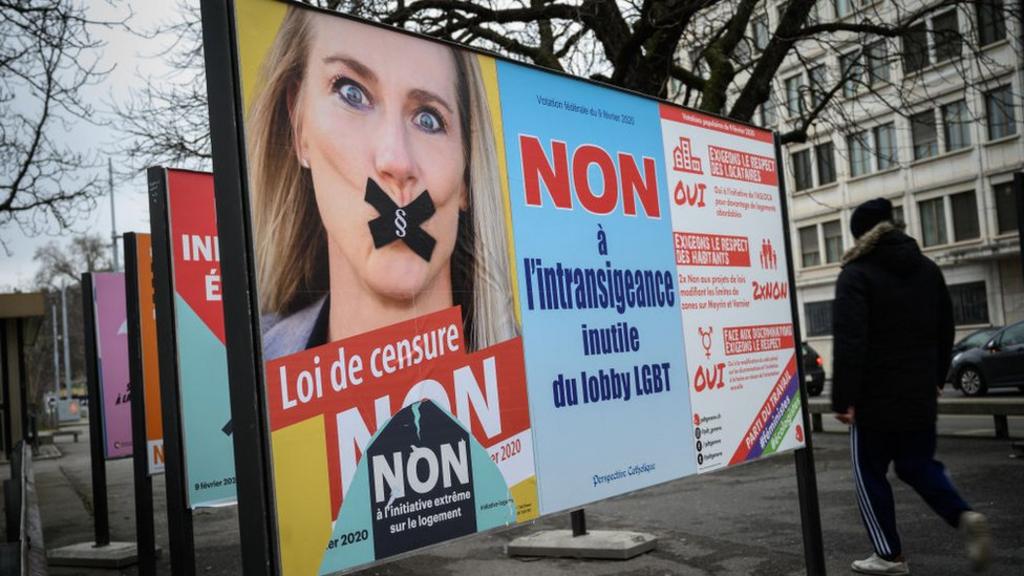
Today, the Swiss voted in a referendum to introduce laws which would extend protection from discrimination to LGBTI people. The proposal attracted support from 63% of Swiss voters and, finally, begins to bring the country into line with many of its neighbours who happen to EU member states. Switzerland is not part of the EU and, therefore, is not under any obligation to implement European laws which combat sexual orientation discrimination.
Critics of the Swiss proposal stated that the proposal was unnecessary because the country’s constitution already protected LGBTI individuals (and the country is a signatory to the European Convention on Human Rights). There were also concerns about what the proposal might mean for freedom of speech. Clearly, a majority of voters did not share these concerns.
Switzerland has a reputation for being a relatively conservative society (with a small ‘c’). After all, it was only in 1991 that the Swiss canton of Appenzell Innerrhoden finally permitted women to have the right to vote in cantonal elections. In federal (national) elections, woman had been given the right to vote since 1971.
We often forget this has been an incremental or gradual process in the UK and it did not happen overnight. Therefore, it is not advisable to be for British people to be smug or to have feelings of superiority about this issue. It was, after all, as recently as 2003 that the Employment Equality (Sexual Orientation) Regulations 2003 were implemented by the then Labour Government of Tony Blair. For the first time in UK employment law, LGBTI individuals were protected from discrimination in employment and training. This important law, critically, did not cover the provision of services and it was with the passage of the Equality Act 2010 that this area was eventually covered.
A link to an article on the BBC News app about the story can be found below:
It never ceases to amaze me that employers and service providers fall foul of arbitrary codes or policies which they impose on employees and service users. Regular readers of this Blog will be aware of previous articles covering discrimination or less favourable treatment which arises because employers or service providers issue generalised guidelines which discriminate against individuals because they happen to have certain hairstyles or wear beards or jewellery.
It is this lack of awareness that often leads to legal action in terms of the Equality Act 2010. By imposing a policy, criterion or practice (PCP) across the board, employers and other organisations could be setting themselves up for a fall specifically in relation to Section 19 of the Equality Act 2010. This part of the Act makes indirect discrimination unlawful i.e. it is an example of prohibited conduct by reason of a person or a group possessing a protected characteristic such as race or religion (Sections 9 and 10 respectively)
Since the introduction of the Race Relations Act 1976 (now repealed by the Equality Act 2010), we have seen a number of well known cases involving indirect discrimination being determined by Courts and Tribunals. So, you would think by now that employers and other organisations would have learned the lesson by now – apparently not as we shall see shortly.
In short order, such bans or generalised restrictions may infringe religious and cultural expression and may not only be a breach of the Equality Act, but could also represent a breach of human rights laws under the Human Rights Act 1998 and Article 9 of the European Convention on Human Rights.
Over the years, groups such as Jews, Muslims, Orthodox Christians, Sikhs and Rastafarians have brought successful legal actions for indirect discrimination on grounds of race and/or religion (see MandlavDowell–Lee [1982] UKHL 7). Being Jewish or Sikh can be both a religious and a racial identity.
Taking all of the above on board, I was really interested to read a story in The Independent this weekend which highlighted the problems of schools imposing dress codes on pupils. I thought: haven’t we been here before and why does no one seem to learn?
The story in question involves Ruby Williams who was “repeatedly sent home from Urswick School in Hackney, East London because she had Afro hair”. The school seems to have reacted with gross insensitivity to the youngster by informing her that her hairstyle was a breach of school uniform policy and that it could “block other pupils from seeing the whiteboard”.
Ruby and her family took legal action against the school (with the support of the Equality and Human Rights Commission) and she has since been awarded an out of court settlement of £8,500. The settlement figure clearly reflects the distress which she has suffered and the fact that all this trouble took place when she was studying for her GCSE exams (remember the Vento Guidelines anyone?). Ruby’s father is a Rastafarian and he has often stressed to his daughter the cultural, racial and religious significance of Afro hairstyles.
Apart from indirect discrimination which the school’s policy has caused to Ruby Williams, she may well also have had a claim in terms of Section 13 (direct discrimination) and Section 26 (harassment) of the Equality Act 2010 for being singled out in this way by the school authorities.
Perhaps the staff and Governors of the school might find it appropriate to undertake an equality awareness course at the next in-service day?
It is always open to an employer or service provider to show that although indirect discrimination has taken place, it can be objectively justified e.g. on national security grounds or health and safety reasons (e.g. Singh v Rowntree MacKintosh [1979] ICR 554 and Panesar v Nestle Co Ltd[1980] IRLR 64 CA).
Each attempt to justify a provision, criterion or policy (PCP) will, of course, turn on its facts and it would be very foolish for organisations to think that there is some sort of magic bullet or get out of jail card which can be used in every situation to justify or excuse conduct which would otherwise amount to unlawful discrimination. Organisations should review policies on a regular basis and, if need be, this may necessitate the carrying out of an equality impact assessment.
A link to the story on The Independent’s website can be found below:
The only gay in the village became a household phrase in the UK thanks to the long running Little Britain sitcom TV and radio series (which has been broadcast by the BBC since 2000).
Daffyd Thomas claimed to be the only gay person in a small, Welsh village (actually he wasn’t), but in some respects his catchphrase reflected the isolation that many people in the LGBTI communities experience – either in their personal or professional lives.
The reason that I mention this topic is because, last week, the LGBTI campaigning organisation, Stonewall, published research about the most inclusive LGBTI friendly employers in the UK (Newcastle City Council topped the list). That said, for many LGBTI employees, an inclusive work place is still a far off dream.
Please find a link to a story on the Sky News website about one employee’s decision to hide his LGBTI identity from his colleagues:
A person’s sexual orientation is, of course, a protected characteristic in terms of Section 12 of the Equality Act 2010. Such individuals should not be subjected to direct discrimination (Section 13); indirect discrimination (Section 19); harassment (Section 26); and victimisation (Section 27).
Many years ago, I remember teaching a group of students who were studying for a professional qualification. Many of them were employed by recruitment agencies and it was my task to highlight the relevant provisions of discrimination law at that time. One evening, we had a discussion about discrimination on the grounds of a person’s sexual orientation – particularly in the context of the ban on gay and lesbian people serving in the UK Armed Forces. This ban would eventually be lifted in 2000 – following the decision of the European Court of Human Rights in Smith and Grady v UK (1999) 29 EHRR 493.
One of the students asked me what protection existed for gay and lesbian people in employment law generally. Very little was my response. Before the introduction of the Scotland Act 1998 and the Human Rights Act 1998, the work place could be very hostile for LGBTI people (see Macdonald v Lord Advocate; Pearce v Governing Body of Mayfield School [2003] UKHL 34).
Yes, admittedly, the UK was (and still is in spite of Brexit) a signatory to the European Convention on Human Rights. In particular, Article 8 of the Convention recognises the right to family and private life. It was this Article which was used to overturn extremely restrictive laws on same sex relationships which existed in Scotland, Northern Ireland, the Isle of Man and the Channel Islands. Reinforcing Article 8 is Article 14 of the Convention is Article 14 which contains a general prohibition on discrimination.
The late 1960s are often referred to as the key period of the start of gay liberation in the UK with the passing of the Sexual Offences Act 1967 which decriminalised homosexual relationships between consenting adults (aged 21 or over) and as long as such conduct was in private. What is often overlooked is that the 1967 Act applied to England and Wales only. The picture was very different (and would remain so for over a decade – sometimes longer) in various parts of the British Isles.
Homosexual relationships were decriminalised in Scotland in 1980; in Northern Ireland in 1982; the UK Crown Dependency of Guernsey in 1983; the UK Crown Dependency of Jersey in 1990; and the UK Crown Dependency of the Isle of Man in 1994. The age of consent was set at 21 for all these parts of the British Isles. Things have since moved on and the age of consent was firstly reduced to 18 and then eventually to 16.
In the last 20 years, the influence of the European Union has been particularly profound regarding measures to combat sexual orientation discrimination.
In 1999, as a result of the Treaty of Amsterdam, the EU adopted two Directives which considerably expanded the scope of its anti-discrimination laws (the Racial Equality Directive (2000/43/EC) and the Employment Equality Directive (2000/78/EC). Of particular interest to this discussion is the Employment Equality Directive which made it unlawful to discriminate against a person on grounds of sexual orientation. Admittedly, this Directive was limited because it covered the areas of employment and vocational training only.
On 1 December 2003, the Employment Equality Directive would eventually become part of UK law in the form of the Employment Equality (Sexual Orientation) Regulations 2003. The Regulations were repealed and replaced by the relevant provisions of the Equality Act 2010 (which came into force on 1 October 2010).
It did not extend to the provision of goods and services, so had the case of Bull and Another v Hall and Another [2013] UKSC 73 occurred when the Directive was first transposed into UK domestic law, the same sex couple who were refused a double room at the guest house in Cornwall would not have been successful in their claim for sexual orientation discrimination. Luckily for them, the Equality Act had since come into force and covered unlawful less favourable treatment on grounds of a person’s sexual orientation with regard to the provision of goods and services.
The Treaty on the Functioning of the European Union (TFEU) is also worthy of comment. Article 19 prohibits discrimination by reason of a person’s sexual orientation and, notably, this provision is hardwired into UK law by way of the Equality Act 2010. Article 19 extended legal protection to gay and lesbian people more generally – over and above the limited areas of employment and vocational training which the Treaty of Amsterdam and the Employment Equality Directive had originally addressed.
The EU Charter of Fundamental Rights (although Poland and the UK had negotiated some opt-outs) contained significant provisions on equality and non-discrimination, namely, Article 20 (equality before the law) and Article 21 (the principle of non-discrimination).
Another massive step forward for the equality of the LGBTI community was the introduction of the Civil Partnerships Act 2004 which would give legal recognition (and protection) to gay and lesbian people who chose to enter such relationships. These rights would be further underpinned by permitting same sex couples to marry (in England and Wales in 2013 and in Scotland in 2014). Currently, Northern Ireland is the only part of the UK not to permit same sex marriage – although this will change from next week onwards (see link below):
Robyn Peoples and Sharni Edwards will celebrate their wedding on Tuesday in Carrickfergus.
This change to the law has come about as a result of the introduction of the Northern Ireland (Executive Formation etc) Act 2019 passed by the UK Parliament (in the absence of of a functioning devolved government for nearly the last 3 years).
Finally, if employers want to do more to create an inclusive work place, they could start by using Stonewall’s inclusive toolkits (see link below):
As a society, the UK has certainly moved on from the overtly hostile attitudes towards members of the LGBTI communities over the last 50 years or so. The legal rights and protections which LGBTI people now enjoy would have seemed unthinkable in 1967 when a limited form of tolerance was ushered in as a result of the Sexual Offences Act (in England and Wales). More recently, the UK and Scottish Governments have issued pardons to those individuals who were convicted of criminal offences under the previous laws (in 2017: the Policing and Crime Act 2017 in England and Wales (known as Turing’s Law after Alan Turing, the Enigma Code Breaker) and, in 2018, the Scottish Parliament followed suit by passing the Historical Sexual Offences (Pardons and Disregards) (Scotland) Act 2018).
Postscript
On Friday 7 February 2020, Phillip Schofield, the British TV celebrity announced that he was gay at the age of 57. Mr Schofield is married with 2 children and had lived a heterosexual life – until now. He likened hiding his sexual orientation to being in prison and being consumed by it.
A link to the story on the Sky News website can be found below:
At 2300 hours GMT today (or 0000 hours CET if you prefer), the United Kingdom will set a precedent and become an ex-member state of the European Union.
The European Union (Withdrawal Agreement) Act 2020 was given Royal Assent on 23 January 2020 and, earlier this week, the European Parliament overwhelmingly ratified the Withdrawal Agreement of November 2019 between the UK and the EU.
Click on the link below for the text of the Agreement:
Job done; back to normal then (whatever that is); the British have taken back control? Well not quite. The Withdrawal Agreement was always going to be the first part of the equation that needed resolving i.e. setting the terms on which the UK would leave the organisation. This has been popularly referred to as the divorce agreement e.g. dealing with the UK’s agreed financial contribution to projects and initiatives to which it had agreed when it was a member state.
The more difficult task will be to figure out what kind of future relationship the EU and the UK will have e.g. about future trading arrangements. UK Prime Minister, Boris Johnson wants such an agreement to be finalised by 31 December 2020; leading figures on the EU side (e.g. Ursula Von der Leyen, the Commission President) have been more cautious.
The fact that Brexit Day has finally arrived does not, however, mean that EU Law will cease to have effect in the UK.
We have now entered what is known as the transition period (31 January 2020 until 31 December 2020) and Article 127 of the Withdrawal Agreement explicitly states:
‘Unless otherwise provided in this Agreement, Union law shall be applicable to and in the United Kingdom during the transition period.’ [My emphasis]
In any event, as I have previously observed, EU Law is hardwired into the UK legal domestic systems. Areas such as consumer law; employment law; discrimination and equality law; environmental protection law and family law have all been extensively influenced by European legal principles. Any lawyer with some knowledge of EU Law knows this to be a question of fact. After 47 years of involvement with the European Project, this should be blindingly obvious.
Even this last week, documents published by the European Commission demonstrated that there will be import/export checks between the Island of Ireland and the UK. The Court of Justice of the EU will have the final say in relation to any disputes – despite what Prime Minister Johnson believes or says.
As Lord Denning opined many years ago in Bulmer (HP) Ltd v Bollinger SA [1974] 1 Ch 401, [1974] 3 WLR 202, [1974] 2 All ER 1226:
“But when we come to matters with a European element, the Treaty [of Rome] is like an incoming tide. It flows into the estuaries and up the rivers. It cannot be held back. Parliament has decreed that the Treaty is henceforward to be part of our law. It is equal in force to any statute.”
Or to use another metaphor: perhaps Brexit is a case of building the legal equivalent of the Thames Barrier after the deluge. Too little, too late. Whether the British Government likes it or not, by dint of Brexit, this country is no longer a rule maker and has assumed the status of rule taker.
We’re still in the month January and the issue of serious disparities in pay between the sexes raises its ugly head once again. I’ve said it before; but I’ll say it again: we’ve had over 40 years of legislation in the UK (first the Equal Pay Act 1970 and now the Equality Act 2010, not to mention EU primary and secondary legislation) which should have put the issue to rest.
The Equality Act 2010 incorporates an equality clause into contracts of employment which means that employers have a duty to ensure that men and women are paid on equal terms for carrying out like work; work rated equivalent; and work of equal value.
It’s hard to believe that the groundbreaking decision of the Court of Justice of the EU in Case 43/75 Defrenne v Sabena (No 2) [1976] ECR 455 was in the 1970s and here we are, entering the second decade of the 21st Century, still talking about the issue of equal pay – or the lack of it.
There is a depressing familiarity to stories in the UK media about the lack of progress regarding this issue. This is surprising because successful equal pay claims can be be very costly in financial terms for employers. In 2019, after Glasgow City Council female employees won their battle for equal pay, there was much speculation about how the employer was going to pay the bill. One of the (seemingly) more dramatic predictions was that the City Council would have to sell Salvador Dali’s world famous painting Christ of St John of the Cross in order to meet its legal obligations to its underpaid female employees. Susan Aitken, the City Council leader, was forced to issue a denial that this was a possibility. When you realise that the estimated value of Dali’s painting starts at £60 million you begin to get an idea of the scale of the problem.
That said, some years ago, Birmingham City Council was forced to sell its share in the National Exhibition Centre in order to meet the (awesome) financial burden of thousands of equal pay claims . The price achieved was £307million – although 3 years later, the asset was sold once more for an eye watering figure of £800 million (allegedly).
Recent research carried out by the English law firm, Slater+Gordon, suggests that women fail to gain pay increases because they are not negotiating with their employers about this issue. Campaigning groups, such as Close the Gap, are firmly of the opinion that the onus should not be placed on women to push for equal pay; rather it should be the responsibility of the State and/or employers to achieve this goal. There has to be real cultural change in society and women need to be valued more if the gender gap is to become a thing of the past.
Links to articles in The Independent about the equal pay research that Slater+Gordon Solicitors carried out can be found below:
And if you remain unconvinced about ingrained gender bias in the corporate world generally, you will find a link below to research carried out by The Independent which demonstrates how many leading tech companies suffer from the lack of women in leadership roles:













 Seán Crossan's Scots Law