The sands of time (or prescription)

Photo by Immo Wegmann on Unsplash

Prescription: terror of the legal profession

When I discuss prescription with students for the first time, I usually can’t resist making the (admittedly) lame observation that it has nothing to do with going to see your General Practitioner for a medical appointment. Though, these last few days, I have been talking a lot about the Coronavirus or COVID-19 and the legal implications of this outbreak for sickness absence from work and eligibility for sick pay.

No, prescription has nothing to do with medicine and is a concept that all lawyers should be familiar with – indeed live in terror of perhaps?

I well remember one developer of legal software informing me that his case management system for personal injury claims had a feature which regularly provided a countdown towards the last possible date when a prospective claim must be submitted to the appropriate court with jurisdiction to hear the matter (so no excuses then?).

Lawyers who fall foul of prescription may well be opening a can of worms for themselves because the clients will almost certainly attempt to sue them for professional negligence.

If the principle of prescription is being deployed by the opposing side in a legal action, you (and your client’s case) may be in serious trouble.

In what way?

Essentially, you have not submitted the claim or complied with court procedures (e.g. deadlines for submission of documents/evidence) within the required time allowance.

In terms of the Prescription and Limitation (Scotland) Act 1973, most delictual (tort) claims must be brought within five years of damage to property. In terms of contractual actions, a pursuer or a claimant who is contemplating legal proceedings in Scotland will usually have 5 years from the effective date of the breach to submit a claim (the quinquennium).

On the other hand, personal injury claims must usually be lodged within three years of the date of the incident which caused injury (the triennium).

In England, the prescription period for contractual claims is 6 years and for most other claims the period is 3 years.

Time limits for submission of claims will be strictly adhered to – unless the Scottish courts deem it just and equitable to extend them.

Sometimes, certain claims – principally Employment Tribunal claims – must be submitted by the claimant in a very short space of time. Normally, for most employment claims (including discrimination claims), the claimant must submit an ET1 application to the Employment Tribunal within 3 months minus 1 day of the act that she is complaining about. If the dismissal from employment took place on 5 March, a claim for unfair dismissal must be submitted by 4 June – at the very latest – otherwise it will be time barred. Admittedly, for equal pay claims, longer time limits apply i.e. 6 months minus 1 day from the discriminatory act complained about.

Prescription is an extremely powerful weapon that can be used by an opposing lawyer to knock out another person’s claim. If prescription is relevant, then the merits of the case will simply not be discussed. The claim is time-barred and that is usually that (see the UK Supreme Court’s decisions in David T Morrison & Co Limited v ICL Plastics [2014] UKSC 48 and Gordon v Campbell Riddell Breeze Paterson LLP (Scotland) [2017] UKSC 75).

Out of time!

In two fairly recent cases before the Outer House of the Court of Session, the issue of prescription was successfully argued by the defenders’ legal teams.

In the first case – Brian Alexander Gracie v Edinburgh City Council [2019] CSOH 6 – an incident which had allegedly taken place in 1965 was time barred (unsurprisingly) on the grounds of prescription. More bizarrely, Mr Gracie, the pursuer himself admitted that he had little recollection of the incident and there was scant evidence to support his assertions in any event. Gracie was alleging that, while at school in the 1960s, the teaching staff had failed in their duty of care to him by permitting him to run out from the playground on to the road where he was hit by a car. Needless to say, his claim for a staggering £650,000 in damages was swiftly dispatched by the council’s lawyers.

A link to the decision of the Outer House in the above case can be found below:

https://www.scotcourts.gov.uk/docs/default-source/cos-general-docs/pdf-docs-for-opinions/2019csoh29.pdf?sfvrsn=0

In the second case – Midlothian Council v David Anderson Keith and others [2019] CSOH 29 – the council had built a housing development on land at Gorebridge which later turned out to be be dangerous because of gas leaks seeping from old coal mines at the site. The site was later demolished and rebuilt because of the risk to human health.

It had instructed a survey prior to the build and the engineering firm which carried this out had assessed the risk from gas to be very low. Due to this assessment, gas defences (e.g. a gas membrane) were not included in the build. In 2013, levels of gas harmful to humans were detected at a site property.

The council wished to sue the firm for allegedly providing negligent advice under their contract. The claim was dismissed by reason of prescription i.e. the contractual obligations between the two parties had become extinct. It’s worth noting that the engineers never accepted liability – the clinching argument of prescription made debate about liability completely irrelevant.

The disagreement between the two sides centred around the point at which the five year prescription period began. The engineering firm argued that it began when the development was completed (June 2009); the council responded by arguing that the critical date was when the high levels of gas were detected at the site (7 September 2013).

Lord Doherty clearly relied upon the UK Supreme Court decision in Gordon v Campbell Riddell Breeze Paterson LLP (Scotland) [2017] UKSC 75. The key date from which the 5 year prescription period should run was the date of completion of the housing development. His Lordship was firmly of the view that the key event was the date when the council placed reliance on the engineering firm’s assessment that it was safe to build on the site. This reliance could be pinpointed to a period between December 2007 and June 2009 i.e. when the development was commenced and completed. The action against the engineers (who never admitted liability) was commenced on 4 September 2018 – nearly 9 years after the development had been completed. The council’s claim was, therefore, dismissed.

A link to the decision of the Outer House in the above case can be found below:

https://www.scotcourts.gov.uk/docs/default-source/cos-general-docs/pdf-docs-for-opinions/2019csoh6.pdf?sfvrsn=0

Overriding prescription?

There is, however, a provision in Section 19A of the Prescription and Limitation (Scotland) Act 1973 which does permit a judge to override the normal rules about prescription. Claims which would normally be time barred may be permitted to proceed to a hearing under Section 19A if the judge believes that it is equitable to do so.

Such an approach was taken in the case of A v Glasgow City Council [2018] CSOH 116 which arose out of the events of the Glasgow Lorry Incident in December 2014. Relatives of the victims of this tragedy were permitted to proceed with their legal actions despite the relevant time limits having passed because it would not have been in the interests of justice to time bar the claims on a technicality.

A link to Lord Doherty’s Opinion in A v Glasgow City Council [2018] CSOH 116 can be found below:

https://www.scotcourts.gov.uk/docs/default-source/cos-general-docs/pdf-docs-for-opinions/2018csoh116.pdf?sfvrsn=0

Removal of the 3 year limitation period – historical child abuse claims

Sometimes Parliament will permit claims to proceed to court – even if they would normally be time barred or fall foul of prescription. This will be achieved by passing legislation and one recent example is the Limitation (Childhood Abuse)(Scotland) Bill.

Clearly, Parliament’s purpose in waiving the normal rules of prescription which are normally strictly adhered to by the Scottish courts is that it is just and equitable to do so. Put simply, the legislation is about righting an historic injustice.

On 14 March 2016, the Scottish Government published a draft Limitation (Childhood Abuse)(Scotland) Bill which was in response to the Consultation on the Removal of the 3 Year Limitation Period from Civil Actions for Damages for Personal Injury for In Care Survivors of Historical Child Abuse.

The draft Bill proposed to remove the triennium or 3 year time limit for cases of historical child abuse that allegedly took place after 26 September 1964.

This Bill was eventually passed by the Scottish Parliament becoming the Limitation (Childhood Abuse)(Scotland) Act 2017. It represents an exception to the normal rules regulating the limitation period for the submission to Scottish civil courts in relation to personal injury claims of this nature.

Conclusion

Time and tide wait for no one; delay is fatal; or tempus fugit (i.e.time flies) can all be applied to legal actions. If you don’t use it (i.e. your right to take court action), you lose it. This is quite sensible: it means that there is a natural cut off for legal actions and, consequently, the courts will not be swamped (well any more than they already are).

Another sensible viewpoint is that litigation should take place fairly quickly so that the evidence of litigants is fresh in the memory (the case of Brian Alexander Gracie v Edinburgh City Council [2019] CSOH 6 is an excellent illustration of this (see above).

Parties bringing claims to Scottish civil courts must be aware of the following:

  • The Triennium or 3 year period in which a claim for personal injury must be submitted; and/or
  • The Quinquennium or 5 year period in which contractual claims or delictual claims for property damage must be submitted.

Admittedly, Section 19A of the Prescription and the Limitation (Scotland) Act 1973 does allow Scottish judges to override the principle of prescription if it is just and equitable to do so.

Speaking of just and equitable grounds, the Scottish Parliament passed the Limitation (Childhood Abuse)(Scotland) Act 2017. This legislation represents an exception to the normal rules regulating the limitation period for the submission to Scottish civil courts of personal injury claims which involve historic child sex abuse allegations.

As a general rule of thumb, however, prescription remains the terror of the legal profession: get the client’s claim submitted on time or face a professional negligence claim.

Copyright Seán J Crossan, 6 March 2020

State of emergency

Photo by Markus Spiske on Unsplash

In a Blog published yesterday, I discussed the issue of entitlement to sick pay as a result of the Coronavirus or COVID-19 outbreak.

Related Blog article:

https://seancrossansscotslaw.com/2020/03/04/sick-pay-or-the-coronavirus-conundrum/

State of emergency

Governor Gavin Newsom of the US State of California declared a state wide emergency on Wednesday 4 March 2020 in order to counter the spread of the virus.

Please see a link below to an article in the Los Angeles’ Times concerning Governor Newsom’s announcement:

https://www.latimes.com/california/newsletter/2020-03-05/coronavirus-cruise-emergency-newsletter

How are the recent developments in California linked to events in the UK?

It should be recalled that Governor Newsom signed into law Assembly Bill 5 of 2019 in January of this year. You don’t remember this? Well, Assembly Bill 5 is better known as the Californian Gig Economy law which, in effect, gives thousands of workers employment status. Significantly, this means that many of these affected individuals will now benefit from greater levels of employment protection – including entitlement to sick pay.

Now, think about this: had the COVID-19 outbreak occurred last year, many Californian workers would have had absolutely no entitlement to receive sick pay if such individuals were forced to self-isolate or take time off because they had been infected. No doubt many of these workers turned employees will be breathing a huge sigh of relief that they are now covered by Assembly Bill 5.

Related Blog article:

https://seancrossansscotslaw.com/2020/02/13/california-dreamin/

The UK approach

Turning our attention to the UK, the British Government has taken a less generous approach to the issue of entitlement to sick pay. True, employees and other workers who already benefit from entitlement to statutory sick pay (SSP) should now be able to claim this from day 1 of sickness absence. It should be emphasised that this is a temporary measure justified on emergency grounds.

Previously, statutory sick pay was payable only from day 4 of the employee’s absence until Prime Minister Johnson’s announcement in the House of Commons on Tuesday 3 March 2020.

Jeremy Corbyn, Leader of the opposition Labour Party, immediately asked the PM if zero hours workers and self-employed individuals would have this benefit extended to them. The PM’s response to Mr Corbyn’s question will have disappointed many of these individuals. No entitlement to statutory sick pay for them. The problem for these individuals is that they do not meet the eligibility threshold where they earn £118 per week (the Lower Earnings Limit).

There is also the small fact that employment status (which is linked to entitlement to sick pay) is defined by the Employment Rights Act 1996. Section 230 of the Act defines an employee as an individual who has a contract of service. Many employment rights flow from this status and this means that many individuals who are engaged on a contract for services will simply not be eligible to claim statutory sick pay.

A link to an article in The Mirror newspaper about the exchanges in the House of Commons between PM Johnson and Mr Corbyn about SSP entitlement can be found below:

https://www.mirror.co.uk/news/politics/breaking-new-coronavirus-sick-pay-21629942

An evolving position?

… and yet, the UK Government’s thinking on this issue may be quickly evolving. On the BBC’s Question Time television programme broadcast on Thursday 5 March 2020, Matt Hancock MP, the UK Health Secretary said that people on zero hours contracts and self-employed persons should not be financially penalised for doing the right thing i.e. self-isolating themselves or being honest about having the virus.

It will be interesting to see how the story develops and what changes to UK employment law may follow as a result.

Copyright Seán J Crossan, 5 March 2020

Sick Pay? (or the Coronavirus Conundrum)

Photo by Macau Photo Agency on Unsplash

Coronavirus (COVID-19) isn’t just a potential threat to your health; it could also mean that your earnings take a hit.

How so?

If you have to take time off from work (i.e. self-isolate yourself) because you have (or might have) been infected by the virus, will you be entitled to receive sick pay from the organisation that you are working for?

It depends very much on your employment status …

… if you are a zero hours worker or genuinely a self-employed person, the answer is an emphatic no.

If you are deemed to be an employee (an individual who works under a contract of service) within the meaning of Section 230 of the Employment Rights Act 1996, you may be fortunate in that you have an entitlement to receive either contractual sick pay or statutory sick pay.

Contractual sick pay

If a contractual sick pay scheme applies to your employment, you might receive, at its fullest extent, 6 months full pay and then 6 months at half pay. This generous arrangement, of course, will not apply from day 1 of the employment and employees will have to build up their continuous service in order to be eligible for the maximum level of contractual sick pay. It is probably the case that an employee with just over a year’s service would receive 1 month at full pay for sickness absence and then 1 month at half pay.

An example of entitlement to contractual sick pay arrangements taken from the Collective Agreement (the National Working Practices Agreement) between Scottish Further Education lecturers and their employers can be seen below:

Statutory sick pay

What about statutory sick pay or SSP? This is relevant in situations where employees are not entitled to receive contractual sick pay.

It’s also worth pointing out that contractual sick pay is often much more generous than SSP and, even then, not all employees will be entitled to receive this benefit because they fall outside the eligibility criteria. The current weekly rate of sickness pay (in March 2020) is £98.25 and could be paid by employers for a maximum of 28 weeks.

Ordinarily, it becomes payable only from 4th day of sickness absence, but as of Wednesday 4th March 2020, the UK Government has announced that employees who self-isolate themselves because of suspected Coronavirus infection, will be paid SSP from day 1 of their sickness absence.

This is a temporary measure which will apply only for the duration of the current COVID-19 emergency, but people who are off sick with a medical condition other than the virus will also be entitled to benefit from these changes.

See links below to articles on the BBC website about sickness pay entitlement and COVID-19:

https://www.bbc.co.uk/news/business-51628524

https://www.bbc.co.uk/news/uk-51738837

The change in Government policy will not be extended to the self-employed; and to zero hours workers (who will not be able to meet the threshold conditions for eligibility). Frances O’Grady, the General Secretary of the UK’s Trades Union Congress (TUC) has stated that as many as 2 million workers may not be eligible for SSP under the current system.

There has been some concern expressed that individuals in these categories may continue to go to work – if they have the virus or suspect as much – because they will not receive SSP during their absence.

Eligibility criteria for SSP

In 2019-20, in order to qualify for SSP you must be an employee earning at least £118 per week or £512 per month (before tax). This is known as the Lower Earnings Limit.

In April 2020, SSP will rise to £95.85 per week, but individuals’ earnings must fall within any of the following bands in order to qualify:

  • £120 per week
  • £520 per month
  • £6,240 per year

Again, this will mean that many zero hours contract workers will simply fail to qualify for SSP payments.

More problems …

There is also another complication concerning eligibility for sickness pay which the COVID-19 outbreak has raised:

Let’s assume that you do qualify for either contractual sick pay or SSP, but you have decided to take the precautionary measure of self-isolation so as not to expose your colleagues to potential risk.

It may be that you have recently returned from a destination such as China or Italy where the virus has been particularly prevalent and you decide to play it safe by not going into work. You contact your HR Department or employer to inform them of your decision; you are thanked for being extremely considerate and responsible; and then you are told that you are not entitled to receive sick pay because you haven’t actually been diagnosed with the virus.

Matt Hancock MP, UK Government Minister for Health, thinks that current legislation does cover such situations and individuals who take precautionary measures, as outlined above, should benefit from sick pay provisions.

With all due respect to Mr Hancock, what he thinks and what current legislation or a contract of employment states might be entirely different realities. That said, Mr Hancock does have the support of the highly regarded Advisory Conciliation and Arbitration Service (ACAS) which is recommending that employers pay self-isolating employees who have taken such a precautionary measure (see link below).

https://www.acas.org.uk/acas-publishes-new-advice-on-handling-coronavirus-at-work

Conclusion

Clearly, COVID-19 is presenting a number of challenges to traditional practices or orthodoxies in the field of employment law. This is a serious issue given that recent estimates are predicting that up to 20% of the UK workforce could be in danger of contracting the virus and, consequently, they will be absent from work.

In some respects, the UK Government has been caught napping on the issue of extending employment protection e.g. entitlement to sick pay to people who do not have a contract of service and the COVID-19 outbreak has really exposed this shortcoming.

As Jonathan Rennie of law firm, TLT, had noted (as recently as this week) the UK Government has failed to implement any of the recommendations of the Taylor Review which favoured extended employment protection to workers who did not have a contract of service. It is somewhat ironic that the virus outbreak has forced the Government to break cover and extend some employment protection rights.

A link to an article on the BBC website about the predicted impact of COVID-19 on the UK workforce can be found below:

https://www.bbc.co.uk/news/uk-51718917

Copyright Seán J Crossan, 4 March 2020

Sick to the back teeth …

Photo by Quang Tri NGUYEN on Unsplash

In the last few months, I’ve discussed two medical negligence cases involving the NHS in Scotland. Since last week, I now have a hat trick with the decision of Lady Wise (sitting in the Court of Session) in respect of Derek Hamilton v Lanarkshire Health Board [2020] CSOH 24.

The facts of the case are pretty straightforward:

In 2013, Mr Hamilton had been playing with his grandson when he swallowed his dental plate. Now, it may seem facetious of me to say this, but Mr Hamilton’s grievance was not directed at his grandson’s high jinks. The issue was with what happened next. He attended the local NHS hospital for treatment and he was informed that he would have to undergo surgery to have the plate removed.

Mr Hamilton duly underwent an operation where Martin Downey, an experienced surgeon, removed said plate via the patient’s oesophagus. Unfortunately, while doing so the surgeon’s actions caused a tear or a perforation in the oesophagus and Mr Hamilton’s condition worsened rapidly. Consequently, the patient spent a total of 45 days in hospital as a result of complications arising from the botched procedure.

Mr Hamilton alleged that Martin Downey, had breached his duty of care to him and that he had carried out a procedure which “all general surgeons know is a catastrophe to be avoided.”

In finding Martin Downey liable for negligence, Lady Wise bluntly observed that:

Mr Downey departed from usual and normal practice … and acted in a manner that no ordinarily competent general surgeon with colorectal speciality exercising ordinary skill and care would have done.

Her Ladyship went on to state that:

“I have found that, but for the taking of that easily avoidable risk, the patient’s oesophagus would have remained intact as it was the act of removing the plate that caused the perforation. The pursuer [Mr Hamilton] has therefore established both breach of duty and causation.”

Mr Hamilton will receive £195,000 (plus interest) in compensation from Lanarkshire Health Board in settlement of his claim for personal injury.

A link to Lady Wise’s decision in the matter can be found below:

https://www.scotcourts.gov.uk/docs/default-source/cos-general-docs/pdf-docs-for-opinions/2020csoh24.pdf?sfvrsn=0

A link to a report on the BBC website about the case can be found below:

Man who swallowed his false teeth wins NHS damages

Derek Hamilton wins £195,000 damages after surgery to remove a dental plate left him seriously ill.

Related Blog Articles:

https://seancrossansscotslaw.com/2020/01/22/duty-of-care/

https://seancrossansscotslaw.com/2020/01/25/counting-the-cost/

https://seancrossansscotslaw.com/2020/01/20/the-plumbers-arm/

https://seancrossansscotslaw.com/2019/08/05/an-unfortunate-error/

Copyright Seán J Crossan, 2 March 2020

Avoid!

Photo by Eiliv-Sonas Aceron on Unsplash

The above photograph conveys everything that is pleasant about staying in a nice hotel or boutique guesthouse.

Sadly, this was not the case for one couple, Mr and Mrs Jenkinson, who had booked into accommodation (the Broadway Hotel) in the English seaside resort of Blackpool in 2014. The couple were so disappointed by the lack of basic hygiene standards and facilities that they were motivated to leave a review on Tripadvisor – a very bad review, in fact, which did the establishment absolutely no favours.

How did the hotel respond?

Not in the way that you would think the management should have responded i.e. by issuing the couple with a grovelling apology and, possibly, a refund?

No, the couple were checking their credit card statement some days after their review had been posted and noticed that £100 had been charged to their account by the Broadway Hotel. Surely, this must have been some oversight or mistake? Following further enquiries by the couple, they discovered that the hotel had levied the charge because they had the nerve to leave a bad review on Tripadvisor about the very poor standards they had experienced while staying there.

When the couple objected to this, the establishment told them to check the small print in its booking documents – which Mrs Jenkinson had admittedly signed. True enough, buried somewhere in the small print was a statement to the effect:

Despite the fact that repeat customers and couples love our hotel, your friends and family may not. … For every bad review left on any website, the group organiser will be charged a maximum £100 per review.

Now, the Broadway Hotel was by no means luxury accommodation (the Jenkinsons had paid £36 for an overnight stay), but even budget hotels must meet basic standards such as adequate hygiene. The hotel failed miserably to meet these standards. More and more often, we do rely on the experiences of other people to guide us in our choices as consumers and the Jenkinsons were posting a fair comment review on Tripadvisor. The ability of businesses and traders to prevent consumers doing this would clearly be a retrograde development.

At the time, the story went viral and Mr and Mrs Jenkinson were invited on to the BBC Television’s Breakfast show to talk about their experiences. Needless to say, the hotel got more than it bargained for with the adverse media publicity and Blackpool Council’s Trading Standards Department taking a keen interest in its business practices.

A link to the story on the BBC website about the Jenkinsons’ experiences at the Broadway Hotel, Blackpool in 2014 can be found below:

https://www.bbc.co.uk/news/technology-30100973

Was this clause enforceable?

At the time of the story breaking, I fortuitously happened to be teaching Unfair Terms in Contract Law to two of my classes. I had never seen a clause like this before and informed my students that it was very unlikely to be capable of enforcement by the hotel given its blatant unfairness – let alone the implications for freedom of speech in the UK.

I’ve long wanted to write about the Jenkinsons’ experience and I was reminded of their story some weeks ago when teaching a group of students about unfair terms in contracts.

Normally, when I discuss this area of the law, I make students aware that businesses used to be extremely trigger happy when using all sorts of unfair terms in contracts in order to avoid their responsibilities to customers.

Prior to the introduction of the Unfair Contract Terms Act 1977 (about more later), businesses and other organisations could exclude or limit their liability for causing death and personal injury so long as adequate notice of the existence of the term was brought to the attention of the other party to the contract.

So, for example, if a garage owner wished to exclude his liability to a customer who put a vehicle in for repairs or a service, he could simply alert the customer to the existence of an exclusion or limitation clause in the contract. The customer leaves the car to have the brakes fixed; picks the car up later; the mechanic has been negligent and not carried out the work properly; the customer later suffers a terrible accident because the brakes haven’t been fixed. Hey presto, no need to worry because the garage owner could point to his standard terms of business which contained an exclusion clause. In effect, the exclusion clause was a get out of jail card.

Another tactic often deployed was where the business could argue that the customer had constructive notice of the existence of the unfair term e.g. the customer should have read the documents presented to him or her. Mrs Jenkinson had signed the booking documents presented to her by the Broadway Hotel. She later admitted that she did not read the terms because she did not have her spectacles with her.

On occasion, the courts might intervene and side with a party objecting to the enforcement of an unfair term under a number of judicial doctrines:

  • the repugnancy rule
  • fundamental breach
  • the contra proferentum rule

Despite judicial intervention, the odds were still stacked against parties who wished to challenge the inherent unfairness and abusive nature of attempts by traders and businesses to exclude or limit their liability.

Sensibly, the UK Parliament decided to tackle what was becoming the Wild West of contractual terms and passed the Unfair Contract Terms Act 1977 which made such attempts to evade liability automatically void.

Generally speaking, the Act made it much harder (but not impossible) for businesses to impose other unfair terms on consumers. Businesses, on the other hand, were still, advised to read the small print of any agreements that they were contemplating entering, although courts would be more sympathetic if a larger business tried to use its unequal bargaining power to impose unfair terms on a smaller business.

The European Union also passed legislation (European Council Directive 93/13 on Unfair Terms in Consumer Contracts and, for a while, the Unfair Terms in Consumer Contracts Regulations of 1994 and 1999 respectively were in force. These were later repealed and replaced by the Consumer Rights Act 2015, although the terms of the Directive live on in this legislation (remember: EU Law is hardwired into UK national laws).

Along the way, the Enterprise Act 2002 and the Consumer Protection from Unfair Trading Regulations 2008 severely restricted the ability of businesses and traders to impose very unfavourable terms on consumers.

The net effect of all of this legislation was that consumers were really protected against the imposition of unfair terms by traders and businesses. Consumers were often deemed to be the weaker party in a relationship with traders and businesses and, therefore, needed to be protected.

Returning to the Jenkinsons’ experience at the a Broadway Hotel, it is worth emphasising that the couple were being provided with accommodation services as consumers and, therefore, would have been entitled to the benefit of existing UK consumer protection laws on the statute books in 2014.

Had this incident occurred in 2020, the Jenkinsons would, of course, have been able to challenge the legality of the penalty clause primarily in terms of the Consumer Protection from Unfair Trading Regulations 2008 and the Consumer Rights Act 2015.

Conclusion

Happily, we have come a long way in consumer law where businesses could previously impose all sorts of unfair, not to say downright abusive, terms on customers.

We are now in a position, where UK consumers will be protected by legislative safeguards which should ensure that these types of terms will not be permitted to stand i.e. they will be automatically void or simply unenforceable. The penalty clause which the Jenkinsons experienced would doubtless have fallen foul of consumer protection legislation had the issue got anywhere near a court room. Nonetheless, it was an interesting example of the inventiveness of businesses regarding the creation of new types of unfair terms in contracts.

It remains the case, however, that in business to business contracts (or in private transactions), it will be highly advisable for parties to remain wary about the potential unfairness of contractual terms. Only the most outrageous and downright abusive terms (such as excluding or limiting liability for death or personal injury) will be automatically void – no matter how much notice of their existence has been given by the party seeking to rely on them. If a business is seeking to have a clause declared void or unenforceable, the debate to be had in terms of the Unfair Contract Terms Act 1977 will often centre around the perceived reasonableness (or otherwise) of the clause.

Copyright Seán J Crossan, 1 March 2020

Go to jail?

Photo by 🇨🇭 Claudio Schwarz | @purzlbaum on Unsplash

Young offenders?

Well, not if you’re under 25 according to recent proposals published by the Scottish Sentencing Council as part of a public consultation process. The main function of the Scottish Sentencing Council is to demystify sentencing decisions and, therefore, educate the public about these matters.

The current proposal might seem very provocative and is bound to divide public opinion. Crime, after all, is a very emotive issue and everyone has an opinion about it whether you have been the victim or the criminal. The purpose of criminal law is about the State punishing those individuals who have broken the rules of the community by engaging in dangerous and/or anti-social activities.

The rationale for the Scottish Sentencing Council’s proposal is that scientific research (carried out by the University of Edinburgh) seems to show that the brains of people aged under 25 years have not fully developed i.e. matured.

Now, it is by no means certain that such a proposal will be implemented and the Scottish Sentencing Council is urging members of the public to respond to its consultation with their opinions on the matter.

https://consultations.scottishsentencingcouncil.org.uk/ssc/young-people/

It is certainly part of a wider strategy which fits in with attempts by the Scottish Government to reduce the numbers of people who are sent to prison each year. There is now perhaps a recognition that prison doesn’t always work. There has been a presumption operating for several years in Scotland, that people will not be sent to prison if the offence would normally be punished by a sentence of less than 6 months. Obviously, this presumption would be ignored if, for example, the offender was a person who persistently broke the rules.

Over the last year, this Blog has looked at a number of initiatives which have taken place which have been about taking different approaches to crime prevention or the rehabilitation of offenders.

In the Autumn (or Fall), I spoke to a group of students about an initiative called the “Call-In-Scheme” where Avon and Somerset Police in England were targeting first offenders aged between 16 and 21 who have been caught dealing drugs. The choice: go to court, be convicted with all the consequences this outcome will entail or go straight. Participants in the scheme were be selected by a panel. Predictably, such an approach sharply divided my audience.

Crime and kindness?

Last March, two American judges – Victoria Pratt and Ginger Lerner-Wren we’re invited to Scotland by Community Justice Scotland, a publicly funded body, where they were hoping to meet hundreds of people who deal with the Scottish criminal justice system.

The two judges were keen to emphasise that there should be more compassion in the criminal justice system when dealing with offenders. They pointed to impressive results in the United States – a New York court alone has seen a dramatic decrease of 20% in youth crime and a 10% reduction in crime overall by using radical methods to deal with offenders. One of the judges, Ginger Lerner-Wren established one of the first mental health courts anywhere in the world. The aim of this court (based in Florida) was to promote treatment of offenders as an alternative to traditional forms of punishment. Judge Pratt, on the other hand, specialises in “procedural justice” which works on the basis “that if people before the courts perceive they are being treated fairly and with dignity and respect, they’ll come to respect the courts, complete their sentences and be more likely to obey the law.”

The Glasgow Alcohol Court

This type of approach has already being piloted in Scotland: Sheriffs in Glasgow deal with cases where alcohol is a ‘contributory factor’ in crime. The Sheriff Alcohol Court has been operating since 2018 and its lifespan was extended in 2019. It now deals with domestic abuse cases involving alcohol. Punishments other than prison sentences are handed out by this court e.g. drug and alcohol treatment orders and community service orders. This approach recognises that criminals can turn their lives around and can become law abiding members of society. Being given a drug treatment order is not an easy option. Participants in schemes such as these are regularly tested and monitored. Break the rules and you will go to jail.

Age of criminal responsibility

In Scotland, in common with many penal systems around the world, we do use a person’s age to determine criminal responsibility. Currently, the age of criminal responsibility is 12 and there is a debate about whether this should be raised even higher. It is worth remembering that, for many years (until 2019 in fact), Scotland had one of the lowest ages of criminal responsibility anywhere in the Western World i.e. 8 years of age.

Somewhat mitigating this feature of Scottish criminal law was the fact that children were not tried in adult courts. The Children’s Hearing or Panel system was primarily set up for this very purpose. It was considered a revolutionary approach because it recognised that by stigmatising (and criminalising) children at a very early age, society could set them on a path from which there was no means of redemption. If you effectively abandoned a child at an early age, you were condemning them to a very grim future where they could (potentially) be in and out of prison for the rest of their lives.

Conclusion

The Scottish Sentencing Council’s proposal is very interesting and it will certainly form part of a lively discussion on how we continue to deal with crime in this country. The public now has 12 weeks to get involved in the consultation by giving their opinions on the matter.

It is important to appreciate that, under the proposals, judges will still be able to send people under 25 to prison if they think this is an appropriate punishment. What the proposals are allowing judges to do is to look more closely at a young person’s background e.g. mental health issues before sentence is passed. It remains the case that, where certain crimes are concerned, the imposition of a prison sentence will be most the appropriate action to take because the issue of public safety will be paramount. Clearly, someone like the notorious child killer Aaron Campbell, will not benefit from the proposals merely because they are under the age of 25.

A link to an article on the BBC News app about theScottish Sentencing Council’s proposal can be found below:

Draft sentencing guidelines say younger offenders should be treated differently because their brains are still developing.

Scottish courts urged not to jail ‘immature’ under-25s

Related Blog Articles:

https://seancrossansscotslaw.com/2019/05/08/the-age-of-criminal-responsibility/

https://seancrossansscotslaw.com/2019/02/27/criminal-responsibility/

https://seancrossansscotslaw.com/2019/03/12/crime-and-kindness/

https://seancrossansscotslaw.com/2019/02/19/dealing-with-alcohol-abuse/

https://seancrossansscotslaw.com/2019/08/30/once-a-criminal/

https://seancrossansscotslaw.com/2019/03/04/commit-the-crime-do-the-time/

https://seancrossansscotslaw.com/2019/04/02/victims-voices/

https://seancrossansscotslaw.com/2019/06/13/doing-time/

https://seancrossansscotslaw.com/2019/03/22/life-should-mean-life/

https://seancrossansscotslaw.com/2017/04/04/scottish-criminal-appeals/

https://seancrossansscotslaw.com/2019/01/29/crime-and-punishment-in-scotland/

Copyright Seán J Crossan, 28 February 2020

Making (period) poverty history?

Photo by The Female Company on Unsplash

On 23 April 2019, Monica Lennon, a Member of the Scottish Parliament for the Labour Party introduced the Period Products (Free Provision) (Scotland) Bill (a draft law). There is nothing particularly unusual about this. After all, it is the job of our parliamentarians to make laws on behalf of the people of Scotland.

The purpose of this Bill captured the imagination of many and gained quite a bit of media attention due to its objective: the eradication of one of the sources of poverty endured by many women on low incomes in Scotland. In short, Ms Lennon’s Bill would ensure that women were given free access to period products.

Although the Bill’s objective was universally praised, the Scottish Government expressed doubts about its financial sustainability – and Ms Lennon, after all, is an opposition and backbench member of Parliament. Politics is politics after all.

Now, after some time in the equivalent of the parliamentary doldrums, the Bill has been given a new lease of life having been approved (the main principles of the proposal in any case) by a majority of Ms Lennon’s Holyrood colleagues.

That is not to say that the Bill will be passed as it was originally introduced to Parliament last April. It is more than likely that it will be subject to intense scrutiny by parliamentary committee and a range of amendments will be proposed.

What the shape of any eventual law will look like is anyone’s guess at this stage, but all credit to Ms Lennon who has persisted in pushing forward this important issue and keeping it firmly in the spotlight.

This is nothing new: most Bills will be subject to amendments as they undergo the scrutiny of the legislature. This is part and parcel of parliamentary life; compromises will have to be made in order that a Bill can be placed on the statute books i.e. can move beyond a mere proposal to something more concrete and lasting – an Act of Parliament.

An info graphic showing the current progress of the Bill (now at Stage 2) can be seen below:

Links to articles on the BBC website about the Bill can be found below:

Period poverty: Are Scots going to get period products for free?

MSPs have given their initial backing to plans to tackle period poverty by making sanitary products available to all free of charge.

Period poverty: MSPs back plans for free sanitary products

MSPs back the general principles of Monica Lennon’s bill but warn changes must be made before it becomes law.

Related Blog Articles:

https://seancrossansscotslaw.com/2020/01/20/criminal-evidence-vulnerable-witnesses/

https://seancrossansscotslaw.com/2019/11/29/from-8-to-12/

https://seancrossansscotslaw.com/2019/10/04/smacking-banned/

https://seancrossansscotslaw.com/2019/05/28/ban-smacking/

https://seancrossansscotslaw.com/2019/06/04/more-bills/

https://seancrossansscotslaw.com/2019/04/29/private-members-bills/

https://seancrossansscotslaw.com/2019/06/13/stalkers-beware/

Copyright Seán J Crossan, 26 February 2020

Welcome to Austria?

Photo by rashid khreiss on Unsplash

Willkomen (welcome) to Austria? Not if you’re Italian or someone travelling across the Austro-Italian frontier last weekend.

Why? The dramatic escalation of Coronavirus (COVID-19) outbreaks in Italy is the short answer.

The Austrian Government is very nervous about this and took emergency action by, arguably, suspending free movement provisions – if only briefly. On Sunday 23 February 2020, the Austrian authorities refused entry to its territory of a train coming from Italy for several hours. The Italian railway authorities had informed their Austrian counterparts that at least two of the passengers were exhibiting signs of a fever. The Austrians were taking no chances. The train was eventually permitted to cross the frontier.

The crisis is far from over with controls between Austria and Italy being currently considered by the Government in Vienna to deal with this public health issue.

A link to an article about this incident can be found below:

https://www.dw.com/en/coronavirus-austria-briefly-halts-trains-from-italy-over-covid-19-concerns/a-52493063

What are the legal implications of an EU member state suspending freedom of movement rules?

Italy and Austria are both member states of the European Union and free movement of persons is a key provision or fundamental freedom of the EU’s Single Market. Both countries are also part of the Schengen Agreement (from which the UK opted out whilst in the EU) which allows visa free travel between participating states. This Agreement has seen the abolition of frontier controls, to a a greater or larger extent, in many parts of Europe.

The imposition of frontier controls between EU member states is not a measure which is considered lightly.

Freedom of movement is a right which is fundamentally based on a person holding EU citizenship (or being related to a person who has citizenship). As Article 20 of the Treaty on the Functioning of the European Union (TFEU) which establishes the concept of citizenship states:

Citizenship of the Union is hereby established. Every person holding the nationality of a Member State shall be a citizen of the Union. Citizenship of the Union shall be additional to and not replace national citizenship.

Article 21 TFEU declares in the following terms:

Every citizen of the [European] Union shall have the right to move and reside freely within the territory of the Member States, subject to the limitations and conditions laid down in the Treaties and by the measures adopted to give them effect.”

These freedom of movement provisions would be meaningless and ineffective if EU citizens faced discrimination on the grounds of their nationality in the host member state. Article 18 of the TFEU prohibits discrimination on the grounds of nationality (see Case 197/84 Steinhauser v City of Biarritz).

According to Article 45(5) TFEU, the free movement provisions can be derogated from i.e. disregarded on the following grounds:

  • Public security
  • Public policy
  • Public health

For its part, the Italian Government has since publicly stated that it will not be reintroducing frontier controls as an emergency measure to combat the spread of the Coronavirus:

https://www.schengenvisainfo.com/news/italy-refuses-to-suspend-schengen-agreement-amid-coronavirus-outbreak/

Attempts by member states to derogate or withdraw from the free movement provisions will not be automatically approved and the affected individuals will always be able to challenge such restrictions in the national courts or, ultimately, before the Court of Justice of the European Union (CJEU) (see, for example, Cases 115-116/81 Adoui & Cornaille; Case 41/74 Van Duyn v Home Office; Case 36/75 Rutili v Minister of Interior).

In 2009, Geert Wilders, the far right Dutch politician was refused entry to the UK because the British Government argued that his presence in the country could undermine public safety by harming race and cross-community relationships. Wilders had made a short film, Fitna, which was highly critical of Islam. He had intended to present a showing of his film at the Westminster Parliament.

Please see a link below to an article in The Guardian about the incident involving Wilders’ attempted visit to the UK:

https://www.theguardian.com/world/2009/feb/12/far-right-dutch-mp-ban-islam

The freedom of movement as originally given to EU (EEC) citizens in the Treaty of Rome had an emphasis on permitting free movement of workers and other economically active individuals. This was perhaps understandable given the labour shortages in certain EU/EEC member states immediately after the Second World War. The postwar economies of France and Belgium, in particular, benefited from hundreds of thousands of economic migrants coming from their partner state, Italy.

Although the UK was not, at this point, a member state, it faced many of the same challenges as the Six EU/EEC Founding Members, but British recruitment of labour would centre on the former (and existing) colonies of its Empire e.g. from the Caribbean (the so called ‘Windrush Generation’).

Some of the most important decisions of the Court of Justice of the European Union (CJEU) about free movement were about removing the barriers which prevented foreign (EU/EEC) nationals working or providing services in another member state (see Case 59/85 Netherlands v Reed (workers); Case 2/74 Reyners v Belgium (services); & Case 246/89 Commission v UK (Nationality of Fishermen) (establishment)).

Under the original Treaty of Rome (now to be found in the TFEU), EU citizens could take advantage of the free movement provisions by going to other member states to receive services: education, health and tourism (see Case 286/82 Luisi v Ministero del Tesero) – and many did just that.

Later, the CJEU would cement these rights by permitting family members of workers to claim entitlement to the free movement provisions of the Treaty of Rome.

That said, the freedom of movement provisions really only began to take on the dimensions of European citizenship as recently as the early 1990s after the stormy passage of the Maastricht Treaty (or the Treaty on European Union).

Underpinning the rights of free movement for individuals which are contained in primary legislation (the European Treaties) and decisions of the CJEU is the Citizens’ Directive (Directive 2004/38). This Directive really spells out (in a concrete way) the rights which EU citizens enjoy, namely, entry, residency, exit and the right to pursue employment opportunities in other member states.

Directive 2004/38 (Articles 4-14) also updated the older Directive 1612/68 (Articles 1-5) which guaranteed equal treatment and non-discrimination in employment to EU nationals residing and working in another member state.

Conclusion

The EU’s freedom of movement rules for its citizens and their dependants is a part of its fundamental law. A member state which derogates or withdraws from these rights does not do so for flimsy or superficial reasons. The TFEU does permit member states to suspend free movement provisions, but such action is always subject to the threat of possible legal action by the affected individuals; fellow member states and enforcement action by the European Commission.

Copyright Seán J Crossan, 25 February 2020

Muslim, male, and single: don’t fly with us!

Photo by Kevin Hackert on Unsplash

Michael O’Leary, the motor mouth CEO of Ryanair, could never be accused of being a shrinking violet or one to shy away from a fight. As they say in Ireland: that one would cause trouble in an empty house.

The latest controversy to engulf Mr O’Leary concerns accusations of racism, religious discrimination and, indeed, sexism. Quite a charge sheet. He has suggested that single, males of the “Muslim persuasion” should be turned away from plane flights because “this is where the threat is.”

Ryanair is an Irish airline, but it services a large number of European destinations and many of its customer base will be single Muslim males who have quite lawful travelling plans.

Ryanair is a popular (I probably meant busy) airline that flies to and from destinations in the UK and many of British citizens are, of course, Muslim.

Mr O’Leary’s comments could potentially fall foul of the provisions of the Equality Act 2010 in relation to direct discrimination (Section 13) on the grounds of the following protected characteristics:

  • Religion (Section 10)
  • Sex (Section 11)

Now the Muslim faith is not a racial characteristic, so where could the accusations of race possibly arise? Well, if you are applying a criterion to your customer base, it could have a disproportionately adverse effect on certain groups within the population. Muslims are much more likely to be found amongst non-White British and Irish UK citizens. Indirect discrimination any one? (see Section 19 of the Equality Act 2010)

There’s also the small matter of European Union law (yes, in the UK we continue to follow these rules throughout the Brexit transition period) and Mr O’Leary’s comments could represent a breach of the Treaty on the Functioning of the European Union (primary legislation) and Equal Treatment Directives (secondary legislation).

There may be one get out for Mr O’Leary: if he can show that his comments were an objective (don’t laugh) and proportionate means of achieving a legitimate end. National security and health and safety concerns do, potentially, fall into this category, but Mr O’Leary’s approach to dealing with terrorism might be regarded as using a sledgehammer to crack a nut i.e. totally over the top and disproportionate. Section 192 of the Equality Act states:

A person does not contravene this Act only by doing, for the purpose of safeguarding national security, anything it is proportionate to do for that purpose.

Mr O’Leary may not be too concerned about the latest furore surrounding his comments – after all, as a fellow Irishman (Oscar Wilde) once remarked: “There is only one thing in life worse than being talked about, and that is not being talked about.

In fairness to Mr O’Leary he has since apologised for his remarks, but the Muslim Council of Britain has condemned his comments (made in an interview with The Times).

Many Muslims have logged on Twitter their negative experiences of flying (see below):

#flyingwhilstMuslim

A link to an article on the BBC News App about Mr O’Leary’s comments can be found below:

Michael O’Leary: Ryanair boss criticised for Muslim profiling comments

The Ryanair boss says Muslim men should be profiled at airports because “that is where the threat is”.

Copyright Seán J Crossan, 22 February 2020

For those in peril on the sea

Photo by Lawrence Hookham on Unsplash

The avoidable death of Annang Neurtey

As someone who works more in the civil rather than the criminal legal tradition, I tend to focus more on the outcome of obtaining damages or compensation for the victim of an industrial or work-place accident.

It’s simply a matter of horses for courses i.e. you stick to what you know or what you’re trained to do. Admittedly, most of the victims of industrial accidents that I have represented are perhaps more focused on obtaining compensation for their injuries – especially if these are life changing. Any criminal liability that the employer may have is purely incidental i.e. something of a side issue. Then again, I suppose you could say that about most civil actions where the criminality of the pursuer remains firmly in the background (think dangerous and careless driving incidents).

The victim of a work-place delict (or tort) may get some satisfaction from their employer or its officers and managers appearing in the dock at a subsequent criminal trial, but this is unlikely to be satisfying in the long term. It will not allow them to get their lives back on track or to move on; payment of compensation is perhaps a more satisfactory conclusion to things. I make that last statement fully in the knowledge that no amount of money can truly give victims back what they have lost.

Yet, every so often, I come across a story or an incident which underlines the importance of criminal law regarding industrial or work-place accidents.

In 2015, one such incident occurred onboard Aquarius, a fishing trawler which operated out of the North East Scottish fishing port of Banff. Serious failings in the operation of the vessel led to the death of a crewman. The victim, 47 year old, Annang Neurtey from Ghana, was swept overboard: his body has never been recovered – adding immensely to the grief of his family.

Anyone who has read Sebastian Junger’s 1997 novel, The Perfect Storm (or viewed the film adaptation of 2000) will be readily familiar with the dangers that fishing folk face at sea. That said, the tragedy which befell Annang Neurtey was entirely avoidable. If the skipper of the Aquarius had properly supervised the crew and followed basic safety procedures, the accident would not have occurred.

Following Mr Neurtey’s death, MB Aquarius Ltd of Buckie, the company which owned and operated the vessel, was investigated by Police Scotland and the Marine and Coastguard Agency. The conclusions reached by investigators were that basic risk assessments had not been properly carried out and that the employer had failed to put a safe system of working in place.

At a subsequent criminal prosecution against Mr Neurtey’s employer for health and safety breaches at Aberdeen Sheriff Court, the company pleaded guilty to breaches of marine safety laws, namely, Regulation 5(1) of the Merchant Shipping and Fishing Vessels (Health and Safety at Work) Regulations 1997 and Sections 85 and 86 of the Merchant Shipping Act 1995.

A fine of £50,000 was imposed on the employer – it would have been £75,000 had an early plea of guilty not been entered by the company.

Mr Neurtey’s family will doubtless be contemplating a civil action for recovery of damages – unless of course his employer does the decent thing and quickly settles such a claim.

A link to the Marine and Coastguard Agency’s Report of its findings concerning Mr Neurtey’s death can be found below:

https://assets.publishing.service.gov.uk/media/57f3c2d7ed915d06fa000030/MAIBInvReport18_2016.pdf

A link to an article in the The Press & Journal about the trial can be found below:

https://www.pressandjournal.co.uk/fp/news/aberdeen/2011786/buckie-based-fishing-company-fined-50000-following-death-of-crew-member/

Those dark satanic mills …

Have concerns about health and safety gone mad? The former British Prime Minister, David Cameron certainly thought so when his Coalition Government (2010-15) introduced the Enterprise and Regulatory Reform Act 2013 (in particular, Section 69 of the said legislation) which removed the right to bring a civil claim for breaches of the Health and Safety at Work Act 1974.

It does not mean that employees can no longer bring a civil claim if an employer breaches its duty of care, but significantly claimants will no longer benefit from the presumption of strict liability previously imposed on organisations. Since this reform, it will be essential for claimants to prove negligence on the part of their employers for breaches of health and safety.

We would, however, do well to remember our history: concerns about health and safety were often ignored in the not so distant past.

The phrase “dark satanic mills” comes from the poem, And did those feet in ancient time by William Blake. The phrase has been interpreted as a searing indictment of the wickedness and exploitative practices of 19th Century British industrialists who most certainly put profit before people. This is why rare individuals such as the Welsh born industrialist, Robert Owen and his New Lanark Mills we’re regarded as truly radical and progressive employers.

The words of Blake’s poem were later put to music by the composer, Hubert Parry, and is better known as Jerusalem – an alternative English National Anthem for many because of its rallying call for social justice for the poor and the oppressed.

Over time, admittedly, the UK Parliament did intervene by bringing in legislation to curb some of the frankly dangerous and disreputable practices which had been tolerated in British factories, shipyards and mines. With the industrial revolution, Britain did indeed become the ‘workshop of the world’, but this accolade disguised the terrible human cost which could be measured in countless deaths, terrible injuries and overwhelmingly misery.

Some months ago, I saw a photograph by Bill Brandt in The Independent’s Saturday Magazine which documented life in an East Durham mining community. I was pretty shocked by what I saw: the houses of the miners had no windows. Think of it: these workers spent their days down the pit in almost total darkness. More shocking, was the fact that Brandt had taken the photograph as recently as 1937.

Photograph by Bill Brandt (1937)

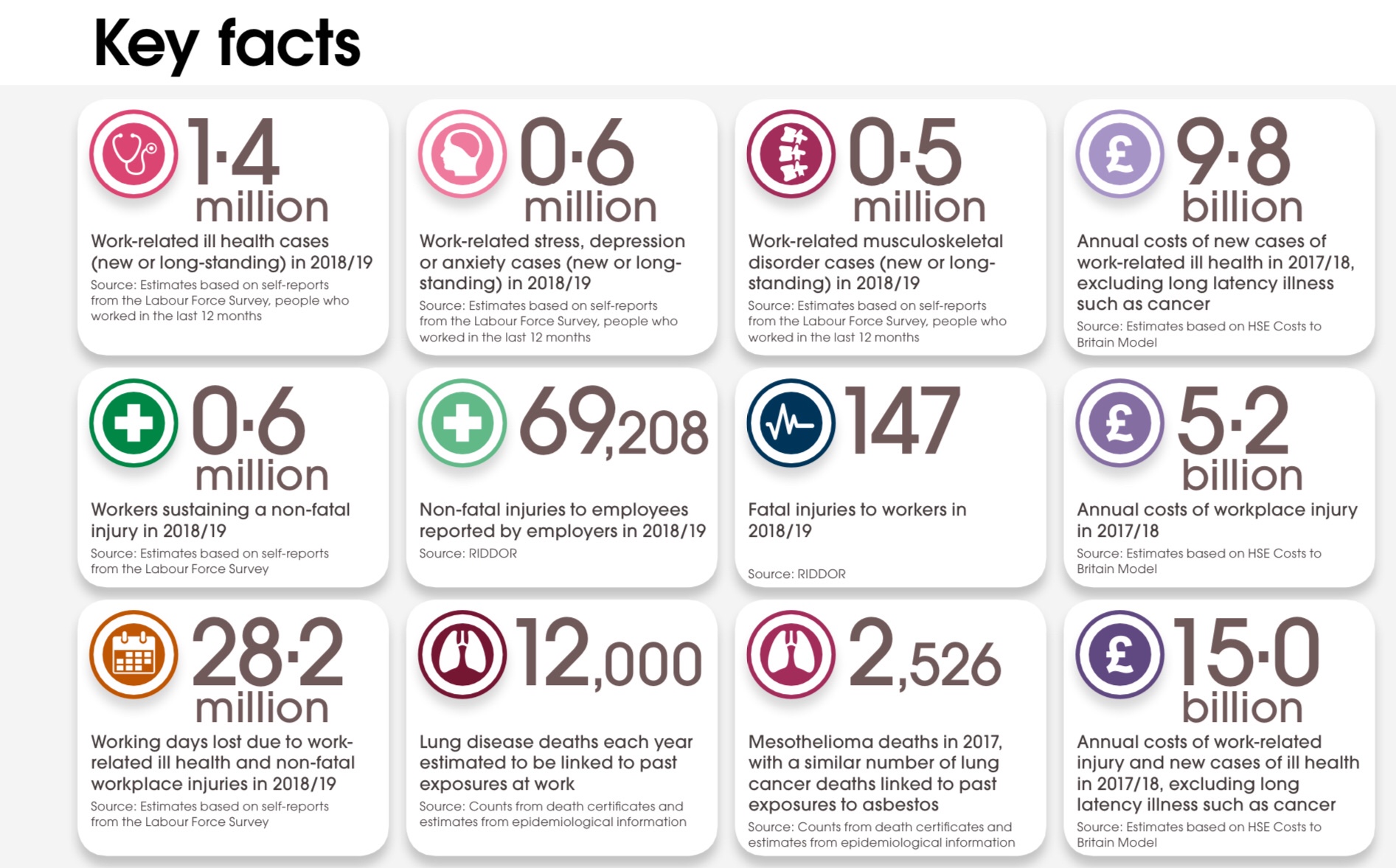
Yet surely, the bad old days are long gone? The British work-place has become a much safer place? Undoubtedly, as we shall see, employers have become much more aware of their responsibilities to their employees and workers in respect of the issue of health and safety.

That said, if you look at the info graphic produced below from the UK Health and Safety Executive, poor conditions and practices in British work-places still result in unacceptably high levels of injuries and illness – in 2019!

Key facts for Great Britain 2019
Source: http://www.hse.gov.uk/statistics/

Recently, Amazon, the global internet retailer, received very unwelcome media attention about the number of industrial injuries which have occurred in its UK premises. It’s probably fair to say that Amazon UK does not enjoy a particularly good reputation amongst trade unions regarding its employment practices and the recent media stories only compound this state of affairs.

Links to stories about Amazon UK on Sky News and Channel 4 News can be found below:

http://news.sky.com/story/hellish-conditions-at-amazon-warehouses-seriously-hurt-hundreds-11936881

https://youtu.be/gYUJjpIxkCU

Health and Safety at Work Act 1974

It is worth noting that the employer’s common law duties which aim to protect the health and safety of employees establishes a regime of civil liability. In other words, should the employer breach these duties, he will most likely face a civil action by the injured employee who will be attempting to recover compensation.

The Health and Safety at Work Act 1974, on the other hand, makes an employers criminally liable if they fail to take reasonably practicable steps to protect the health and safety of their employees. An employer will, therefore, face penalties in a criminal court for breaches of the Act.

The Health and Safety (Offences) Act 2008

The provisions of this Act came into force on 16 January 2009 and apply to offences committed after this date by employers. Scottish criminal courts will now have the power to impose maximum fines of £20,000 on employers who breach health and safety rules. In the most serious cases where health and safety rules have been breached or ignored, the courts may also have the right to imprison those responsible.

The Criminal Justice and Licensing (Scotland) Act 2010

Sections 65-68 of the Criminal Justice and Licensing (Scotland) Act 2010 should make it easier for organisations to face prosecution in Scotland in relation to allegations of criminal wrongdoing. According to Section 65, the term “organisation” applies to any of the following bodies:

  • a body corporate;
  • an unincorporated association;
  • a partnership;
  • a body of trustees;
  • a government department;
  • a part of the Scottish Administration;
  • any other entity which is not an individual

Such proceedings against organisations may be on indictment (Section 66) or on complaint (Section 67).

For a long time, it has been argued that an organisational culture which promotes lax practices or downright dangerous behaviour can lead to the commission of criminal offences. This an attempt to make organisations more accountable under the criminal law for conduct which causes harm to members of the public.

Overall, this means that an employer could face both a criminal action and a civil action for damages where he has neglected to obey the criminal law and the common law in respect of the employee’s health and safety.

Conclusion

If only we need reminding that health and safety remains a major issue in the work-place, we need only look to a story from Scotland which appeared in national media outlets just this week.

Workers at the Mossmorran and Ineos chemical plants took unauthorised industrial action (wildcat strikes) which was motivated by serious concerns about the lack of health and safety in the work-place. Happily, the employers seem to be listening to the concerns and the employees are now back at work.

Failure by employers to take health and safety issues seriously can leave themselves open to both civil and criminal liability. During Britain’s Industrial Revolution (from the 18th to the early 20th Centuries), it’s true to say that there was no such thing as a culture of health and safety in the work-place. Industrialists like Robert Owen were remarkable because they broke with the paradigm of British industrial practice i.e. workers were resources to be used up and tossed aside when no longer needed.

The growth of the trade union movement and the emergence of the British Labour Party (itself a creation of the union movement) led to pressure for change and tangible improvements were made to working practices. Despite these advances, cases such as the death of Annang Neurtey and the figures from the Health and Safety Executive surely caution us against complacency.

Links to reports on the BBC Scotland website about the industrial action can be found below:

Union GMB said the workers had “continuously raised their concerns about conditions and safety on-site”.

Mossmorran: Walkout at chemical plant over working conditions

Union officials said that concerns over health and safety and pay had been resolved following talks.

Mossmorran: Workers to return after wildcat strike in Fife

Related Blog Articles:

https://seancrossansscotslaw.com/2019/10/23/a-hard-days-night/

https://seancrossansscotslaw.com/2019/04/19/dont-stop-the-music/

https://seancrossansscotslaw.com/2019/02/22/stress-kills/

Copyright Seán J Crossan, 21 February 2020