
For those in peril on the sea

Photo by Lawrence Hookham on Unsplash

The avoidable death of Annang Neurtey

As someone who works more in the civil rather than the criminal legal tradition, I tend to focus more on the outcome of obtaining damages or compensation for the victim of an industrial or work-place accident.

It’s simply a matter of horses for courses i.e. you stick to what you know or what you’re trained to do. Admittedly, most of the victims of industrial accidents that I have represented are perhaps more focused on obtaining compensation for their injuries – especially if these are life changing. Any criminal liability that the employer may have is purely incidental i.e. something of a side issue. Then again, I suppose you could say that about most civil actions where the criminality of the pursuer remains firmly in the background (think dangerous and careless driving incidents).

The victim of a work-place delict (or tort) may get some satisfaction from their employer or its officers and managers appearing in the dock at a subsequent criminal trial, but this is unlikely to be satisfying in the long term. It will not allow them to get their lives back on track or to move on; payment of compensation is perhaps a more satisfactory conclusion to things. I make that last statement fully in the knowledge that no amount of money can truly give victims back what they have lost.

Yet, every so often, I come across a story or an incident which underlines the importance of criminal law regarding industrial or work-place accidents.

In 2015, one such incident occurred onboard Aquarius, a fishing trawler which operated out of the North East Scottish fishing port of Banff. Serious failings in the operation of the vessel led to the death of a crewman. The victim, 47 year old, Annang Neurtey from Ghana, was swept overboard: his body has never been recovered – adding immensely to the grief of his family.

Anyone who has read Sebastian Junger’s 1997 novel, The Perfect Storm (or viewed the film adaptation of 2000) will be readily familiar with the dangers that fishing folk face at sea. That said, the tragedy which befell Annang Neurtey was entirely avoidable. If the skipper of the Aquarius had properly supervised the crew and followed basic safety procedures, the accident would not have occurred.

Following Mr Neurtey’s death, MB Aquarius Ltd of Buckie, the company which owned and operated the vessel, was investigated by Police Scotland and the Marine and Coastguard Agency. The conclusions reached by investigators were that basic risk assessments had not been properly carried out and that the employer had failed to put a safe system of working in place.

At a subsequent criminal prosecution against Mr Neurtey’s employer for health and safety breaches at Aberdeen Sheriff Court, the company pleaded guilty to breaches of marine safety laws, namely, Regulation 5(1) of the Merchant Shipping and Fishing Vessels (Health and Safety at Work) Regulations 1997 and Sections 85 and 86 of the Merchant Shipping Act 1995.

A fine of £50,000 was imposed on the employer – it would have been £75,000 had an early plea of guilty not been entered by the company.

Mr Neurtey’s family will doubtless be contemplating a civil action for recovery of damages – unless of course his employer does the decent thing and quickly settles such a claim.

A link to the Marine and Coastguard Agency’s Report of its findings concerning Mr Neurtey’s death can be found below:

https://assets.publishing.service.gov.uk/media/57f3c2d7ed915d06fa000030/MAIBInvReport18_2016.pdf

A link to an article in the The Press & Journal about the trial can be found below:

https://www.pressandjournal.co.uk/fp/news/aberdeen/2011786/buckie-based-fishing-company-fined-50000-following-death-of-crew-member/

Those dark satanic mills …

Have concerns about health and safety gone mad? The former British Prime Minister, David Cameron certainly thought so when his Coalition Government (2010-15) introduced the Enterprise and Regulatory Reform Act 2013 (in particular, Section 69 of the said legislation) which removed the right to bring a civil claim for breaches of the Health and Safety at Work Act 1974.

It does not mean that employees can no longer bring a civil claim if an employer breaches its duty of care, but significantly claimants will no longer benefit from the presumption of strict liability previously imposed on organisations. Since this reform, it will be essential for claimants to prove negligence on the part of their employers for breaches of health and safety.

We would, however, do well to remember our history: concerns about health and safety were often ignored in the not so distant past.

The phrase “dark satanic mills” comes from the poem, And did those feet in ancient time by William Blake. The phrase has been interpreted as a searing indictment of the wickedness and exploitative practices of 19th Century British industrialists who most certainly put profit before people. This is why rare individuals such as the Welsh born industrialist, Robert Owen and his New Lanark Mills we’re regarded as truly radical and progressive employers.

The words of Blake’s poem were later put to music by the composer, Hubert Parry, and is better known as Jerusalem – an alternative English National Anthem for many because of its rallying call for social justice for the poor and the oppressed.

Over time, admittedly, the UK Parliament did intervene by bringing in legislation to curb some of the frankly dangerous and disreputable practices which had been tolerated in British factories, shipyards and mines. With the industrial revolution, Britain did indeed become the ‘workshop of the world’, but this accolade disguised the terrible human cost which could be measured in countless deaths, terrible injuries and overwhelmingly misery.

Some months ago, I saw a photograph by Bill Brandt in The Independent’s Saturday Magazine which documented life in an East Durham mining community. I was pretty shocked by what I saw: the houses of the miners had no windows. Think of it: these workers spent their days down the pit in almost total darkness. More shocking, was the fact that Brandt had taken the photograph as recently as 1937.
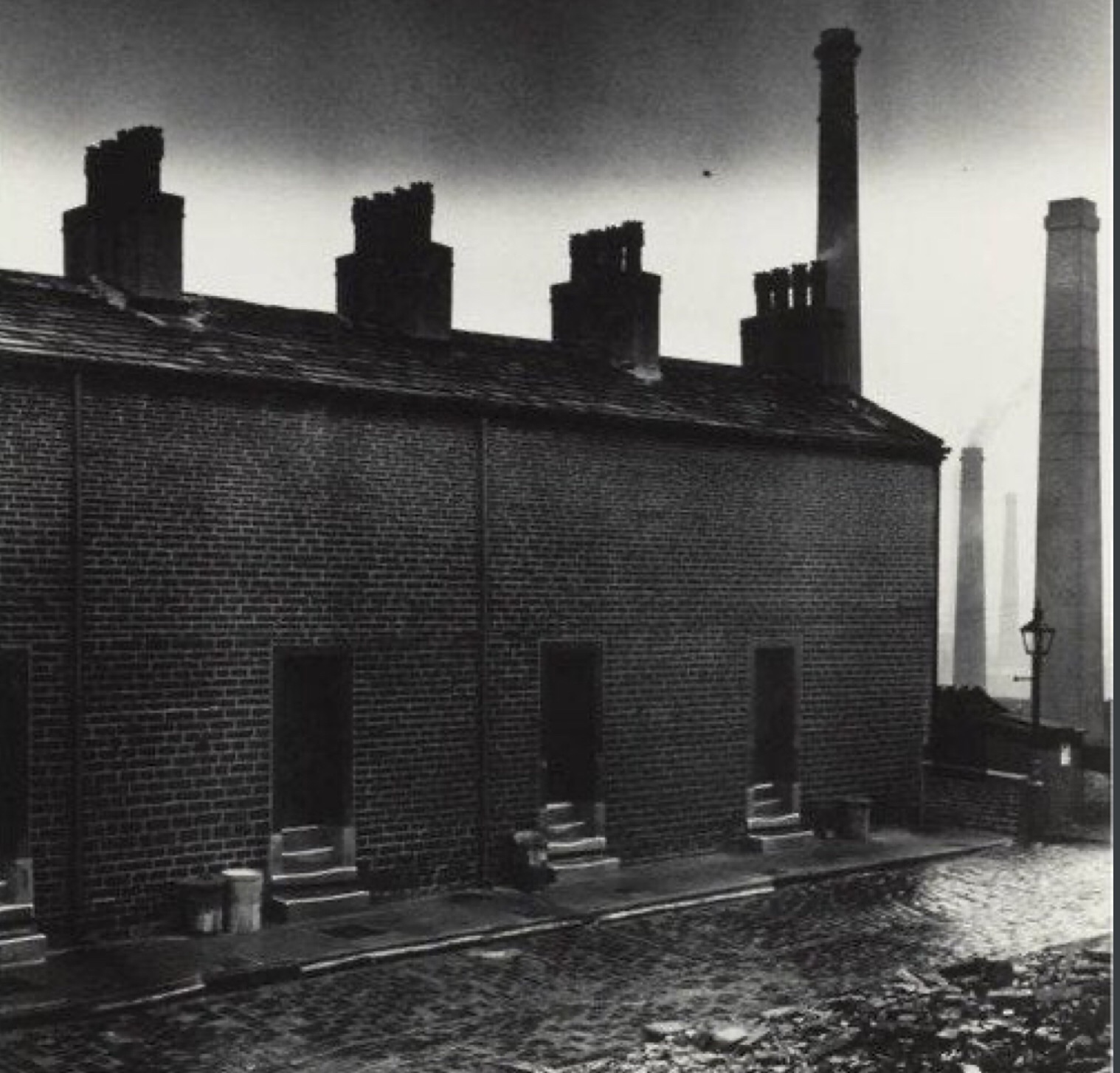
Photograph by Bill Brandt (1937)

Yet surely, the bad old days are long gone? The British work-place has become a much safer place? Undoubtedly, as we shall see, employers have become much more aware of their responsibilities to their employees and workers in respect of the issue of health and safety.

That said, if you look at the info graphic produced below from the UK Health and Safety Executive, poor conditions and practices in British work-places still result in unacceptably high levels of injuries and illness – in 2019!
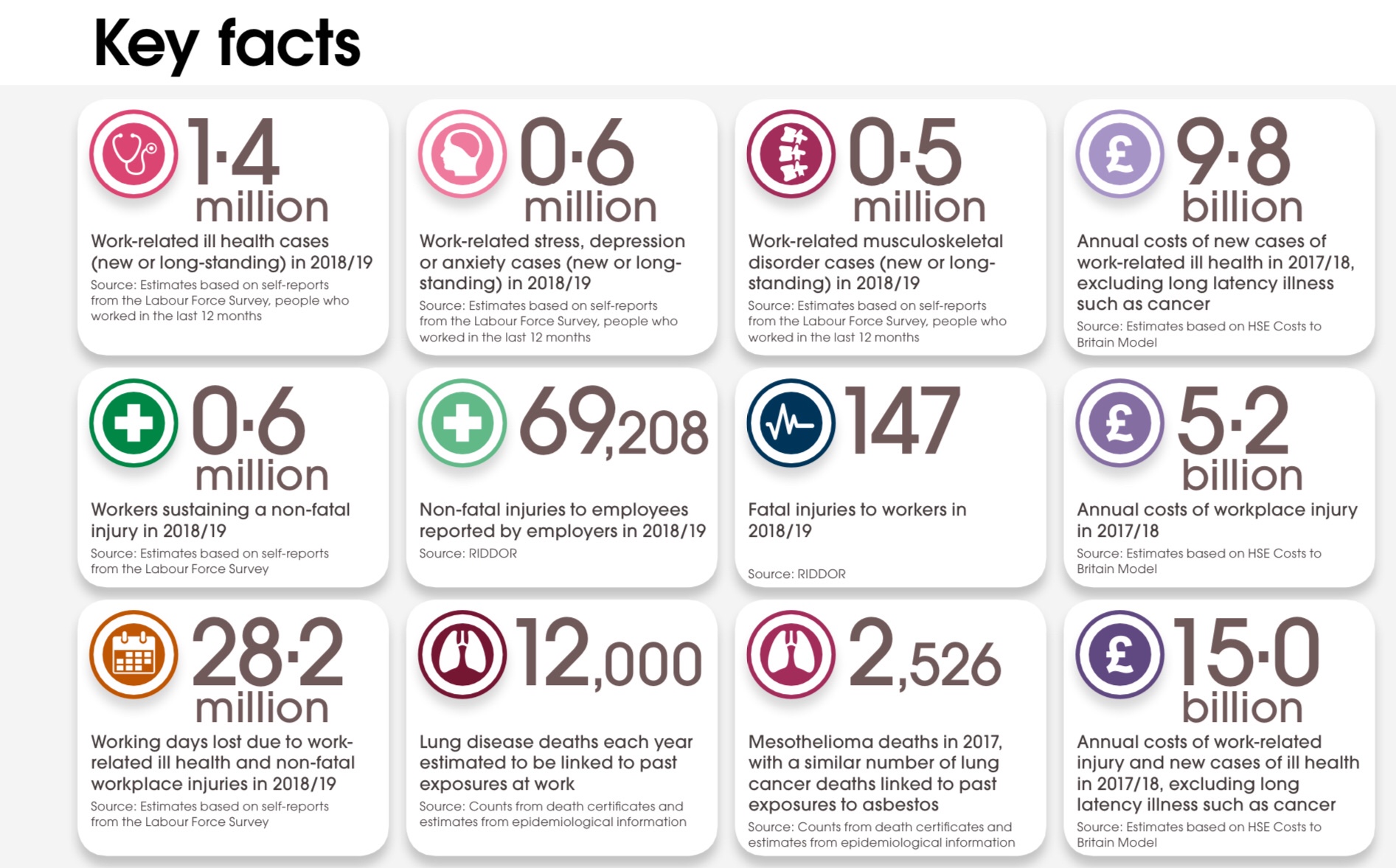
Key facts for Great Britain 2019
Source: http://www.hse.gov.uk/statistics/

Recently, Amazon, the global internet retailer, received very unwelcome media attention about the number of industrial injuries which have occurred in its UK premises. It’s probably fair to say that Amazon UK does not enjoy a particularly good reputation amongst trade unions regarding its employment practices and the recent media stories only compound this state of affairs.

Links to stories about Amazon UK on Sky News and Channel 4 News can be found below:

http://news.sky.com/story/hellish-conditions-at-amazon-warehouses-seriously-hurt-hundreds-11936881

https://youtu.be/gYUJjpIxkCU

Health and Safety at Work Act 1974

It is worth noting that the employer’s common law duties which aim to protect the health and safety of employees establishes a regime of civil liability. In other words, should the employer breach these duties, he will most likely face a civil action by the injured employee who will be attempting to recover compensation.

The Health and Safety at Work Act 1974, on the other hand, makes an employers criminally liable if they fail to take reasonably practicable steps to protect the health and safety of their employees. An employer will, therefore, face penalties in a criminal court for breaches of the Act.

The Health and Safety (Offences) Act 2008

The provisions of this Act came into force on 16 January 2009 and apply to offences committed after this date by employers. Scottish criminal courts will now have the power to impose maximum fines of £20,000 on employers who breach health and safety rules. In the most serious cases where health and safety rules have been breached or ignored, the courts may also have the right to imprison those responsible.

The Criminal Justice and Licensing (Scotland) Act 2010

Sections 65-68 of the Criminal Justice and Licensing (Scotland) Act 2010 should make it easier for organisations to face prosecution in Scotland in relation to allegations of criminal wrongdoing. According to Section 65, the term “organisation” applies to any of the following bodies:

  • a body corporate;
  • an unincorporated association;
  • a partnership;
  • a body of trustees;
  • a government department;
  • a part of the Scottish Administration;
  • any other entity which is not an individual

Such proceedings against organisations may be on indictment (Section 66) or on complaint (Section 67).

For a long time, it has been argued that an organisational culture which promotes lax practices or downright dangerous behaviour can lead to the commission of criminal offences. This an attempt to make organisations more accountable under the criminal law for conduct which causes harm to members of the public.

Overall, this means that an employer could face both a criminal action and a civil action for damages where he has neglected to obey the criminal law and the common law in respect of the employee’s health and safety.

Conclusion

If only we need reminding that health and safety remains a major issue in the work-place, we need only look to a story from Scotland which appeared in national media outlets just this week.

Workers at the Mossmorran and Ineos chemical plants took unauthorised industrial action (wildcat strikes) which was motivated by serious concerns about the lack of health and safety in the work-place. Happily, the employers seem to be listening to the concerns and the employees are now back at work.

Failure by employers to take health and safety issues seriously can leave themselves open to both civil and criminal liability. During Britain’s Industrial Revolution (from the 18th to the early 20th Centuries), it’s true to say that there was no such thing as a culture of health and safety in the work-place. Industrialists like Robert Owen were remarkable because they broke with the paradigm of British industrial practice i.e. workers were resources to be used up and tossed aside when no longer needed.

The growth of the trade union movement and the emergence of the British Labour Party (itself a creation of the union movement) led to pressure for change and tangible improvements were made to working practices. Despite these advances, cases such as the death of Annang Neurtey and the figures from the Health and Safety Executive surely caution us against complacency.

Links to reports on the BBC Scotland website about the industrial action can be found below:

Union GMB said the workers had “continuously raised their concerns about conditions and safety on-site”.

Mossmorran: Walkout at chemical plant over working conditions

Union officials said that concerns over health and safety and pay had been resolved following talks.

Mossmorran: Workers to return after wildcat strike in Fife

Related Blog Articles:

https://seancrossansscotslaw.com/2019/10/23/a-hard-days-night/

https://seancrossansscotslaw.com/2019/04/19/dont-stop-the-music/

https://seancrossansscotslaw.com/2019/02/22/stress-kills/

Copyright Seán J Crossan, 21 February 2020

California dreamin’?

Photo by Ross Sneddon on Unsplash

I’m currently in the fourth week of Semester 2 and I’m teaching Employment Law to a group of second year students. I usually begin this course by discussing the importance of an individual’s employment status.

In today’s world of work, the great divide very much rests upon whether a person has a contract of service OR a contract for services.

An employee is said to have a contract of service as defined by Section 230(1) of the Employment Rights Act 1996. Having this status potentially allows someone to acquire employment protection such as the right not to be unfairly dismissed; the right to a redundancy payment; the right to be the beneficiary of family friendly and flexible working practices.

After the first few lectures have been completed on employment status, I usually ask the students if they think this is an important issue?

Hopefully, if I have been doing my job properly and they have been listening to me, the penny will have dropped: it is more often better to be an employee than someone who works under a contract for services (e.g. zero hours workers, casual and atypical workers, freelancers and the genuinely self-employed).

There are notable exceptions (aren’t there always?): high earning British television celebrities (e.g. Lorraine Kelly) or a number of BBC news journalists have preferred to be treated as freelancers or self-employed persons. Why? They can then minimise their exposure to income tax liability in a way (often via the medium of personal service companies) that would not be possible because if they were employees they would almost certainly be taxed at source on a PAYE (pay as you earn) basis.

We have seen an explosion in the type of work that is often characterised or labelled as the ‘gig economy’. This work is often characterised by a distinct lack of employment rights; irregular working patterns; chronic insecurity; lack of long term career progression; and low pay. It is often impossible for such individuals to complete the necessary periods continuous service to acquire employment rights.

Companies such as Deliveroo, Lyft and Uber have become synonymous with the ‘gig economy’, as have whole sectors of the employment market e.g. catering, cleaning and hospitality services.

Admittedly, the UK Government of Prime Minister Theresa May (2016-19) did commission Matthew Taylor to review employment status. The main conclusion reached by the Taylor Review was that a minimum level of employment protection should be extended to workers – after all these individuals pay their National Insurance contributions too.

Links to the Taylor Report and the UK Government’s response can be found below:

https://assets.publishing.service.gov.uk/government/uploads/system/uploads/attachment_data/file/627671/good-work-taylor-review-modern-working-practices-rg.pdf

https://assets.publishing.service.gov.uk/government/uploads/system/uploads/attachment_data/file/679767/180206_BEIS_Good_Work_Report__Accessible_A4_.pdf

In Scotland, the devolved Government has also established a Fair Work Convention with the aim of promoting better and progressive employment practices by 2025 (see the link below):

https://www.fairworkconvention.scot

Admittedly, an employee does not gain these rights from day 1 of employment. They become entitled to claim certain rights as they build up their continuous service with the employer. So, for example, an employee (generally speaking) has the right not to be unfairly dismissed in terms of the Employment Rights Act 1996 if they have completed 2 years of continuous service with the employer.

Meanwhile, on the other side of the world …

… or California dreamin’

It’s not just in the UK that debates about employment status are currently playing out. At the tail end of 2019, it was with particular interest that I read about a story from the United States which highlighted many of the issues which I have just been discussing in this Blog.

A study, carried out in 2015/16 by economists (Professors Lawrence Katz and Alan Krueger at Harvard and Princeton Universities respectively) calculated that “12.5 million people were considered independent contractors, or 8.4% of the U.S. workforce.”

https://scholar.harvard.edu/files/lkatz/files/katz_krueger_cws_v3.pdf

Interestingly, in 2019, Professors Katz and Krueger appeared to disown or play down certain of their findings – especially in relation to the number of American gig economy jobs:

https://edition.cnn.com/2019/01/07/economy/gig-economy-katz-krueger/index.html

Assembly Bill 5

The US State of California has just enacted a law, Assembly Bill 5 2019 or AB5 (known more popularly as the gig economy law) giving those individuals working in the gig economy more employment rights. The law came into force on 1 January 2020.

A link to AB5 as enacted by the California State legislature can be found below:

https://leginfo.legislature.ca.gov/faces/billTextClient.xhtml?bill_id=201920200AB5

In theory, AB5 makes it much more difficult for employers to classify individuals as independent contractors for services meaning that many more people will be treated as employees with the right to claim the minimum wage and the right to receive sick pay.

The Supreme Court of California laid down very strict criteria for determining whether an individual was an employee or an independent contractor in what is being referred to as the ‘landmark’ decision of Dynamex Operations West, Inc v the Superior Court of Los Angeles County 30 April 2018 Opinion S222732.

The case establishes the ‘ABC Test’ which operates on the presumption that individuals hired by an organisation or business are employees unless the hirer can show otherwise. In this case, the Supreme Court moved away from the ‘seminal’ Borello Test which had been the standard way of determining a person’s employment status since the 1980s. Critically, AB5 reflects the Dynamex criteria.

Essentially, the hirer must satisfy all three parts of the ABC Test in order to prove that an individual is a genuine independent contractor.

The criteria in ABC Test (as contained in AB5) can be set out as follows:

(A) The person is free from the control and direction of the hiring entity in connection with the performance of the work, both under the contract for the performance of the work and in fact.

(B) The person performs work that is outside the usual course of the hiring entity’s business.

(C) The person is customarily engaged in an independently established trade, occupation, or business of the same nature as that involved in the work performed.

The Dynamex decision is regarded as a landmark judgement because it overturns the Borello Test which had been the leading precedent for determining employment status in California since the late 1980s (see S. G. Borello & Sons, Inc. v Department of Industrial Relations (1989) 48 Cal.3d 341).

In Dynamex, the Californian Supreme Court made the following statement:

Although in some circumstances classification as an independent contractor may be advantageous to workers as well as to businesses, the risk that workers who should be treated as employees may be improperly misclassified as independent contractors is significant in light of the potentially substantial economic incentives that a business may have in mischaracterizing some workers as independent contractors. Such incentives include the unfair competitive
advantage the business may obtain over competitors that properly classify similar workers as employees and that thereby assume the fiscal and other responsibilities and burdens that an employer owes to its employees.

The Court noted, moreover, that:

In recent years, the relevant regulatory agencies of both the federal and state governments have declared that the misclassification of workers as independent contractors rather than employees
is a very serious problem, depriving federal and state governments of billions of dollars in tax revenue and millions of workers of the labor law protections to which they are entitled
.”

A link to the Dynamex judgement can be found below:

https://scocal.stanford.edu/opinion/dynamex-operations-west-inc-v-superior-court-34584

Legislators in other US States (New Jersey and New York particularly) have expressed a desire to follow the Californian example and Democratic US presidential candidates, Bernie Sanders and Elizabeth Warren are strongly in favour of this type of law.

As you would expect in such a litigious society as the United States, AB5 has already been the subject of a legal challenge (which was unsuccessful). Predictably, Uber and another company, Postmates, were at the forefront of this action.

This legal challenge was hardly surprising, given that The Los Angeles Times reported in August 2019 that Uber and Lyft intended to establish a campaigning fund worth $60 million to fight AB5.

A link to the story can be found below:

https://www.latimes.com/business/technology/story/2019-08-29/ab5-uber-lyft-newsom-lorena-gonzalez-ballot-tony-west

Conclusion

So, even in the land of free enterprise, it would seem that not everyone wants to be their own boss and many people would, in fact, be more than happy to welcome the recognition of their status as employees.

That said, AB5 has, surprisingly, not met with the approval of every worker or potential employee. The California performing arts community has experienced problems with the new law, mainly because of its use of the term ‘fine artist’ which was not defined. Fine artists are exempt from the provisions of AB5, but who exactly is a fine artist? No one seems to be sure and The Los Angeles Times reported that one opera company had cancelled performances because they were unsure whether performers were to be classified as employees (with the additional costs that this would entail) or whether they were genuinely independent contractors.

Lorena Gonzalez, the Californian Assemblywoman who drafted AB5 said that a definition of the term was deliberately omitted from the law and that it the responsibility of the State’s Employment Development Department to clarify this issue.

Readers will find links below to media articles about AB5:

https://apple.news/A_pjrttPvTDSMSpV-VMet8w

https://www.bbc.co.uk/news/business-49659775

https://www.latimes.com/entertainment-arts/story/2020-01-29/ab5-independent-contractor-california-2020-arts

Related Blog Articles:

https://seancrossansscotslaw.com/2019/04/19/the-gig-economy/

https://seancrossansscotslaw.com/2019/07/22/good-work/

https://seancrossansscotslaw.com/2019/03/22/hello-im-lorraine-and-im-definitely-self-employed/

https://seancrossansscotslaw.com/2019/12/21/employee-or-not/

https://seancrossansscotslaw.com/2019/01/17/employment-status/

https://seancrossansscotslaw.com/2019/05/08/call-me-an-uber/

https://seancrossansscotslaw.com/2019/03/25/strippers-are-workers-too-discuss/

https://seancrossansscotslaw.com/2019/02/14/horses-for-courses-the-equine-flu-affair/

https://seancrossansscotslaw.com/2019/04/30/paternity-leave/

https://seancrossansscotslaw.com/2019/02/25/the-work-life-balance-or-utopia-reimagined/

Copyright Seán J Crossan, 13 February 2020

The only gay in the village?

The colours of Pride

Photo by Steve Johnson on Unsplash

The only gay in the village became a household phrase in the UK thanks to the long running Little Britain sitcom TV and radio series (which has been broadcast by the BBC since 2000).

Daffyd Thomas claimed to be the only gay person in a small, Welsh village (actually he wasn’t), but in some respects his catchphrase reflected the isolation that many people in the LGBTI communities experience – either in their personal or professional lives.

The reason that I mention this topic is because, last week, the LGBTI campaigning organisation, Stonewall, published research about the most inclusive LGBTI friendly employers in the UK (Newcastle City Council topped the list). That said, for many LGBTI employees, an inclusive work place is still a far off dream.

Please find a link to a story on the Sky News website about one employee’s decision to hide his LGBTI identity from his colleagues:

https://news.sky.com/story/i-felt-i-had-to-hide-my-lgbt-identity-at-work-so-i-decided-to-do-something-about-it-11920174

Links to Stonewall’s findings (and a Sky News article) can be found below:

https://www.stonewall.org.uk/system/files/2020_top_100_report.pdf

https://news.sky.com/story/stonewall-reveals-its-most-lgbt-inclusive-employers-11919950

A person’s sexual orientation is, of course, a protected characteristic in terms of Section 12 of the Equality Act 2010. Such individuals should not be subjected to direct discrimination (Section 13); indirect discrimination (Section 19); harassment (Section 26); and victimisation (Section 27).

Many years ago, I remember teaching a group of students who were studying for a professional qualification. Many of them were employed by recruitment agencies and it was my task to highlight the relevant provisions of discrimination law at that time. One evening, we had a discussion about discrimination on the grounds of a person’s sexual orientation – particularly in the context of the ban on gay and lesbian people serving in the UK Armed Forces. This ban would eventually be lifted in 2000 – following the decision of the European Court of Human Rights in Smith and Grady v UK (1999) 29 EHRR 493.

One of the students asked me what protection existed for gay and lesbian people in employment law generally. Very little was my response. Before the introduction of the Scotland Act 1998 and the Human Rights Act 1998, the work place could be very hostile for LGBTI people (see Macdonald v Lord Advocate; Pearce v Governing Body of Mayfield School [2003] UKHL 34).

Yes, admittedly, the UK was (and still is in spite of Brexit) a signatory to the European Convention on Human Rights. In particular, Article 8 of the Convention recognises the right to family and private life. It was this Article which was used to overturn extremely restrictive laws on same sex relationships which existed in Scotland, Northern Ireland, the Isle of Man and the Channel Islands. Reinforcing Article 8 is Article 14 of the Convention is Article 14 which contains a general prohibition on discrimination.

The late 1960s are often referred to as the key period of the start of gay liberation in the UK with the passing of the Sexual Offences Act 1967 which decriminalised homosexual relationships between consenting adults (aged 21 or over) and as long as such conduct was in private. What is often overlooked is that the 1967 Act applied to England and Wales only. The picture was very different (and would remain so for over a decade – sometimes longer) in various parts of the British Isles.

Homosexual relationships were decriminalised in Scotland in 1980; in Northern Ireland in 1982; the UK Crown Dependency of Guernsey in 1983; the UK Crown Dependency of Jersey in 1990; and the UK Crown Dependency of the Isle of Man in 1994. The age of consent was set at 21 for all these parts of the British Isles. Things have since moved on and the age of consent was firstly reduced to 18 and then eventually to 16.

In the last 20 years, the influence of the European Union has been particularly profound regarding measures to combat sexual orientation discrimination.

In 1999, as a result of the Treaty of Amsterdam, the EU adopted two Directives which considerably expanded the scope of its anti-discrimination laws (the Racial Equality Directive (2000/43/EC) and the Employment Equality Directive (2000/78/EC). Of particular interest to this discussion is the Employment Equality Directive which made it unlawful to discriminate against a person on grounds of sexual orientation. Admittedly, this Directive was limited because it covered the areas of employment and vocational training only.

On 1 December 2003, the Employment Equality Directive would eventually become part of UK law in the form of the Employment Equality (Sexual Orientation) Regulations 2003. The Regulations were repealed and replaced by the relevant provisions of the Equality Act 2010 (which came into force on 1 October 2010).

It did not extend to the provision of goods and services, so had the case of Bull and Another v Hall and Another [2013] UKSC 73 occurred when the Directive was first transposed into UK domestic law, the same sex couple who were refused a double room at the guest house in Cornwall would not have been successful in their claim for sexual orientation discrimination. Luckily for them, the Equality Act had since come into force and covered unlawful less favourable treatment on grounds of a person’s sexual orientation with regard to the provision of goods and services.

The Treaty on the Functioning of the European Union (TFEU) is also worthy of comment. Article 19 prohibits discrimination by reason of a person’s sexual orientation and, notably, this provision is hardwired into UK law by way of the Equality Act 2010. Article 19 extended legal protection to gay and lesbian people more generally – over and above the limited areas of employment and vocational training which the Treaty of Amsterdam and the Employment Equality Directive had originally addressed.

The EU Charter of Fundamental Rights (although Poland and the UK had negotiated some opt-outs) contained significant provisions on equality and non-discrimination, namely, Article 20 (equality before the law) and Article 21 (the principle of non-discrimination).

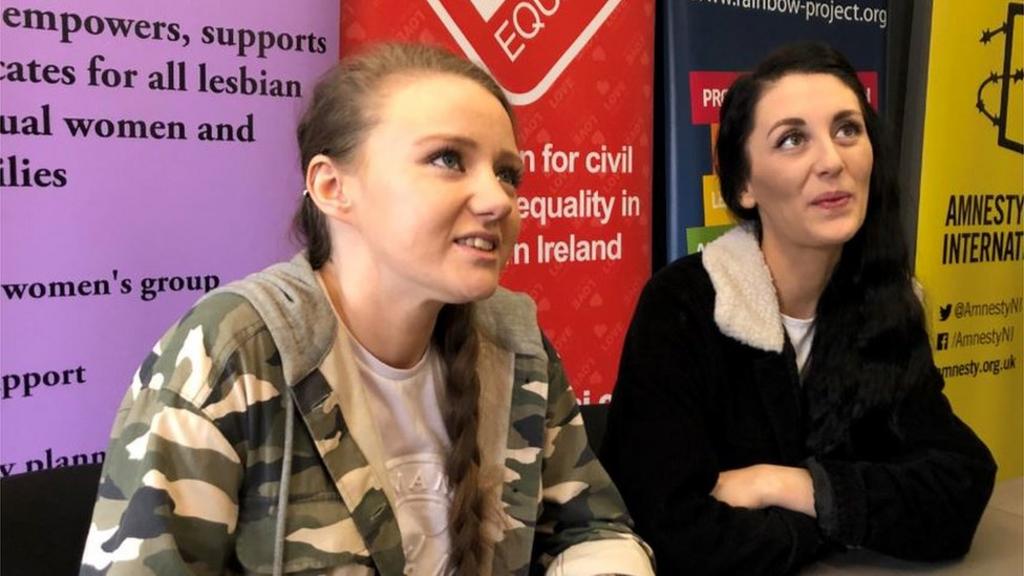
Another massive step forward for the equality of the LGBTI community was the introduction of the Civil Partnerships Act 2004 which would give legal recognition (and protection) to gay and lesbian people who chose to enter such relationships. These rights would be further underpinned by permitting same sex couples to marry (in England and Wales in 2013 and in Scotland in 2014). Currently, Northern Ireland is the only part of the UK not to permit same sex marriage – although this will change from next week onwards (see link below):

Same-sex marriage: Couple ‘excited but nervous’ to become first in NI

Robyn Peoples and Sharni Edwards will celebrate their wedding on Tuesday in Carrickfergus.

This change to the law has come about as a result of the introduction of the Northern Ireland (Executive Formation etc) Act 2019 passed by the UK Parliament (in the absence of of a functioning devolved government for nearly the last 3 years).

Finally, if employers want to do more to create an inclusive work place, they could start by using Stonewall’s inclusive toolkits (see link below):

https://www.stonewall.org.uk/best-practice-toolkits-and-resources

Conclusion

As a society, the UK has certainly moved on from the overtly hostile attitudes towards members of the LGBTI communities over the last 50 years or so. The legal rights and protections which LGBTI people now enjoy would have seemed unthinkable in 1967 when a limited form of tolerance was ushered in as a result of the Sexual Offences Act (in England and Wales). More recently, the UK and Scottish Governments have issued pardons to those individuals who were convicted of criminal offences under the previous laws (in 2017: the Policing and Crime Act 2017 in England and Wales (known as Turing’s Law after Alan Turing, the Enigma Code Breaker) and, in 2018, the Scottish Parliament followed suit by passing the Historical Sexual Offences (Pardons and Disregards) (Scotland) Act 2018).

Postscript

On Friday 7 February 2020, Phillip Schofield, the British TV celebrity announced that he was gay at the age of 57. Mr Schofield is married with 2 children and had lived a heterosexual life – until now. He likened hiding his sexual orientation to being in prison and being consumed by it.

A link to the story on the Sky News website can be found below:

http://news.sky.com/story/phillip-schofield-comes-out-as-gay-11928156

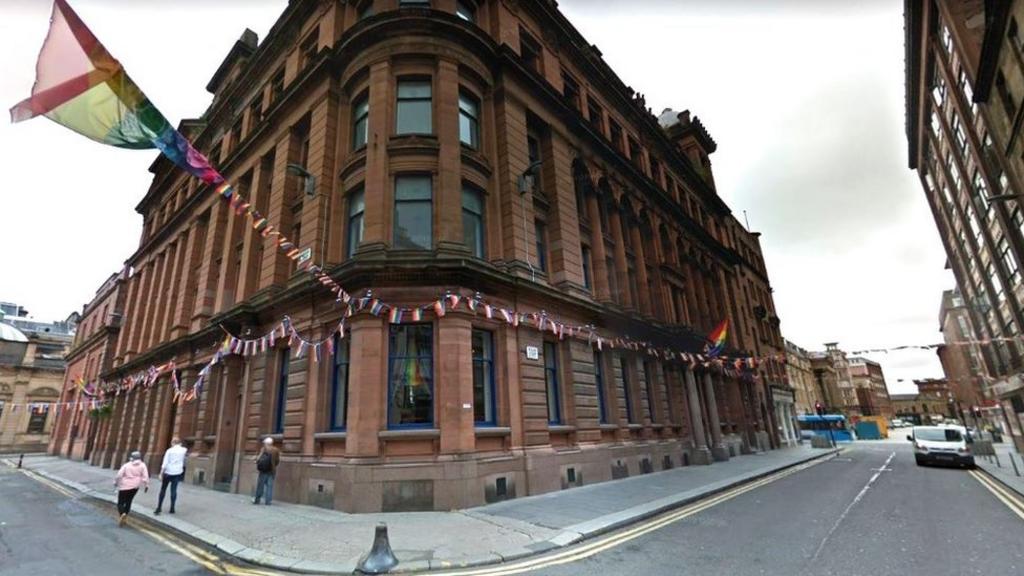
If anyone doubts that homophobia still exists in the UK, please see the story below:

Homophobic graffiti daubed on Polo Lounge entrance in Glasgow

Police have launched an investigation after they were alerted to the vandalism at the Polo Lounge.

Related Blog Articles:

https://seancrossansscotslaw.com/2020/01/04/pansexual/

https://seancrossansscotslaw.com/2019/12/31/civil-partner-i-do/

https://seancrossansscotslaw.com/2019/12/08/different-standards/

https://seancrossansscotslaw.com/2019/12/06/biased-blood/

https://seancrossansscotslaw.com/2019/10/04/a-very-civil-partnership/

https://seancrossansscotslaw.com/2019/02/20/love-and-marriage/

https://seancrossansscotslaw.com/2019/02/08/the-gay-cake-row/

Copyright Seán J Crossan, 15 February 2020

2020: same old sexism (yes, equal pay again)

Photo by Artur Tumasjan on Unsplash

We’re still in the month January and the issue of serious disparities in pay between the sexes raises its ugly head once again. I’ve said it before; but I’ll say it again: we’ve had over 40 years of legislation in the UK (first the Equal Pay Act 1970 and now the Equality Act 2010, not to mention EU primary and secondary legislation) which should have put the issue to rest.

The Equality Act 2010 incorporates an equality clause into contracts of employment which means that employers have a duty to ensure that men and women are paid on equal terms for carrying out like work; work rated equivalent; and work of equal value.

It’s hard to believe that the groundbreaking decision of the Court of Justice of the EU in Case 43/75 Defrenne v Sabena (No 2) [1976] ECR 455 was in the 1970s and here we are, entering the second decade of the 21st Century, still talking about the issue of equal pay – or the lack of it.

There is a depressing familiarity to stories in the UK media about the lack of progress regarding this issue. This is surprising because successful equal pay claims can be be very costly in financial terms for employers. In 2019, after Glasgow City Council female employees won their battle for equal pay, there was much speculation about how the employer was going to pay the bill. One of the (seemingly) more dramatic predictions was that the City Council would have to sell Salvador Dali’s world famous painting Christ of St John of the Cross in order to meet its legal obligations to its underpaid female employees. Susan Aitken, the City Council leader, was forced to issue a denial that this was a possibility. When you realise that the estimated value of Dali’s painting starts at £60 million you begin to get an idea of the scale of the problem.

https://www.glasgowtimes.co.uk/news/16594318.glasgow-city-council-wont-be-flogging-off-famous-dali-painting-to-cover-equal-pay-claims/

That said, some years ago, Birmingham City Council was forced to sell its share in the National Exhibition Centre in order to meet the (awesome) financial burden of thousands of equal pay claims . The price achieved was £307million – although 3 years later, the asset was sold once more for an eye watering figure of £800 million (allegedly).

https://www.ft.com/content/da429608-9d8e-11e4-8946-00144feabdc0

Recent research carried out by the English law firm, Slater+Gordon, suggests that women fail to gain pay increases because they are not negotiating with their employers about this issue. Campaigning groups, such as Close the Gap, are firmly of the opinion that the onus should not be placed on women to push for equal pay; rather it should be the responsibility of the State and/or employers to achieve this goal. There has to be real cultural change in society and women need to be valued more if the gender gap is to become a thing of the past.

Links to articles in The Independent about the equal pay research that Slater+Gordon Solicitors carried out can be found below:

https://edition.independent.co.uk/editions/uk.co.independent.issue.280120/data/9304961/index.html

https://edition.independent.co.uk/editions/uk.co.independent.issue.280120/data/9304901/index.html

https://edition.independent.co.uk/editions/uk.co.independent.issue.280120/data/9304016/index.html

Postscript

And if you remain unconvinced about ingrained gender bias in the corporate world generally, you will find a link below to research carried out by The Independent which demonstrates how many leading tech companies suffer from the lack of women in leadership roles:

https://edition.independent.co.uk/editions/uk.co.independent.issue.200220/data/9344746/index.html

Copyright Seán J Crossan, 30 January & 20 February 2020

Pregnancy discrimination (or New Year, same old story … Part 2)

Photo by Sincerely Media on Unsplash

We’re barely into 2020 and we seem to be on something of a roll with stories about sex discrimination. Yesterday, I discussed the issue of equal pay.

Only this morning I was flicking through the newspaper and came across another story, this time, concerning pregnancy discrimination.

Helen Larkin was dismissed from her post with the Liz Earle Beauty Company on the grounds of her pregnancy. Her employer was restructuring the company and refused to consider Ms Larkin for two alternative posts within the organisation. This refusal to consider suitable, alternative employment appeared to be motivated by the fact that Ms Larkin would shortly be going off on her period of maternity leave.

This treatment amounted to unlawful direct discrimination in terms of Sections 13 and 18 of the Equality Act 2010. Her dismissal would also be automatically unfair in terms of the Employment Rights Act 1996.

Consequently, Ms Larkin was awarded over £17,000 in compensation. This sum, of course, reflects an element to injury to feelings (the so called Vento Bands or Guidelines). In fact, Ms Larkin was awarded £10,000 in compensation to reflect injury to feelings.

A link to the judgement of the Employment Tribunal can be found below:

https://assets.publishing.service.gov.uk/media/5e2f0300e5274a6c42dcd132/Mrs_H_Larkin_v_Liz_Earle_Beauty_Co._Ltd_-_1403400.2018.pdf

A study carried out jointly by the UK Government Department (Business, Innovation and Skills) and the Equality and Human Rights Commission previously discovered that some 54,000 women per year in this country were forced out of their employment for reasons related to pregnancy and/or maternity.

A link to a summary of the research on the website of the Equality and Human Rights Commission can be found below:

https://www.equalityhumanrights.com/en/managing-pregnancy-and-maternity-workplace/pregnancy-and-maternity-discrimination-research-findings

Again, as I noted in yesterday’s Blog (New Year, same old story …), we have had anti-discrimination laws in the UK for nearly 45 years and yet we still regularly hear stories about pregnancy and maternity discrimination.

Readers might be interested to learn about the work of a pressure group (Pregnant then screwed) which campaigns to end the ‘motherhood penalty’:

https://pregnantthenscrewed.com

A link to Helen Larkin’s story as reported in The Independent can be found below:

https://edition.independent.co.uk/editions/uk.co.independent.issue.110120/data/9278901/index.html

Related Blog articles:

https://seancrossansscotslaw.com/2020/01/10/new-year-same-old-story/

https://seancrossansscotslaw.com/2019/02/14/hurt-feelings/

https://seancrossansscotslaw.com/2019/02/22/sticks-and-stones-may-break-my-bones-but-names-will-never-hurt-me/

https://seancrossansscotslaw.com/2019/07/08/just-blew-it-again/

https://seancrossansscotslaw.com/2019/08/22/the-trouble-with-pregnancy/

https://seancrossansscotslaw.com/2019/09/10/barbaric/

Copyright Seán J Crossan, 11 January 2020

New Year, same old story …

Photo by Markus Spiske on Unsplash

It’s becoming depressingly predictable: the persistence of the gender pay gay in the United Kingdom.

This time last year, I was discussing with my students the struggle that City of Glasgow Council female employees were undertaking to win their claims for equal pay. After a period of industrial action, the women finally won their struggle:

https://www.theguardian.com/society/2019/jan/17/glasgow-council-women-workers-win-12-year-equal-pay-battle

We’ve just entered 2020 and it seems as if nothing much has changed in the wider world (more on this later).

Theoretically, the gender pay gap should be a thing of the past. We have had legislation in place for nearly 45 years in this country: the Equal Pay Act 1970 (which came into force in December 1975) and the current Equality Act 2010.

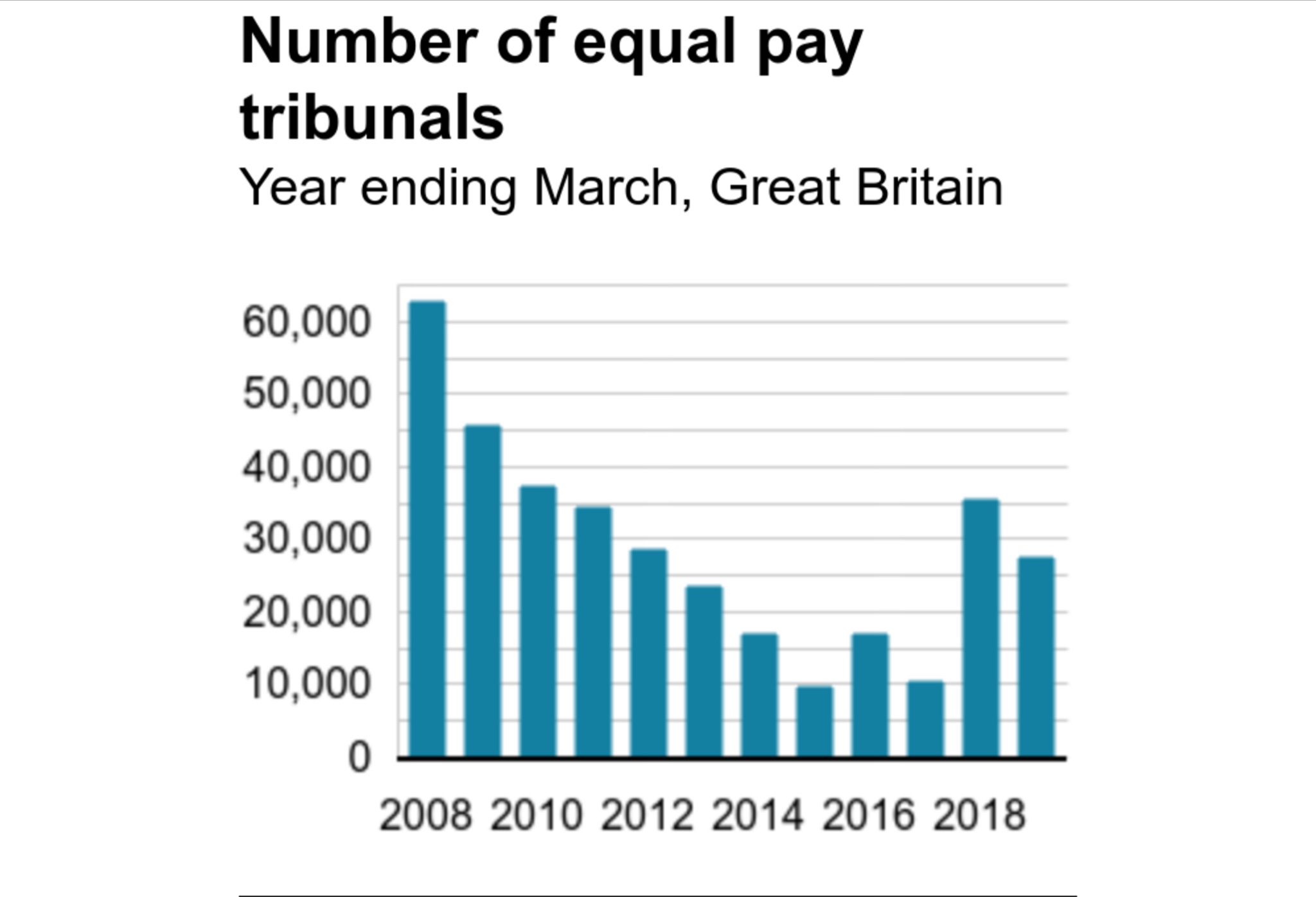
An info graphic which shows the number of Employment Tribunal cases in the UK involving equal pay claims (2008-2019) can be seen below:

Source: UK Ministry of Justice obtained from BBC News

True, the above figures show the number of equal pay claims in overall decline – effectively being halved (from a high of over 60,000 in 2008 to just over 30,000 in 2019); but my riposte to that would to say still too many.

In today’s edition of The Independent, new research, carried out by the Institute of Public Policy Research, indicates that female General Practitioners (physicians for our overseas readers) are paid up to £40,000 less than their male colleagues every year.

For each £1 that a male colleague earns, a woman earns 35 pence less. To reinforce this point, the article states that female GPs are effectively providing their services free of charge between September and December every year.

In language of the Equality Act 2010, the female GPs are carrying out ‘like work’ when comparing themselves to their male colleagues. There seems to be absolutely no lawful justification for this disparity in pay between the sexes.

A link to the article in The Independent can be found below:

https://edition.independent.co.uk/editions/uk.co.independent.issue.100120/data/9277336/index.html

The equal pay laws imply a sex or gender equality clause into every person’s contract of employment. Employers therefore have a legal duty to ensure gender equality in relation to terms and conditions of service.

It seems pretty simple, so why isn’t it happening in 2020?

An explanation for this situation in the medical profession has centred around the development of a ‘two tier’ system whereby more men are partners in GP surgeries whereas a large number of women take on the role of a salaried GP. Women tend to become salaried GPs because they feel that this allows them to work flexibly around their family commitments. So, again, what we appear to be seeing is women being penalised because they are trying to balance work and family (the so called ‘motherhood’ penalty).

Also on this day …

And purely by coincidence another equal pay story …

… Samira Ahmed, BBC journalist, wins her Employment Tribunal claim for equal pay (see below):

http://news.sky.com/story/samira-ahmed-tv-presenter-wins-sex-discrimination-equal-pay-claim-against-the-bbc-11905304

And if you’re still not convinced …

read the following article in The Independent about discrimination in pay between male and female apprentices (guess what?; it’s not the men who are the victims):

https://edition.independent.co.uk/editions/uk.co.independent.issue.150120/data/9283611/index.html

Copyright – Seán J Crossan, 10 and 15 January 2020

I’m a climate activist, don’t fire me!

Photo by Stock Photography on Unsplash

Today seems to be something of a red letter day for the Blog with regard to the issue of protected philosophical beliefs in terms of the Equality Act 2010.

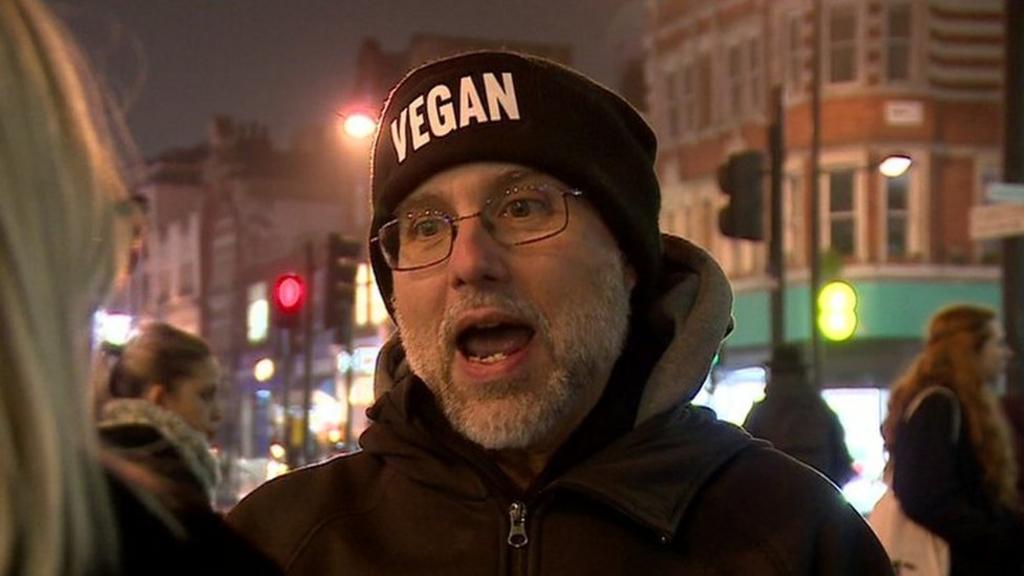
We have already heard the news that Jordi Casamitjana has won the part of his Employment Tribunal claim that his ethical veganism is a philosophical belief in terms of Sections 4 and 10 of the 2010 Act (see Casamitjana v League Against Cruel Sports [2020]).

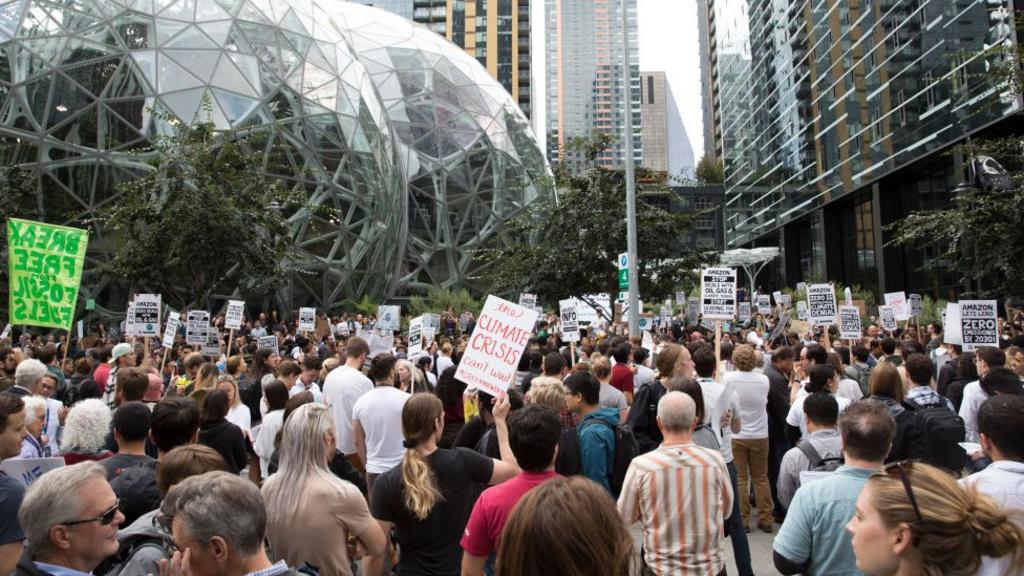
It was some interest that another news item popped up today concerning allegations that Amazon stands accused of threatening to dismiss those of its employees who become involved in climate protests. I would hazard a guess that Amazon is making a statement of intent that it may dismiss employees who perhaps break the law when they are involved in climate protests such as those organised by Extinction Rebellion and other similarly minded groups.

Criminal acts by employees committed outside the workplace could be regarded as gross misconduct in terms of Section 98 of the Employment Rights Act 1996. In other words, such behaviour by employees could result in the employer suffering reputational damage and, consequently, any dismissal for misconduct could be potentially fair. That said, employers should always carry out the proper disciplinary procedures when contemplating dismissal as the ultimate sanction for employee misbehaviour.

The real gripe – according to Amazon Employees for Climate Justice – is that the tech company allegedly objects to employees speaking critically about its failure to be more environmentally responsible.

Yet, there are potential dangers here for Amazon in the UK. In Grainger plc v Nicholson (2010) IRLR 4, the Employment Appeal Tribunal established that an employee’s belief in climate change could constitute discrimination on the grounds of a philosophical belief.

So, we could have situation where Amazon employees who are taking part in quite peaceful and lawful climate change protests end up being dismissed. This would open up the possibility that employees of Amazon UK might have the right to bring claims for direct discrimination (Section 13: Equality Act 2010) in respect of their philosophical beliefs (Sections 4 and 10 of the Act).

In the USA, there could be even more serious legal implications – infringing the right to free speech which is protected under the Constitution.

Perhaps Amazon needs to go back to the drawing board …

A link to an article on the BBC News App can be found below:

Amazon ‘threatens to fire’ climate change activists

The company said employees “may receive a notification” from HR if rules were “not being followed”.

Related Blog article:

https://seancrossansscotslaw.com/2019/06/05/im-a-political-activist-dont-sack-me/

Copyright Seán J Crossan, 3 January 2020

I want to believe …

Photo by Vegan Liftz on Unsplash

… well now Jordi Casamitjana can believe … officially. He has just won part of his Employment Tribunal case (Casamitjana v League Against Cruel Sports) which confirms that ethical veganism is a protected philosophical belief in terms of Sections 4 and 10 of the Equality Act 2010.

Please note, however, that the Employment Tribunal is yet to determine whether Mr Casamitjana was dismissed because of these protected beliefs – that is another matter.

A link can be found below to the Preliminary Judgement of the Employment Tribunal on the question of whether ethical veganism is a philosophical belief in terms of the Equality Act 2010:

https://assets.publishing.service.gov.uk/media/5e3419ece5274a08dc828fdd/Mr_J_Casamitjana_Costa_v_The_League_Against_Cruel_Sports_-_3331129-18_-_Open_Preliminary_Hearing_Judgment___Reasons.pdf

Please also find a link below to the BBC News App about Tribunal’s decision:

Ethical veganism is ‘philosophical belief’

Ethical veganism is a “philosophical belief” and therefore protected by law, employment tribunal rules.

Related Blog Articles:

https://seancrossansscotslaw.com/2020/01/02/going-mainstream/

https://seancrossansscotslaw.com/2019/05/12/veganism-discrimination/

https://seancrossansscotslaw.com/2019/04/08/the-trouble-with-veganism/

https://seancrossansscotslaw.com/2019/03/26/veganism-is-human-cruelty/

https://seancrossansscotslaw.com/2019/04/21/the-vegan-athlete/

https://seancrossansscotslaw.com/2019/04/01/the-shameful-secret-the-vegan-butcher/

https://seancrossansscotslaw.com/2019/02/19/vegans-should-be-punched-in-the-face/

https://seancrossansscotslaw.com/2019/01/22/philosophical-beliefs/

Copyright Seán J Crossan, 3 January and 14 February 2020

You’re never off duty …

Photo by thom masat on Unsplash

… certainly not when you’re a school teacher.

This is the lesson which a Scottish secondary teacher has learned to his cost. He was filmed by a pupil while drunk in the street wearing only his boxer shorts. Teacher Z (he remains anonymous) was charged with drunkenness and subjecting paramedics to abuse. Apparently, he did not inform his employer and, following a hearing before the General Teaching Council, he has been ruled unfit to continue practising as a teacher.

I often grimace when I hear someone trying to justify bad behaviour on the basis that it happened outside work. If I had a £20 note for each time I heard this remark …

Regular readers of this Blog will be well aware that employers are entitled to dismiss an employee who has committed an act of gross misconduct in terms of Section 98 of the Employment Rights Act 1996. Such behaviour could include misconduct committed outside working hours.

Provided the employer follows the correct disciplinary procedures, the dismissal will almost certainly be regarded as a fair by an Employment Tribunal.

A link to the story on the BBC News App can be found below:

Teacher struck off after pupil filmed him wearing just boxer shorts

Footage of the secondary teacher drunk in a public road was posted online and viewed by teachers and pupils.

Related Blog Articles:

https://seancrossansscotslaw.com/2019/12/08/different-standards/

https://seancrossansscotslaw.com/2019/12/03/the-limits-of-privacy/

https://seancrossansscotslaw.com/2019/09/03/facebook-folly/

https://seancrossansscotslaw.com/2019/06/05/im-a-political-activist-dont-sack-me/

https://seancrossansscotslaw.com/2019/05/20/social-media-and-dismissal/

https://seancrossansscotslaw.com/2019/04/11/social-media-misuse/

https://seancrossansscotslaw.com/2019/04/09/drunk-and-disorderly/

https://seancrossansscotslaw.com/2019/02/07/it-happened-outside-work-or-its-my-private-life/

Copyright Seán J Crossan, 2 January 2020

Hostile, degrading, humiliating

Thanks to @tchickphoto for making this photo available freely on @unsplash 🎁

Scanning through the papers today for news worthy stories, I found myself looking across the sea (the Irish Sea to be precise) and it was there that I stumbled upon an interesting article in The Irish Times.

Regular readers of this Blog will be aware that I have a particular interest in the areas of discrimination and employment law and this story ticked both boxes.

A female supermarket delicatessen worker was repeatedly subjected to sexual harassment on an almost daily basis by one of her male co-workers. The dreadful treatment appears to have started less than a month after the woman commenced her employment (May 2018). Her manager (a man) was fully aware of the situation, but did nothing to put an end to her ordeal. In fact, he witnessed one of the brazen attempts by her tormentor and made a joke of it. This joke involved comments about people from Limerick. I have to say as someone who has Limerick ancestry, I felt pretty insulted when reading the manager’s gratuitous comment.

A link to the story in The Irish Times can be found below:

https://www.irishtimes.com/news/ireland/irish-news/deli-worker-awarded-20-000-for-almost-daily-sexual-harassment-1.4128207

The woman complained about the situation, but she was not informed about the progress of this by her employer. Eventually, the woman felt that she had little choice but to resign from her employment. This could be viewed as the last straw – her employer’s conduct having led to a complete breakdown in their relationship. It might be said that the implied duty of trust and confidence on the part of the employer had been completely shattered.

In the UK, we would, of course, recognise this situation as one of constructive (unfair) dismissal in terms of the Employment Rights Act 1996 and the Equality Act 2010 (she was being subjected to discrimination/unlawful less favourable treatment on the grounds of her sex).

When the woman’s formal complaint was submitted, her employer did move her male colleague to a different location within the supermarket (the storeroom), but he went absent on sick leave shortly afterwards.

The whole experience was extremely distressing for the woman who has now been awarded €20,000 in compensation.

Again, readers in the UK will make the obvious comparison with our Vento scale (or bands) for compensation for victims of discrimination. The sum awarded to this woman would fall into the middle band in the UK (£8,800 to £26,300).

A link to an article about the current UK Vento scale or bands can be found below:

https://www.crosslandsolicitors.com/site/hr-hub/injury-to-feelings-awards-updated-Vento-guidelines-April-2018

Anyone with a background in discrimination law who reads the article from The Irish Times about this story will immediately recognise the terminology used. The women alleged that her co-worker’s behaviour “was a violation of dignity in that it created an intimidating, hostile, degrading, humiliating and offensive environment for her.”

Such a statement reflects the language of the European Commission’s Code of Practice on Measures to combat sexual harassment. This Code was first formulated as far back as 1991 and has now been largely implemented into the legal systems of EU member states. The Republic of Ireland is, of course for the time being, one of our fellow EU member states and Irish anti-discrimination practitioners will be readily familiar with the terminology. For many years, Employment Tribunals and UK courts routinely used the Commission’s Code of Practice when dealing with cases which involve allegations of sexual harassment.

Current UK law on harassment in the workplace is contained primarily in the Equality Act 2010. More seriously, acts of harassment can also be a criminal offence.

A link to a guidance published by the UK Equality and Human Rights Commission concerning sexual harassment in the workplace can be found below:

https://www.equalityhumanrights.com/sites/default/files/sexual-harassment-and-the-law-guidance-for-employers.docx

The Conciliator appointed by Ireland’s Workplace Relations Commission, an independent statutory body created by Oireachtas – both Houses of the Irish Parliament, concluded that the woman’s employer had “failed to put appropriate measures in place to stop this harassment and sexual harassment from occurring or to reverse its effects”.

The Conciliator also noted that “the supermarket failed to conclude its investigation and make a decision is the most egregious flaw in the process.” The employer tried to justify this failure by saying that, as a matter of natural justice, it could not conclude the investigation because the male colleague had since left Ireland to return to his country of origin. The Conciliator stayed that the employer made this decision “at the expense of the complainant and closure for her of this appalling experience”.

Employers, please take note: failing to follow basic grievance procedures contained in the employment contract can have serious and expensive consequences. Such a failure on your part can contribute to the breakdown of the relationship with the employee and may very well open the door to claims for constructive dismissal against you.

Related Blog Articles

https://seancrossansscotslaw.com/2019/02/14/hurt-feelings/

https://seancrossansscotslaw.com/2019/02/22/sticks-and-stones-may-break-my-bones-but-names-will-never-hurt-me/

Copyright Seán J Crossan, 1 January 2020